
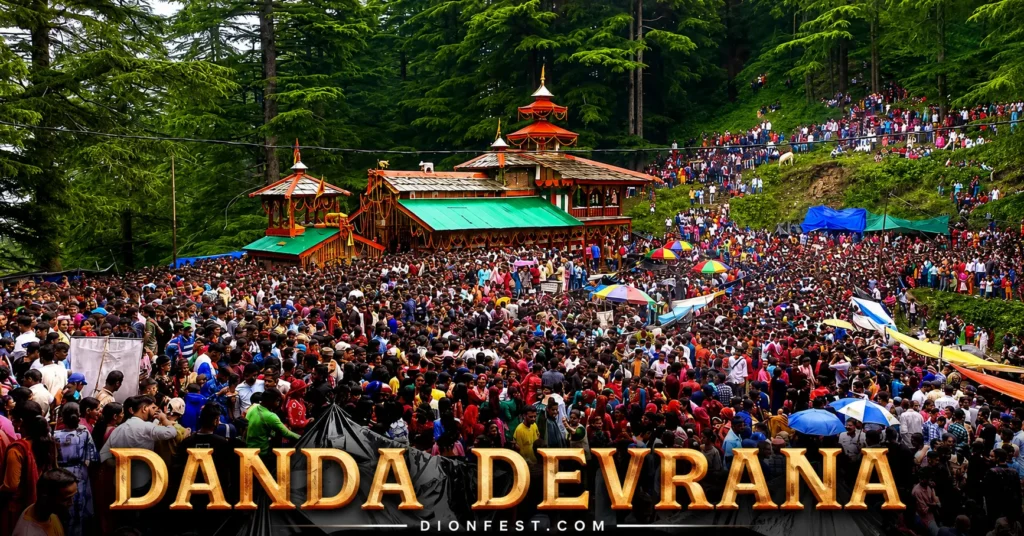
I grew up in Naugaon, a small town in Uttarkashi. Our village deity is Lord Rudreshwar Mahadev. And every year, from the time I was a child, I have waited for one thing Danda Devrana Mela.
Not because someone told me to. Because the moment you hear those drums echoing through the mountains on the way up to Devrana, something shifts in your chest. You pick up your pace without realizing it.
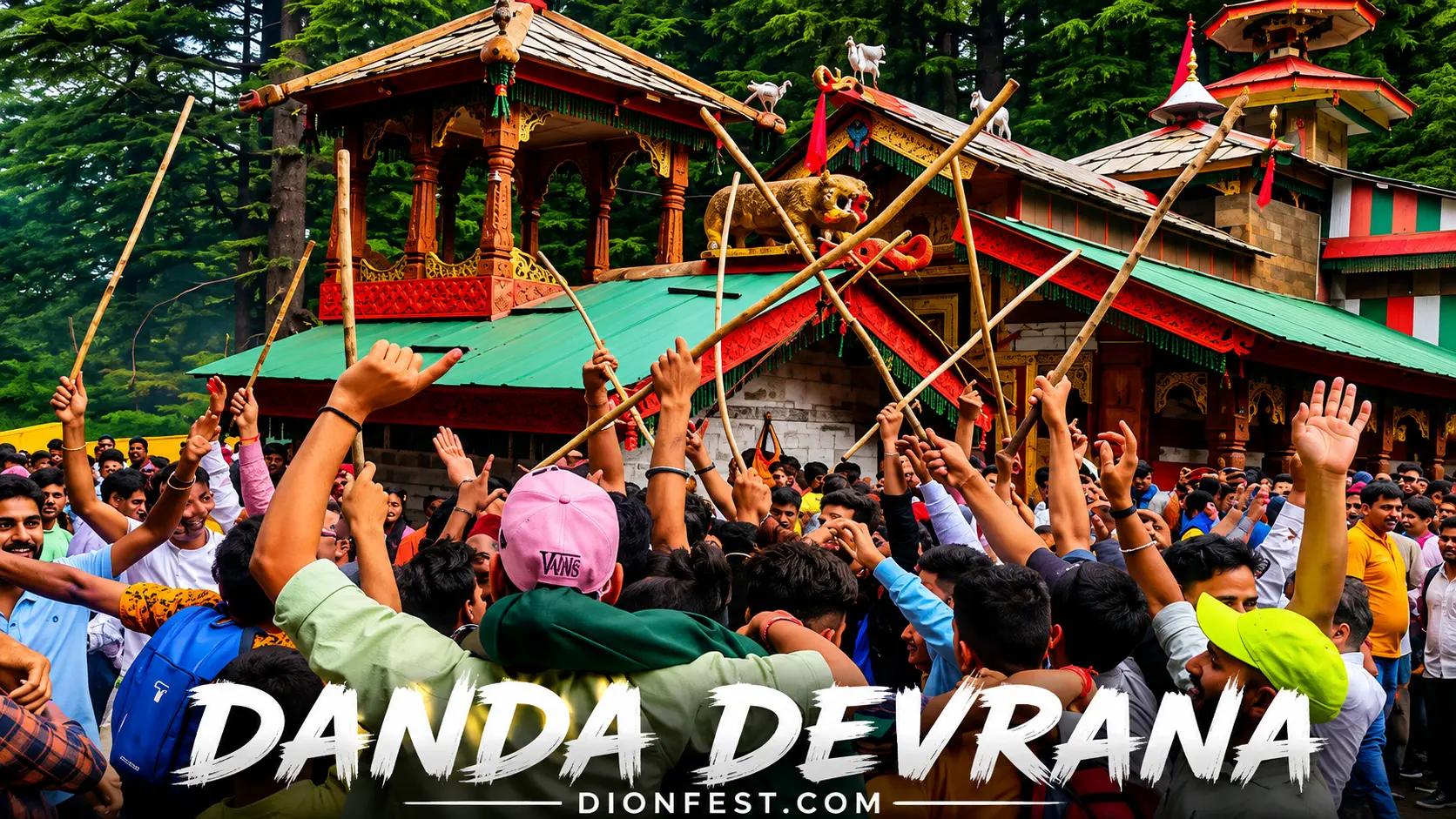
At 4 in the morning, while the rest of Uttarakhand sleeps, the pujari of the Devrana temple climbs onto a carved wooden lion and bathes the idol of Rudreshwar Maharaj with milk. The drums start. And the crowd that has gathered before dawn in the deodar forest finally gets its darshan.
Then, at 4 in the afternoon, the Mora the sacred idol comes out. That is the moment that stops you cold, no matter how many times you have seen it.
This is Danda Devrana Mela. And almost nobody outside Rawain Valley has heard of it.
QUICK FACTS
| Festival Name | Danda Devrana Mela (also: Devrana ki Jatar / Danda ki Jatar) |
| Location | Devrana, Naugaon Block, Uttarkashi, Uttarakhand |
| Altitude | Approx. 2,500 metres |
| Month | Ashadh (June–July, Hindu calendar) |
| Deity | Rudreshwar Maharaj (form of Lord Shiva) |
| Villages Covered | 65 villages of Rawain Valley |
| Type | Religious fair + folk cultural festival |
| Status | Now included in Uttarakhand State Fair Calendar (Nov 2024) |
What is Danda Devrana Mela?
Danda Devrana Mela is an annual religious fair held in the village of Devrana, in the Naugaon Block of Uttarkashi district. Locally it is called Danda ki Jatar “jatar” being the Garhwali word for a traditional pilgrimage fair tied to a local deity.
The fair is dedicated to Rudreshwar Maharaj, a regional form of Lord Shiva, who is the collective deity (gram devta) of 65 villages across the Rawain, Jaunpur, and Jaunsar areas. The mela happens every year in the Hindu month of Ashadh, which typically falls in June or July.
It is the biggest fair of Rawain Valley. Between 10,000 and 15,000 people attend the main fair not just from the local sub-regions of Rawain, Jaunpur, and Jaunsar, but from different parts of India. Then, after the main fair, Rudreshwar Maharaj’s doli (a palanquin carrying the deity) travels village to village for a full month, with smaller fairs held wherever the doli stops.
In November 2024, Chief Minister Pushkar Singh Dhami announced that Danda Devrana Mela will be formally included in Uttarakhand’s state fair calendar the first official government recognition of the fair.
Where is Devrana and How Do You Get There?
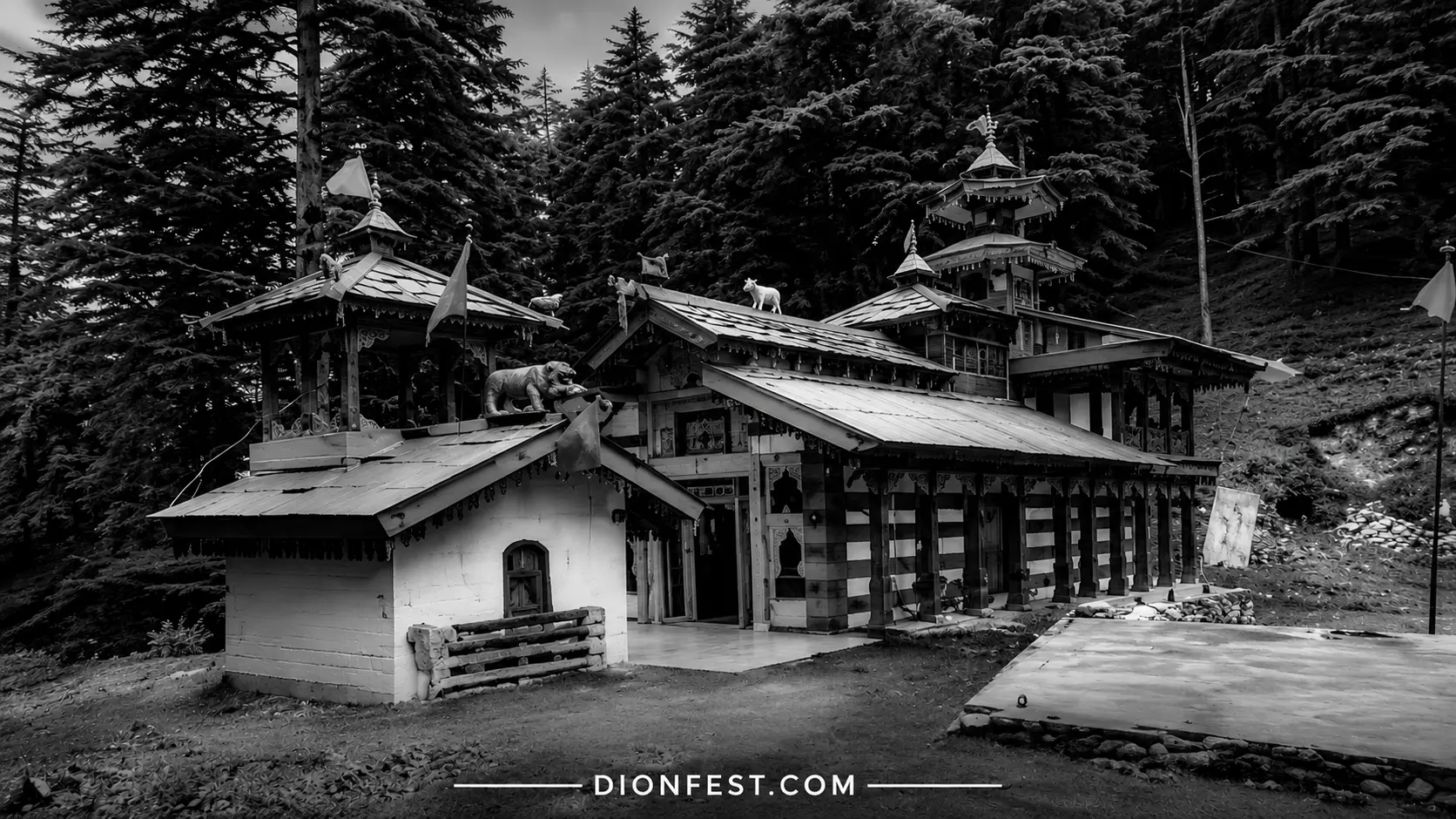 Devrana sits inside dense deodar forests at around 2,500 metres. It falls under the Naugaon Block of Uttarkashi district, in the Rawain Valley.
Getting there:
- From Dehradun: Take the route to Uttarkashi, then head toward Naugaon via Barkot. Naugaon is the nearest major town.
- From Uttarkashi town: Approximately 100 km by road via Barkot and Naugaon.
- Last stretch: From Naugaon, local roads lead toward the Devrana temple. The final section involves forest trail walking.
The path to Devrana is worth paying attention to. The trail winds through forests and past apple orchards stretching across the hillsides in every direction. In June and July, the trees are thick with fruit. Many families from Naugaon and nearby villages have orchards along this route for them, the walk to the mela is also a homecoming of a different kind.
But here is what you notice most on the walk up: the sound arrives before the fair does. From a distance, the drums and the traditional instruments of the Rawain region start echoing through the mountains. Faint at first. Then with every step, louder. By the time you reach the temple grounds, the excitement has already been building for a while.
Best time to travel: The fair falls in Ashadh (June–July). Monsoon starts around the same time in Uttarakhand, so the roads can be difficult. Plan for delays, especially on mountain roads closer to the venue.
The Main Ritual: What Happens at the Mela
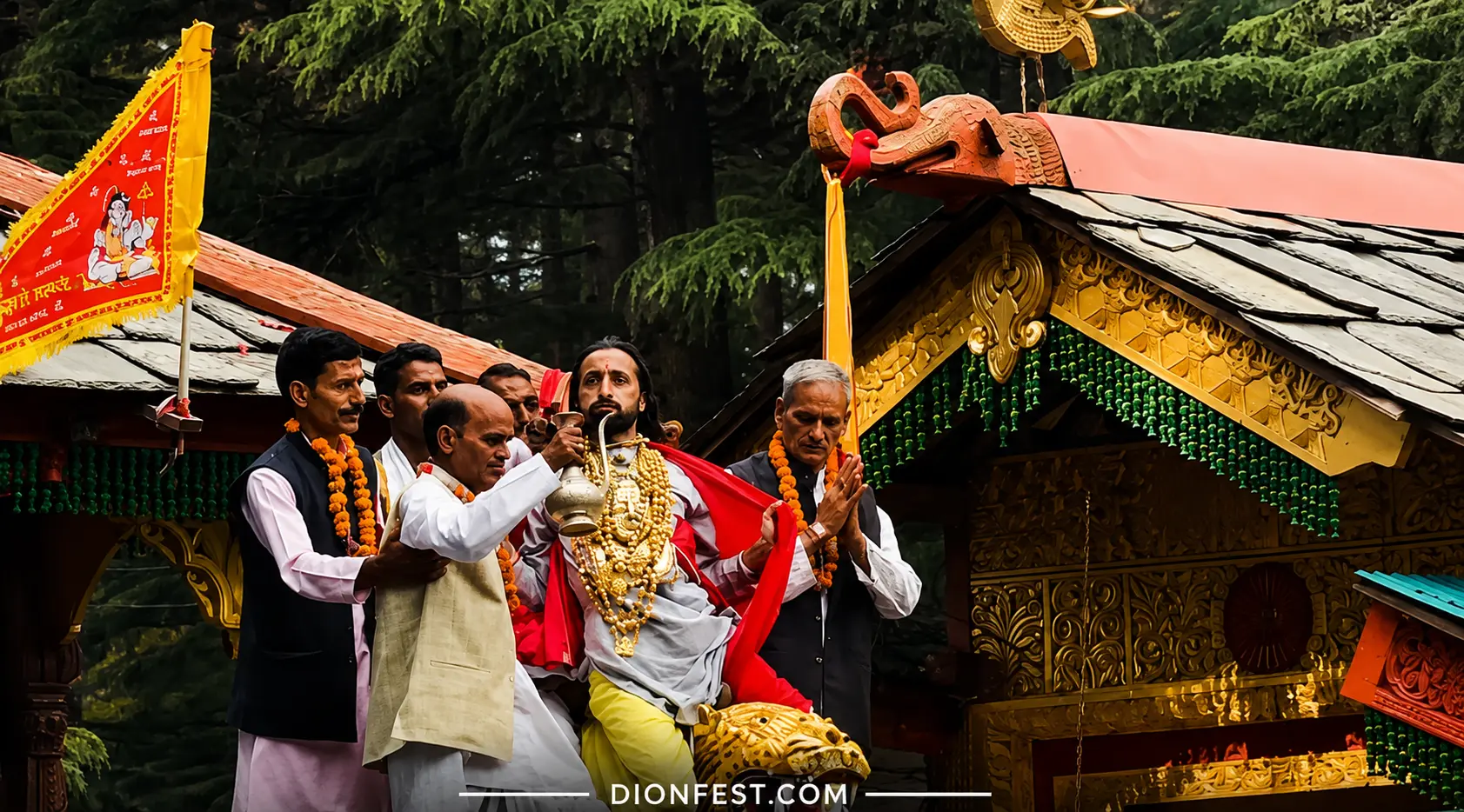 The fair begins at 4 in the morning.
Priest Sankit Thapliyal the pujari of the Devrana temple climbs onto a wooden lion structure built above the temple. From there, he bathes the idol of Rudreshwar Maharaj with milk. This ritual is the official opening of the mela.
By the time the sun is up, the temple grounds are full. There is a large open field surrounding the temple, and on fair day it fills with families, pilgrims, and visitors. People sit on the grass together sharing food and stories. Small food stalls fill the air with the smell of local dishes. Between 10,000 and 15,000 people gather here from Uttarkashi, from other parts of Uttarakhand, and from across India. For a mountain village at 2,500 metres, inside a deodar forest, that number is hard to picture until you see it.
Hudki players traditional musicians from Garh village recite the gatha (oral history/legend) of Rudreshwar Maharaj to the assembled crowd. The pujari gifts them angavastra (a cloth offering) in acknowledgement. Women join the procession of the dev doli and perform folk dances alongside it.The fair was covered in detail by ETV Bharat in July 2023.
Then, around 4 in the afternoon, comes the moment that everyone is actually waiting for.
The Mora the sacred idol of Rudreshwar Maharaj is brought out for darshan. The drumming, which has been building through the day, grows louder. Thousands of people press forward with folded hands. Prayers fill the air. For a few minutes, the entire valley feels like it is holding its breath.
People who have attended this mela their whole lives still get goosebumps at that moment. That says something about what the fair actually is.
The One-Month Doli Yatra Across 65 Villages
 This is the part of the Devrana fair that most people do not know about and it is, arguably, more remarkable than the main fair itself.
After the main mela, Rudreshwar Maharaj’s doli does not stay at the temple. It begins a circuit of the Palli Mungarshanti Patti area, visiting village after village for a full month. Each village that the doli arrives at holds its own local mela on that day.
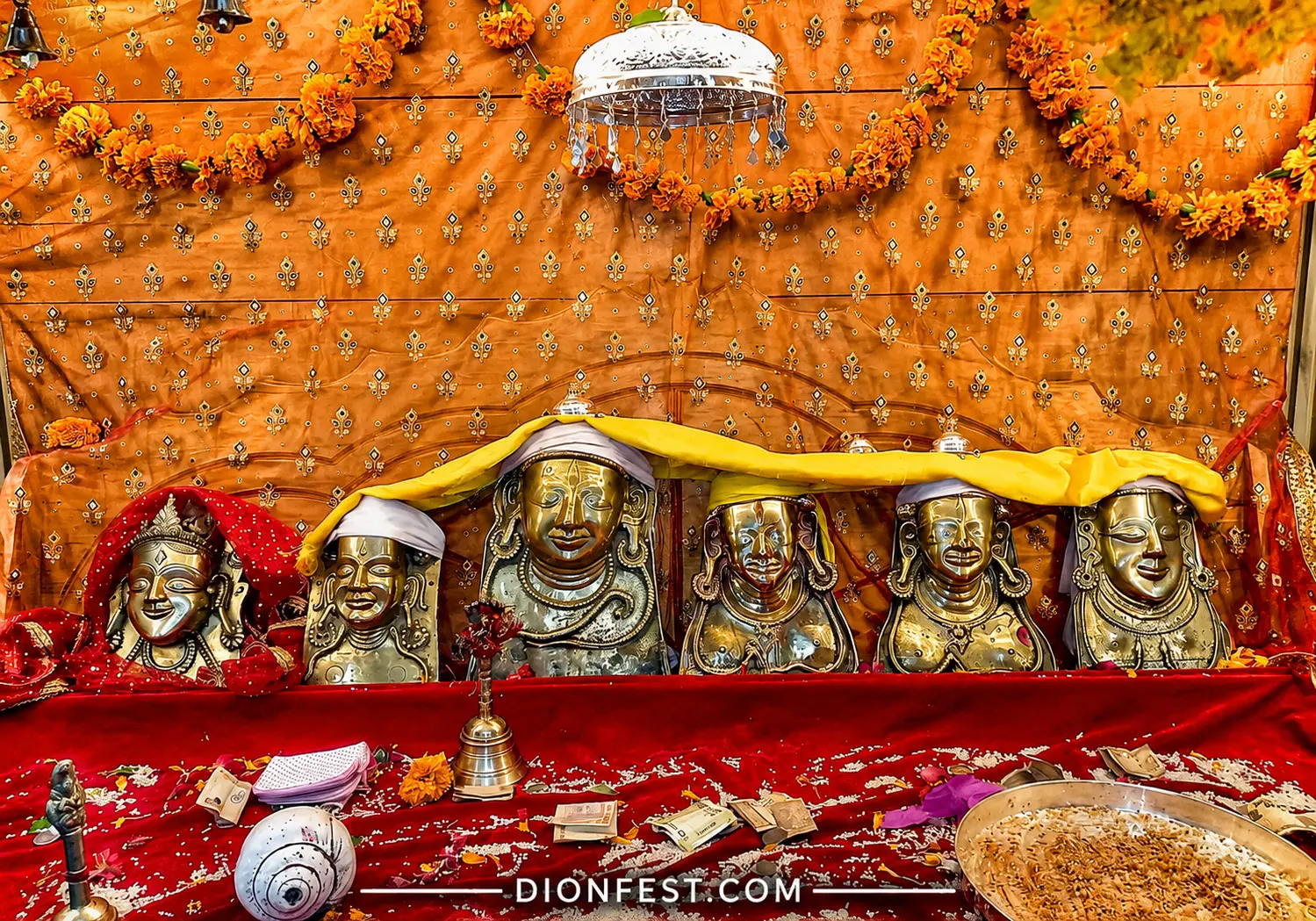
During this month-long circuit, devotees get something unusual: darshan of five deities together at one time. The five are:
- Rudreshwar Maharaj
- Dharm Raj Yudhishthir
- Baba Boukh Naag
- Mahasu Maharaj
- Mata Nateshwari
All five appear together only during this doli yatra. For the people of Rawain Valley, this is a once-a-year event that connects them not just to one deity, but to their entire regional religious tradition.
Folk Dances of the Fair: Harul, Rasaun, Tandi
 Three folk dances define the cultural atmosphere of the Devrana mela. All three are performed to the beat of the dhol damaun the traditional paired drum of Garhwal. People wear traditional dress (poshak) specific to the Rawain region.
Harul: A folk dance of the Jaunsari and Rawain communities, performed in a line or semi-circle with men and women holding each other’s hands. Each Harul song tells a narrative historical stories, tales of local gods, or accounts of events from the tribe’s past. The movements involve slow and fast footwork, tapping, and rhythmic coordination.
Rasaun (Rasoun): A group circle dance performed with great energy. This is the dance you are most likely to see women joining freely. The semi-circular formation expands and contracts as the rhythm changes.
Tandi: Performed on happy occasions in the Uttarkashi region and Jaunpur area of Tehri. Everyone in the group holds hands and moves in a connected chain. The songs sung during Tandi reflect social events current happenings, stories of notable people, community concerns.
Together, these three dances function as a living record of Rawain culture. They are not performed on stages for tourists. They happen because people want to dance.
What Makes This Fair Unique
A few things set Danda Devrana Mela apart from other Uttarakhand festivals:
It is not on any major tourist map yet. At the time of writing, there is almost no English-language information about this fair. No travel blog has covered it properly. No tourism website lists it. This changes now that the CM has added it to the state fair calendar, but for now, it is one of the few genuinely undiscovered festivals in the Himalayas.
The 4 AM opening and the 4 PM climax. The fair has two defining moments, twelve hours apart. The day starts with the pujari bathing the idol in milk at 4 AM before dawn. It peaks at 4 PM when the Mora the sacred idol is brought out for public darshan. Most visitors plan to be there for both.
The Mora darshan. The moment the sacred idol comes out in the afternoon is what regulars describe as the emotional centre of the whole fair. The drumming builds, the crowd presses forward, the valley fills with prayer. It is not something you can describe well to someone who has not stood in that crowd.
The forest setting. Devrana sits inside thick deodar jungle at 2,500 metres. The temple complex is surrounded by trees. The sound of the dhol damaun in that setting at altitude, in the cold morning air is not something you forget quickly.
The doli circuit. The month-long village tour after the main fair means that Danda Devrana Mela is not a single day event. It is a continuous, moving celebration that reaches into villages with no other connection to mainstream tourism.
The five deities. The convergence of Rudreshwar Maharaj, Dharm Raj Yudhishthir, Baba Boukh Naag, Mahasu Maharaj, and Mata Nateshwari in one place happens only during this doli yatra. For devotees, this is the central reason to attend.
Rawain Valley – The Region Behind the Festival
To understand Danda Devrana Mela, you need some context on Rawain Valley.
Rawain is a sub-region of Uttarkashi, distinct in its culture, dialect, and traditions from the rest of Garhwal. The valley sits along the Tons River basin, bordered by Himachal Pradesh on the north. The people here are historically tied to the Jaunsari tribal tradition a community with a distinct culture that predates both Garhwali and standard Pahari conventions.
Rawain is the valley where folk traditions have survived with less interference than most Himalayan regions. The people here still celebrate devgoți (deity festivals), still perform the same dances their grandparents did, and still elect traditional village systems alongside the panchayat structure.
For visitors, that means Rawain feels different from tourist-facing Uttarakhand. There are no resort hotels. The culture is not packaged for outsiders. What you see at the Devrana mela is not performed for you it is happening whether you are there or not.
When to Visit and What to Expect
Date: The fair falls in Ashadh, which translates to approximately mid-June to mid-July in the Gregorian calendar. The exact date changes each year based on the Hindu lunar calendar. For 2026 specifically, verify the date on a Hindu panchang or contact the local Naugaon Block administration closer to the time.
Accommodation: Naugaon town has basic guesthouses and hotels. Do not expect anything in or near Devrana village itself. Plan to base yourself in Naugaon and travel to the mela site on the day.
What to carry:
- Warm layers – 2,500 metres in the early morning is cold, even in June
- Torchlight if attending the 4 AM ritual
- Cash only – no digital payments in this area
- Respect for the ritual space – this is a religious gathering, not a tourist event
Photography: Ask before photographing people, especially during rituals. Many communities in Rawain are cautious about photography of their deity-related practices.
FAQ
What is Danda Devrana Mela?
Danda Devrana Mela, also called Devrana ki Jatar, is an annual religious fair held at Devrana village in Uttarkashi, Uttarakhand. It is dedicated to Rudreshwar Maharaj, a form of Lord Shiva who is worshipped as the collective deity of 65 villages in the Rawain Valley. The main fair happens in the Hindu month of Ashadh (June–July), followed by a month-long doli yatra (procession) through surrounding villages.
Where exactly is Danda Devrana Mela held?
The main fair is held at the Rudreshwar Maharaj temple in Devrana village, Naugaon Block, Uttarkashi district, Uttarakhand. The temple is located inside dense deodar forests at approximately 2,500 metres altitude.
When does Danda Devrana Mela happen in 2026?
The fair falls in the Hindu month of Ashadh (June–July 2026). The exact date is determined by the Hindu lunar calendar. For the confirmed 2026 date, check a current panchang or contact the Naugaon Block office in Uttarkashi.
Who attends the Danda Devrana Mela?
Between 10,000 and 15,000 people attend the main fair, coming from the Rawain, Jaunpur, and Jaunsar sub-regions of Uttarakhand and from different parts of India. The doli yatra after the main fair reaches villages across the Palli Mungarshanti Patti area over the following month.
What is the significance of Rudreshwar Maharaj?
Rudreshwar Maharaj is a regional deity a form of Lord Shiva who is considered the gram devta (village deity) of 65 villages in the Rawain Valley. His idol is kept at the Devrana temple, and the annual jatar is the main occasion when the deity is taken out in a procession to visit all 65 villages.
What folk dances happen at Danda Devrana Mela?
Three dances are performed at the fair: Harul (a narrative group dance of the Jaunsari tradition), Rasaun (a circle group dance), and Tandi (a chain dance performed to socially-themed songs). All three are performed in traditional dress to the beat of the dhol damaun, the paired drum of Garhwal.
Is Danda Devrana Mela open for tourists to visit?
Yes, but it is not a tourist-facing event. There is no tourist infrastructure at or near Devrana. Visitors who want to attend should base themselves in Naugaon, be prepared for basic conditions, and approach the fair with respect for its religious nature. It is an authentic community gathering, not a cultural show.
Why was this fair recently in the news?
In November 2024, Uttarakhand Chief Minister Pushkar Singh Dhami officially announced that Danda Devrana Mela would be included in the Uttarakhand state fair calendar. This was the first formal government recognition of the fair, suggesting it may receive more infrastructure and promotion in coming years.
How do I reach Devrana for the Mela?
From Dehradun, take the Uttarkashi route and head toward Barkot, then Naugaon. Naugaon is the nearest town with accommodation. From Naugaon, local roads and forest trails lead to the Devrana temple area. The journey from Dehradun takes approximately 8–9 hours by road, with the last section being mountain roads that can be slow in monsoon season.
For updated travel information, check Uttarakhand Tourism’s official site.
Conclusion
I have attended Danda Devrana Mela more times than I can count. The route, the apple orchards, the drums getting louder on the walk up, the crowd at the temple, the Mora coming out at 4 PM none of it gets ordinary. Every year when I stand among that crowd and hear those familiar drums in the mountains, something settles. It feels like I have come home.
Danda Devrana Mela is not just a festival for the people of Rawain Valley. It is the thread that connects 65 villages to their deity, to each other, and to every generation that stood in that field before them.
The CM’s 2024 announcement will bring attention, and with it, change. If you want to experience this fair before it becomes something packaged and promoted, do not wait too long.

Abhay Ramola researches world festivals across primary sources, local accounts, and on-ground reporting. He founded Dionfest to cover what gets missed when festivals become tourism content the history, the ritual, and the people behind it.
Pingback: Sea of Devotion at Danda Devrana Jatra: Thousands Seek Rudreshwar Maharaj’s Blessings in Rawain Valley – DoonPaparazzi