
Corpus Christi Festival 2026: Dates, Traditions, and Where the World Celebrates
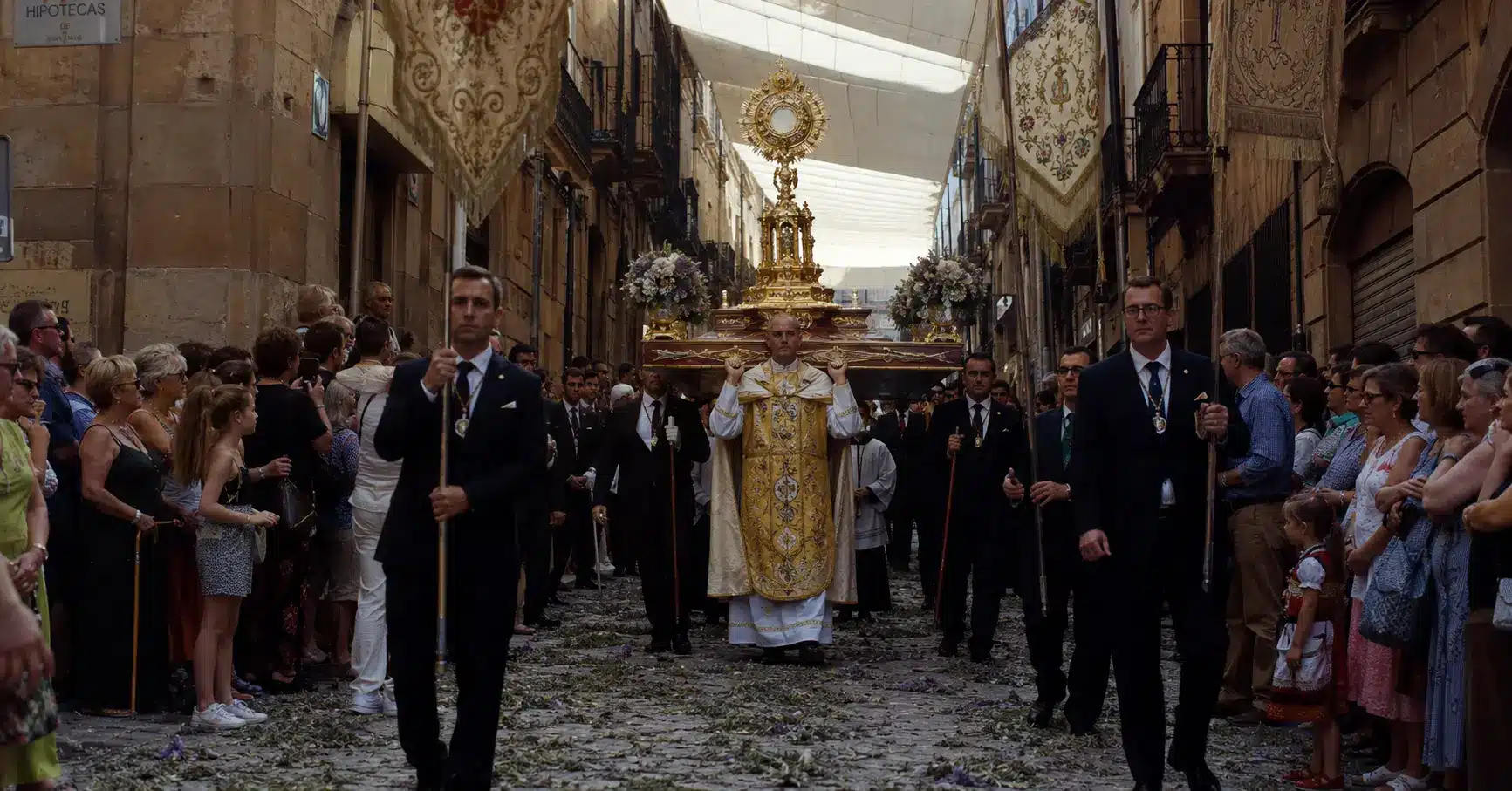
On June 4, 2026, in a Spanish city built on a steep hill above a river, a 500-year-old gold monstrance will leave its cathedral for the only time all year. The streets will smell of crushed thyme. The crowd will go quiet.
KEY FACTS
| Detail | Information |
|---|---|
| Festival Name | Corpus Christi |
| Also Known As | Corpus Domini; Fronleichnam (Germany) |
| 2026 Date | Thursday, June 4, 2026 |
| USA / Some Dioceses | Moved to Sunday, June 7, 2026 |
| Type | Catholic religious feast |
| Significance | Real presence of Jesus Christ in the Eucharist |
| Duration | 1 day (week-long festivals in Toledo and Cusco) |
| Celebrated In | 25+ countries |
| Most Famous Celebration | Toledo, Spain |
| Public Holiday In | Austria, Brazil, Bolivia, Colombia, Croatia, parts of Germany, Poland, Portugal, and more |
Corpus Christi is a Catholic feast day observed by over a billion people across 25+ countries. It falls 60 days after Easter Sunday on June 4 in 2026. The celebration honors the belief that Jesus Christ is truly present in the consecrated bread and wine of the Eucharist. Celebrations range from 600-year-old street processions in Spain and a Catholic-Inca fusion in Peru to flower carpet parades in Germany and dyed sawdust carpets in Colombia.
What is Corpus Christi? History and Origin
The story starts with a Belgian nun who said she kept seeing a vision of a bright moon with a dark spot on it.
Her name was Juliana of Liège. She read the dark spot as a sign that the Catholic Church was missing a feast dedicated to the Eucharist the bread and wine Catholics believe to be the actual body and blood of Jesus Christ. She started pushing for this feast around 1209. The Church took decades to listen.
In 1246, the Bishop of Liège agreed and ordered a local celebration. Juliana never saw the feast go global. She died in 1258.
In 1264, Pope Urban IV made it official for the entire Latin Church through a papal bull. He also commissioned the most famous Eucharistic hymn in Catholic history: Pange Lingua, by Thomas Aquinas.
The timing was shaped partly by the Miracle of Bolsena in 1263. A Bohemian priest who doubted transubstantiation was saying Mass in Bolsena, Italy, when the consecrated host reportedly began to bleed. Urban IV was in nearby Orvieto at the time. The following year, he declared the feast.
By the 1300s, Corpus Christi processions were happening across Catholic Europe. Streets were decorated, the host was carried in a monstrance, entire cities turned out. Toledo, Spain has celebrated it every year since the 15th century.
The feast is primarily Catholic but is also observed in some Anglican and Lutheran churches. The Church of England calls it the Day of Thanksgiving for the Institution of Holy Communion.
Corpus Christi Festival 2026 Date and Timing
Corpus Christi Festival 2026 falls on Thursday, June 4
The date moves every year because it is tied to Easter. It is always celebrated 60 days after Easter Sunday, on the Thursday following Trinity Sunday.
For Corpus Christi Festival 2026:
- Easter Sunday: April 5, 2026
- Pentecost: May 24, 2026
- Trinity Sunday: May 31, 2026
- Corpus Christi: June 4, 2026
In many US dioceses, the celebration moves to the nearest Sunday June 7, 2026. In Colombia, it is observed on June 8 as a national public holiday.
Upcoming dates:
| Year | Date |
|---|---|
| 2025 | Thursday, June 19 |
| 2026 | Thursday, June 4 |
| 2027 | Thursday, May 27 |
| 2028 | Thursday, June 15 |
How is Corpus Christi Celebrated? Core Traditions
The Procession
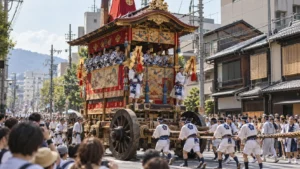
The common thread across every celebration is a procession. A priest carries the consecrated host in a monstrance an ornate gold or silver vessel through the streets, while the community lines the route or walks alongside.
Streets are prepared in advance. In Spain, aromatic herbs thyme, lavender, rosemary are scattered on the cobblestones. In Germany’s Black Forest, communities lay flower carpets along the route, sometimes close to a kilometer long. In Colombia’s Bello, the carpet is made from dyed sawdust. Each culture has built its own layer of tradition around this same central act over hundreds of years.
The Monstrance
The monstrance is what carries the consecrated host. In major cities, these are ancient artifacts.
Toledo’s monstrance the Custodia de Arfe was built between 1515 and 1523 by goldsmith Enrique de Arfe, at the order of Cardinal Cisneros. It weighs 160 kilograms. It has never left Toledo. It exits the cathedral exactly once a year: on Corpus Christi Thursday.
The Tarasca
In several Spanish cities Toledo, Granada, Seville Corpus Christi includes a parade of the Tarasca, a dragon figure from medieval legend. The image is a woman riding a tamed dragon. In Toledo, the Tarasca parade happens on the Wednesday before the main procession, joined by giant papier-mâché figures representing different continents.
Chiri Uchu in Cusco
In Cusco, Peru, this feast has a food tradition found nowhere else. Chiri Uchu “cold pepper” in Quechua is a dish eaten specifically on Corpus Christi. Served cold, it includes dried meat, guinea pig, roasted corn, seaweed, and moraya (freeze-dried potato). Twelve traditional dishes are prepared the night before the festival. Chiri Uchu does not appear on any other day of the year.
Best Places to Experience Corpus Christi
Toledo, Spain The Main Event
Toledo is the best-known Corpus Christi celebration in the world. The city has observed it since the 15th century. It has been a Festival of International Tourist Interest since 1980.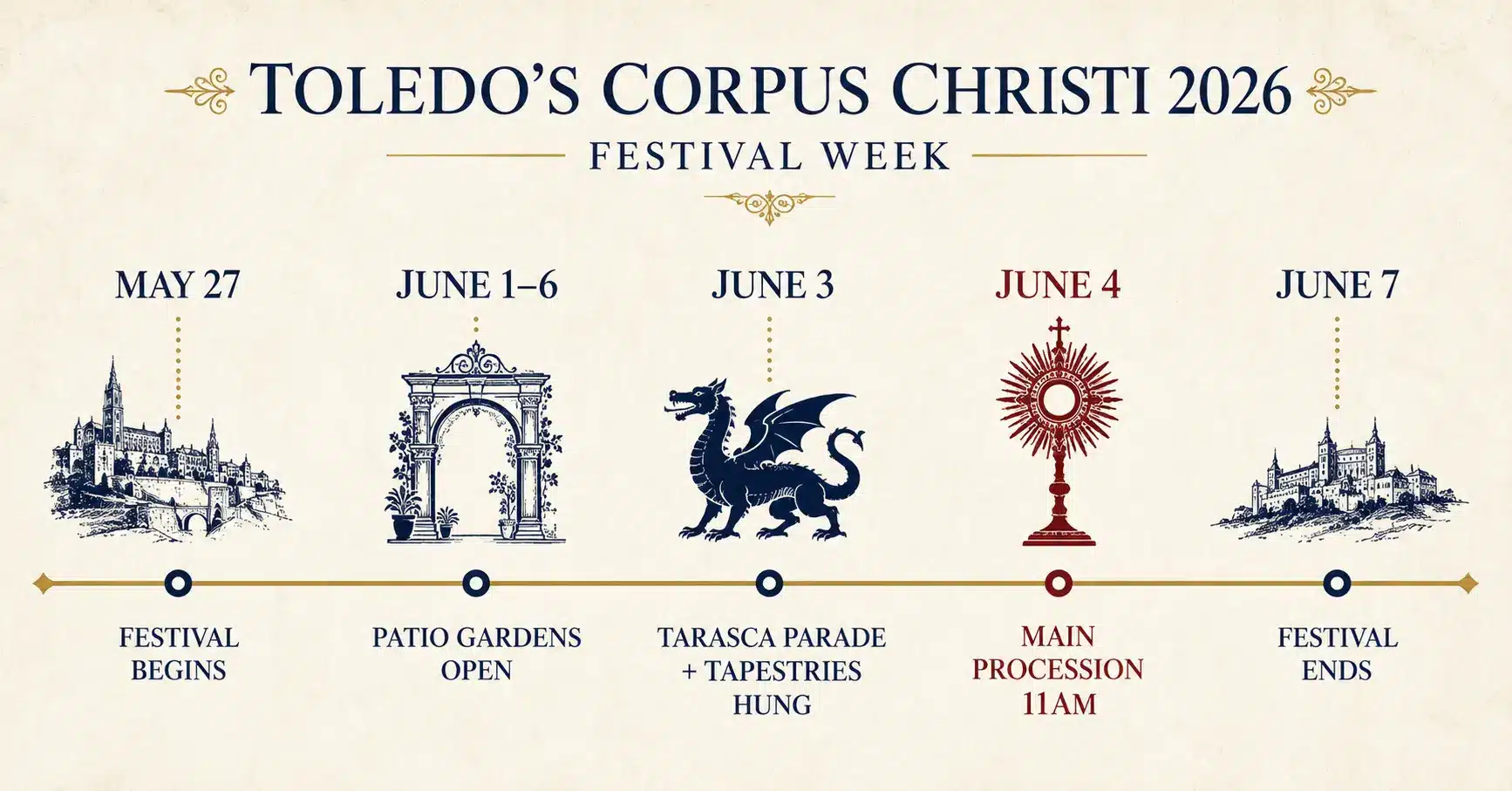 In 2026, the festival week runs May 27 to June 7. The main procession is on Thursday, June 4, starting at 11:00 AM from the Primate Cathedral.
Preparation begins five weeks before procession day. Wooden awnings go up along the entire route to keep the Custodia shaded. On June 3, the cathedral hangs 48 Flemish tapestries woven in the 16th and 17th centuries along its outer walls. The ground gets a scatter of aromatic herbs. Balconies fill with antique pennants and embroidered cloth.
At 11 AM on June 4, giant figures representing five continents lead the procession. Religious fraternities follow. Then the clergy, civic authorities, and the Archbishop of Toledo.
This is the only day all year when the Custodia leaves the cathedral. When it finally crosses the threshold, Felipe Barandiaran a journalist who attended the Toledo procession wrote that he felt “people around me holding their breath.” The silence broke with 21 cannon shots, the Royal March, and every bell in the city ringing at once. (Source: americaneedsfatima.org)
The festival week also includes concerts, a Patio and Garden competition where 43 private historic courtyards open to the public from June 1–6, and free outdoor performances.
Practical note: Toledo’s streets close to all traffic on procession day. Park by the Tagus River and walk up. It is a steep climb but there is no other option.
Granada, Spain
Granada’s festival runs May 30 to June 6, 2026. The main procession starts June 4 at 10:15 AM from the Granada Cathedral. On June 3, the Tarasca parade features a woman mounted on a dragon, followed by oversized papier-mâché characters. Granada’s festival is also known for its casetas marquee tents at the fairground where families eat, drink, and dance throughout the week.
Cusco, Peru Where Catholic Meets Inca
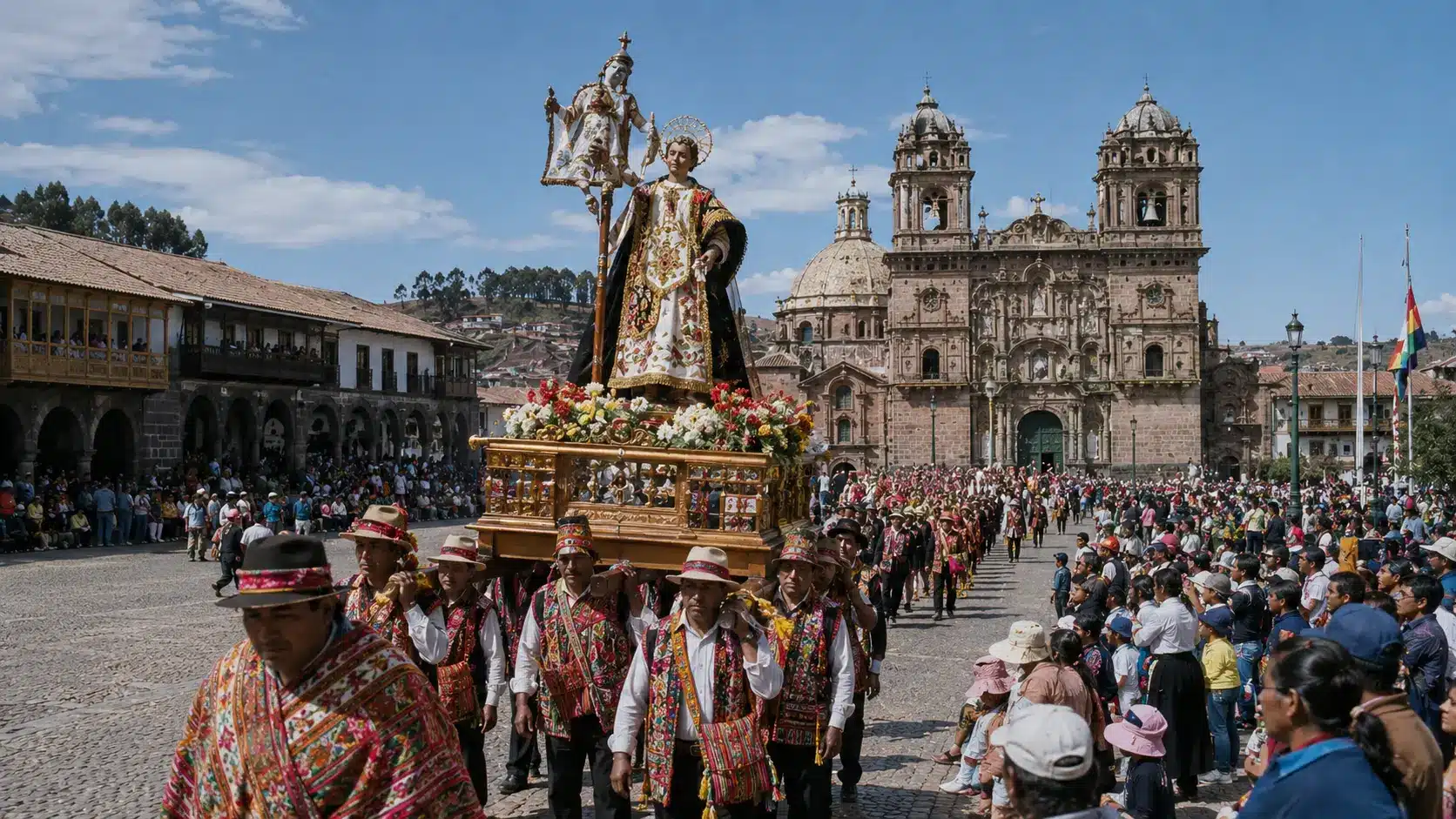 Cusco’s Corpus Christi was declared Cultural Heritage of Peru in 2004. It is unlike any European celebration because Catholic ritual and Andean tradition have been merging here for 400 years.
In Corpus Christi Festival 2026, the main events run June 3 to June 11:
- June 3: Saints and virgins from 15 surrounding parishes process to the Cusco Cathedral. Each image travels with musicians, dancers, and the carguyoq — the person organizing that parish’s participation. They all converge and enter the Cathedral together.
- June 4: The main day. All 15 sacred images parade around the Plaza de Armas — the historic main square built on the foundations of the Inca city with music and traditional dances.
- June 11: The Octave of Corpus. The saints return to their home parishes.
When the Spanish arrived in the 16th century, the Incas already had a strong tradition of parading the mummified remains of their rulers through public spaces. Catholic missionaries used that existing ritual to introduce Corpus Christi. The two merged over four centuries. The 15 saints that process through Cusco today occupy the same cultural role the Inca rulers once did. It is not a transplanted European festival. It is something that evolved specifically here.
If you are visiting Cusco in June: Corpus Christi is June 4, and Inti Raymi the ancient Inca Festival of the Sun is June 24. Staying for both is worth it.
Germany Fronleichnam and the Flower Carpets
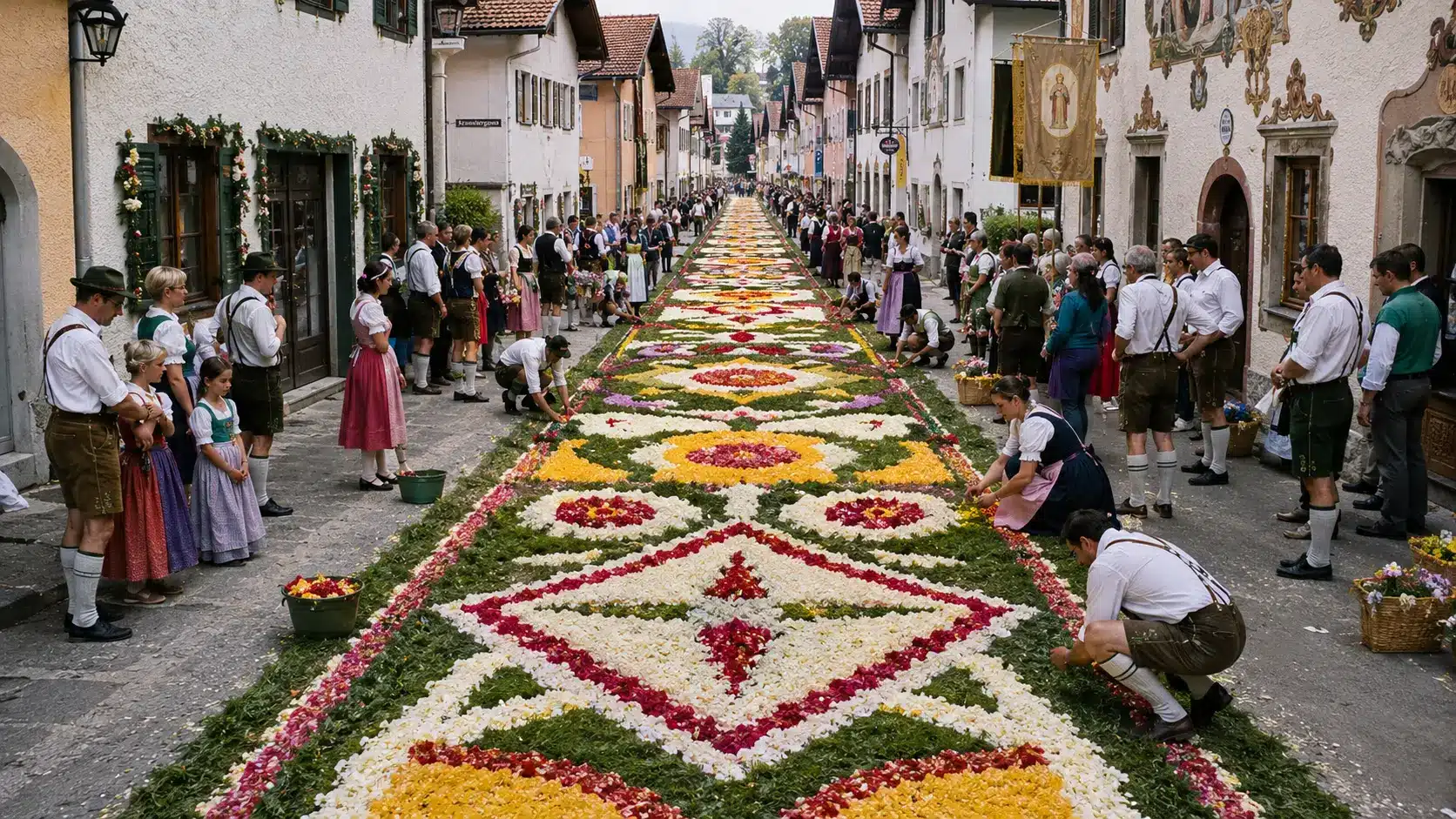 In Germany, Corpus Christi is Fronleichnam from Middle High German for “Body of the Lord.” It is a public holiday in Bavaria, Baden-Württemberg, North Rhine-Westphalia, Rhineland-Palatinate, Hesse, and Saarland.
In rural areas of the Black Forest and the Swabian Alps, flower carpets line the procession route. Children wear white. Adults dress in traditional regional clothing.
In Bamberg, 18 men carry a 650-kilogram cross through the city. In Cologne, over 100 boats parade on the Rhine a tradition tracing to a medieval legend about a thief who was stopped while crossing the river with a stolen host.
Colombia and Brazil
In Colombia, Corpus Christi is a public holiday observed on Monday, June 8, 2026. In Anolaima, the festivities run for three days. In Bello, a dyed sawdust carpet covers the street for the local priest to walk on.
Brazil also observes Corpus Christi as a national public holiday on June 4. If you are planning a June trip to Brazil, the country is also in the middle of Festa Junina Brazil’s second-biggest festival after Carnival. Both Corpus Christi and Festa Junina are rooted in the same Catholic calendar. The two overlap directly in June, which makes this the best month to experience Brazilian festival culture.
Practical Guide
For Toledo
- Book accommodation 6–8 weeks in advance. Toledo fills fast during Corpus week.
- No cars on procession day. Park by the river and walk up.
- Arrive at the procession route by 9:30 AM. The medieval streets are narrow and fill early.
- The Patio and Garden competition (June 1–6) opens 40+ private historic courtyards — worth attending.
- Early June in Toledo: mid-20s Celsius, warm days, shade in the alleys.
For Cusco
- Altitude is 3,400 meters. Budget two days to acclimatize before the festival.
- Andean winter in June means sunny days and cold nights, sometimes below zero. Pack layers.
- The Plaza de Armas procession is free and open to all.
- Try Chiri Uchu from the food stalls on June 4.
What to Wear
No dress code for spectators. Modest clothing is appropriate near the procession or inside churches.
Interesting Facts
- Toledo’s Custodia de Arfe took eight years to build (1515–1523) and has never left the city. It exits the cathedral exactly once a year.
- The oldest documented uninterrupted Corpus Christi procession in Spain is in Valencia, first recorded in 1335 and observed continuously since 1372.
- An ancient Spanish proverb says: “There are three Thursdays that shine more than the sun: Holy Thursday, Ascension Thursday, and Corpus Christi.”
- The feast exists partly because of a doubting priest. The Miracle of Bolsena in 1263 where a priest who doubted transubstantiation reportedly saw a host bleed directly influenced Urban IV to declare the feast the following year.
- Corpus Christi is a public holiday in 25 countries. Not a national holiday in France, Italy, the UK, or the US.
- In Mexico, children dress as inditos on this day in traditional indigenous clothing with baskets of fruit. The custom traces to the colonial era, when indigenous communities brought produce to sell at city markets on the day of the procession.
FAQ
When is Corpus Christi in 2026?
Corpus Christi 2026 is Thursday, June 4. In most US dioceses, it moves to Sunday, June 7. In Colombia, it is observed on Monday, June 8.
What does Corpus Christi mean?
It is Latin for “Body of Christ.” The full official name is the Solemnity of the Most Holy Body and Blood of Christ. The feast honors the Catholic belief that Jesus Christ is truly present in the Eucharist.
Why is Corpus Christi always on a Thursday?
Thursday connects the feast to the Last Supper, which took place on a Thursday. Maundy Thursday already marks this during the somber Holy Week. Corpus Christi puts the same event on a later Thursday for a more joyful, public celebration.
How is Corpus Christi celebrated around the world?
A procession of the Eucharist through the streets is the constant. Beyond that, every culture built its own tradition: Toledo uses a 500-year-old gold monstrance and herbs on the cobblestones; Cusco blends Catholic and Inca ceremonial tradition; German towns build flower carpets; Colombia creates dyed sawdust carpets.
Is Corpus Christi a public holiday?
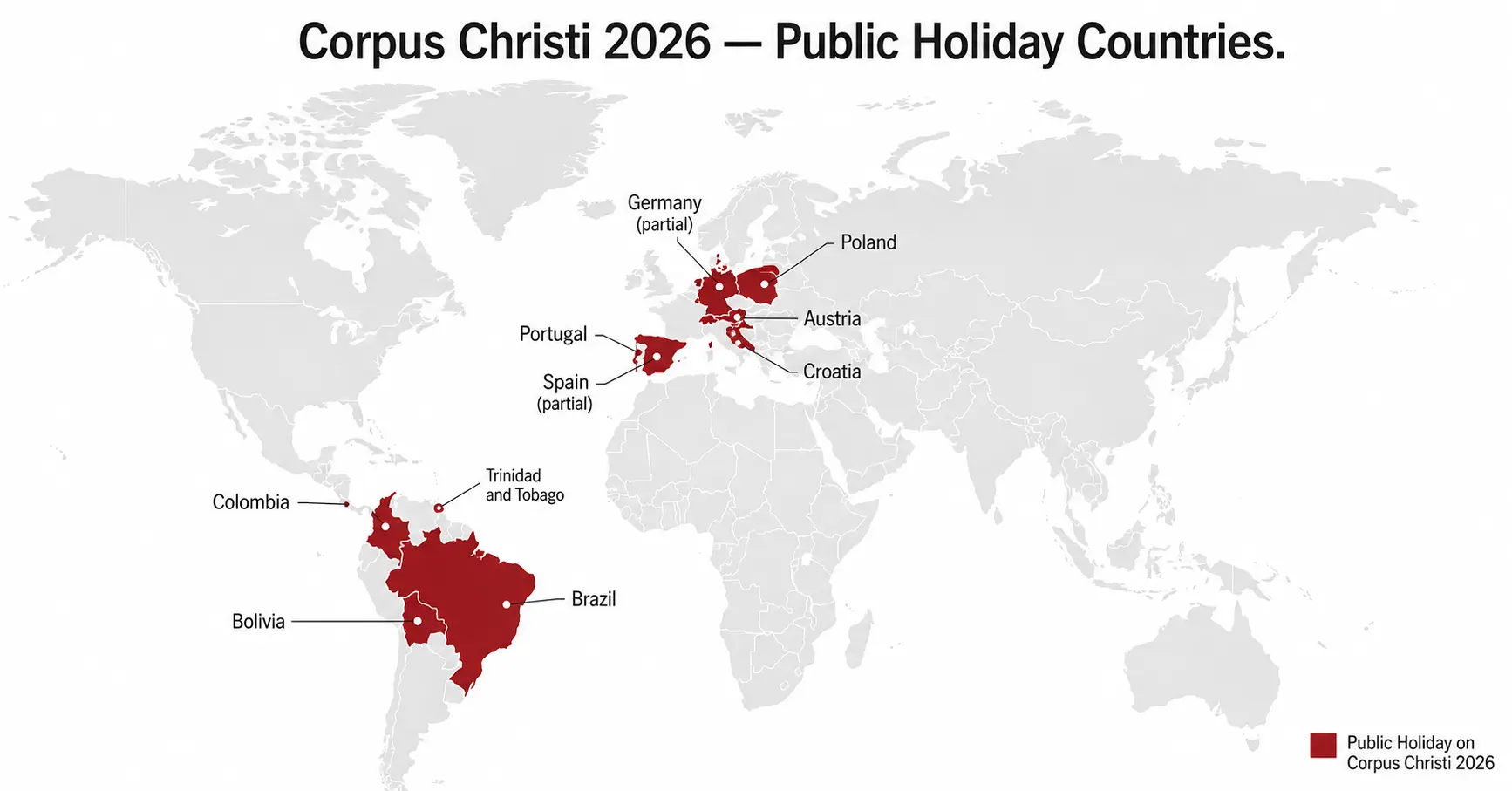 Yes, in over 20 countries Austria, Bolivia, Brazil, Colombia, Croatia, parts of Germany, Poland, Portugal, parts of Spain and Switzerland, Trinidad and Tobago, and others. Not a national holiday in France, Italy, the UK, or the US.
Where is the best place to celebrate Corpus Christi?
Toledo, Spain for the most elaborate celebration the festival week runs May 27 to June 7, 2026, procession on June 4. Cusco, Peru for the most culturally distinct 400 years of Catholic-Andean tradition have produced something that exists nowhere else.
What is the Custodia de Arfe?
A late-Gothic monstrance made by Enrique de Arfe between 1515 and 1523, commissioned by Cardinal Cisneros. It weighs 160 kilograms, is made of gold and silver, has never left Toledo, and is carried through the city streets on June 4 starting at 11:00 AM.
What is Chiri Uchu?
A cold dish eaten specifically on Corpus Christi in Cusco. It includes guinea pig, dried beef, roasted corn, seaweed, and freeze-dried potato. It is not served any other day of the year.
How did Corpus Christi begin?
It traces to Juliana of Liège, a Belgian nun who from around 1209 claimed visions calling for a feast dedicated to the Eucharist. A local feast was established in 1246. Pope Urban IV made it universal in 1264, partly spurred by the Miracle of Bolsena the year before.
Is Corpus Christi only a Catholic celebration?
Primarily, yes. It is also observed in some Anglican and Lutheran churches, and some Western Rite Orthodox Christians mark it as well.
Conclusion
Corpus Christi Festival 2026 is June 4. In Toledo, the procession starts at 11 AM and the streets will smell of thyme. In Cusco, 15 saints from 15 parishes will converge on a square that was the center of the Inca world 500 years ago. In Germany’s Black Forest, someone is laying a flower carpet longer than most city blocks.
For travelers, Toledo and Cusco are both worth planning a trip around. Both cities fill up early book ahead.
Read next: Festa Junina 2026 — Brazil’s June Festival Guide | Nagasaki Lantern Festival 2026

Abhay Ramola researches world festivals across primary sources, local accounts, and on-ground reporting. He founded Dionfest to cover what gets missed when festivals become tourism content the history, the ritual, and the people behind it.
Hello to every one, the contents present at this web page are actually awesome for people knowledge, well, keep up the good work fellows.
What i don’t realize is if truth be told how you are not actually a lot more well-preferred than you
may be now. You are very intelligent. You realize thus significantly relating to this subject, made me in my
view consider it from a lot of varied angles. Its like men and women are not involved until it’s one thing
to accomplish with Woman gaga! Your individual stuffs outstanding.
All the time take care of it up!
Hey! I could have sworn I’ve been to this site before but after reading through some of the post
I realized it’s new to me. Nonetheless, I’m definitely happy I
found it and I’ll be book-marking and checking back often!
Pretty! This was an incredibly wonderful post. Thanks for providing this information.
I actually felt your post is relevant and timely, either) and living a life in full appreciation of Nature, helps people feel grounded.
Considering deep philosophical topics is likewise an experience
that can help us make the discovery of self understanding.
I cannot imagine all the things we get annoyed
about in our lives makes a difference. Constantly invested in taking into
consideration the numerous things that we confront
just about every working day is certainly undoubtedly necessary, as no other person is going to
deal with existence for any of us. Personally I think that men and women ought to be a whole lot more sane.
Knowledge is terrific, however, so much of that which we think about is so abstract.
Having a cup of kava is a zen process that takes one back to the present instant.
We have to become more in the here and today, without being overwhelmed by our
lifestyle and the drama we experience each day.
In reality, virtually all subject areas are a
tad bit more intricate than a casual viewer could decide on,
in line with their position. I’m not stating that I happen to be an authority on this amazing question being mentioned, consequently I assume it’s for some other
message board people to look into. I am not
wanting to make trouble or be wearisome. Instead, I understand from knowledge that this could be the circumstance.
I practice Postpartum Massage Therapy, and in my own selected
discipline, I witness it quite a lot. Just-graduated Postnatal
Massage Practitioners are more likely to overpromise; that
is, these individuals don’t at this point actually recognize the restrictions of their own “scope of practice,” and hence they can easily come up with statements that are overbroad when coming into
contact with patients. It’s the same phenomenon; they have been minimally schooled in a theme, don’t know the
complete level of the idea, and finally assume they are the
Specialists.