At exactly the point when the Swedish sun refuses to set when 10 PM looks like 6 PM and the sky stays gold for hours a country of 10 million people steps outside, puts flowers in their hair, grabs a glass of schnapps, and starts hopping around a pole like frogs.
No irony. No explanation needed.
It’s Midsummer. And no festival on Earth quite looks like this one.
Charu Uppal, a filmmaker who has lived in Sweden for years, put it better than most travel guides ever could: “Darkness in Sweden is darker than dark. There should be a special name for that dark it’s not just black. It’s thick, viscous and heavy. In comes June. Waltzing in all its brightness. Brightness of Swedish summer is no ordinary brightness. There should be a special name for it too. It’s light, fluffy and perfumed.”
That contrast those months of near-total darkness flipping to endless summer light is why Swedes don’t just celebrate Midsummer. They need it.
Key Facts
| Festival Name | Midsummer (Midsommar) |
| Also Known As | Midsommarafton (Eve), Midsommardagen (Day) |
| Midsummer Festival 2026 | Friday, June 19 (Eve) — Saturday, June 20 (Day) |
| Main Celebration | Friday afternoon and evening |
| Public Holiday | Midsummer Day (June 20) is a public holiday |
| Celebrated In | Sweden (and Swedish diaspora worldwide) |
| Type | National cultural festival |
| Origins | Pre-Christian pagan solstice celebration |
| Best Location | Dalarna region, especially Leksand |
Swedish Midsummer, called Midsommar, falls on the Friday nearest the summer solstice. In 2026, that’s June 19. Swedes gather outdoors to raise a decorated maypole, make flower crowns, eat pickled herring and strawberries, and drink schnapps to traditional drinking songs. It is one of the few holidays that secular, modern Swedes still observe without any cynicism which tells you something about how deep it runs.
What is Swedish Midsummer? History and Origins
Swedish Midsummer is older than Sweden itself.
The roots go back to pre-Christian Scandinavia, when Norse people marked the summer solstice with bonfires, fertility rituals, and communal gatherings. The longest day of the year was considered a time of power, magic, and abundance. Nature was at its peak. Crops were growing. Light had defeated darkness.
When Christianity spread through Scandinavia, the Church tried to fold this pagan holiday into its calendar, tying the solstice celebrations loosely to the feast of St. John the Baptist. But the pre-Christian folk traditions survived almost entirely intact. The flowers, the dancing, the maypole, the belief in magic on this particular night none of it disappeared. It just continued under a different name.
By the 1500s, Swedes were already raising tall leafy poles and dancing around them. In some areas, people dressed as “green men” covered in ferns. Houses and farm tools were decorated with greenery. Midsummer was primarily a gathering for young people a time for courtship, outdoor meals, and the particular joy that comes from knowing the long dark Swedish winter is finally far away.
In industrial communities of central Sweden, mill workers were given a feast of pickled herring, beer and schnapps each Midsummer. Gradually, over the 20th century, it became what it is today: the most distinctly Swedish of all national celebrations.
Swedish food writer Per Styregard, who grew up with the holiday, described it simply: “A national holiday as important to us Swedes as Independence Day is to Americans, though its roots go much further back.” That comparison holds up. You cancel plans for it. You travel for it. You do not miss it.
Midsummer Festival 2026 Dates, Timing and What to Expect
Midsummer Festival 2026: Friday, June 19 Midsummer Day 2026: Saturday, June 20 (public holiday)
One thing that catches visitors off guard: the action is on the Eve, not the Day. That’s when the maypole goes up, when people gather outdoors, when the singing and dancing happen. By Midsummer Day, most Swedes are recovering.
Midsummer Eve is not an official public holiday but offices, banks, and shops close early or entirely. Most Swedes treat the weekend as a four-day break, with many taking the following Monday off informally. Trains, roads, and accommodation fill up from Thursday onwards. If you’re travelling in Sweden that weekend, book everything well in advance.
Worth noting: June 19 also happens to be the date of China’s Dragon Boat Festival 2026. Two entirely different cultures, marking the same day in completely different ways one with maypoles and schnapps, the other with dragon boats and rice dumplings. The coincidence is a good reminder of how the same date can carry entirely different meanings across the world.
In Stockholm, the sun sets around 10:15 PM on June 19. In northern Sweden, it doesn’t set at all. The sky just stays lit through the night. That’s the midnight sun and it gives Midsummer an atmosphere you won’t find at any other festival.
How is Midsummer Celebrated? Traditions Explained
The Maypole (Midsommarstång)
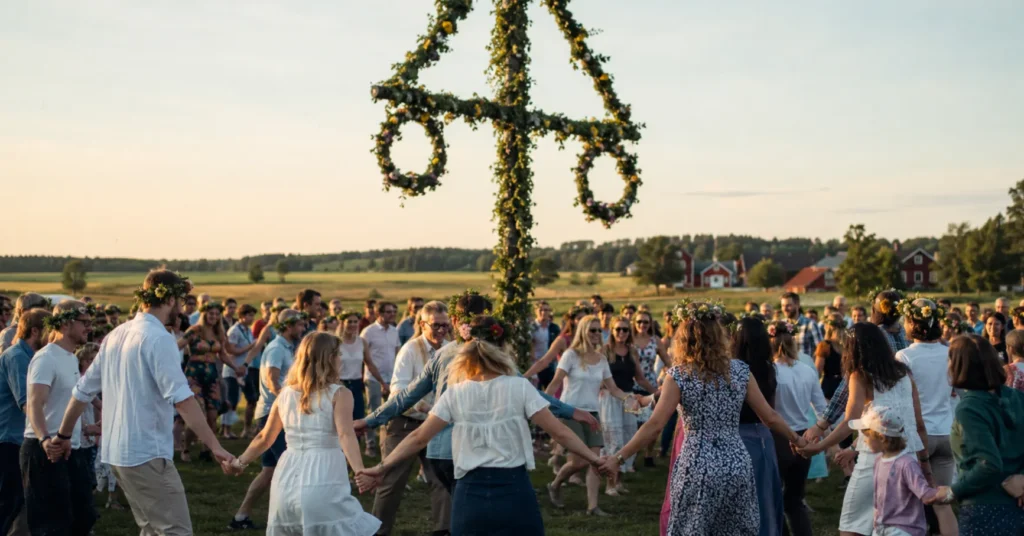
The maypole is the centerpiece of every Midsummer celebration. It’s a tall wooden pole often four metres or more decorated with birch leaves, flowers, and greenery. On Midsummer Eve afternoon, people gather in a village clearing or open meadow to raise it together.
Once up, the dancing begins. Children and adults form circles, hold hands, and move around the pole to traditional folk music.
Raising it is not always straightforward. Photographer Michelle Bablitz, who attended Midsommar in the Dalarna village of Enviken in 2016, described watching the whole process from the sidelines: “The men hoisting the maypole attempted different angles to no avail. With their staunch dedication to tradition, these Swedes perfectly embodied Midsommar. Finally, after about an hour of holding the maypole half-lifted, they triumphed.”
That stubbornness the refusal to give up on a pole is somehow very Swedish.
The Little Frogs Dance (Smågroderma)
The most famous dance of Midsummer is Små grodorna, which means “The Little Frogs.” Participants squat, hop, and wave their arms like frogs while singing a folk song with the same name. This is done by adults and children alike, with complete enthusiasm and zero embarrassment.
Swedish actress Alicia Vikander told Jimmy Kimmel about it in an interview that went quietly viral: “Everybody between the ages of five and 95 in Sweden knows this dance and does it every year.” She then demonstrated it in heels. That interview does more for Midsummer tourism than any travel brochure.
Flower Crowns
From early on Midsummer Eve, Swedes make flower wreaths from wildflowers and wear them throughout the day. The tradition links to old beliefs about midsummer plants having healing powers. Making the crown is as much a part of it as wearing it.
When Angela Dunn, a British travel writer, attended Midsummer in 2025 with her Swedish friend Malin, this was the first thing she noticed: “Most of the women and young girls were wearing wreaths in their hair, many self-made with flowers from their gardens.”
The Seven Flowers Tradition
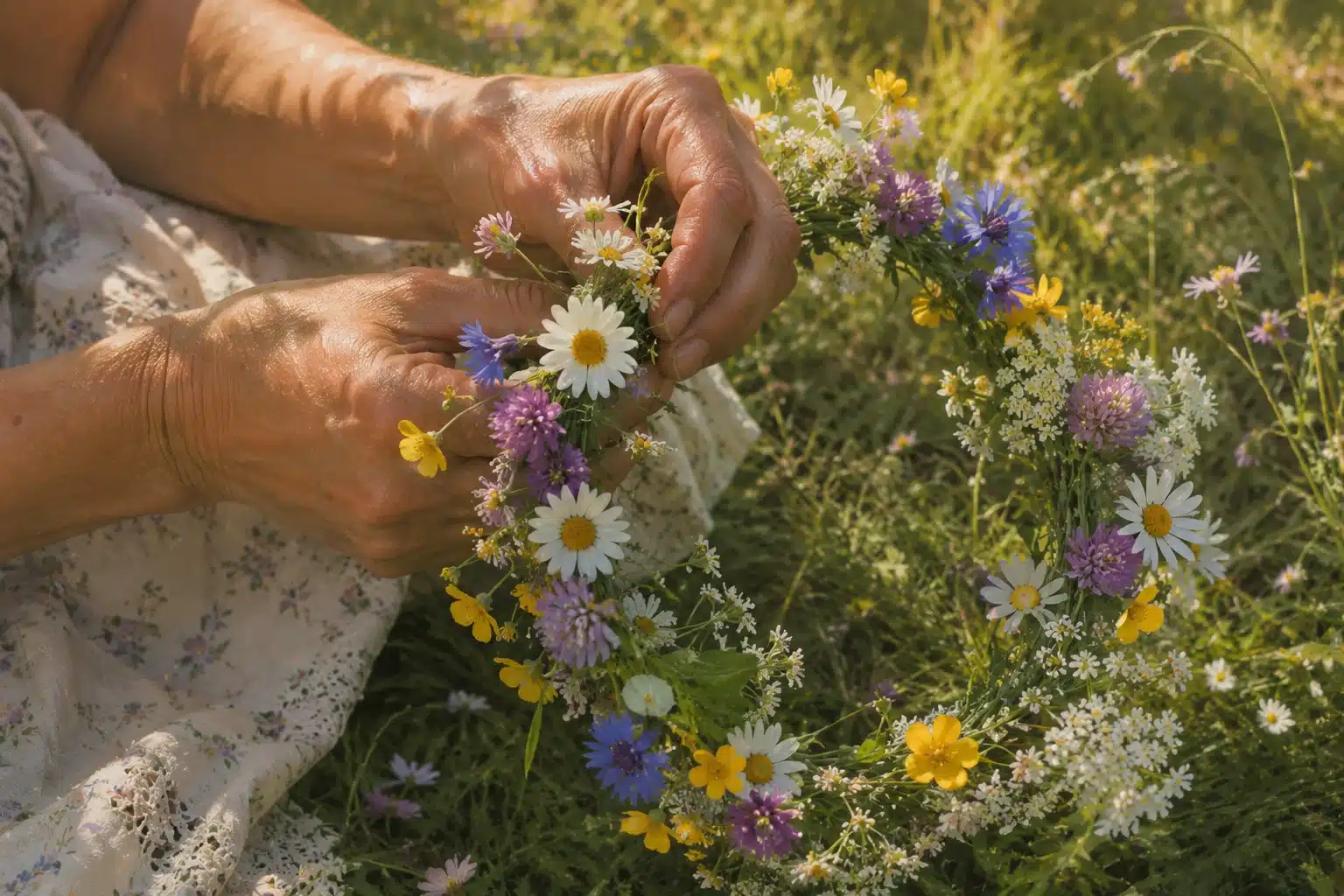 One of the oldest surviving customs: a young woman picks seven different types of wildflowers in complete silence on Midsummer Eve and places them under her pillow. According to folk tradition, she will dream of her future husband that night. One word breaks the spell.
This tradition is centuries old and still practised. It has something in common with Japan’s Tanabata Festival 2026 another summer celebration built entirely around the idea of one magical night, one wish, and two people meant to find each other. Different countries, same longing.
Folk Costumes
In Dalarna especially, many Swedes wear traditional regional dress: white blouses, colourful skirts, embroidered aprons. Each region historically had its own pattern. People wear these without self-consciousness it’s not a costume. It’s a choice.
What Do Swedes Eat and Drink on Midsummer?
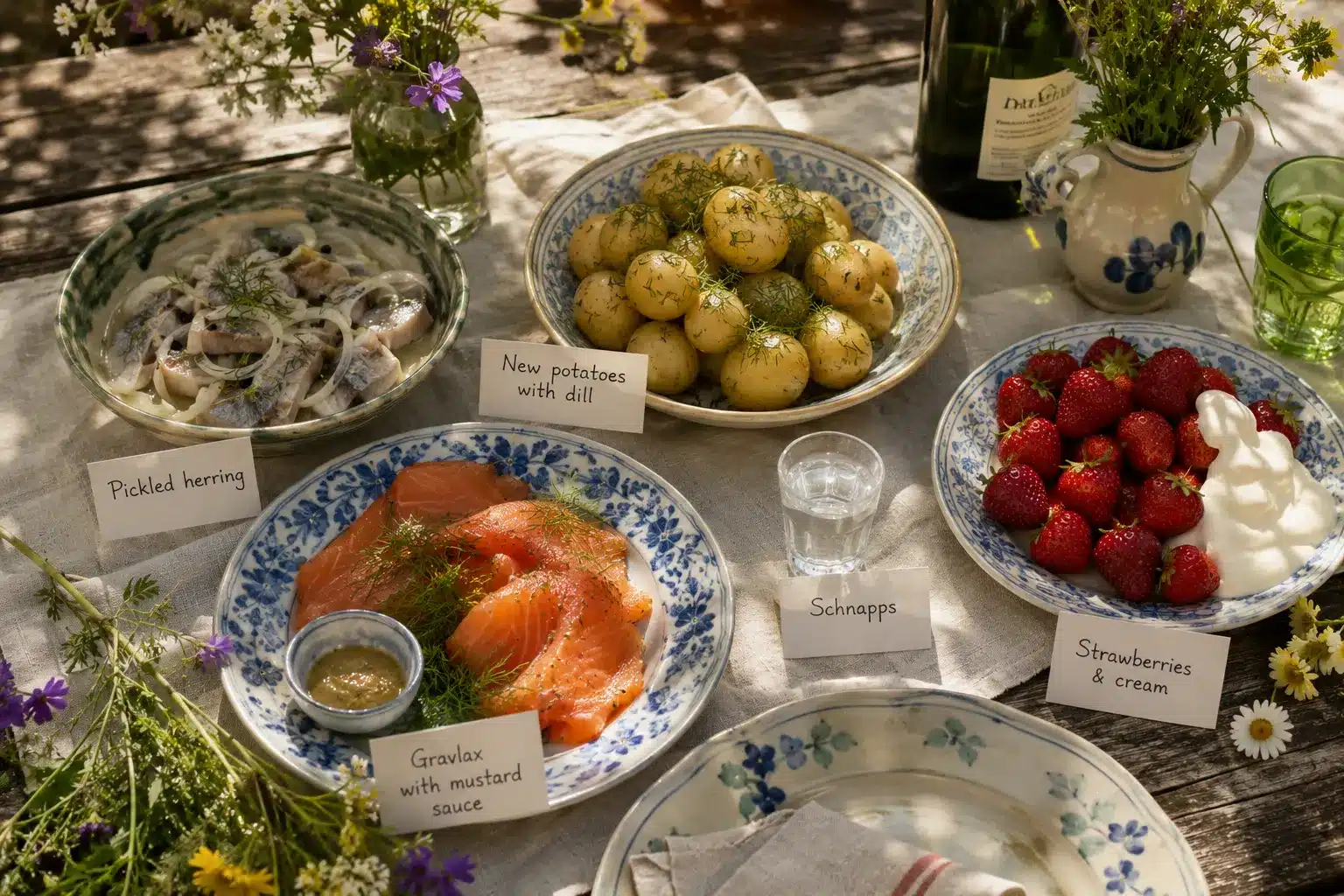 Food is not a side note at Midsummer. The whole afternoon is built around it.
The table always has:
- Pickled herring in multiple flavours classic onion, mustard, dill, sometimes curry. Try a few. Sampling the range is part of the ritual.
- New potatoes (färskpotatis) small, boiled with fresh dill. These are the first potatoes of the season. Their flavour at this point of the year is different: earthy, soft, genuinely sweet.
- Gravlax cured salmon with mustard-dill sauce.
- Rye bread and crispbread, butter, Swedish cheeses.
- Swedish meatballs on some tables.
Drinks:
Schnapps, called snaps in Swedish, is the drink of Midsummer. It’s usually herb-flavoured dill, caraway, elderflower. Each glass comes with a snapsvisa, a drinking song sung by everyone at the table before drinking. The best-known is Helan Går (“the whole glass goes down”). New rounds mean new songs. This continues until nobody can remember the words.
Angela Dunn, after her 2025 Midsummer trip, summed up the whole cultural picture with one observation: “Grandparents, kids and millennials it seems there’s not a single demographic in Sweden that doesn’t know the words to ‘Waterloo.'” ABBA runs through Sweden the way folk songs do. Both traditions coexist without anyone finding this strange.
Dessert:
Fresh Swedish strawberries with whipped cream, or layered into a strawberry sponge cake called jordgubbstårta. Swedish strawberries ripen around Midsummer long bright spring nights and cooler temperatures give them a sweetness that’s hard to describe without tasting.
Brian McCann, an American expat who has lived in Stockholm for years and attended Midsommar on the island of Öland in 2024, had one line on this subject: “Swedish strawberries are the best. Really.”
That’s not marketing. That’s someone who has eaten a lot of strawberries and is making a factual statement.
Best Places to Experience Midsummer in Sweden
1. Dalarna The Most Traditional
Dalarna, a region of rolling hills and lakes roughly three hours north of Stockholm by train, is where the old customs are kept most intact: folk costumes, fiddlers, church boat races, maypoles in every village.
Leksand is the largest and most famous. Around 30,000 people come to watch locals process from the town church Leksand Midsummer to the Sammilsdal, a natural grassy outdoor space beside Lake Siljan, where they dance around the maypole to folk music. This is not a performance arranged for tourists. It’s a real community event that happens to be large.
If you want Midsummer done the way it was done 200 years ago, Leksand is the right answer.
2. Skansen, Stockholm
For visitors staying in Stockholm, the Skansen open-air museum is the most accessible option. It has hosted Midsummer celebrations for over a century. You’ll find wreath-weaving workshops, folk dancing, traditional crafts, and the full maypole ceremony on the grounds of a hillside museum overlooking the city. It runs through the evening.
3. Stockholm Archipelago
Many Stockholmers leave the city entirely for Midsummer and head to the archipelago the 30,000 islands scattered across the Baltic. Grinda, Vaxholm, and Värmdö all host celebrations by the water. Stockholm itself becomes noticeably quiet during the weekend, which has its own strange appeal.
Travel writer Lani Kingston experienced Midsummer in the Swedish countryside near Lake Hjälmaren and described what staying up past 3 AM felt like: “We sat there on the kitchen floor for hours, listening and tapping along to folk songs. Deep voices were punctuated by the occasional female voice singing in Swedish, known by all in the room but me. In between each song, the room returned to the deep silence of nighttime in the countryside. As we left the farmhouse, the wail of the accordion bade us goodbye. The 3 AM sky was still light, and the sun decided not to set at all, just skip straight to rising.”
That’s the archipelago and countryside experience. The city doesn’t give you that.
4. Swedish Lapland Midnight Sun
For something beyond the standard celebration, head north to Swedish Lapland. Here, the sun doesn’t set at all around the solstice. You can join a Midsummer gathering while it’s fully daylight at midnight 24 hours of light. Combined with the chance to walk through national parks and learn about Sámi culture, this is the most unusual version of the celebration available.
Practical Guide What to Wear, Bring and Know
What to wear:
- A flower crown – make one or buy one, both are fine
- A light summer dress or relaxed clothing; folk costume if you want to lean all the way in
- Flat comfortable shoes – you will be dancing on grass
- A jacket or cardigan: June evenings in Sweden can turn cold, especially if rain comes
What to bring:
- A blanket or picnic mat
- A reusable cup for schnapps and drinks
- A camera the light at 9 PM on Midsummer Eve in Sweden is extraordinary
What to know:
- Book trains and accommodation at least four to six weeks in advance. Rail connections from cities to rural areas fill fast from Thursday
- Arrive early in the afternoon in Dalarna if you want a good position near the maypole
- Most Midsummer celebrations are free and open to everyone
- Swedes take this seriously. It’s not a performance for visitors. Treat it accordingly
- If June outdoor festivals are what you enjoy, it’s worth knowing that Brazil’s Festa Junina 2026 runs through the same month different country, same instinct to gather outdoors, eat together, and dance to folk music
8 Things About Swedish Midsummer That Surprised Visitors
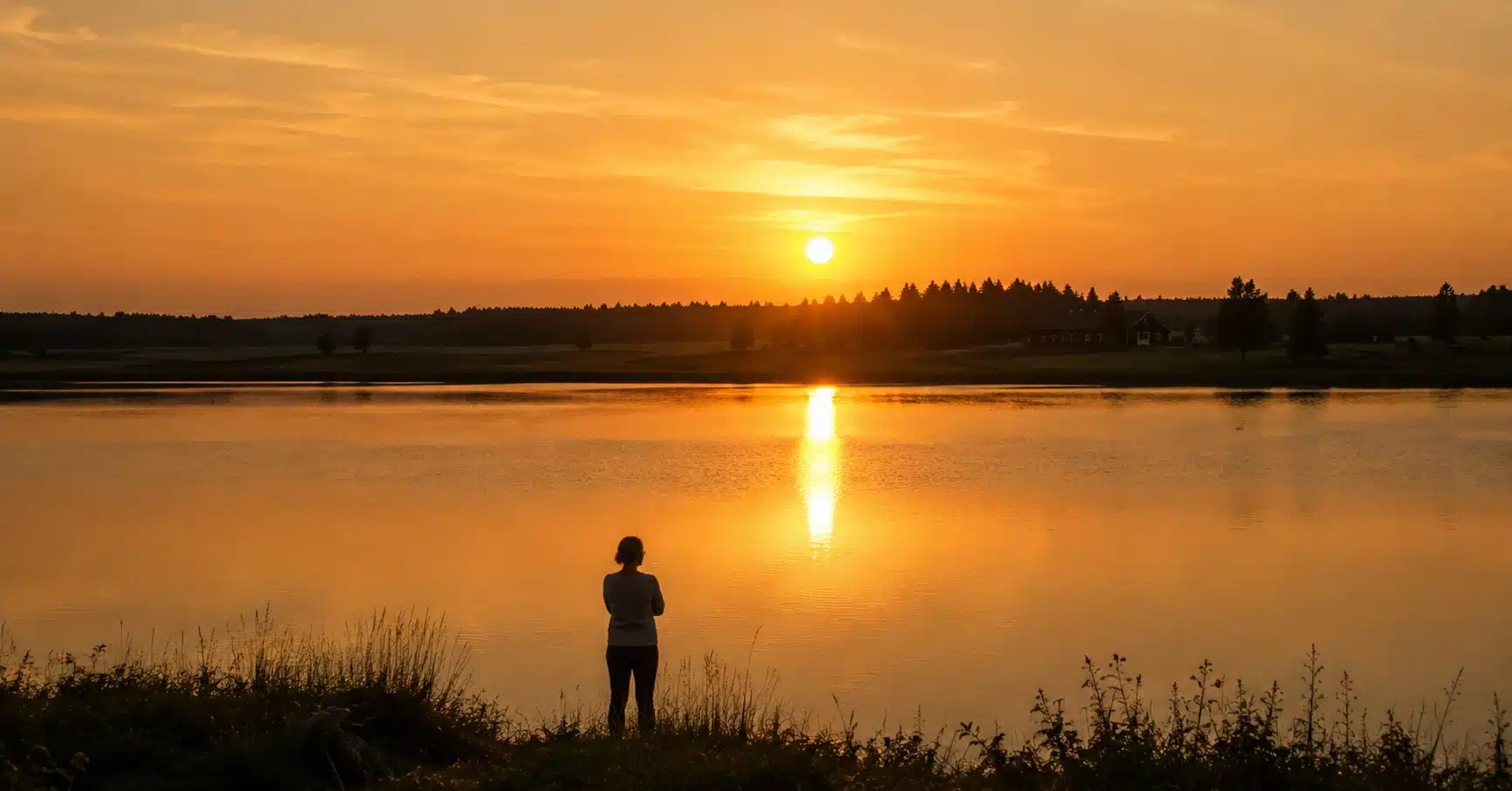 1. The sun genuinely doesn’t set in northern Sweden. In Swedish Lapland, Midsummer means roughly 24 hours of daylight. You can watch the maypole dance at midnight under full sunlight. Not dusk full sunlight.
2. Stockholm goes quiet. Every year, Sweden’s capital empties out for the weekend. Most residents leave for the countryside or the archipelago. If you’re in Stockholm for Midsummer without a plan, the city becomes a ghost town.
3. It matters more than Christmas to many Swedes. Several surveys have found Swedes rank Midsummer above Christmas when asked which holiday they value most. The outdoor element, the warmth, and the relief of summer after a long dark winter all factor in.
4. The horror film Midsommar (2019) has nothing to do with the real festival. Director Ari Aster set his horror film during a Swedish solstice-like event in Hälsingland. Real Swedish Midsummer involves zero ritual sacrifice. It did, however, introduce millions of people worldwide to the existence of the holiday, which resulted in a measurable spike in tourism interest.
5. The Little Frogs dance is done by everyone, not just children. Unlike most folk dances where children perform while adults watch, Swedish adults hop around the maypole imitating frogs with complete commitment. It is entirely normal.
6. The maypole tradition dates to at least the 1500s. Written records confirm Swedes were raising decorated poles and dancing around them at Midsummer by the 16th century. Some historians trace it earlier.
7. It’s considered the most romantic night of the year. The seven-flowers tradition, the long evenings, the schnapps, and the outdoor dancing have all made Midsummer a night strongly associated with courtship in Swedish folklore. Sweden also reportedly sees one of its highest conception rates in the months following Midsummer weekend.
8. Even secular Swedes show up for this. Sweden is one of Europe’s most secular countries. Very few national holidays are observed with genuine feeling across all ages and backgrounds. Midsummer is one of the exceptions. That’s what makes it worth attending.
FAQ
When is Midsummer Festival 2026 in Sweden?
Midsummer Eve 2026 is Friday, June 19. Midsummer Day is Saturday, June 20, which is the public holiday. The main celebrations are on the Eve Friday afternoon through the night.
What is the Swedish word for Midsummer?
Midsommar. Midsummer Eve is Midsommarafton and Midsummer Day is Midsommardagen.
Is Midsummer a public holiday in Sweden?
Midsummer Festival 2026 (Saturday, June 20 in 2026) is an official public holiday. The Eve (Friday, June 19) is not, but offices and shops close early or entirely. It’s treated as a de facto holiday across Sweden.
What happens at a Swedish Midsummer celebration?
A decorated maypole is raised, everyone dances around it, flower crowns are made and worn, there’s a long outdoor meal of pickled herring, new potatoes, and cured salmon, and the evening is fuelled by schnapps and traditional drinking songs.
What is the Little Frogs dance at Midsummer?
Små grodorna is a folk song and dance where participants hop, squat, and wave their arms like frogs. Adults do this. Enthusiastically. Every year.
What is the best place to experience Swedish Midsummer?
Leksand in Dalarna is the most traditional and biggest, with around 30,000 people gathering around a lakeside outdoor space for folk dancing in regional costumes. Skansen in Stockholm is the easiest option for city visitors.
What do Swedes eat at Midsummer?
Pickled herring in several flavours, boiled new potatoes with dill, gravlax, rye bread, Swedish cheeses. Schnapps and cold beer throughout. Fresh strawberries with cream or strawberry cake for dessert.
What is the seven flowers tradition?
A young woman picks seven different wildflowers in complete silence on Midsummer Eve and places them under her pillow. According to folk tradition, she’ll dream of her future partner that night. One word breaks it. The tradition is still practised.
Can tourists attend Swedish Midsummer celebrations?
Yes. Most public celebrations including Skansen in Stockholm and events in Dalarna — are open and free to anyone. Book accommodation and transport well in advance.
How long does Midsummer last in Sweden?
The main event is Friday afternoon and evening. In practice, most Swedes take the entire weekend, and many take the following Monday off, making it an informal four-day holiday.
Conclusion
Swedish Midsummer is not a performance put on for tourists. It’s a living tradition that a largely secular, modern country still chooses to observe with genuine feeling.
The flowers, the dancing, the schnapps, the sky that refuses to go dark none of it is nostalgic theatre. It’s simply what Swedes do when June arrives. If you’re near Sweden on June 19, 2026, go find a maypole. Hop around it. The frogs will not judge you.

Abhay Ramola researches world festivals across primary sources, local accounts, and on-ground reporting. He founded Dionfest to cover what gets missed when festivals become tourism content the history, the ritual, and the people behind it.