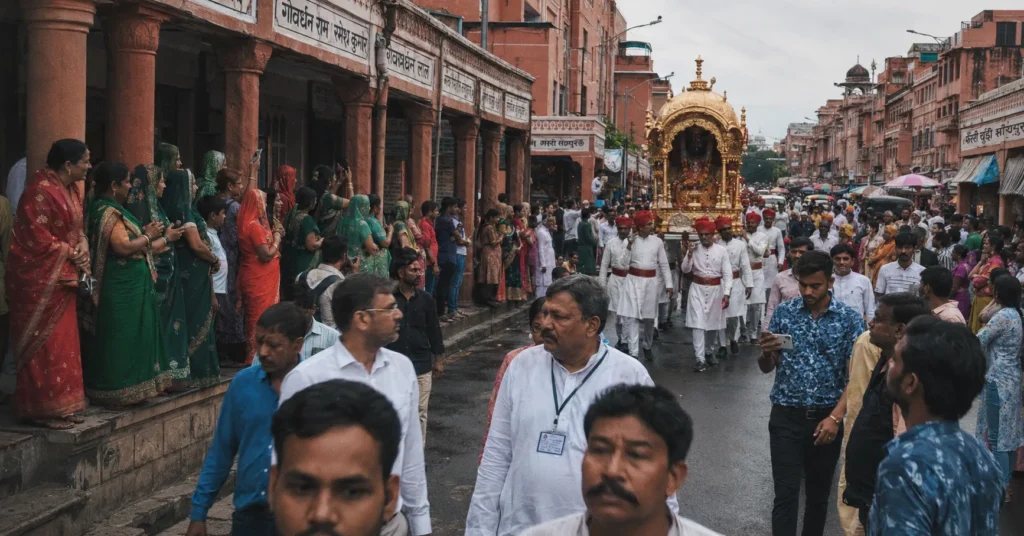
Every August, Jaipur turns green. Not just the trees the women too. Green saris, green bangles, green mehndi stalls opening before dawn on street corners that are usually just selling vegetables. If you’ve never seen Teej in Rajasthan, it’s one of those festivals that doesn’t photograph the way it feels. You need to be there.
The Three Teej Festival 2026 in Rajasthan and the Dates
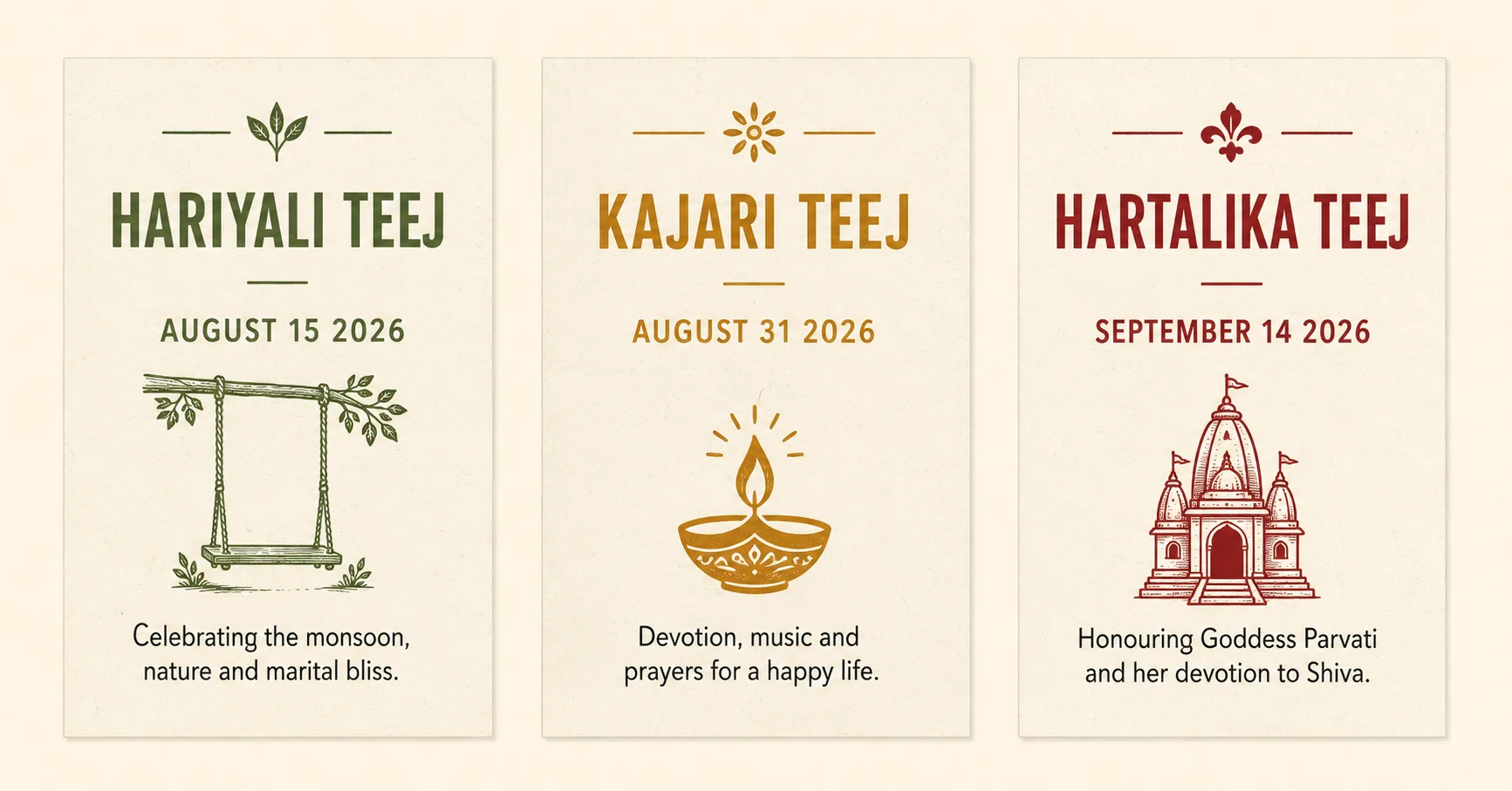 Most people don’t realize “Teej” is three separate festivals. They fall back-to-back across August and September, each with its own character.
Hariyali Teej — August 15, 2026 (Saturday) The main event. Celebrated in Jaipur with a full royal procession. This year it falls on Independence Day, which means the city will be doubly packed. Plan accordingly.
Kajari Teej — August 31, 2026 (Monday) The better-kept secret. Celebrated quietly in Jaipur, but Bundi — a smaller fort town 210 km away — goes all out. If you hate crowds, this is your date.
Hartalika Teej — September 14, 2026 (Monday) The most spiritually intense of the three. Women fast without food or water for an entire day. More temple-focused, less procession. Worth noting: September 14 is also Ganesh Chaturthi if you’re extending your India trip, the two festivals overlap on the same date.
For first-timers: aim for August 15 in Jaipur or August 31 in Bundi.
What Teej Actually Is
Teej marks the reunion of Goddess Parvati and Lord Shiva. Parvati fasted and prayed across multiple lifetimes to win Shiva as her husband. Teej is the day he finally came back to her.
That story is the reason married women fast for their husband’s long life. Unmarried women fast too, praying for a good match. The fast is nirjala: no food, no water, from sunrise until they see the moon. It’s genuinely demanding.
This Shiva-Parvati devotion runs through many of India’s biggest religious festivals. If you want to understand the mythology behind it, our guide to Kumbh Mela covers the same cosmic backstory the churning of the ocean, the nectar of immortality, why Shiva sits at the center of it all.
The spiritual core is serious. But around it, there’s a full celebration swings in the trees, folk songs, mehndi, street food, the procession.
The Jaipur Procession: What to Expect
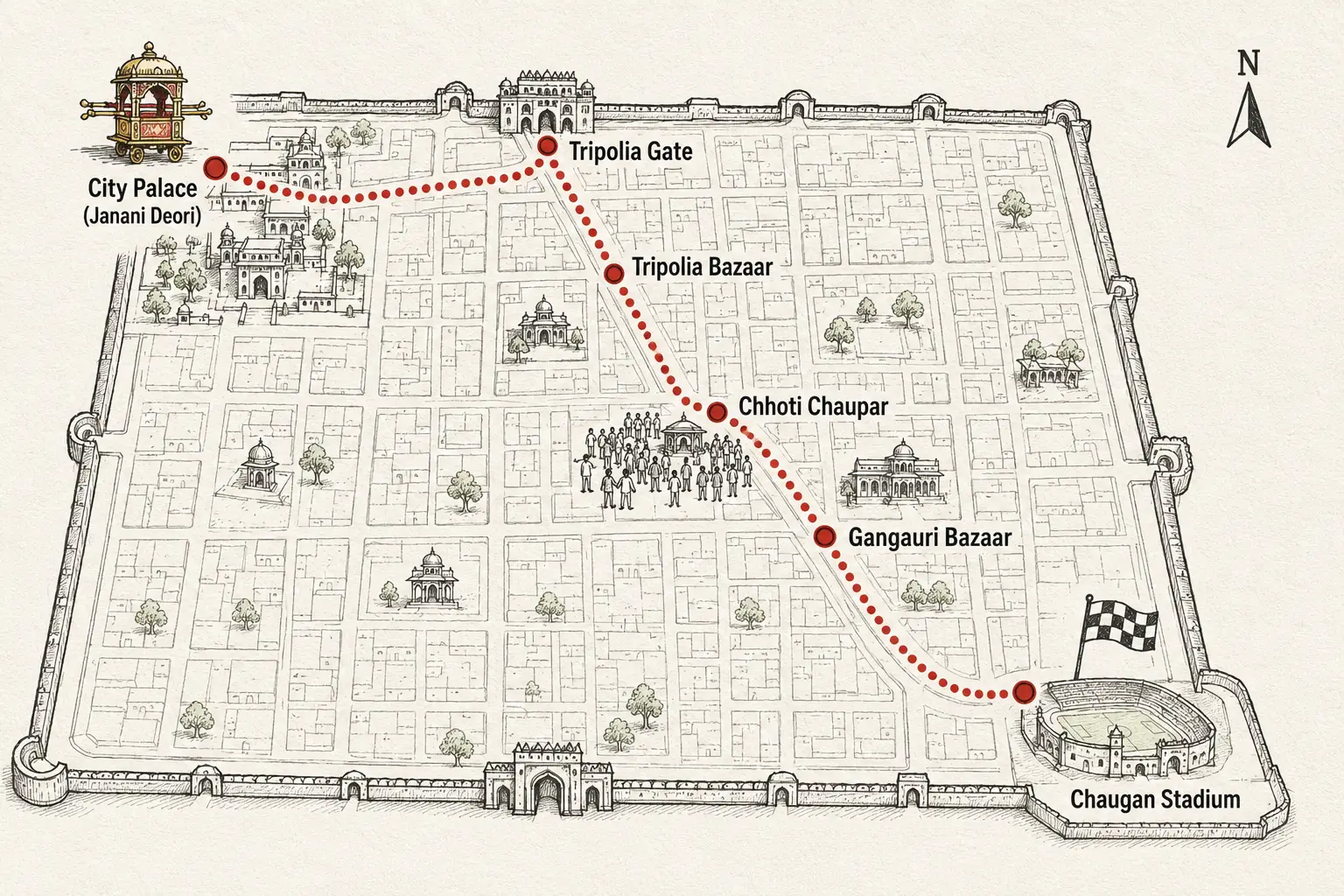 The Jaipur Teej procession is organized by the royal family’s trust. A decorated palanquin carrying an idol of Teej Mata moves through the old city, accompanied by elephants, camels, folk dancers, and musicians.
Route: Starts inside City Palace at Janani Deori → out through Tripolia Gate → Tripolia Bazaar → Chhoti Chaupar → Gangauri Bazaar → ends at Chaugan Stadium.
Timing: Usually starts 4–5 PM. The exact time changes every year check Jaipur Municipal Corporation announcements in early August.
Where to stand: Tripolia Bazaar, Chhoti Chaupar, and Gangauri Bazaar. The RTDC (Rajasthan Tourism Development Corporation) also sets up special viewing seating near Tripolia Gate worth checking if you want a guaranteed spot.
August in Jaipur is hot, humid, and this is a massive crowd. Carry water. Keep your bag in front of you. Wear something you can move in.
What It’s Actually Like to Be There
Arv from JaipurThruMyLens a Jaipur-based photographer who has covered the city’s festivals for over a decade attended the procession and wrote about the experience in detail. Here’s what he found that most guides skip:
Getting there: Don’t drive. Parking near the old city is nearly impossible on Teej day. He took an Uber to Chhoti Chaupar and arrived well before the procession — useful, because the surrounding lanes of Purani Basti are worth walking while you wait. There’s a centuries-old temple to Lord Jagannath in there that most visitors never find.
The viewing decks: The old city has colonnades with raised public viewing decks, built specifically for watching royal processions. In recent years, police have been clearing people off them ongoing metro construction has weakened some of the buildings, and no one wants to take chances. Don’t count on getting a rooftop view. Street level along Tripolia Bazaar works fine.
What passes by, in order:
- 11 decorated poles called Gogaji Maharaj Ke Nishaan, carried by members of the Valmiki community. They lead everything.
- Folk performers: Kachi Ghodi dancers in Leheriya-print dresses, snake charmers with pungis, fire breathers
- Bullock carts and a mock camel corps with cannon Jaipur state kept a real camel corps before independence and the troops served in both World Wars
- An elephant carrying the Panchranga, the flag of the old Jeypore state
- The palanquin with Teej Mata’s idol, surrounded by female police constables walking in single file holding a thick rope. The escort men wear white achkan with red turbans.
Duration: The entire procession takes roughly 20 minutes to pass a fixed spot.
Afterward: Traffic is blocked across the walled city. To get an auto or cab, walk to MI Road. This takes a while in the crowd don’t assume you’ll get out quickly.
Arv’s strongest advice: hire a local guide before you go. The procession has 300 years of history in it. Without someone explaining what’s in front of you, it reads like a parade. With context, you understand what you’re actually watching.
Bundi: The Alternative Worth Considering
Bundi is 3.5 hours from Jaipur by road. It has a step-well, a palace, and a fort that most tourists still haven’t heard of.
During Kajari Teej (August 31), the procession goes through the old city at night, with oil lamps along the streets. It’s everything the Jaipur version is, minus several thousand people. More intimate, easier to navigate, and you can actually see what’s happening.
If you want to skip the Independence Day double-crowd situation in Jaipur, Bundi on August 31 is the right call.
What to Wear If You Want to Participate
Green is the primary color. It goes with the monsoon season new growth, prosperity, all of that. Women wear:
- Green or yellow saris or lehengas
- Red also works it’s associated with marriage
- Full mehndi on both hands, applied the night before
- Bangles, especially glass ones in green and red
- Sindoor for married women
If you’re a woman traveler and want to dress for the occasion, any Indian outfit in green or red is appropriate. You can pick up a basic salwar suit in Johari Bazaar or Tripolia Bazaar for ₹400–800. Nobody will mind most people will appreciate it.
Mehndi: Where to Get It in Jaipur
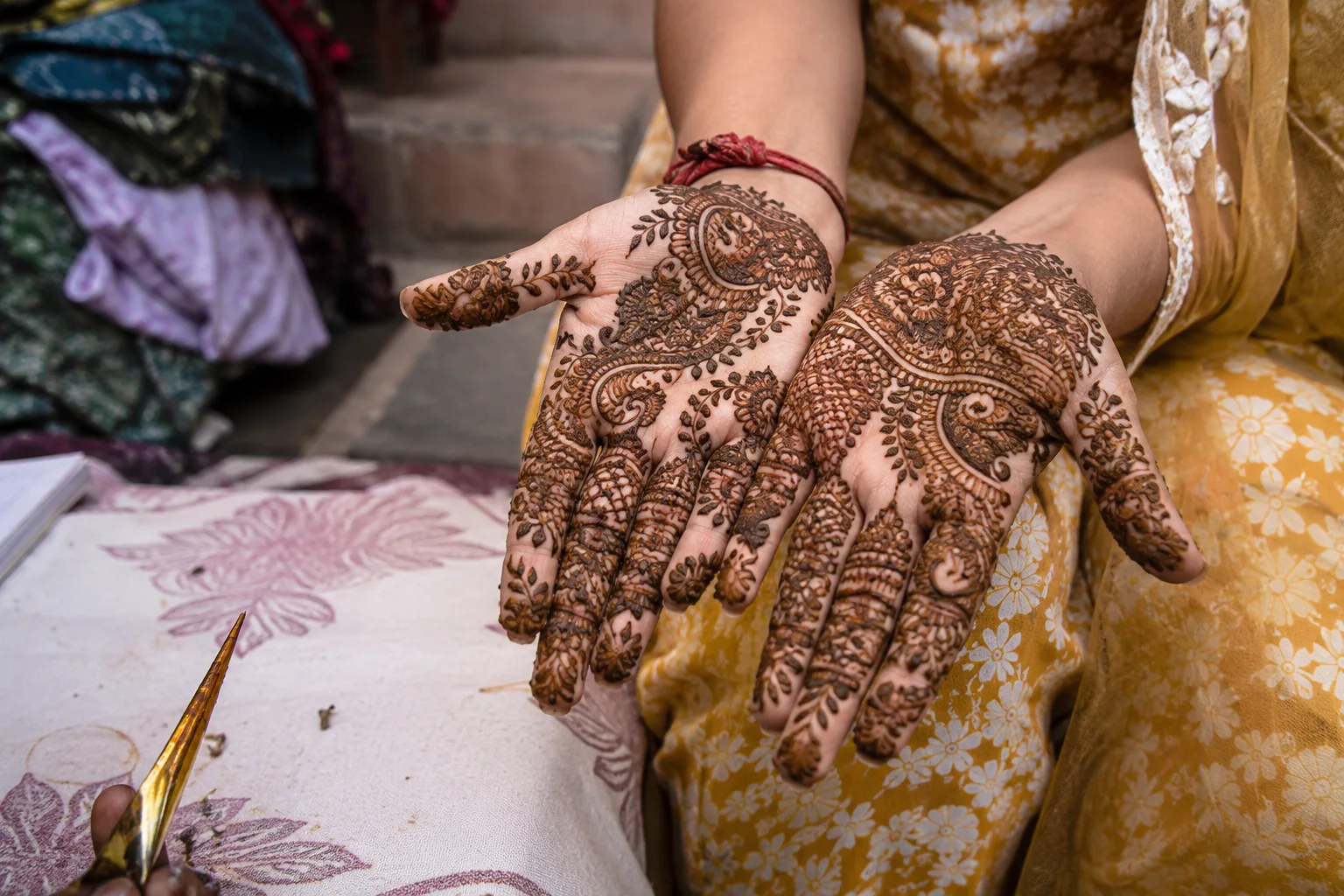 Mehndi stalls spread across the old city starting the day before Teej. The best concentration:
- Hawa Mahal Road
- Johari Bazaar
- MI Road
Basic design for both hands runs ₹100–300. Most artists are quick 20 to 30 minutes. The color deepens overnight; don’t wash with water for at least 4–5 hours after.
The Food
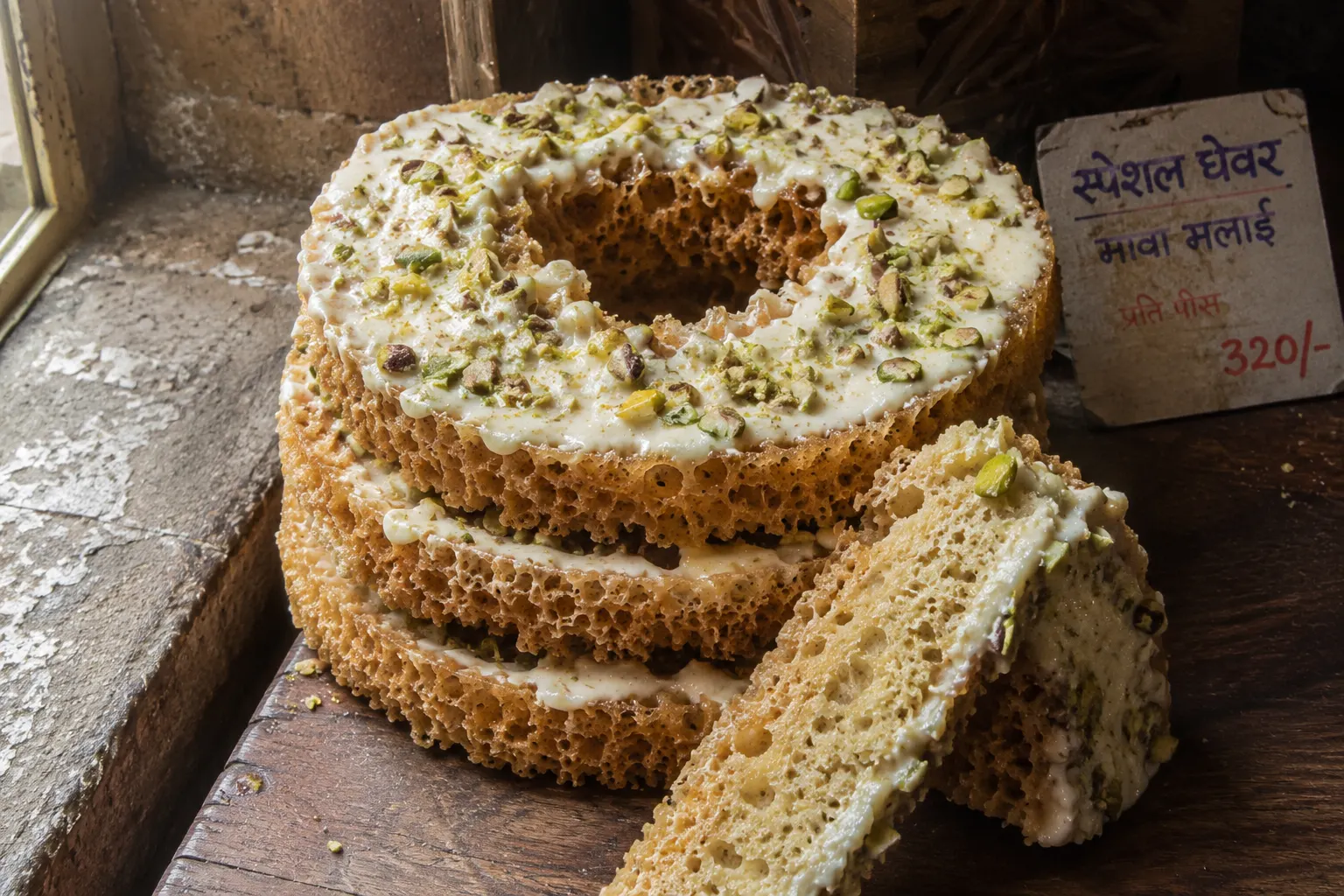 Ghevar is what you eat during Teej. It’s a disc-shaped Rajasthani sweet fried flour lattice soaked in sugar syrup, often topped with rabdi (reduced cream) or dry fruits. Shops start making it 2–3 weeks before the festival. Some sell out.
Good places in Jaipur:
- LMB (Laxmi Mishthan Bhandar), Johari Bazaar the most established
- Rawat Mishthan Bhandar, Station Road
- Ganesh Mishthan Bhandar, near Sanganeri Gate
For women observing the fast, ghevar is often the first food they eat after breaking it. If you’re not fasting, eat it anyway. It doesn’t exist anywhere else like this.
Getting There
Train: Jaipur Junction has direct trains from Delhi (4.5–5 hours), Mumbai (~18 hours), and most major cities. Book 4–6 weeks out trains fill up fast around Independence Day weekend.
Bus: Rajasthan Roadways runs frequent services from Delhi and Agra. Volvo buses from Delhi take 5–6 hours.
Flight: Jaipur Airport has direct connections from Delhi, Mumbai, Bengaluru, and Hyderabad.
Arrive by August 14. Hotels fill up, and the pre-festival evening markets and mehndi activity on the 14th are part of the experience.
Where to Stay
Old city hotels put you in walking distance of the procession route. They’re also louder and 30–50% more expensive around Teej.
Old city (walking distance):
- Hotel Pearl Palace – reliable budget pick, well-managed
- Dera Mandawa – mid-range, rooftop
Outside the old city (quieter, easier transport):
- C-Scheme and Bani Park both have guesthouses in the ₹1,500–4,000 range
Book in early July. Later than that, you get what’s left.
A Few Practical Things
Photography: The procession is public photograph freely. For individual portraits of women at close range, ask first. Most are happy to be photographed; some aren’t.
Weather: August in Jaipur is 35–38°C with humidity and intermittent heavy rain. Pack a small folding umbrella. Not a nice-to-have.
Crowds in 2026: Independence Day plus Teej in the same day means this year’s crowd will be larger than usual. Keep your phone in a front pocket. The procession route is generally safe, but stay aware of your group.
Language: Hindi gets you through everything in Jaipur. English works in most hotels and tourist-facing businesses.
What the Festival Guides Don’t Tell You
The procession is the part you can show up and watch. It’s worth seeing. But it’s not the actual festival.
The real Teej is in the neighborhoods women gathering in courtyards, swings hung from mango trees, folk songs passed down without being written anywhere. If you have any local connection in Jaipur, ask if you can join a family on this day. That’s where it lives.
You can see the procession. The songs, the swings, the meal after the fast those require an invitation.
Quick reference – Teej 2026: Hariyali Teej August 15 · Kajari Teej August 31 · Hartalika Teej September 14

Abhay Ramola researches world festivals across primary sources, local accounts, and on-ground reporting. He founded Dionfest to cover what gets missed when festivals become tourism content the history, the ritual, and the people behind it.