About Basant Panchami
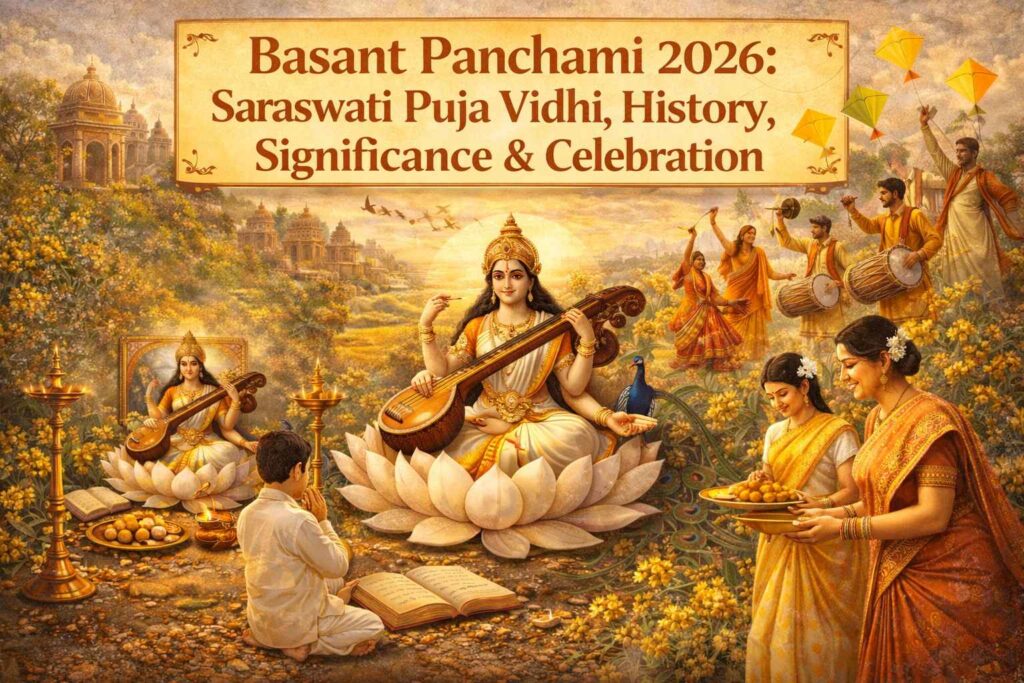
Basant Panchami — also spelled Basant Panchami or Vasant Panchami — is a Hindu spring festival that marks the seasonal transition from winter toward spring and is widely associated with the worship of Goddess Saraswati (the deity of knowledge, music, language and the arts). On this day people across India (and in parts of Nepal, Bangladesh, and among Hindus in Indonesia) wear yellow, prepare yellow foods, decorate images of Saraswati in yellow, and often hold special prayers in schools and temples; the yellow theme echoes the mustard (sarson) fields that bloom at this time.
What is Basant Panchami Festival
Basant/Vasant Panchami is observed on the fifth day (Panchami) of the bright half of the Hindu month of Magha (according to the lunar calendar), and for many communities the day is specifically celebrated as Saraswati Puja — a time when students, artists and teachers seek the goddess’s blessing for learning and creativity. Regional traditions vary: in eastern India (West Bengal, Assam, Bihar) large Saraswati pujas are held in schools and homes; in Punjab and parts of north India it’s also celebrated as a kite-flying and seasonal fair (Basant) with people donning yellow turbans and clothes. Rituals typically include dressing the deity’s idol in yellow, offering yellow foods (like saffron rice or kheer), beginning new study for children, and cultural programmes.
Why it is called Vasant Panchami
The name comes from Sanskrit: “Vasant/Vasant” (Basanta) means “spring” and “Panchami” means “the fifth (day)”, so the festival’s name literally signals “the fifth day of spring” as reckoned on the lunar calendar (the bright fortnight of Magha). The association with the colour yellow and spring blooms (notably mustard) reinforces the name and the seasonal meaning — the whole festival celebrates the arrival of spring (Vasant) as well as honoring Saraswati, hence the dual identity as both a seasonal festival (Basant) and a religious observance (Vasant/Saraswati Puja).
Basant Panchami History
The history of Basant Panchami is deeply rooted in ancient Indian religious, cultural, and agricultural traditions. References to the festival appear in early Hindu scriptures and Puranic literature, where it is described as a sacred day marking the awakening of nature and the beginning of the spring season. Historically, Basant Panchami was observed as an auspicious time to start new activities related to learning, farming, music, and art. In ancient gurukuls, this day symbolized the formal beginning of education for young children, reinforcing its long-standing connection with knowledge and wisdom. Over centuries, kings, scholars, and poets patronized Basant Panchami celebrations, especially in regions like North India and Bengal, helping the festival evolve into both a seasonal and spiritual observance.
Mythological History
The mythological history of Basant Panchami is closely linked to Hindu creation stories. According to one popular legend, when Lord Brahma created the universe, it lacked harmony and sound. To restore balance, he created Goddess Saraswati, who brought wisdom, speech, music, and learning into the world. It is believed that Saraswati appeared on the fifth day of Magha Shukla Panchami, which is why this day became sacred in her honor. Other myths associate Basant Panchami with Lord Krishna, who wore yellow garments on this day and inspired devotees to adopt the color as a symbol of joy, prosperity, and the vibrancy of spring.
Connection with Saraswati Puja
The connection between Basant Panchami and Saraswati Puja is central to the festival’s identity. On this day, devotees worship Goddess Saraswati as the embodiment of knowledge, intellect, creativity, and enlightenment. Schools, colleges, and cultural institutions organize Saraswati Puja ceremonies, where books, musical instruments, and tools of learning are placed before the deity for blessings. Children are often introduced to writing their first letters, a ritual known as Vidyarambh or Akshar Abhyas, highlighting the festival’s educational significance. This strong association has made Basant Panchami one of the most important days for students, teachers, artists, and scholars, blending spiritual devotion with the pursuit of learning.
Basant Panchami Significance
The significance of Basant Panchami lies in its unique blend of cultural, spiritual, and seasonal meaning. Celebrated at the threshold of spring, the festival symbolizes renewal, positivity, and the awakening of nature after winter. Basant Panchami is traditionally considered an auspicious day to begin new ventures, especially those related to education, creativity, and spiritual growth. The festival honors Goddess Saraswati, making it a powerful reminder of the importance of knowledge, wisdom, and discipline in human life. The dominance of the color yellow reflects energy, prosperity, and the blooming mustard fields that mark the arrival of spring.
Importance for Students
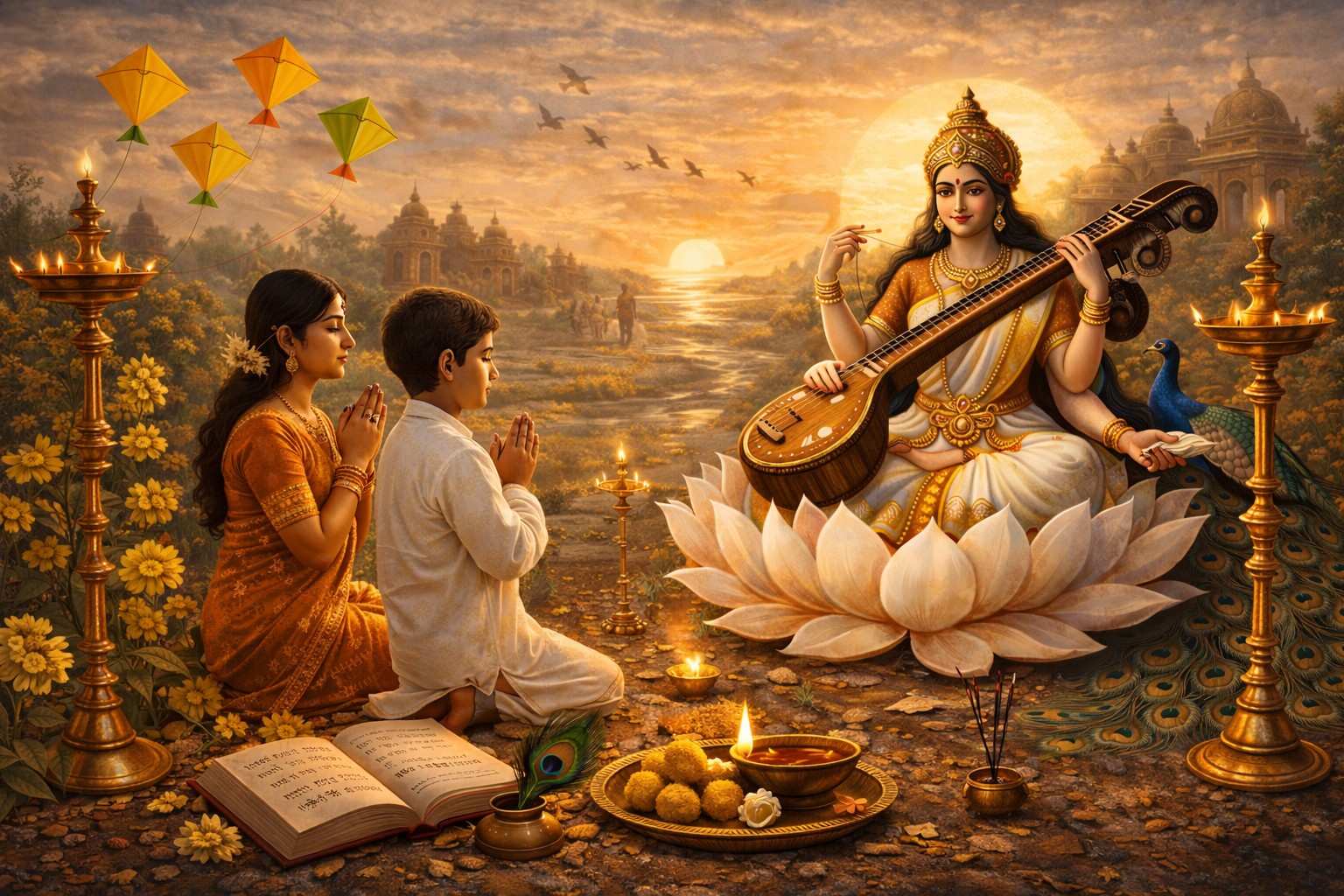
Basant Panchami holds exceptional importance for students, teachers, and scholars. Since the day is dedicated to Goddess Saraswati, it is believed that prayers offered on Basant Panchami enhance learning ability, concentration, memory, and creativity. Many families introduce young children to education on this day through rituals like Vidyarambh or Akshar Abhyas, where children write their first letters. Students place books, pens, and musical instruments before the goddess, seeking blessings for academic success and intellectual growth. Because of this strong educational connection, Basant Panchami is widely regarded as the most favorable day to start studies, art, music, and other intellectual pursuits.
Spiritual and Seasonal Importance
The spiritual importance of Basant Panchami lies in its emphasis on inner purification, clarity of thought, and devotion to knowledge. Worshipping Goddess Saraswati on this day is believed to remove ignorance and bring enlightenment and wisdom. Spiritually, the festival encourages self-discipline, learning, and harmony between mind and soul.
Seasonally, Basant Panchami marks the arrival of spring (Vasant Ritu), a time when nature begins to flourish. Farmers see it as a sign of good harvests, while communities celebrate the end of harsh winter days. The joyful atmosphere, yellow attire, and cultural activities together highlight the deep connection between human life, nature, and spirituality that defines the true essence of Basant Panchami.
Saraswati Puja on Basant Panchami
Saraswati Puja on Basant Panchami is one of the most important and widely observed aspects of the festival. Basant Panchami is traditionally regarded as the day when Goddess Saraswati manifested to bless the world with wisdom, speech, music, and learning. On this auspicious day, devotees perform Saraswati Puja with great devotion, especially in schools, colleges, homes, and cultural institutions. The rituals symbolize respect for knowledge and the conscious effort to remove ignorance. The serene atmosphere, dominated by yellow color, reflects clarity of thought, optimism, and intellectual awakening, which aligns perfectly with the spiritual essence of Basant Panchami.
Saraswati Puja Basant Panchami
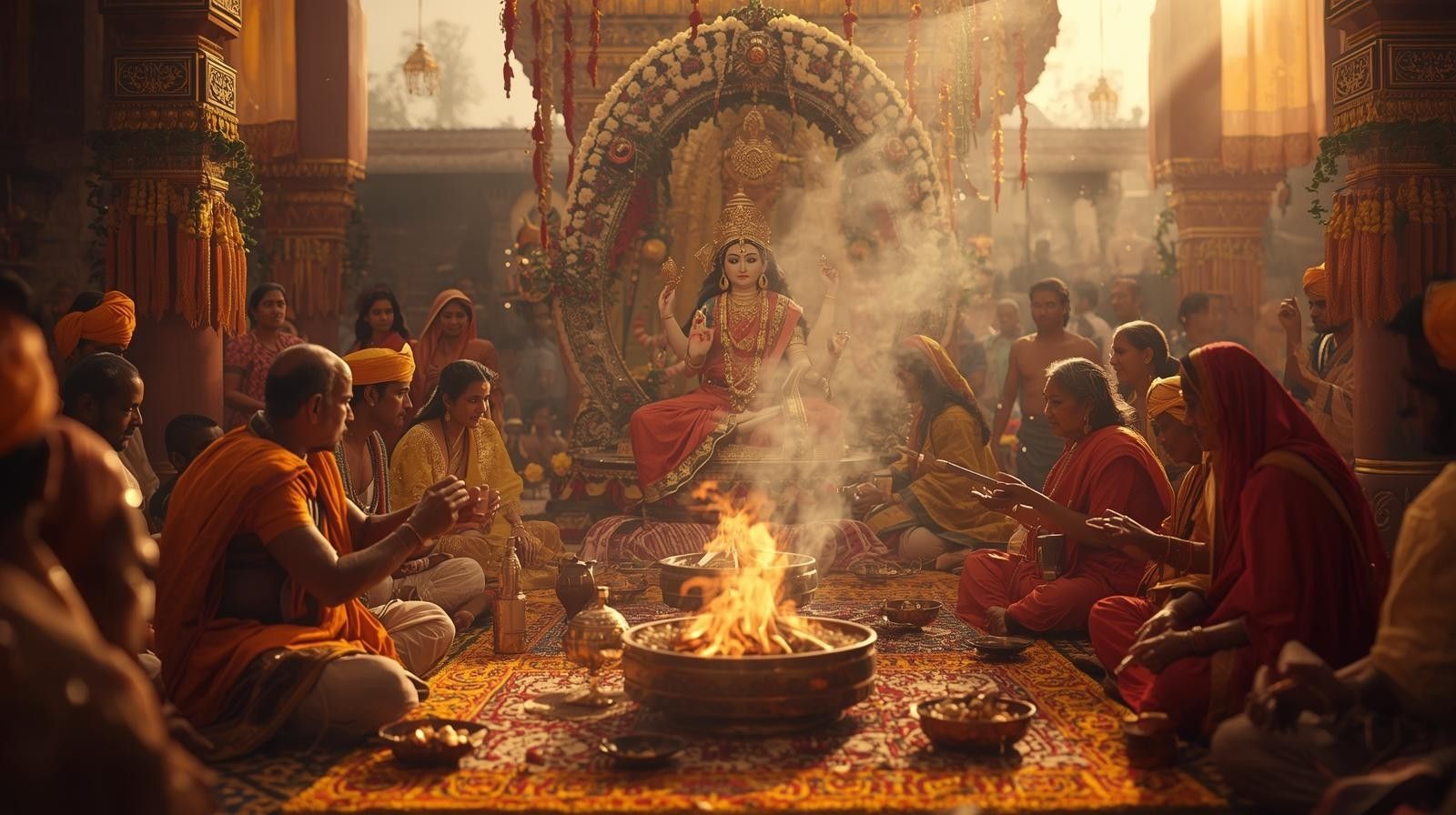
The celebration of Saraswati Puja on Basant Panchami is deeply rooted in Indian tradition. Early in the morning, idols or images of Goddess Saraswati are placed on decorated altars, often draped in white and yellow garments. Books, notebooks, pens, musical instruments, and art tools are arranged before the goddess, symbolizing dedication to learning and creativity. Devotees observe prayers, chant Saraswati mantras, and seek blessings for academic success and artistic excellence. In many regions, students avoid reading or writing on this day until the puja is completed, showing reverence to the goddess who represents pure knowledge and wisdom.
Why Saraswati Puja is Done
Saraswati Puja is done to seek divine blessings for knowledge, intelligence, creativity, and enlightenment. Worshipping Goddess Saraswati on Basant Panchami is believed to improve concentration, sharpen intellect, and guide individuals toward righteous learning. Spiritually, the puja signifies the victory of wisdom over ignorance and light over darkness. For students, artists, teachers, and scholars, Saraswati Puja serves as a reminder that true success comes from humility, discipline, and continuous learning. This is why Basant Panchami is considered the most sacred day to honor Saraswati and begin educational or creative journeys.
Basant Panchami Pooja Vidhi
Basant Panchami Pooja Vidhi refers to the traditional method of performing Saraswati Puja on the auspicious day of Basant Panchami. The pooja is usually performed in the morning during Brahma Muhurat or an auspicious time. Devotees begin by cleaning the house and the pooja area, as purity is considered essential for worship. An idol or picture of Goddess Saraswati is placed on a raised platform covered with a yellow or white cloth, symbolizing wisdom and peace.
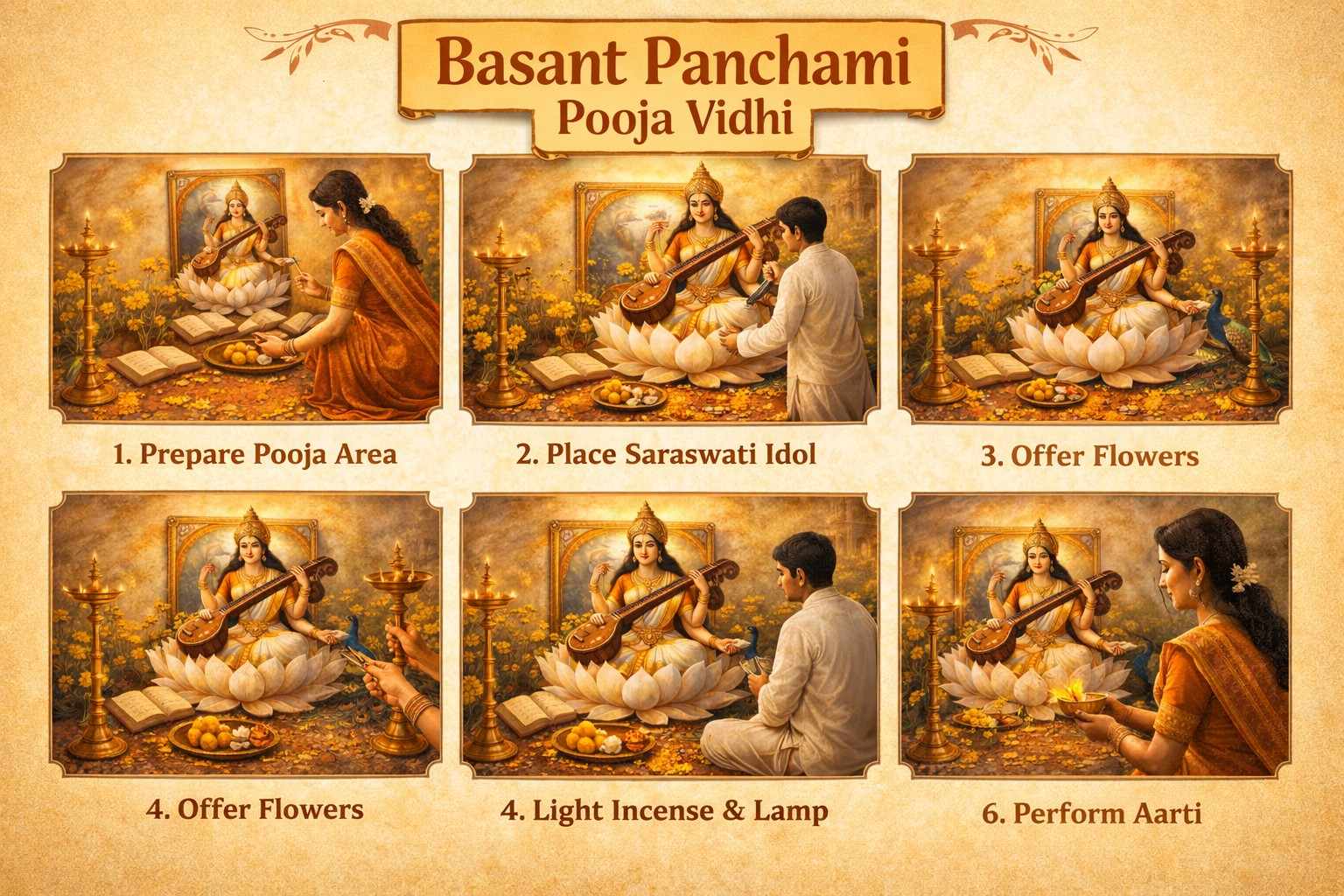
The worshipper takes a vow (sankalp), lights a diya, and invokes Goddess Saraswati through mantras. Yellow flowers, fruits, and sweets are offered, followed by chanting Saraswati Vandana and other sacred hymns. The pooja concludes with aarti and distribution of prasad, seeking blessings for knowledge, intelligence, and success in learning.
Step-by-Step Pooja Method
The step-by-step pooja method for Basant Panchami is simple yet spiritually meaningful. First, devotees take a bath and wear clean, preferably yellow, clothes. The pooja place is purified with gangajal. After placing the idol or image of Goddess Saraswati, devotees offer flowers, akshat (rice), turmeric, and sandalwood paste.
Books, notebooks, pens, musical instruments, and art tools are placed near the deity to receive blessings. Saraswati mantras are recited, and incense sticks are lit to create a calm and focused atmosphere. Many people avoid studying or writing until the pooja is complete, showing respect for the goddess. The ritual ends with aarti and prayer for wisdom, creativity, and clarity of thought.
Basant Panchami Puja Samagri
The Basant Panchami Puja Samagri includes all items required to perform Saraswati Puja properly. Common samagri items are an idol or picture of Goddess Saraswati, yellow cloth, yellow flowers, fruits, sweets (especially boondi or kesari halwa), rice grains, turmeric, sandalwood paste, incense sticks, diya, cotton wicks, and camphor.
Additionally, books, pens, musical instruments, and study materials are essential components of the puja samagri, as they represent learning and creativity. Using yellow-colored items is considered highly auspicious, as yellow symbolizes knowledge, energy, and the arrival of spring, making the Basant Panchami pooja spiritually complete and meaningful.
Basant Panchami Celebration in India
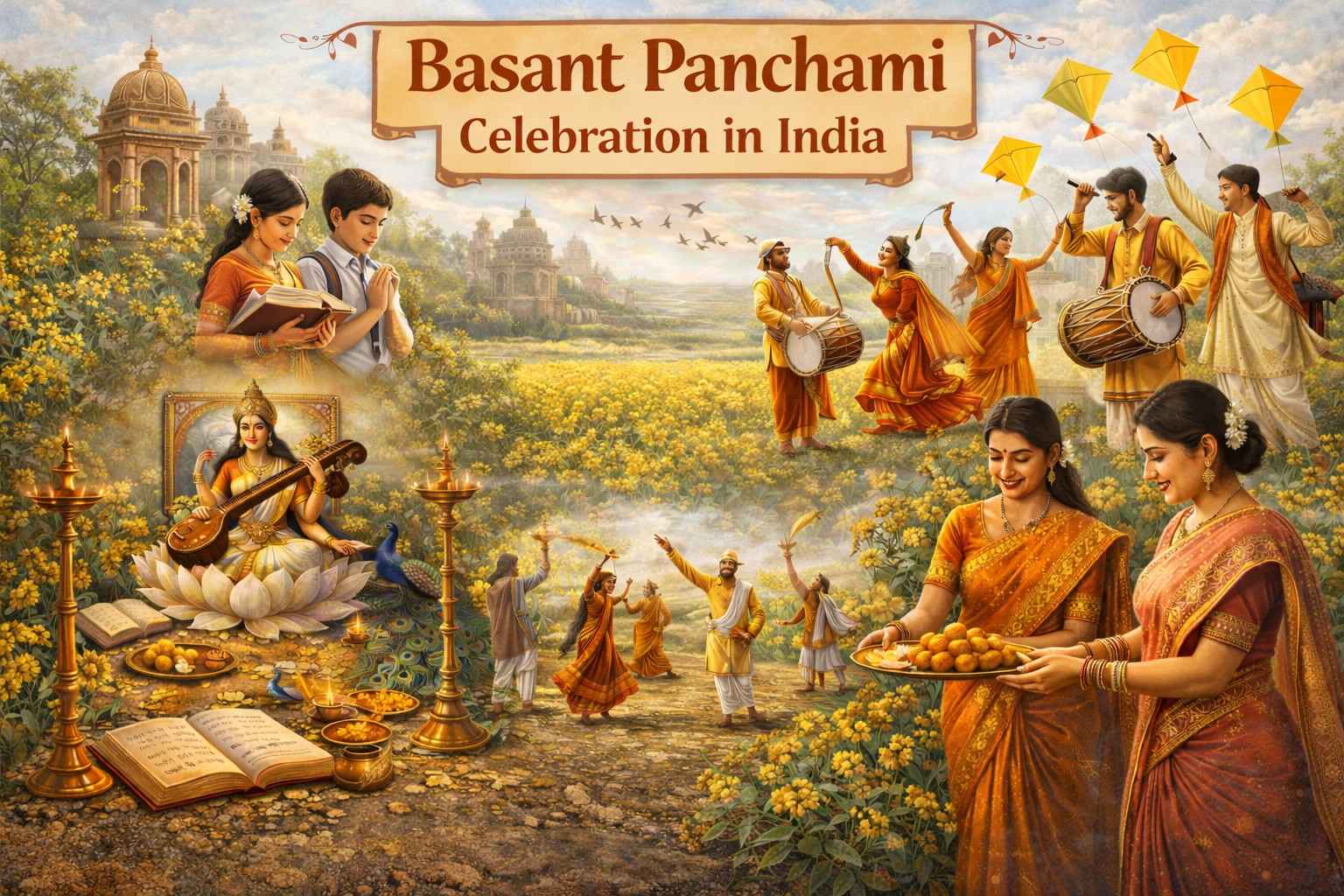
Basant Panchami (also called Vasant Panchami) is celebrated across India with regional flavors that nevertheless share common motifs: worship of Goddess Saraswati, wearing yellow, offering yellow foods, and marking the coming of spring and mustard blooms. In eastern states such as West Bengal and Assam it is primarily observed as Saraswati Puja in schools and homes; in Punjab and parts of North India the day is also a seasonal Basant festival of kite-flying and outdoor fairs; in Maharashtra, Uttar Pradesh and other regions people combine local agricultural rituals with prayers for learning and prosperity.
How Basant Panchami is celebrated
Celebrations typically begin in the morning after a ritual bath: altars or idols of Saraswati are placed on a raised, clean platform often draped with yellow or white cloth, and students place books, pens and musical instruments before the deity for blessings (the Vidyarambh or initiation of learning is commonly done on this day). Devotees offer yellow flowers, saffron-tinted sweets, turmeric and rice, chant Saraswati stotras, perform aarti, and distribute prasad. In many schools and colleges special cultural programmes (music, dance, poetry) are organised to honour Saraswati and encourage creative learning. In Punjab and some northwestern areas families and communities fly kites, wear bright yellow turbans or garments, and celebrate outdoors to welcome spring.
Vasant Panchami Festival traditions
Traditional motifs of the Vasant Panchami festival include the colour yellow (symbolic of mustard fields and solar energy), the Saraswati Puja ritual, and beginnings — especially educational beginnings like Aksharābhyās/Vidyarambh where children are taught their first letters. Regional customs add variety: mass Saraswati pujas and school cultural competitions in Bengal; kite festivals, fairs and royal historical pageantry in Punjab (a long-recorded Basant kite tradition); and agricultural offerings or folk songs in many rural areas celebrating a hopeful sowing/harvest season. Across India these traditions connect seasonal renewal with spiritual and intellectual renewal.
Basant Panchami Laddu Gopal Dress
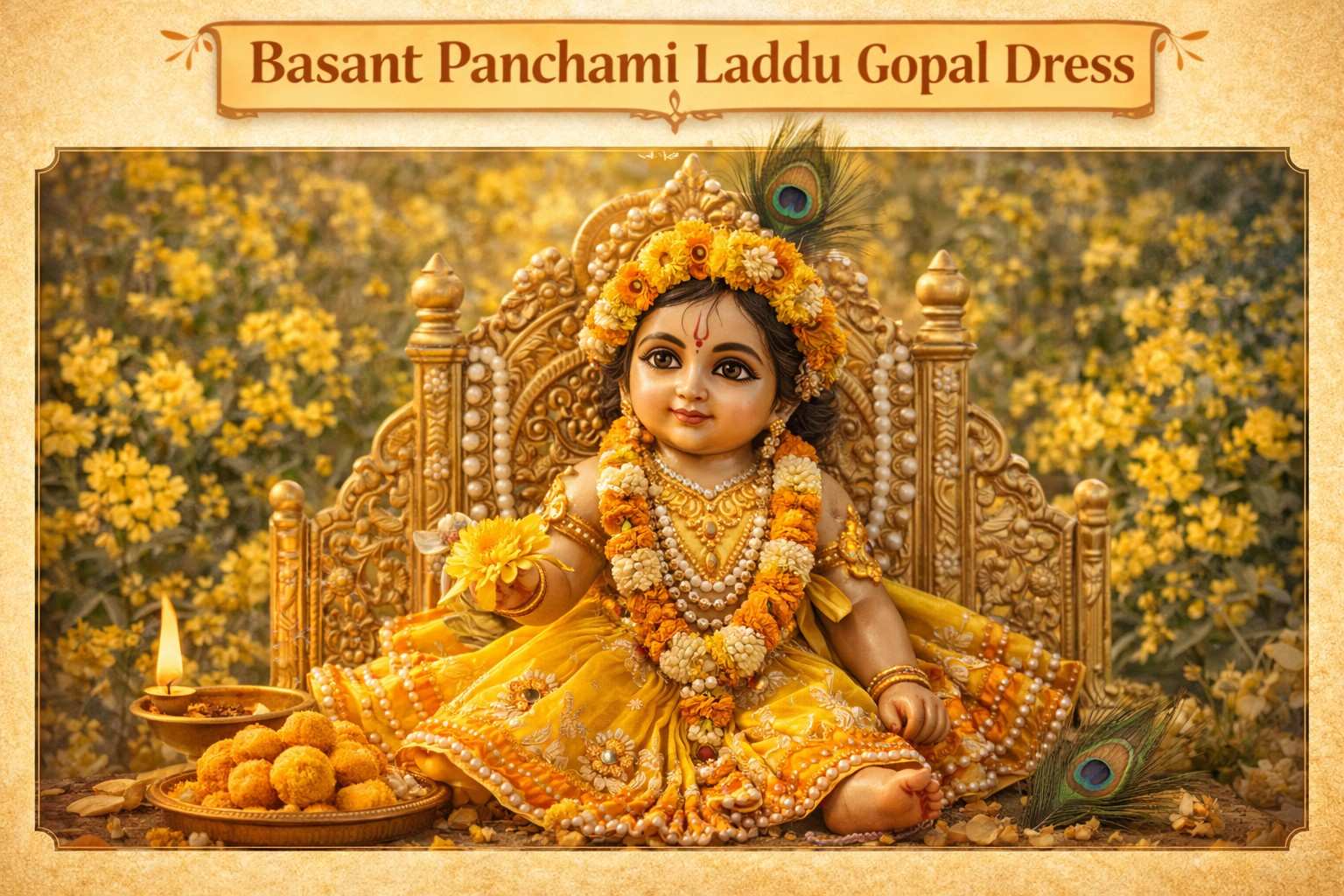
The Basant Panchami Laddu Gopal dress holds special religious and cultural significance among devotees of Laddu Gopal. On the auspicious occasion of Basant Panchami, devotees lovingly dress Laddu Gopal in bright yellow attire (poshak) to celebrate the arrival of spring and honor the festival dedicated to knowledge, positivity, and new beginnings. Dressing Laddu Gopal on this day is considered highly auspicious, as Basant Panchami is associated with prosperity, joy, and divine blessings. Homes and temples decorate Laddu Gopal with yellow clothes, flowers, and ornaments, reflecting devotion and seasonal happiness.
Why Yellow Dress Is Worn
The tradition of wearing and offering a yellow dress on Basant Panchami is deeply symbolic. Yellow represents energy, wisdom, optimism, and learning, and it is strongly linked with the blooming mustard fields during the spring season. Spiritually, yellow is considered the favorite color of Lord Krishna, making it especially meaningful to dress Laddu Gopal in yellow on this day. The color also aligns with the worship of Goddess Saraswati, whose blessings are sought for knowledge and intellect. Thus, adorning Laddu Gopal in yellow attire signifies harmony between devotion, nature, and spiritual growth.
Laddu Gopal Basant Panchami Special Dress
A Laddu Gopal Basant Panchami special dress is usually designed with bright yellow fabric, sometimes embellished with golden borders, floral patterns, or light embroidery to reflect festivity and elegance. Devotees may also add yellow accessories such as turbans, crowns, malas, or flower garlands to enhance the divine appearance. Some households choose themed spring poshaks inspired by flowers or mustard hues, making the celebration more vibrant. Offering a special Basant Panchami dress to Laddu Gopal is believed to bring happiness, prosperity, and blessings into the home, making the ritual an expression of love, devotion, and seasonal joy.
Basant Panchami 2026 Date & Muhurat

In 2026, Basant Panchami, also known as Vasant Panchami, will be celebrated on Friday, 23 January 2026 according to the Hindu lunar calendar (Shukla Paksha of Magha Month), when the Panchami tithi prevails.
Basant Panchami Date and Time
- Date: Friday, 23 January 2026 — this is the traditional date when Hindus observe Basant Panchami and perform Saraswati Puja in homes, schools and temples.
- Panchami Tithi Begins: Early 02:28 AM on 23 January 2026 and lasts until about 01:46 AM on 24 January 2026 (next day).
- During this period, devotees plan the Basant Panchami pooja and associated rituals.
Auspicious Timings
- The auspicious muhurat for Saraswati Puja on Basant Panchami typically falls in the morning period, when the Panchami tithi is strong and considered most favorable for worship and vidyarambh (beginning of learning).
- Commonly cited muhurat times for performing the Basant Panchami pooja range from around 07:13 AM to 12:33 PM / 12:50 PM depending on local panchang and sunrise.
- This auspicious window is recommended for chanting mantras, offering prayers to Goddess Saraswati, and starting educational activities, as it aligns with the morning hours of positivity and spiritual receptivity.
On this day of Basant Panchami 2026, devotees wear yellow, perform Saraswati Puja with books and instruments placed before the deity, and observe the auspicious timings to seek knowledge and blessings as the season of spring begins.