Baisakhi: History, Significance & Celebrations
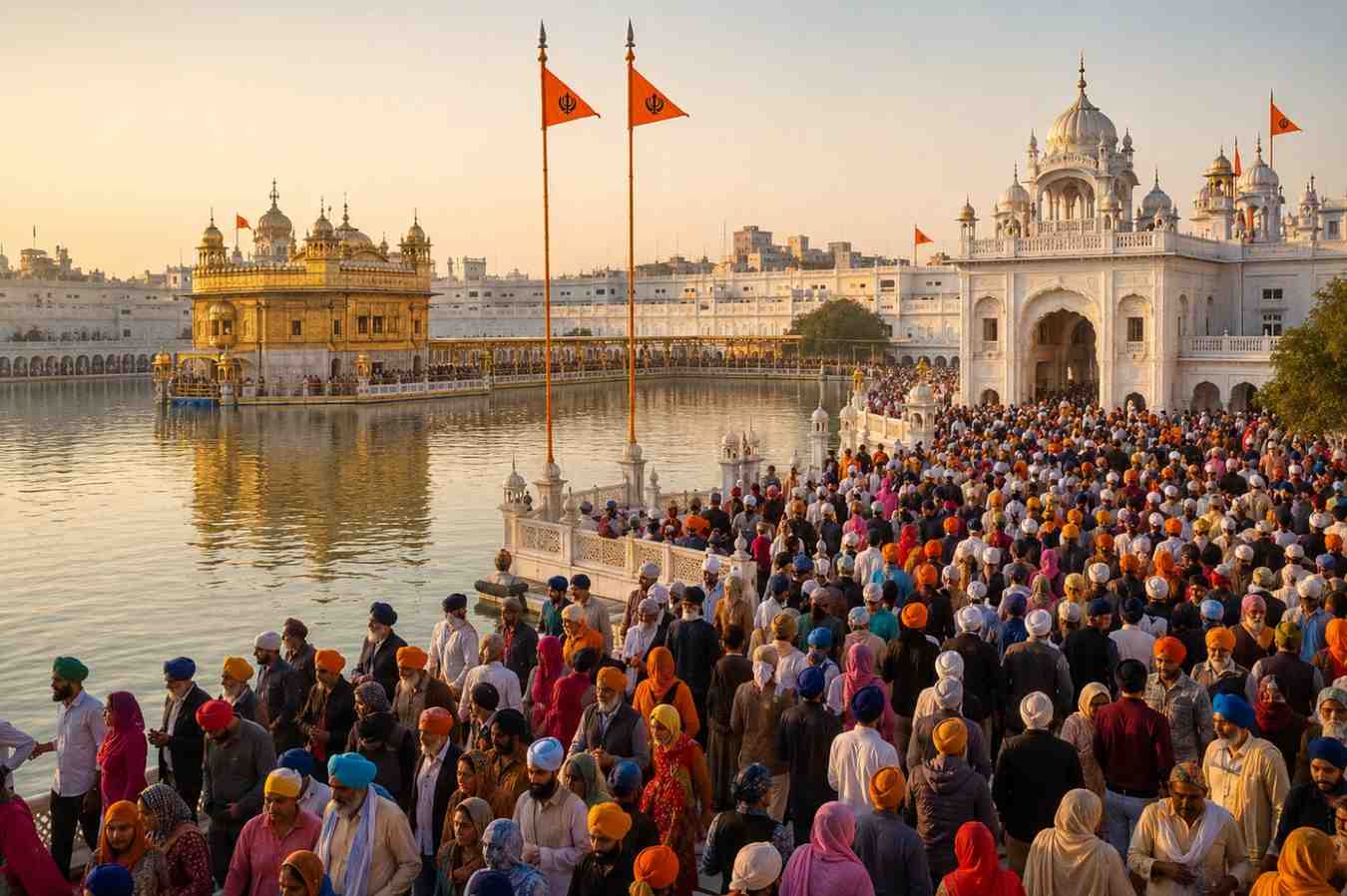
Every April 13, something shifts in Punjab. Farmers who have spent months watching their wheat crop grow are finally cutting it. Nihangs in blue robes march through the streets. Bhangra drums start early in the morning and somehow still sound fresh by evening. If you grew up in a Punjabi household anywhere in the world, Baisakhi does not need an explanation. But if you are coming to it fresh — wondering why it is celebrated, what it actually means, and what all the fuss is about — this is where to start.
What Is Baisakhi?
Baisakhi (also spelled Vaisakhi) falls on the first day of the Vaisakh month in the Punjabi calendar, which almost always lands on April 13 — occasionally April 14. It is one of the oldest harvest festivals in northern India, and also one of the most historically significant days in Sikhism.
The two things are not contradictory. Baisakhi was already a harvest celebration long before 1699. The Mughal calendar used it as the solar new year. But on Baisakhi of 1699, Guru Gobind Singh gave it an entirely new layer of meaning — one that Sikhs all over the world still mark with processions, prayers, and the kind of collective memory that does not fade across generations.
India celebrates its calendar differently in different corners. Makar Sankranti marks a solar transition in January, mostly in central and western India. Baisakhi does the same for the north in April — same astronomical logic, different geography, different culture built around it.
Why Is Baisakhi Celebrated?
There are two distinct answers to this question, and both are correct depending on who you ask.
The Agricultural Reason
Punjab’s wheat crop — one of the most important in South Asia — is ready for harvest in April. Baisakhi marks the moment farmers can finally cut what they spent the winter growing. This is not symbolic. In agrarian Punjab, this was survival. The community gathered, the harvest came in, and the celebration was an expression of relief as much as joy.
This harvest dimension connects Baisakhi to other spring celebrations across India, like Holi, which also marks the end of winter and arrival of spring across the northern states.
The Sikh Religious Reason
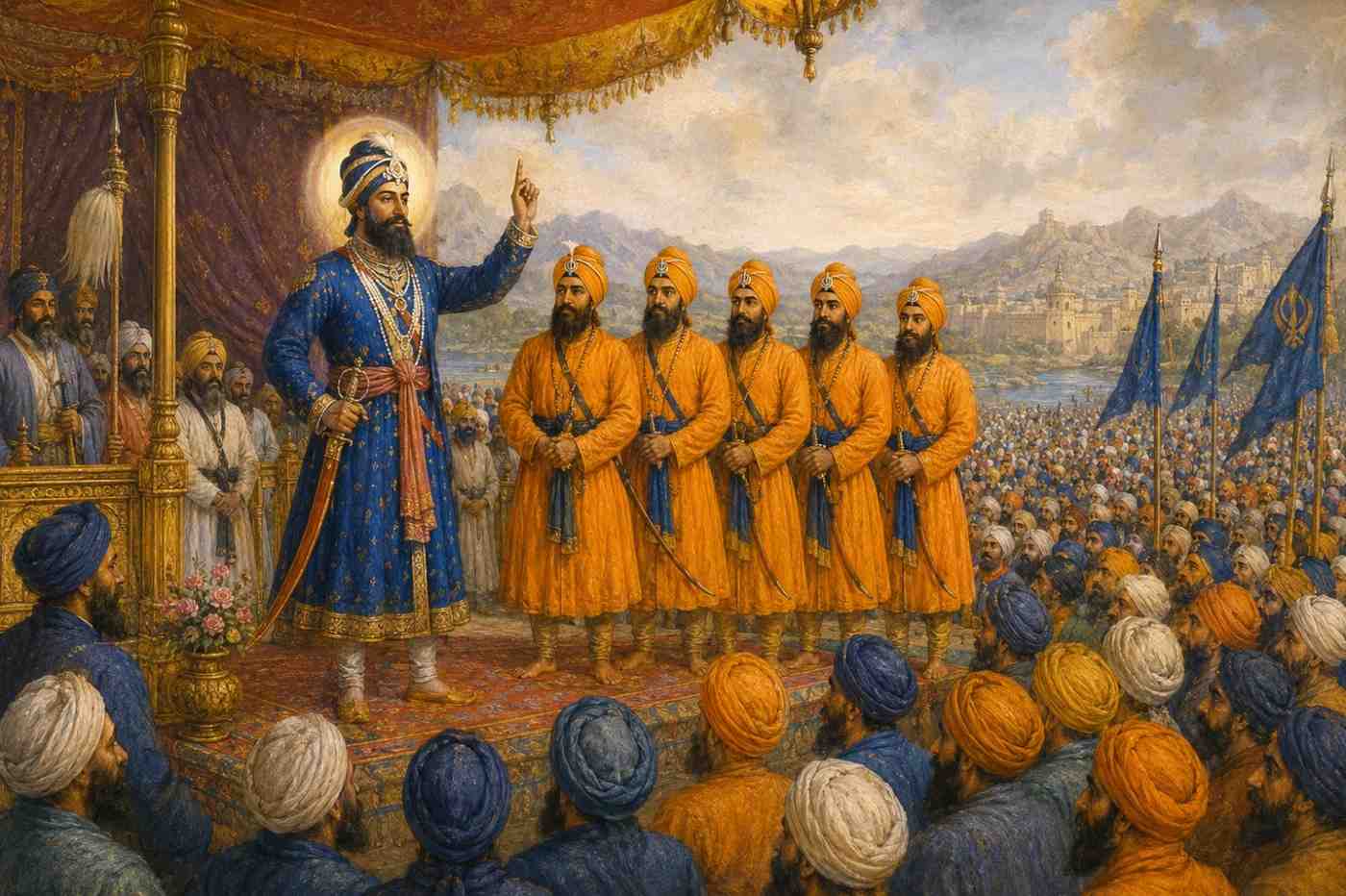 On Baisakhi of 1699, Guru Gobind Singh — the tenth Sikh Guru — established the Khalsa Panth at Anandpur Sahib. He called Sikhs from across the region to gather. Then he came out of his tent with a sword and asked for someone willing to give their life for the faith. The crowd went silent. He asked again. A man stepped forward. The Guru took him inside the tent, came back with a bloodied sword, and asked again. Four more men came forward.
Those five men — now called the Panj Pyare, or the Five Beloved — were not killed. The Guru had been testing the willingness to sacrifice. He baptized them with amrit (sweetened water stirred with a double-edged sword), gave them the names ending in Singh (for men) and Kaur (for women), and founded an order with a clear code of conduct.
This is why Baisakhi is the birthday of the Khalsa. Not just a harvest day. Not just a new year. A founding moment.
Short answer: Baisakhi is celebrated because it is the Punjabi harvest festival AND the day Guru Gobind Singh founded the Khalsa in 1699. For Sikhs, the second reason is primary. For the broader region, both matter.
Baisakhi Festival Is Celebrated in Which State?
The short answer: Punjab. The states of Punjab and Haryana see the most intense Baisakhi celebrations in India. Himachal Pradesh also has significant observances. Amritsar — home to the Golden Temple — is probably the single most important place to experience Baisakhi.
But the same solar new year is marked across multiple Indian states under different names:
| Region | Festival Name | Primary Theme |
|---|---|---|
| Punjab & Haryana | Baisakhi / Vaisakhi | Harvest + Khalsa founding |
| West Bengal | Naba Barsha | Bengali New Year |
| Assam | Bohag Bihu / Rongali Bihu | New Year + spring harvest |
| Tamil Nadu | Puthandu | Tamil New Year |
| Kerala | Vishu | New Year |
The same solar transition also runs across Southeast Asia on roughly April 13–14. Thailand has Songkran. Sri Lanka has Sinhala New Year. Myanmar has Thingyan. Baisakhi is the Punjabi version, and by sheer weight of the Sikh diaspora globally, it is the most internationally recognized of these.
Outside India, Baisakhi is celebrated wherever there are Sikh communities — Canada (particularly British Columbia), the UK (Southall in London is famous for it), the United States, Australia, and East Africa.
The History Behind Baisakhi
Baisakhi as a harvest festival predates Sikhism. The Mughals used April 13 as the fiscal new year — tax collection was tied to it. Farmers brought in their crops, accounts were settled, and the calendar turned.
But 1699 is the year that changed everything for Sikhs. Guru Gobind Singh had watched his father, Guru Tegh Bahadur — the ninth Guru — be publicly executed in Delhi in 1675 for refusing to convert to Islam under Mughal pressure. He spent the following years building a community that could defend itself and its faith.
By 1699, he was ready to formalize that community into something with structure, identity, and law. The Khalsa that emerged from that Baisakhi was not just a religious order. It was a political statement — a people with a distinct identity and the willingness to protect it.
The founding also formalized the Five Ks (Panj Kakars) — five articles of faith that initiated Sikhs wear:
- Kesh — uncut hair
- Kangha — wooden comb
- Kara — steel bracelet
- Kachera — cotton undergarment
- Kirpan — steel sword
One darker piece of history tied to Baisakhi: on April 13, 1919, British forces under General Dyer opened fire on a crowd gathered at Jallianwala Bagh in Amritsar to celebrate Baisakhi. Hundreds were killed in what became one of the worst atrocities of British colonial rule in India. The site is now a national memorial, and the massacre is remembered every Baisakhi.
Significance of Baisakhi
Baisakhi carries weight in three different directions at once, which is unusual for a festival.
For Sikhs
It is the most important date in the religious calendar after Gurpurabs (anniversaries of the Gurus). Many Sikhs choose Baisakhi to receive amrit — the Sikh baptism — joining the Khalsa formally. At the Golden Temple in Amritsar, the Nishan Sahib (the triangular Sikh flag outside every gurdwara) is ceremonially replaced in a flag-changing ritual.
For Punjabi Hindus and the Broader Region
Baisakhi is the harvest festival. Farmers offer thanks. Families cook and gather. There are fairs (melas) with music, wrestling matches, folk performances, and food stalls. India has no shortage of large festival gatherings — Kumbh Mela is the largest religious gathering on earth, but the local Baisakhi melas in Punjab towns have their own scale and energy.
As a Marker of Cultural Identity
For the Punjabi diaspora, Baisakhi is one of the clearest expressions of where they come from. It travels well — bhangra and giddha translate across continents. The Khalsa Day parade in Toronto is one of the largest in North America. London’s Nagar Kirtan in Southall draws hundreds of thousands each year.
How Baisakhi Is Celebrated
At the Gurdwara
The day starts early. Amrit Sanchar — the Sikh baptism ceremony — often happens in the early morning. Kirtan (devotional music) runs throughout the day. Langar, the community meal that all gurdwaras serve free to anyone who walks in, is especially elaborate on Baisakhi. The food is good, it is free, and you sit on the floor with everyone else regardless of who you are.
Nagar Kirtan
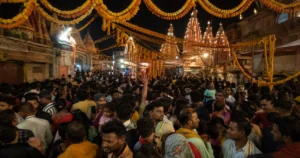
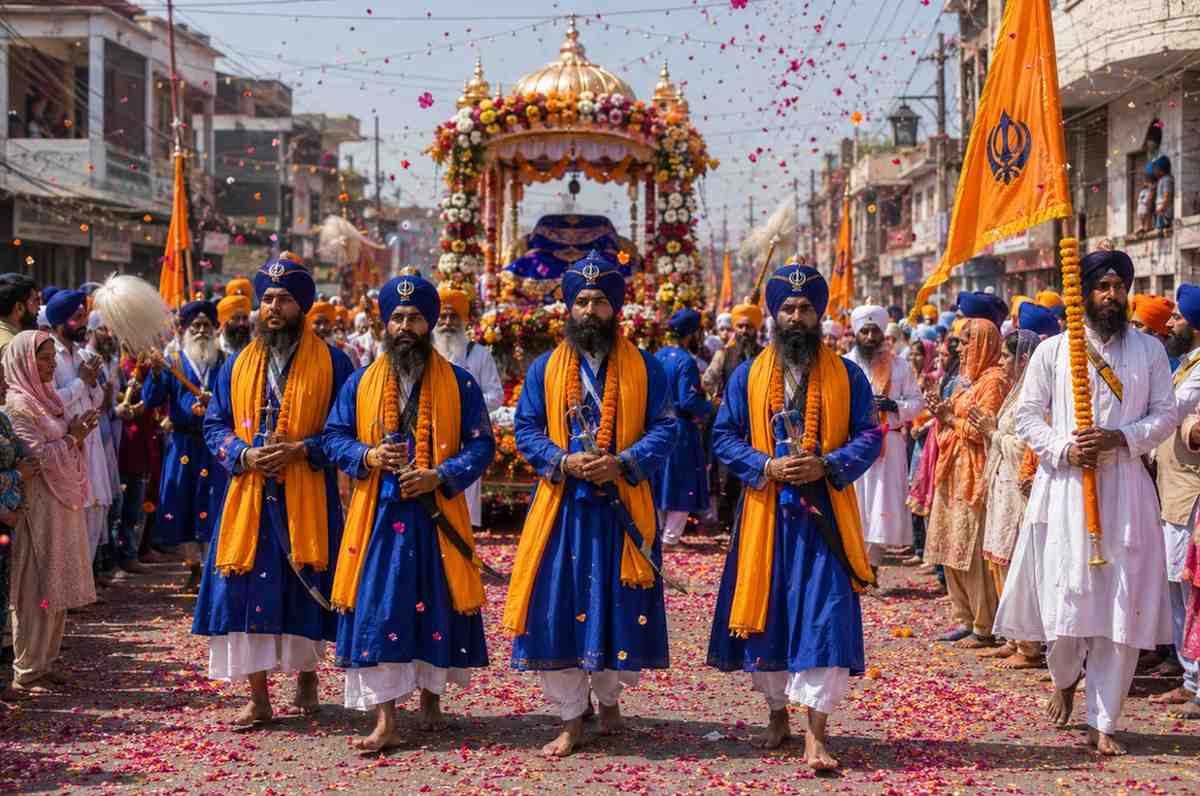 This is the street procession — Nagar means town, Kirtan means devotional singing. The Panj Pyare lead it, dressed in traditional Sikh attire and carrying the Nishan Sahib flag. Behind them, people carry the Guru Granth Sahib on a decorated float. Kirtan groups walk and sing. Gatka (the Sikh martial art) is performed along the route.
These processions happen in every city with a significant Sikh population — Amritsar, Delhi, Chandigarh, Birmingham, Vancouver, and Yuba City in California, which holds one of the largest Sikh parades outside India.
Bhangra and Giddha
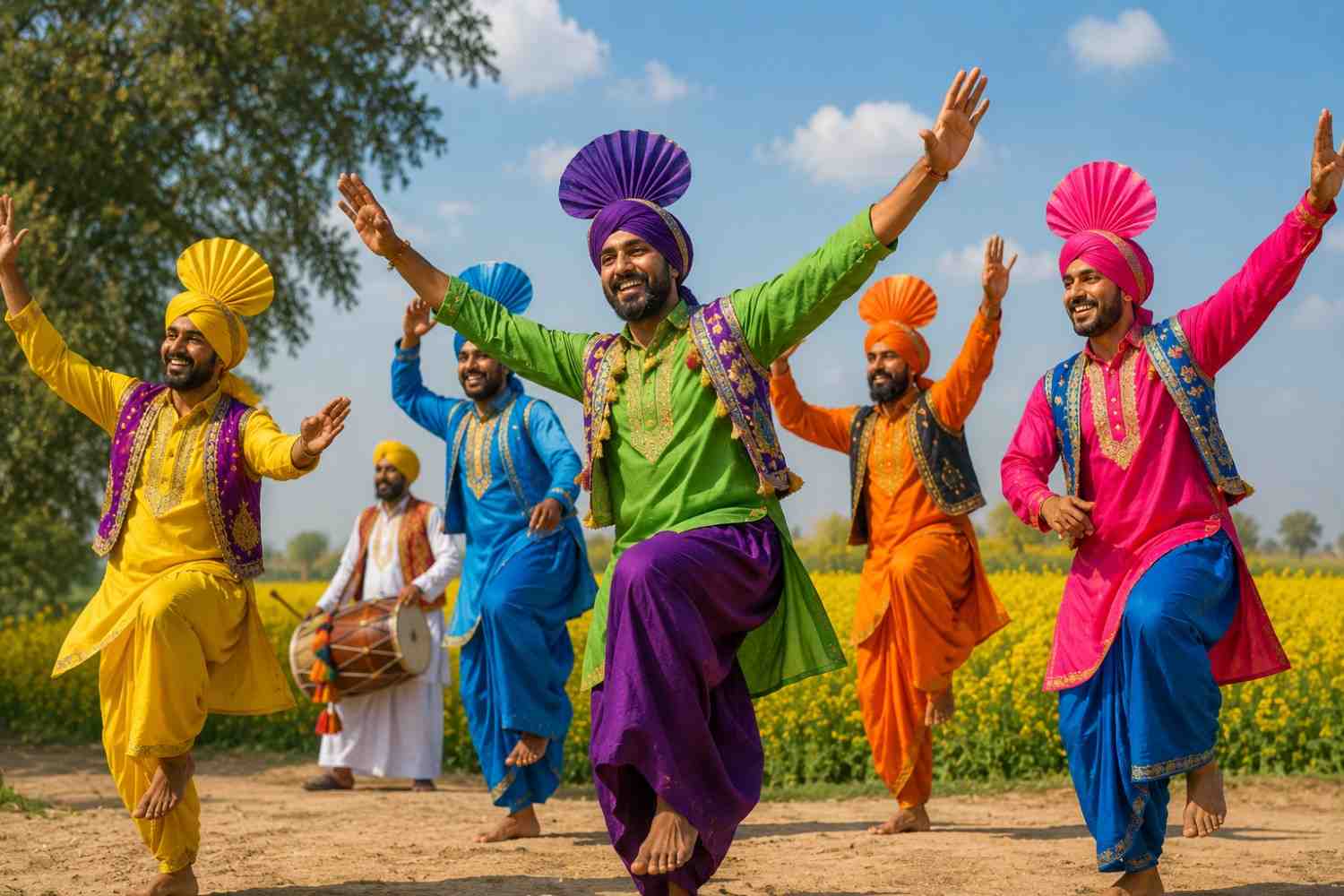 Bhangra is the men’s folk dance of Punjab — energetic, rhythmic, rooted in the harvest. Giddha is the women’s equivalent — more lyrical, often incorporating folk poetry called boliyaan. The music is dhol-driven: a large double-headed drum that sets the tempo for an entire crowd.
The Mela
Rural and semi-urban Punjab still holds traditional fairs on Baisakhi. Cattle trading, wrestling (kushti), music performances, street food. These are the kinds of public gatherings that India has organized around festival days for centuries — the same logic that runs through Navratri fairs or Diwali bazaars across the country.
Baisakhi Food & Traditions
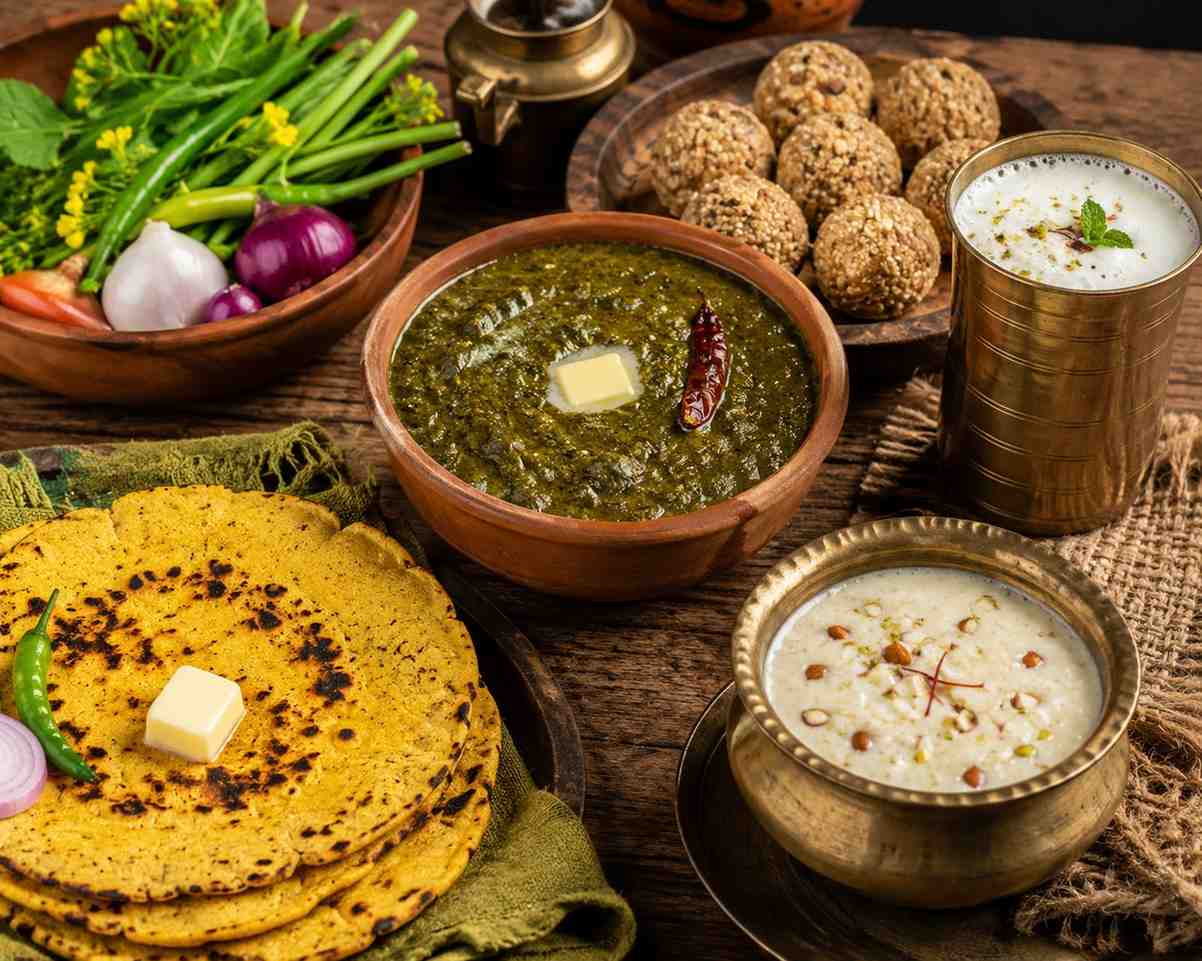 Baisakhi food is harvest food — rich, filling, and built for people who have been working the fields.
- Makki di Roti & Sarson da Saag — cornbread and mustard greens. The Punjabi winter staple. By Baisakhi the mustard fields are finishing, so this is often the last proper batch of the season.
- Kheer — rice pudding, made in large quantities and shared with neighbors and at gurdwaras.
- Kada Prasad — the wheat flour halwa distributed in gurdwaras after the ceremony. Dense, sweet, made with equal parts flour, ghee, and sugar. It is not optional.
- Lassi — yogurt-based drink, sweet or salted. Given the April heat, extremely welcome.
- Pinni and Panjiri — traditional sweets made with flour, ghee, and nuts, prepared at home and distributed to family.
The tradition of cooking in large quantities and sharing connects directly to the Sikh principle of seva (selfless service) and the langar tradition.
Lohri, celebrated about three months earlier in January, has its own food traditions — rewri, popcorn, and sesame-jaggery sweets shared around a bonfire. Lohri and Baisakhi bookend the Punjab agricultural cycle in a way that makes more sense once you understand the farming calendar.
Happy Baisakhi: Greetings & Wishes
If someone wishes you on Baisakhi, the traditional Sikh response is “Waheguru Ji Ka Khalsa, Waheguru Ji Ki Fateh” — which means “The Khalsa belongs to God, Victory belongs to God.”
In everyday Punjabi, people say “Baisakhi Diyan Vadhaiyan” (Congratulations on Baisakhi). In Hindi, “Shubh Baisakhi” works fine.
Some greetings you can use:
“May this Baisakhi bring you new beginnings and the energy to pursue them. Waheguru Ji Ka Khalsa, Waheguru Ji Ki Fateh.”
“Wishing you and your family a joyful Baisakhi. May the harvest of this year be as good as the one ahead.”
“Happy Baisakhi! May this day bring health, peace, and something worth dancing bhangra about.”
Baisakhi 2025, 2026 & 2027 Dates
| Year | Date | Day |
|---|---|---|
| 2025 | April 13, 2025 | Sunday |
| 2026 | April 14, 2026 | Tuesday |
| 2027 | April 14, 2027 | Wednesday |
Baisakhi typically falls on April 13 and shifts to April 14 roughly every 36 years due to the relationship between the solar and Gregorian calendars. It falls on April 14 in 2026 and 2027 before returning to April 13.
Frequently Asked Questions
Is Baisakhi a Hindu or Sikh festival? Both, historically. As a harvest festival it predates Sikhism and is celebrated by Punjabi Hindus as well. As the founding day of the Khalsa, it is one of the most important dates in the Sikh religious calendar. The two layers coexist.
Why does Baisakhi fall on April 13? It corresponds to the first day of Vaisakh in the Punjabi solar calendar, marking the sun’s entry into Aries (Mesh Sankranti). This lands on April 13 most years, occasionally April 14.
What is the difference between Baisakhi and Vaisakhi? Same festival. “Vaisakhi” is the Sanskritized spelling. “Baisakhi” is the common Punjabi pronunciation. Both refer to the same day.
What happened at Jallianwala Bagh on Baisakhi 1919? On April 13, 1919, thousands had gathered at Jallianwala Bagh in Amritsar to celebrate Baisakhi. British General Reginald Dyer ordered his troops to open fire on the unarmed crowd without warning. Hundreds were killed. The site is now a national memorial, and the massacre accelerated the Indian independence movement.
Is Baisakhi a national holiday in India? It is a gazetted holiday in Punjab and Haryana, not a central government national holiday. Banks and government offices in Punjab are typically closed on April 13.
What are the Five Ks of Sikhism? Kesh (uncut hair), Kangha (wooden comb), Kara (steel bracelet), Kachera (cotton undergarment), and Kirpan (steel sword). These were instituted by Guru Gobind Singh on Baisakhi 1699 as signs of a baptized Khalsa Sikh.
Baisakhi is not just a date on the calendar. For farmers it is the moment a season’s worth of work finally pays off. For Sikhs it is the day a community decided what it stood for — and backed that decision with everything it had. That combination of the practical and the profound is what keeps Baisakhi alive not just in Punjab but in gurdwaras and community halls across every continent where Punjabis have settled. Whether you celebrate it with kada prasad at the gurdwara, bhangra at a mela, or just a tall glass of lassi on a warm April morning — the spirit of the day is the same. New year. New harvest. Same roots.

Abhay Ramola researches world festivals across primary sources, local accounts, and on-ground reporting. He founded Dionfest to cover what gets missed when festivals become tourism content the history, the ritual, and the people behind it.