
Van Mahotsav 2026: India’s 76-Year-Old Tree Festival
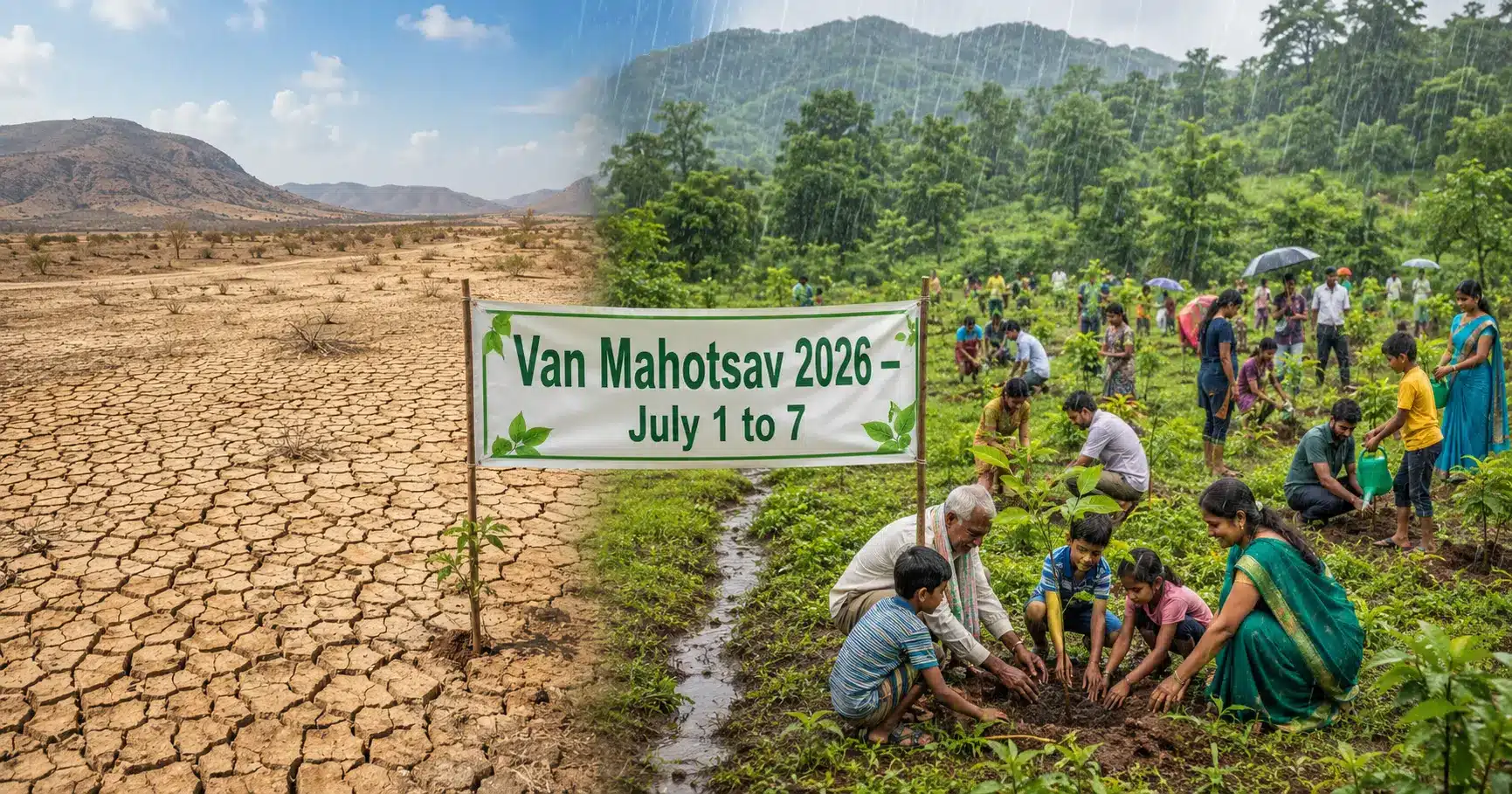
Every July, India runs one of the world’s oldest government-backed tree-planting campaigns. It’s called Van Mahotsav, and it has been running since 1950. Millions of trees go into the ground each year during this week. Yet most people know almost nothing about it beyond the name.
This article covers Van Mahotsav 2026 in full its history, purpose, how it’s celebrated, what students should know for essays and drawings, and why the event still matters today.
What Is Van Mahotsav?
Van Mahotsav is an annual tree-planting festival held during the first week of July every year in India. The name comes from Sanskrit “Van” means forest, and “Mahotsav” means festival or celebration. Together, it translates roughly to “Festival of Trees.”
It is not a single-day event. It runs for a full seven days and involves schools, government departments, forest departments, NGOs, and ordinary citizens. The goal is simple: plant as many trees as possible and raise awareness about why forests matter.
The event takes place during the early monsoon season on purpose. July is when rainfall begins across most of India, which gives newly planted saplings their best chance of surviving.
Who Started Van Mahotsav and When?
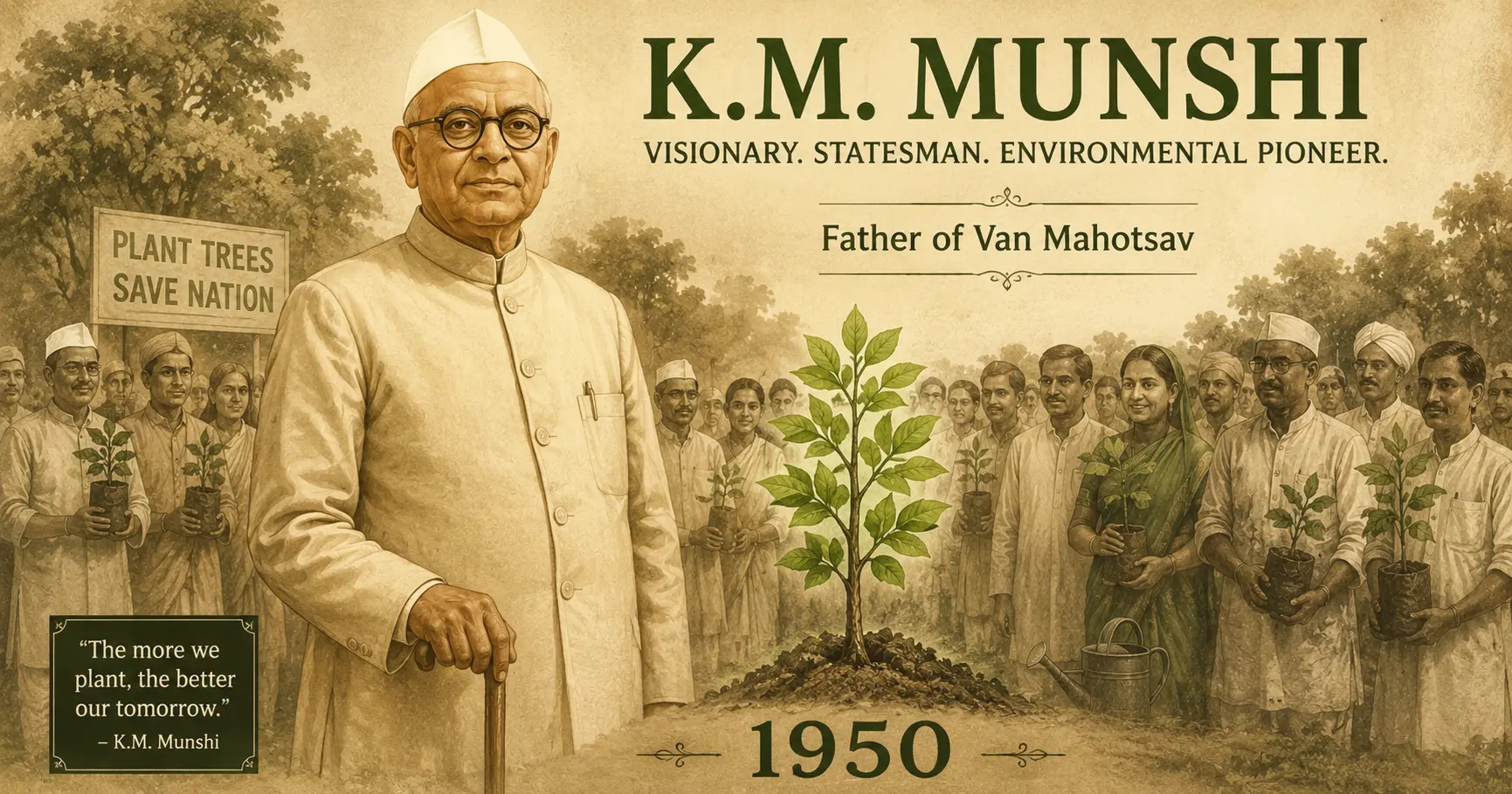 Van Mahotsav was started by K.M. Munshi in 1950. Munshi was India’s first Union Minister of Agriculture and Food. He launched the campaign because India was losing forests rapidly after independence, and the country needed a mass movement — not just government policy to fix the problem.
Munshi believed that trees were not just an environmental resource but a cultural and emotional one. He called trees “life-givers” and pushed for the idea that planting a tree should feel like a celebration, not a chore.
The first Van Mahotsav saw around 5 crore trees planted across India. That scale was remarkable for 1950 and set the tone for the decades that followed.
Jawaharlal Nehru, India’s first Prime Minister, backed the campaign and personally participated in early editions. That political support gave it national legitimacy from the start.
Van Mahotsav 2026 Date and Theme
Van Mahotsav is India’s annual tree planting week, observed during the first week of July every year. In 2026, Van Mahotsav week runs from July 1st to July 7th. It was started in 1950 by K.M. Munshi, India’s first Agriculture Minister, as a way to build public awareness about deforestation and encourage mass tree planting across the country. The name means “Festival of Trees” in Hindi “van” means forest, “mahotsav” means festival or celebration.
Van Mahotsav Week 2026 Schedule
Van Mahotsav week runs for seven days, with tree planting drives organized by schools, government departments, forest departments, and NGOs across India. The first day typically sees the most organized activity state governments and central government ministries hold formal tree planting ceremonies with officials. Schools run plantation drives on their campuses. In forests and degraded land areas, large-scale community planting happens throughout the week. The week doesn’t have fixed national events the way Republic Day or Independence Day does the activities are decentralized and happen at the local level.
What Is the 2026 Theme for Van Mahotsav
The official theme for Van Mahotsav 2026 has not been announced at the time of writing themes are typically declared by the Ministry of Environment, Forest and Climate Change a few weeks before the event. Past themes have focused on specific issues: urban forestry, tribal forest rights, climate resilience, and biodiversity. The theme shapes which type of planting and awareness activity gets emphasized that year.
Why Is Van Mahotsav Celebrated?
Van Mahotsav is celebrated for several specific, practical reasons not just symbolic ones.
- India’s forest cover is under pressure. According to the India State of Forest Report (ISFR) 2023, India’s total forest and tree cover stands at about 8,27,357 sq km, which is roughly 25.17% of the country’s total geographical area. While this shows a slight increase over previous years, it still falls short of the national target of 33% forest cover set in the National Forest Policy of 1988.
- Deforestation drives climate problems. Forests regulate rainfall, reduce soil erosion, maintain groundwater levels, and absorb carbon dioxide. When they shrink, farmers lose stable rainfall, rivers lose their flow, and temperatures rise faster.
- Urban heat is a growing crisis. Indian cities are getting hotter. The urban heat island effect where cities are warmer than surrounding rural areas because of concrete and reduced tree cover is measurable in almost every major Indian city. Trees directly counter this by providing shade and releasing moisture.
- Mass participation creates habits. A government order can plant a thousand trees. A cultural event can get a million people to plant one each. Van Mahotsav was designed from the beginning to be a people’s movement, not just a bureaucratic programme.
- Schools and children need environmental education. The festival brings tree-planting into classrooms through essays, drawings, and plantation drives, creating environmental awareness at a young age.
Van Mahotsav 2026: Key Details
Van Mahotsav 2026 will be observed during the first week of July 2026, as it is every year. The exact dates are July 1 to July 7, 2026.
Here is what to expect:
- Central Government initiatives: The Ministry of Environment, Forest and Climate Change (MoEFCC) typically announces targets for saplings to be planted during this period. In recent years, India has set ambitious targets under campaigns like “Ek Ped Maa Ke Naam” (Plant a Tree for Mother), launched in 2024.
- State-level programmes: Every state organises its own plantation drives during the week. States like Uttar Pradesh, Maharashtra, Madhya Pradesh, and Rajasthan typically run large-scale campaigns involving lakhs of participants.
- School participation: Schools across India conduct plantation activities, essay competitions, poster-making, and drawing contests centred on Van Mahotsav themes.
- Corporate and NGO involvement: Under Corporate Social Responsibility (CSR) mandates, many companies run tree-planting programmes tied to Van Mahotsav, planting trees in degraded land, urban areas, and along highways.
The 2024 “Ek Ped Maa Ke Naam” campaign targeted 100 crore trees planted across India by the end of 2024. Van Mahotsav 2026 will likely align with India’s updated commitments under its Nationally Determined Contributions (NDCs) to the Paris Agreement, which include creating an additional carbon sink of 2.5 to 3 billion tonnes of CO2 equivalent through forest and tree cover by 2030.
How Van Mahotsav Is Celebrated Across India
The celebrations vary by region and institution, but certain elements are common nationwide.
In Schools:
- Plantation drives where students plant saplings in the school grounds or nearby areas
- Essay writing competitions on topics like forest conservation, climate change, and the importance of trees
- Poster and drawing competitions with tree-planting and nature themes
- Guest lectures by forest officers or environmentalists
In Government Offices:
- Mass plantation events in public parks, roadsides, and government land
- Distribution of free saplings to citizens
- Awareness campaigns through local media
In Rural Areas:
- Community plantation on common land, riverbanks, and farm boundaries
- Gram panchayats often coordinate with the district forest department to identify degraded land for plantation
In Cities:
- Urban forestry drives where trees are planted in parks, dividers, and empty plots
- NGOs and resident welfare associations organise tree adoption programmes, where a person or family takes responsibility for maintaining a planted tree
Van Mahotsav Essay: Key Points for Students
If you are writing a Van Mahotsav essay for school, here are the key points to cover, in a logical order:
- Introduction: Define Van Mahotsav a week-long tree-planting festival held every July in India since 1950.
- Who started it: K.M. Munshi, India’s first Agriculture Minister, started it in 1950. Prime Minister Nehru supported it.
- Why it matters: India’s forests cover about 25% of its land, against a target of 33%. Trees reduce heat, prevent floods, support wildlife, and store carbon.
- How it’s celebrated: Schools, governments, NGOs, and individuals plant trees, conduct awareness events, and organise competitions.
- The environmental context: Link it to climate change, the urban heat island effect, and India’s international commitments under the Paris Agreement.
- What you personally did or plan to do: End with a personal pledge or action this makes the essay more original.
- Conclusion: Restate why Van Mahotsav is not just a ceremony but a necessity for India’s future.
Keep sentences short. Use facts where you can (the 25% vs 33% figure is strong). Avoid vague statements like “trees are very important for us” — instead say specifically why: they stabilise groundwater, prevent soil erosion, reduce urban temperatures.
Van Mahotsav Drawing: Ideas and Themes
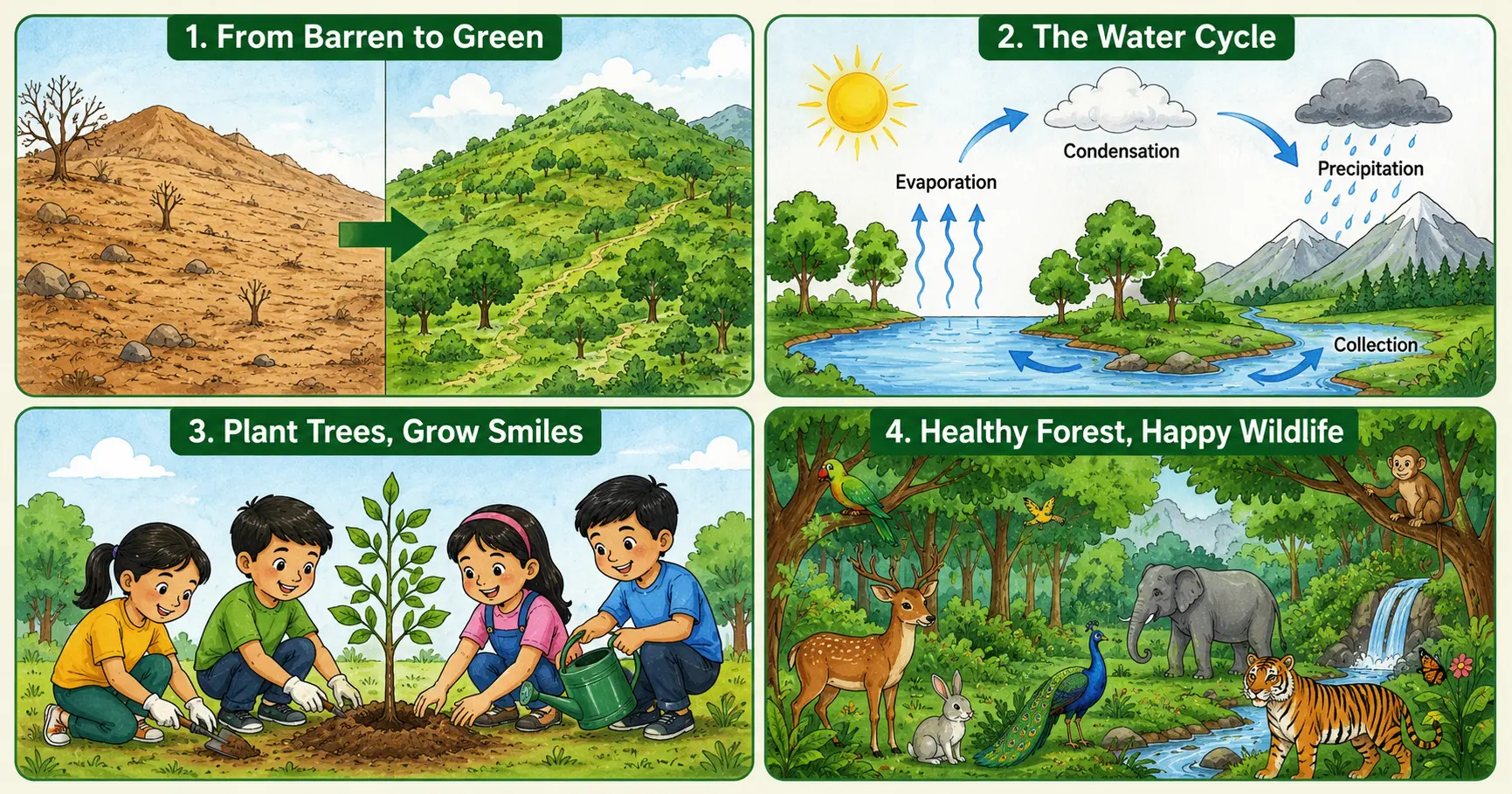 For a Van Mahotsav drawing, the best entries usually tell a small story rather than just showing a tree in isolation. Here are some ideas:
- Before and after: Draw a barren hill on one side and a green, forested hill on the other, with a line of people planting trees in the middle.
- The water cycle: Show trees absorbing rainwater, clouds forming above a forest, and rain falling back on the earth. This teaches the science of why forests create rainfall.
- Children planting trees: A group of students planting saplings, with a slogan like “One Person, One Tree” written at the top.
- Animals in the forest: Show how wildlife depends on trees birds nesting, deer grazing, rivers flowing. This makes the point that Van Mahotsav is not just about humans.
- The contrast city: Draw one side as a hot, smoggy city with no trees, and the other as a cool, green city with tree-lined streets. This makes a point about urban greening.
For the colour palette, use rich greens, earthy browns, and sky blues. Avoid using just one shade of green — mix light and dark greens to make the trees look natural.
India’s Forest Cover: The Real Numbers
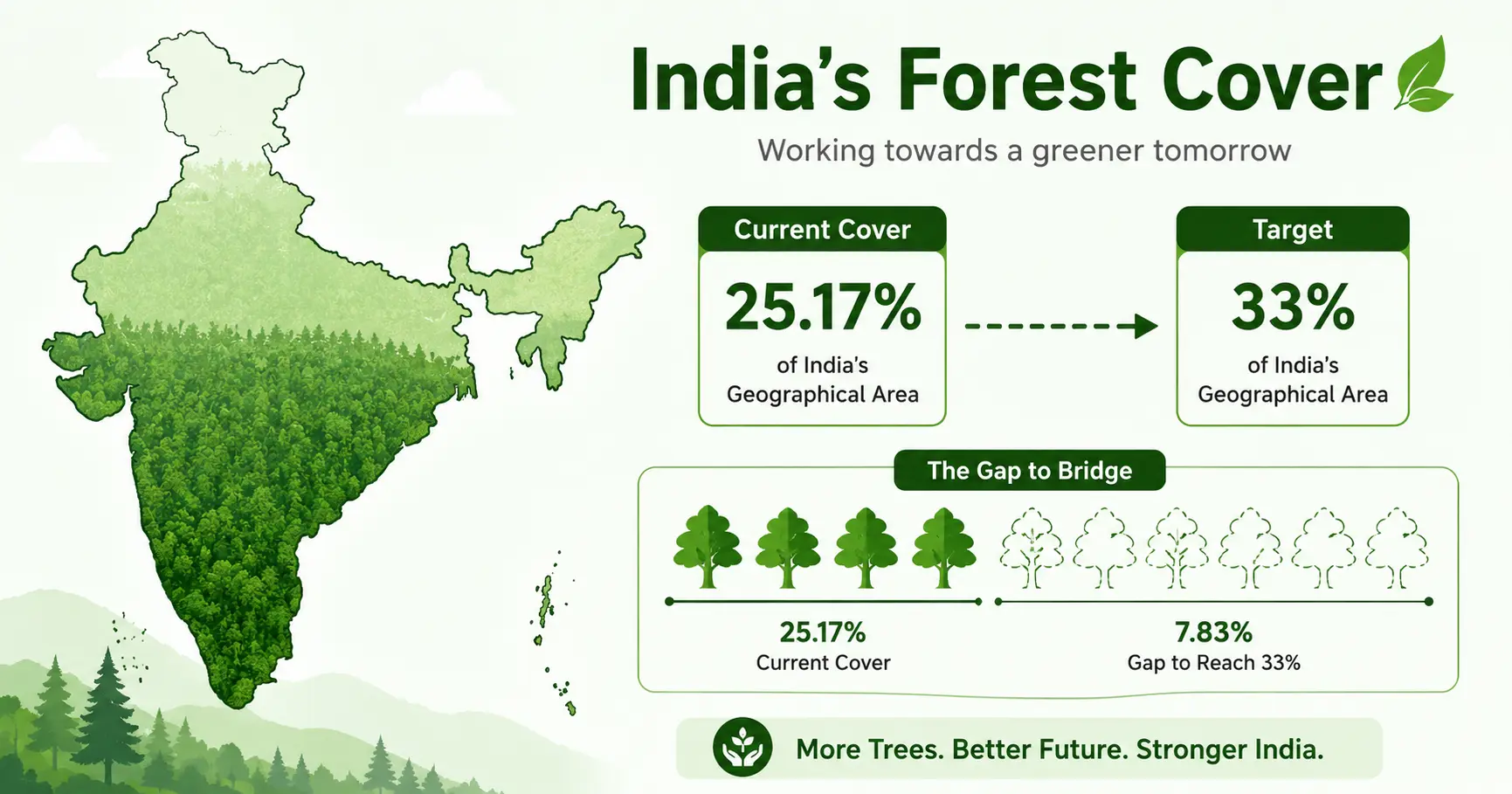 Here is the actual data you need, not vague claims:
| Metric | Figure |
|---|---|
| Total forest and tree cover (ISFR 2023) | 8,27,357 sq km |
| Percentage of total land area | 25.17% |
| National target (National Forest Policy, 1988) | 33% |
| Gap between current cover and target | ~7.83 percentage points |
| States with highest forest cover (%) | Mizoram (84.53%), Arunachal Pradesh (79.33%), Meghalaya (76.00%) |
| States with lowest forest cover | Haryana, Punjab, Rajasthan |
The numbers show a small, steady increase over the years. India added approximately 1,445 sq km of forest and tree cover between 2021 and 2023. At this rate, reaching the 33% target will take decades.
This is exactly why Van Mahotsav in India remains relevant. The gap is real. The urgency is real.
Does Van Mahotsav Actually Work?
This is the question most articles skip. Let’s answer it directly.
The short answer: It works partially, but there are real problems.
What works:
- It creates genuine mass participation. Millions of Indians plant trees during the week, and this builds a culture of environmental responsibility.
- It has anchored tree-planting in the school calendar, reaching children every year across every state.
- Large-scale government plantation drives have added measurable forest cover over time.
What doesn’t work as well:
- Survival rates of planted saplings are often low. Studies have estimated that only 20–40% of planted saplings in mass plantation drives survive beyond two years, because follow-up care (watering, protection from grazing animals, pest control) is inconsistent.
- Monoculture planting is a risk. Some drives plant a single species across large areas, which creates forests with low biodiversity and high vulnerability to disease.
- Urban plantation on poor soil without proper pit preparation leads to stunted tree growth or early death.
The honest assessment: Van Mahotsav matters, but planting a tree on July 1 and forgetting about it on July 8 is not conservation. The real test is whether planted trees survive and grow. India’s improving forest cover numbers suggest the cumulative effect is positive, but survival rates need more attention at every level school, government, and corporate.
India’s approach with Van Mahotsav mirrors what global movements like Earth Day achieve through mass civic participation — coordinated action on a single day that builds long-term habits.
What You Can Do During Van Mahotsav
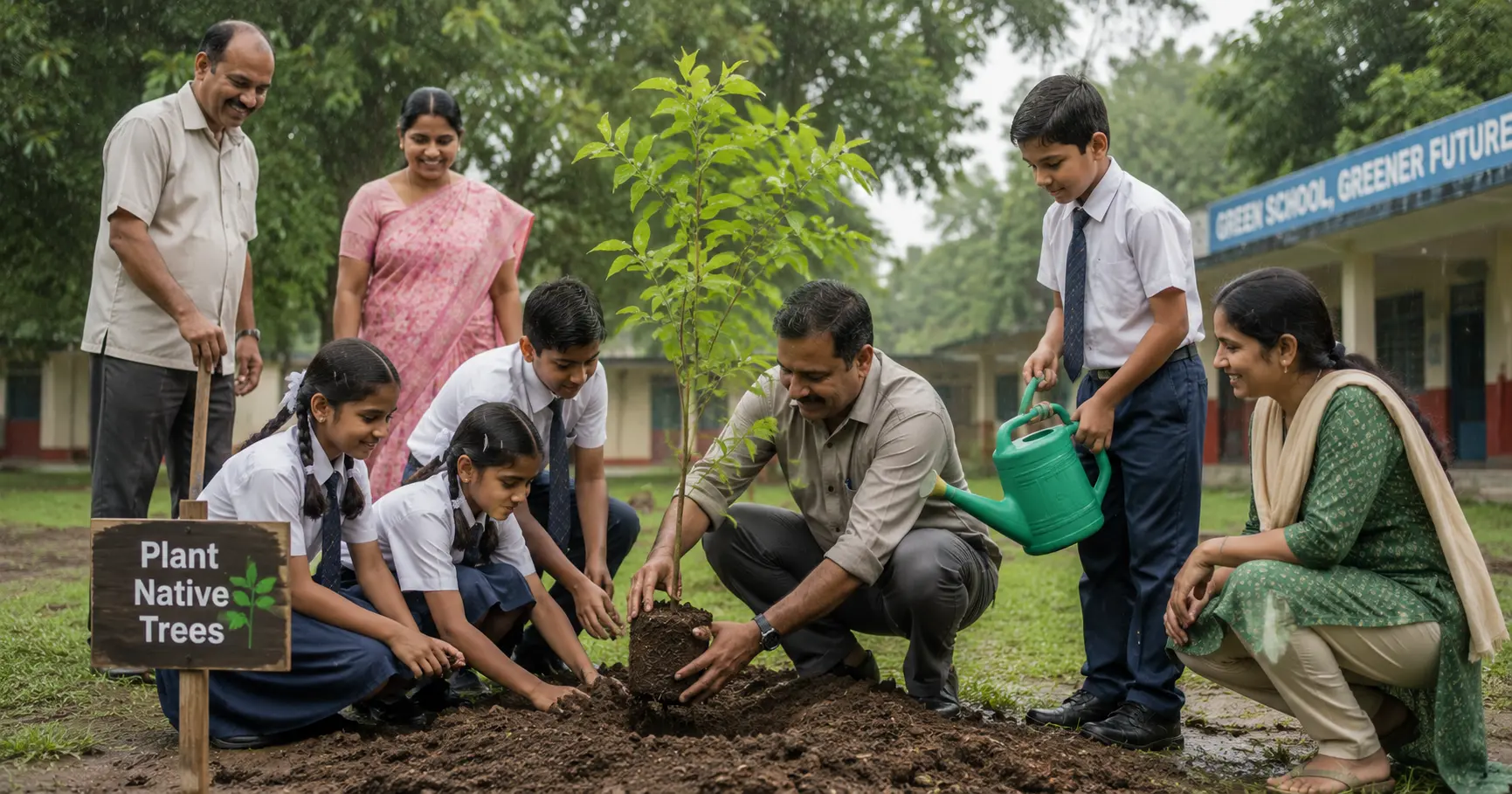 Here are specific, actionable steps not generic advice:
- Plant a native species, not an exotic one. Native trees like neem, peepal, banyan, arjun, and jamun are adapted to local soil and climate. They survive better and support local birds and insects. Exotic ornamental species often don’t.
- Dig the pit correctly before planting. A pit of at least 30cm x 30cm x 30cm, filled with a mix of topsoil and compost, gives the sapling’s roots space to establish. Most failed plantation drives skip this step.
- Water the sapling for at least the first two summers. The first summer after planting is the most critical. A sapling that survives two summers without additional watering is usually established.
- Track your tree. Take a photo on the day you plant it. Check it every month. This accountability even just personal accountability dramatically improves survival rates.
- Participate in a local drive. The forest department in your district almost certainly organises a plantation drive during the first week of July. Show up. Bring someone.
- Teach a child the science. If you have children or interact with students, explain why trees matter in specific terms groundwater, temperature, oxygen, habitat. Abstract slogans don’t stick. Specific science does.
World Environment Day 2026 Theme
Official UNEP Theme and What It Means
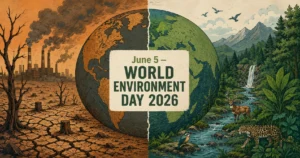
World Environment Day is June 5th about a month before Van Mahotsav week. It’s organized by the United Nations Environment Programme (UNEP) and has a different theme each year. The 2026 theme has not yet been officially confirmed by UNEP. Van Mahotsav and World Environment Day are separate events one is India-specific, the other is global but they share the same broad concern: forests, land degradation, and environmental awareness. In India, the period from early June through early July has become an informal environmental action season, with World Environment Day, World Oceans Day, and Van Mahotsav all falling within the same five-week stretch.
FAQ
Q1. When is Van Mahotsav 2026? Van Mahotsav 2026 runs from July 1 to July 7, 2026. It is held during the first week of July every year to coincide with the onset of the monsoon season in most of India.
Q2. Who started Van Mahotsav? K.M. Munshi, India’s first Union Minister of Agriculture and Food, started Van Mahotsav in 1950. He was also a prominent lawyer, author, and politician. Prime Minister Jawaharlal Nehru supported the initiative from its launch.
Q3. Why is Van Mahotsav celebrated in July? July is when the southwest monsoon brings rainfall to most parts of India. Planting saplings at the start of the rainy season gives them access to natural water, which significantly improves their survival rates compared to planting in dry months.
Q4. What is the theme of Van Mahotsav 2026? The official theme for Van Mahotsav 2026 has not been announced yet as of early 2026. Themes are typically declared by the Ministry of Enviro
nment, Forest and Climate Change closer to the event. Previous themes have focused on climate change, biodiversity, and urban greening. Watch for the official government announcement in June 2026.
Q5. How many trees are planted during Van Mahotsav each year? The numbers vary by year and by how aggressively state governments participate. Historically, Van Mahotsav weeks have seen anywhere from a few crore to tens of crore trees planted nationally. The 2024 “Ek Ped Maa Ke Naam” campaign targeted 100 crore trees over the full year, with Van Mahotsav serving as a major catalyst for that effort.
Van Mahotsav 2026: The Bigger Picture
Van Mahotsav 2026 is not just a government programme. It is a reminder that India’s forest problem is too large for any single ministry to solve alone.
India needs roughly 8% more forest cover to hit its own national target. That gap equals millions of hectares of land that need trees — trees that survive, grow tall, and stay standing for decades. One week of planting every July, repeated for 76 years, has moved the needle. But the work is far from done.
The festival matters because habits form young. A child who plants a neem sapling in July 2026 and watches it grow over the next ten years learns something no classroom lesson fully teaches: that living systems respond to care. That trees breathe. That shade does not appear from nowhere.
Start small. Plant one tree this July. Water it through its first summer. Then do it again next year. That is what Van Mahotsav was always really asking for not a ceremony, but a commitment.

Abhay Ramola researches world festivals across primary sources, local accounts, and on-ground reporting. He founded Dionfest to cover what gets missed when festivals become tourism content the history, the ritual, and the people behind it.




5 thoughts on “Van Mahotsav 2026: India’s 76-Year-Old Tree Festival”