World Cleanup Day 2026: Everything You Need to Know About Clean Up the World Weekend
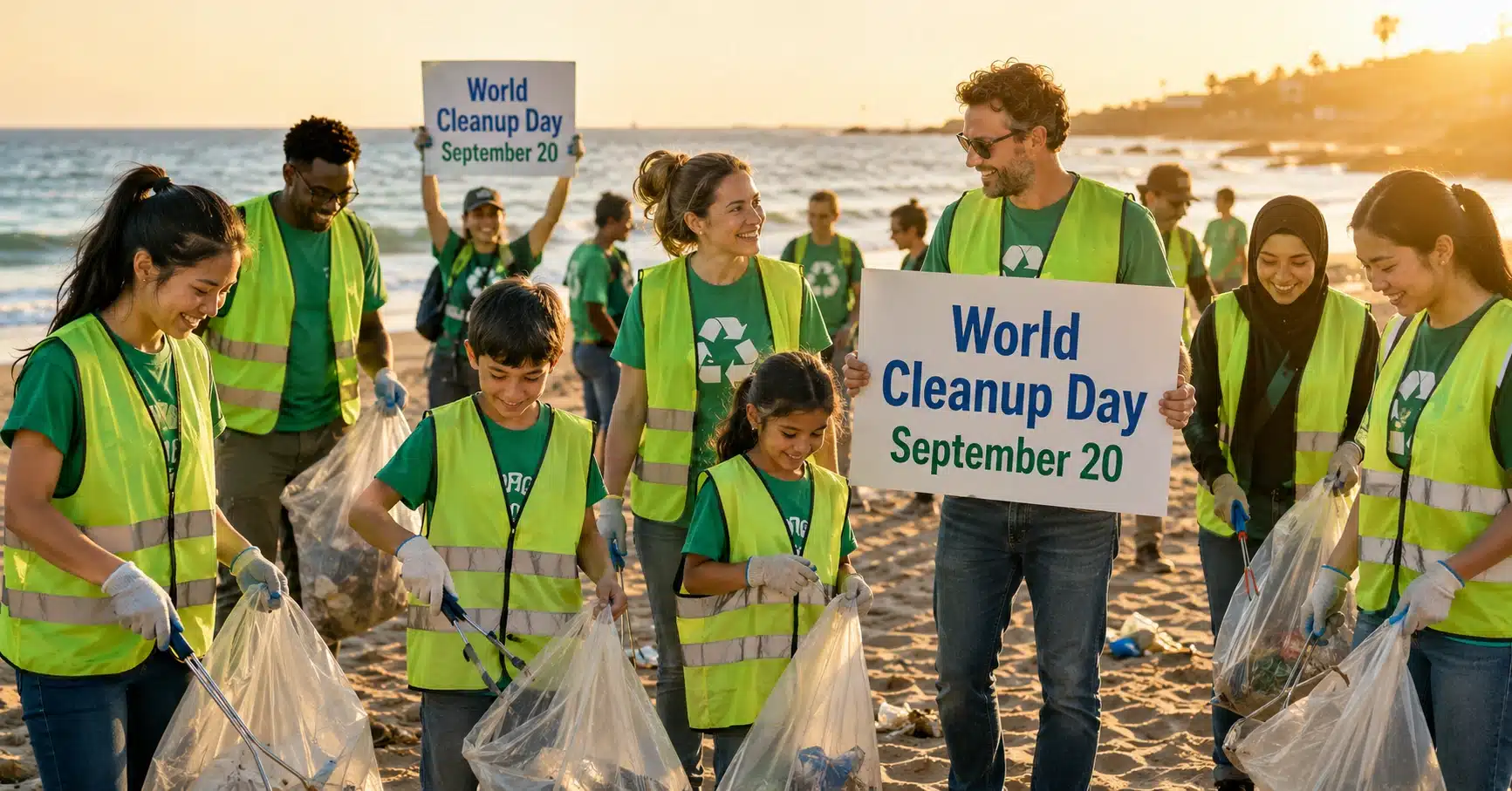
Every September, millions of people across the globe pick up trash bags and head outside. They clean beaches, parks, rivers, roadsides, and forests. This is World Cleanup Day the largest single-day civic movement on the planet. And if you have never heard of it, or you want to understand what it is, how it started, and how to join, this article covers everything.
What Is World Cleanup Day?
World Cleanup Day is a global civic event held every year on September 20. On this one day, volunteers from nearly every country on Earth organize local cleanups to remove litter from their streets, coasts, forests, and waterways.
The United Nations General Assembly officially recognized it in December 2023 through Resolution A/RE S/78/122. Since then, it sits on the UN calendar as an annual observance, coordinated jointly by UN-Habitat and the nonprofit Let’s Do It! World.
The goal is not just to pick up trash. The bigger aim is to change how people think about waste — to shift behavior, push governments to act, and prove that ordinary people can drive global change when they organize together.
What Is Clean Up the World Weekend?
Clean Up the World Weekend is a related but separate initiative. It started in 1993 when Australia’s “Clean Up Australia” campaign went global. Run by the Clean Up the World organization in partnership with the United Nations Environment Programme (UNEP), this campaign happens every third weekend of September which often lines up with World Cleanup Day.
At its peak, 35 million volunteers from 120 countries participated in a single Clean Up the World Weekend. The campaign focuses on parks, waterways, and forests, encouraging communities to do year-round environmental projects, not just one-day cleanups.
Think of it this way: World Cleanup Day is the main September event. Clean Up the World Weekend is the older, broader campaign that runs alongside it. Both share the same spirit get outside, clean up, show you care.
How Did It All Start?
 The story of this movement goes back to a sailing race and a disgusted Australian.
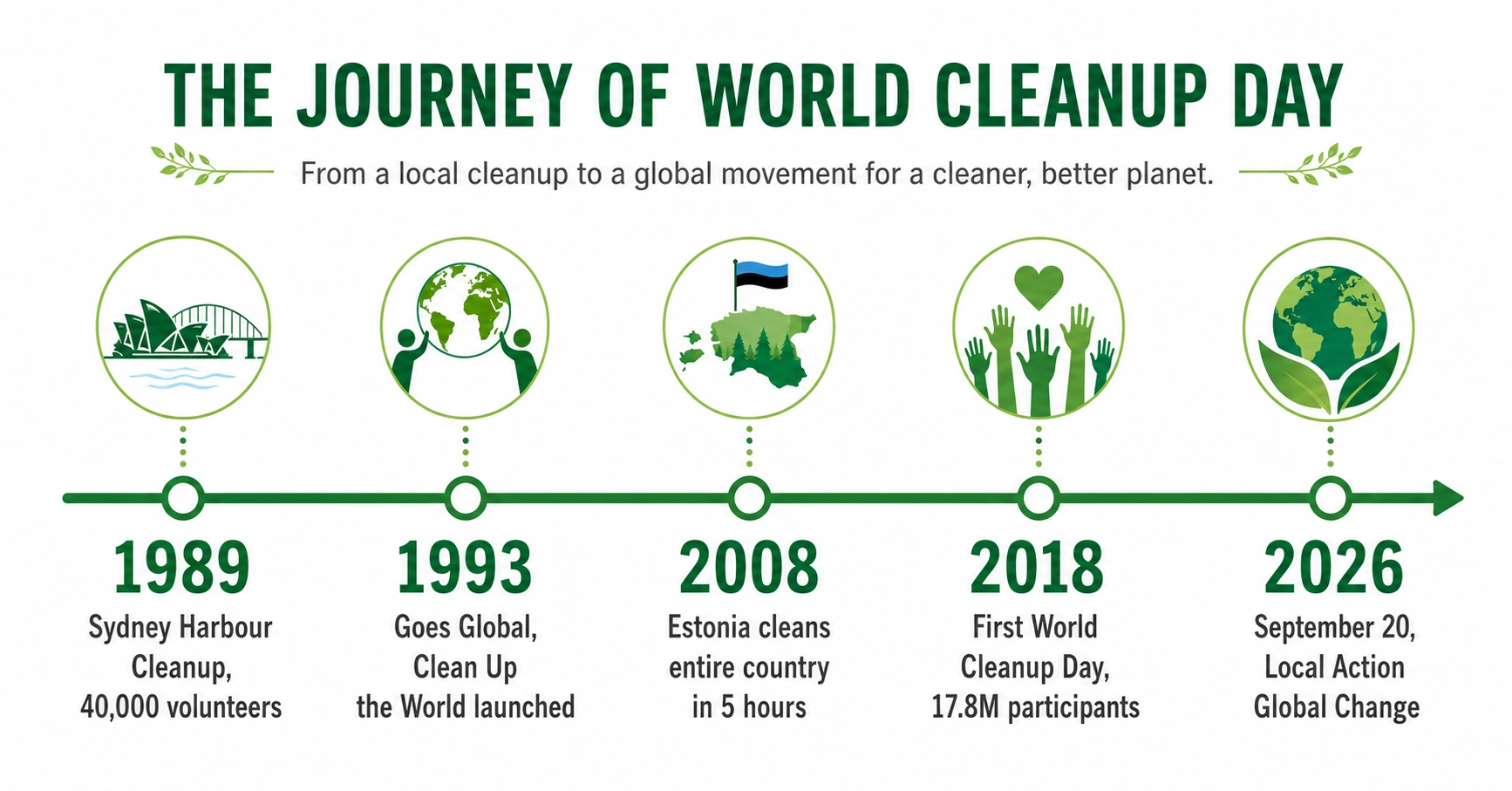
Ian Kiernan and the Sydney Harbour Cleanup (1989)
In 1989, Ian Kiernan, an Australian yachtsman and builder, competed in a solo around-the-world sailing race. What he found out at sea horrified him: the ocean was full of plastic, garbage, and floating waste. When he got home, he organized a cleanup of Sydney Harbour.
On that first day, 40,000 volunteers showed up and removed rusted car bodies, plastic bags, glass bottles, and cigarette butts from the water. It was an enormous success. “Clean Up Australia Day” was born.
Going Global (1993)
By 1993, the idea spread beyond Australia. With UN backing, Ian Kiernan launched Clean Up the World, turning a national campaign into a global one. Sydney became the movement’s headquarters. Countries across Africa, Asia, Latin America, and Europe joined.
Estonia’s Big Moment (2008)
The next major leap came in September 2008. In Estonia, a small country of just 1.3 million people, a group of organizers asked a bold question: What if an entire country cleaned up in a single day?
On September 16, 2008, 50,000 Estonians roughly 5% of the entire population — came out and cleaned their country in just five hours. Estonian President Toomas Hendrik Ilves participated personally. Over 600 businesses supported the event. It made global headlines.
That model, “one country, one day,” inspired a much bigger idea.
“One World, One Day” (2018)
The organizers behind the Estonian cleanup, led by activist Heidi Solba and the Let’s Do It! World network, scaled the concept globally. On September 15, 2018, the first World Cleanup Day took place.
The results were staggering: 17.8 million people from 157 countries participated in a single day. World leaders joined. Media covered it widely. The “one world, one day” model proved it could work.
What Is the Theme of World Cleanup Day 2026?
The proposed theme for World Cleanup Day 2026 is “Local Action as the Foundation of Global Change.”
This theme makes a specific argument: large-scale environmental problems only get solved when people take action in their own neighborhoods, streets, and communities. Global goals mean nothing without local follow-through.
The 2026 event falls on September 20, 2026. UN-Habitat is currently finalizing which city or country will host the official global observance. The 2025 theme focused on textile and fashion waste, since discarded clothing is one of the fastest-growing waste streams in urban areas worldwide.
World Cleanup Day 2026 continues that focus on practical, community-level action which fits directly with the Clean Up the World Weekend model that has been running since 1993.
World Cleanup Day vs World Environment Day: What Is Celebrated on 5 June?
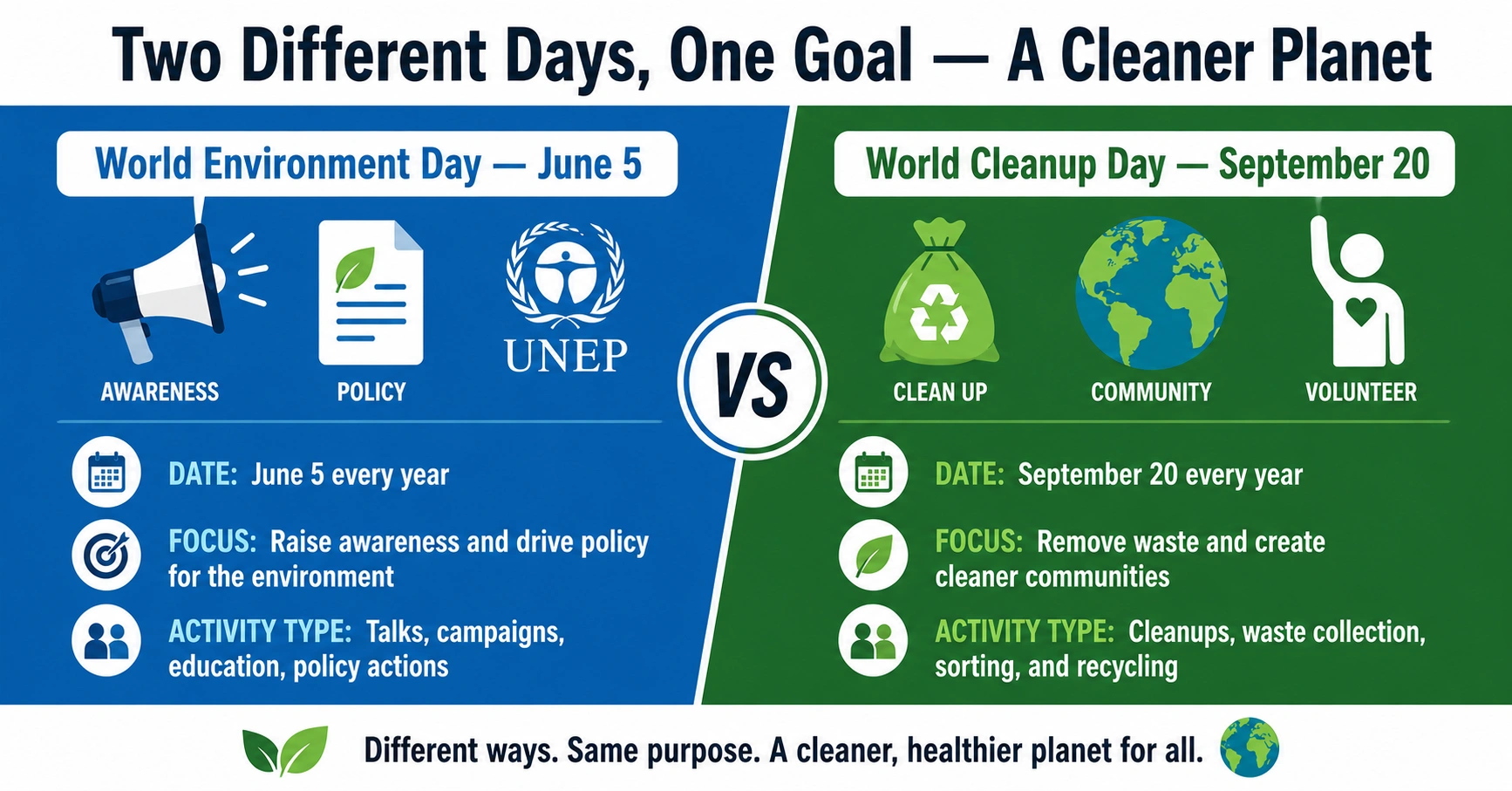 People sometimes confuse these two events. They are completely different.
June 5 is World Environment Day, not World Cleanup Day.
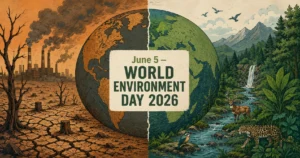
World Environment Day is celebrated annually on June 5 and encourages awareness and action for the protection of the environment. It is the United Nations’ primary outreach day on environmental issues.
World Environment Day 2026 focuses on climate change specifically on the urgent signals the Earth is sending and the responses we choose to send back. UNEP’s global campaign calls on people to step in #NowForClimate. Azerbaijan will host the official 2026 global celebration.
World Cleanup Day, by contrast, happens on September 20. Here is a quick comparison:
| Feature | World Environment Day | World Cleanup Day |
|---|---|---|
| Date | June 5 | September 20 |
| Founded | 1972 (UN Stockholm Conference) | 2018 (first global edition) |
| Led by | UNEP | UN-Habitat + Let’s Do It! World |
| Focus | Awareness, policy, advocacy | Physical cleanup action |
| Main activity | Events, forums, campaigns | Volunteer cleanups worldwide |
Both days serve the environment but in different ways. June 5 is about raising awareness. September 20 is about getting your hands dirty.
The Numbers: How Big Has This Movement Become?
 The scale of World Cleanup Day is hard to grasp until you look at the data directly.
- 2018 (First global edition): 17.8 million participants, 157 countries
- 2019: Numbers grew further; let’s Do It! World expanded its network
- 2020 and 2021: COVID restrictions cut participation, but nearly 9 million people still showed up from 191 countries
- 2022: 15 million participants from 190 countries as the world reopened
- 2023: 19.1 million people from 91% of all countries participated, and 205,000 tonnes of waste were collected globally.
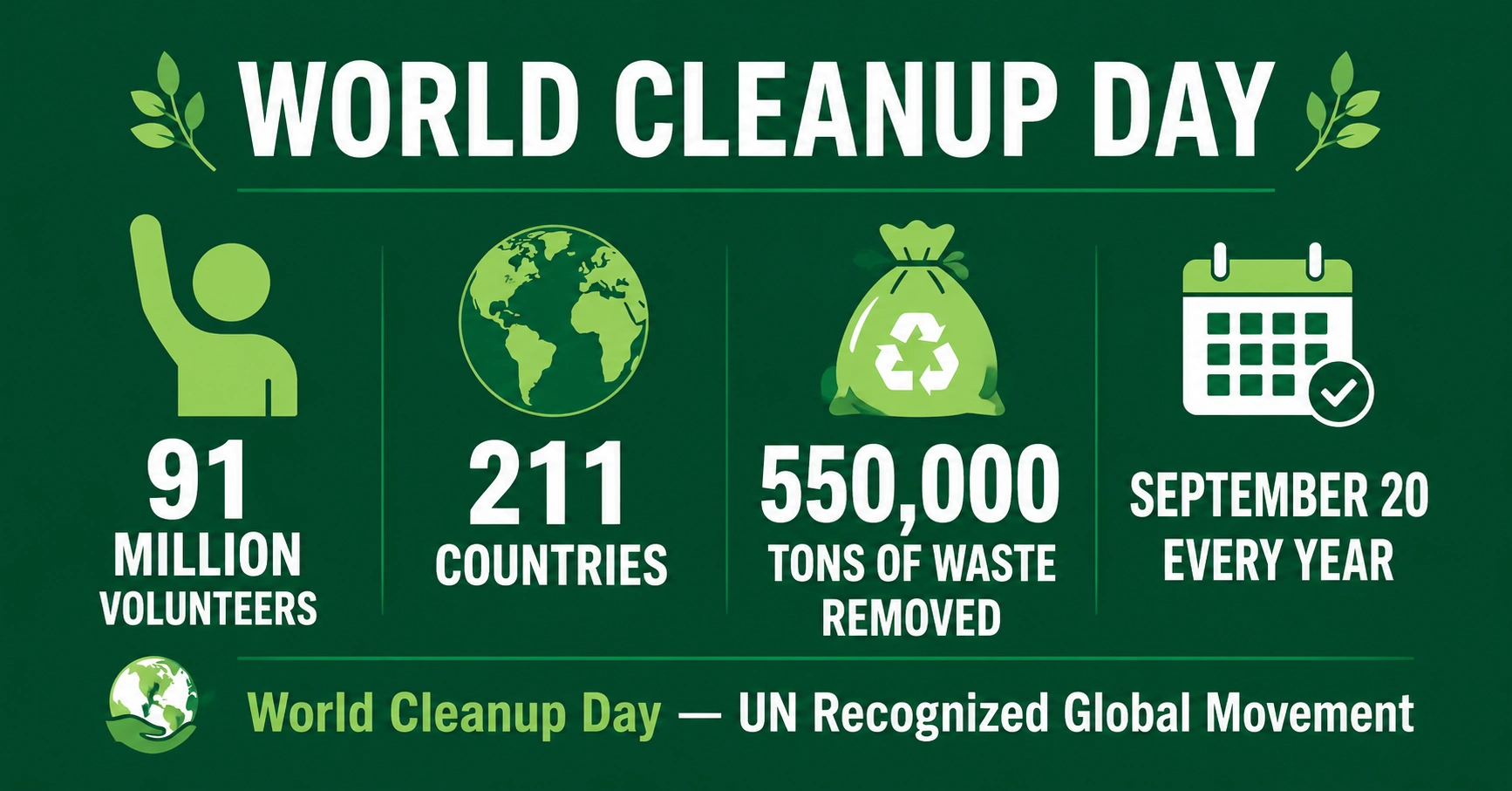
- Since 2018 total: World Cleanup Day has mobilized 211 countries and territories, including 95% of UN Member States, collecting almost 550,000 tons of land and ocean waste and engaging 91 million individuals.
That 550,000 tons of waste removed is not an abstract figure. That is waste that did not end up in oceans, rivers, or soil. Birds did not eat it. Fish did not choke on it. Children did not play near it.
The older Clean Up the World Weekend has its own track record: at its height, it drew 35 million volunteers from 120 countries in a single year. Across Africa, Asia-Pacific, Latin America, and Europe, community groups, schools, and local councils have run events every September since 1993.
Why Does One Day of Cleanup Actually Matter?
This is a fair question. Critics sometimes argue that annual cleanups are symbolic while the real problem how we produce and dispose of waste stays unsolved. That criticism has merit. But it misses the larger picture.
Here is what one day of mass cleanup actually does:
- It generates data. Cleanup volunteers log what they find plastic types, cigarette butts, food containers. That data helps governments and researchers understand which waste categories need better regulation.
- It creates peer pressure on governments. When millions of citizens visibly clean up what companies leave behind, it builds political will for stricter packaging laws and producer responsibility rules.
- It builds community. Studies on civic participation show that shared public action increases people’s sense of responsibility toward their environment year-round — not just on cleanup day.
- It shifts youth behavior. In 2023, Mozambique engaged 2 million of its children in cleanup activities, mobilizing 10% of its population. In Namibia, 80% of participants were children. These are future adults learning what civic responsibility looks like.
The cleanup itself is only part of the story. The movement it builds around that cleanup is the real output.
Countries like India run year-round green campaigns such as Van Mahotsav, where millions of trees get planted every July proof that single-day events can inspire year-round action.
How to Participate in World Cleanup Day 2026
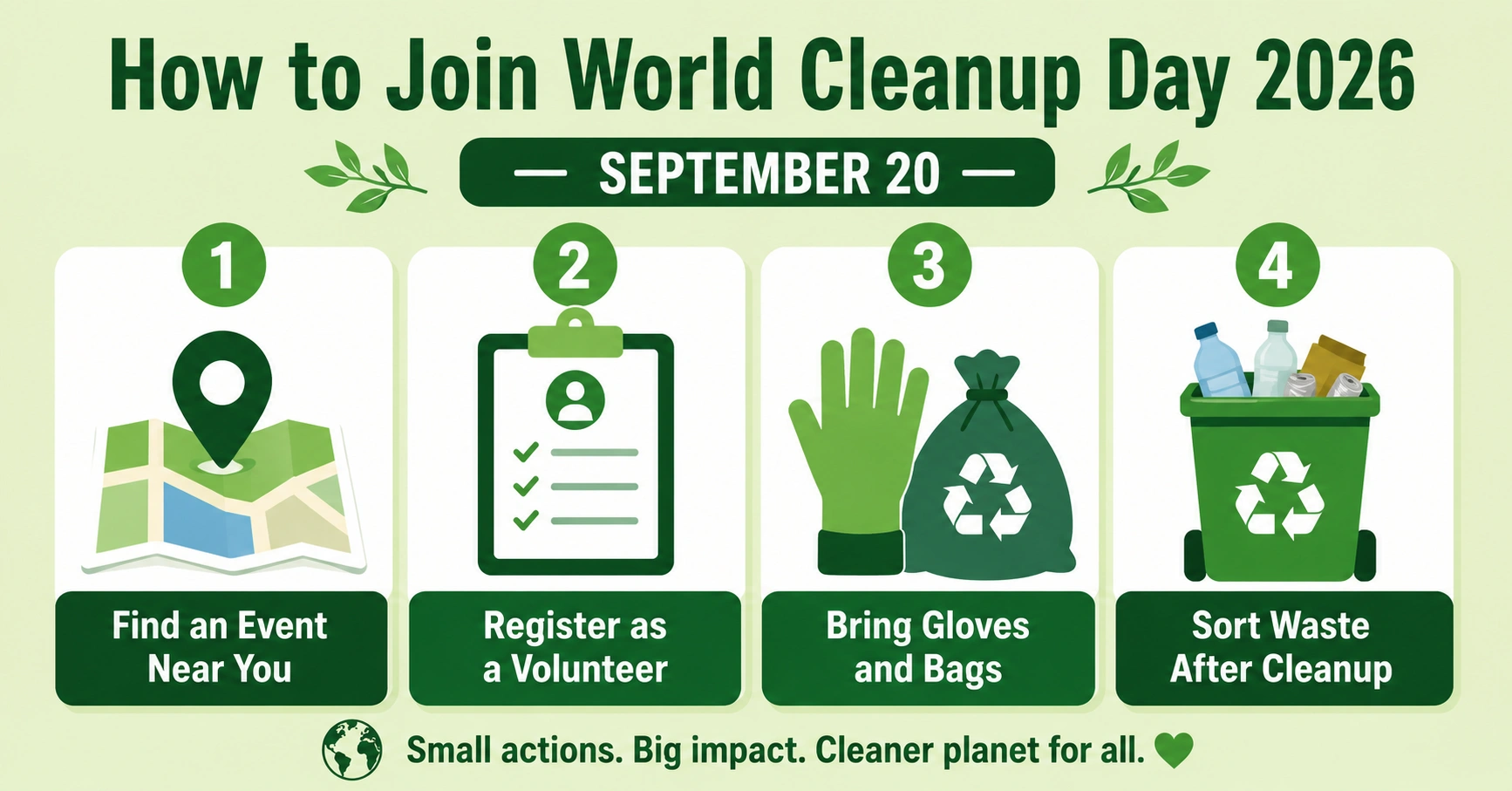 World Cleanup Day 2026 is September 20. Here is how to get involved, whether you are an individual, a school, or a company.
For Individuals
- Visit worldcleanupday.org and use the map to find a registered cleanup event near you.
- Register as a volunteer so organizers know how many people to expect and can prepare equipment.
- Bring reusable gloves, a bag for collected waste, and water. Most events provide bags and gloves, but having your own is better.
- Sort what you collect separate recyclables from general waste so the data is useful.
For Groups and Schools
- Register your own cleanup event on the World Cleanup Day website. You get listed on the global map and can attract additional volunteers.
- Choose a specific location: a park, a beach, a river bank, a school yard, or a roadside stretch. Focused cleanups produce better results than vague ones.
- Partner with your local municipality for waste collection after the event. Many local governments actively support registered cleanup events.
For Companies
- Organize a team cleanup as a corporate social responsibility activity. This is one of the easiest and most visible ways for companies to show environmental commitment.
- Sponsor local cleanup events by providing bags, gloves, or refreshments.
- Use the event to audit your own waste footprint and commit to specific reductions.
Before and After the Day
Participation does not have to stop on September 20. The Clean Up the World campaign runs year-round projects. You can register your community group, plan cleanup events throughout the year, and track your impact over time.
What Happens at Green Festivals During Cleanup Season?
September is not just about picking up trash. Across the world, green festivals run events that connect cleanup action with music, art, education, and community celebration.
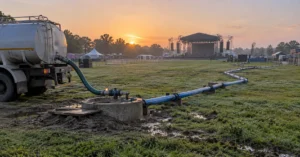
Green festivals often schedule cleanup activities as part of their programming participants clean up festival grounds, nearby parks, or local waterways before or after the main events. This turns environmental action into something social and enjoyable rather than a chore.
If you attend a green festival in September, look for:
- Organized cleanup walks that happen before or after festival performances.
- Waste-sorting stations that educate attendees about recycling on-site.
- Talks and panels on zero-waste living, sustainable consumption, and community organizing.
- Partnerships with local environmental nonprofits that let attendees sign up for future cleanup events.
The connection between green festivals and World Cleanup Day is natural. Both attract people who care about the environment. much like Earth Day, which brings together over a billion people every April 22 for the same reason.Both work best when they bring together communities rather than isolating individuals. And both show that caring for the planet does not have to be grim work it can be energetic, social, and worth celebrating.
The Unique Angle: What Cleanup Day Gets Wrong (And Right)
Most articles about World Cleanup Day are purely celebratory. Here is a more honest take.
What the Movement Gets Right
The scale is real. Getting 20 million people to physically act on an environmental problem in a single day — across wars, political tensions, and economic hardship is a genuine organizational achievement. The data it generates is genuinely useful. And the youth engagement it builds in countries like Mozambique and Namibia creates long-term environmental stewardship.
What Critics Get Right Too
Picking up litter treats symptoms, not causes. The plastic bottle on the beach came from a factory, traveled through a supply chain, was sold by a retailer, and was discarded by a consumer. A cleanup removes it from the beach, but none of those upstream steps change.
Cleanup Day’s organizers acknowledge this. That is why the 2026 theme focuses on “local action as the foundation of global change” — the framing has shifted from simple cleanup to policy pressure and systemic awareness. The data volunteers collect now feeds into UN reports that inform plastic treaty negotiations and national waste management laws.
The Honest Bottom Line
World Cleanup Day is not a solution. It is a catalyst. It builds the public will and political momentum that solutions require. If you want cleaner rivers and coasts, you need both the September cleanup event and the year-round policy work that follows from it. One without the other is incomplete.
FAQ
When is World Cleanup Day 2026?
World Cleanup Day 2026 is on Sunday, September 20, 2026. It happens every year on September 20, as designated by the United Nations General Assembly.
What is the theme of World Cleanup Day 2026?
The proposed theme for World Cleanup Day 2026 is “Local Action as the Foundation of Global Change.” This theme highlights that global waste problems require organized community action at the local level to produce real results.
What is celebrated on June 5?
June 5 is World Environment Day, not World Cleanup Day. World Environment Day was established by the UN in 1972 and focuses on environmental awareness and policy. In 2026, the theme is climate change under the campaign #NowForClimate, hosted by Azerbaijan.
How is Clean Up the World Weekend different from World Cleanup Day?
Clean Up the World Weekend is an older campaign started in 1993, in partnership with UNEP, that takes place every third weekend of September. World Cleanup Day is the UN-recognized global event on September 20 each year. They overlap in timing and purpose but are run by different organizations. Think of them as two branches of the same movement.
How many people participate in World Cleanup Day globally?
In recent years, participation has been between 15 and 20 million people annually from 190+ countries. Since 2018, more than 91 million individuals have participated in total, removing almost 550,000 tons of waste across 211 countries and territories.
Final Word: World Cleanup Day Is Bigger Than a Day
World Cleanup Day started as one man’s outrage at a garbage-filled ocean. It became a Sydney Harbour cleanup. Then a national campaign. Then a global movement recognized by the United Nations. That trajectory is worth taking seriously.
The world produces over 2 billion tonnes of municipal solid waste every year. A single cleanup day cannot reverse that. But World Cleanup Day has done something harder than clean up a beach it has made millions of people feel personally responsible for their environment. And that feeling, when it sticks, changes voting behavior, consumer choices, and political demands.
Mark September 20, 2026 on your calendar. Find a cleanup near you, bring a friend, and spend two hours doing something that actually matters. Then keep pushing for the policies that make future cleanups unnecessary.
Looking for more content on green events, eco-festivals, and environmental action? Explore the Green Festivals section for more.

Abhay Ramola researches world festivals across primary sources, local accounts, and on-ground reporting. He founded Dionfest to cover what gets missed when festivals become tourism content the history, the ritual, and the people behind it.