
World Environment Day 2026: Date, Theme, History & How You Can Actually Help
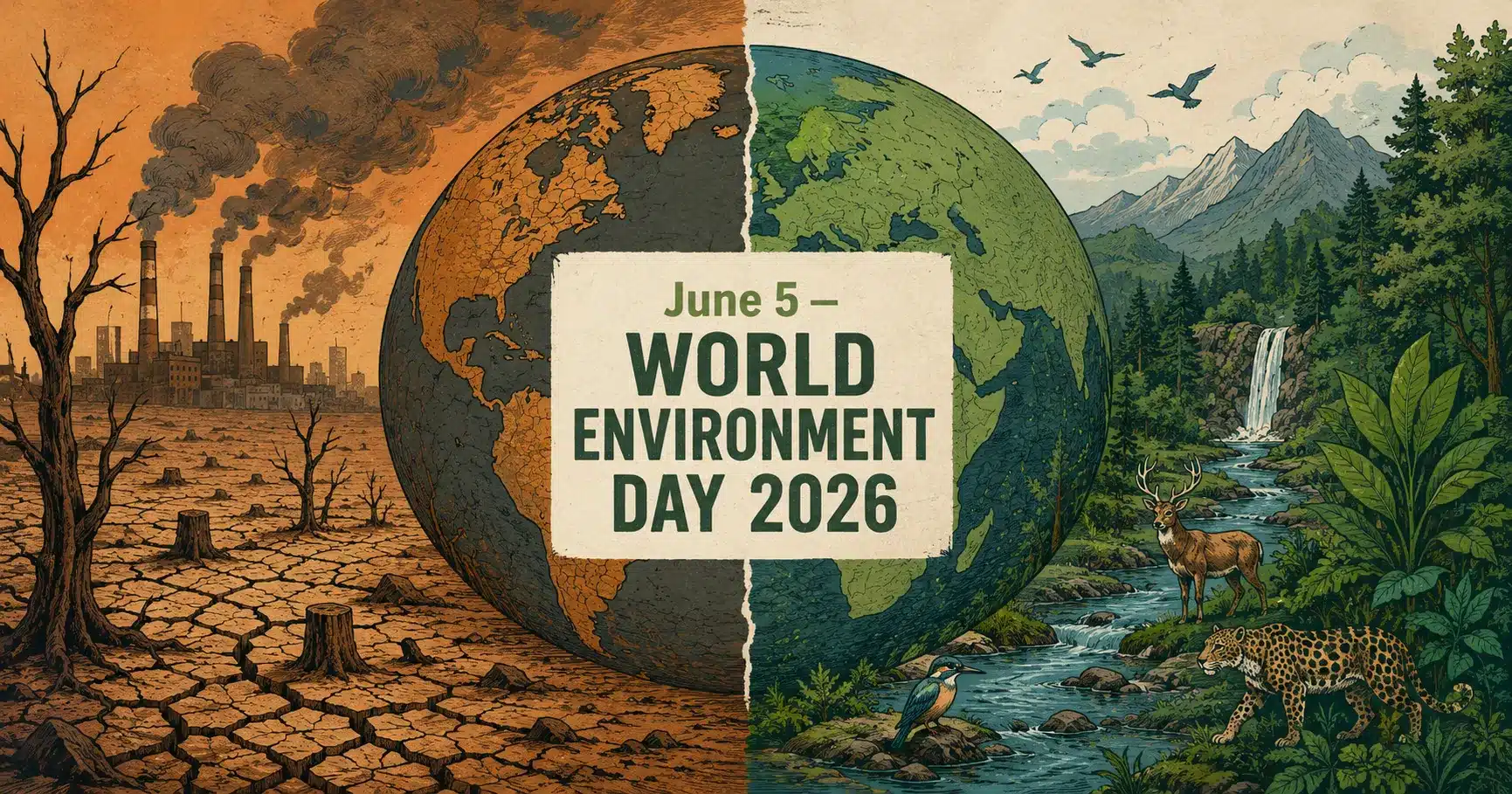
Every year on June 5, the world pauses to recognize something easy to forget in the rush of daily life: the planet we live on is changing fast, and not for the better. World Environment Day is the United Nations’ main platform to push that message and in 2026, the stakes feel higher than ever.
This guide covers everything you need to know about World Environment Day what it is, why it was started, what’s happening in 2026, how it connects to events like World Nature Conservation Day, and what you can do that actually matters.
What Is World Environment Day?
World Environment Day is the United Nations’ biggest annual event for encouraging awareness and action on environmental protection. It happens every year on June 5 and has been running since 1973.
The day is organized by the United Nations Environment Programme (UNEP). Each year, a different country hosts the global celebration, and a new theme focuses attention on one specific environmental challenge.
Over 143 countries participate. Millions of people take part through tree planting, clean-ups, marches, policy discussions, and online campaigns. It is widely considered the largest global platform for environmental public outreach in existence.
The goal is not just awareness. World Environment Day is designed to push governments, businesses, and individuals to take real, measurable steps toward protecting the natural world.
World Environment Day 2026: Theme, Date, and Host Country
Date: Friday, June 5, 2026
Host Country: Azerbaijan (global observance in Baku)
Theme: “Inspired by Nature. For Climate. For Our Future.”
Campaign Hashtag: #NowForClimate
The 2026 World Environment Day focuses on climate change specifically on the urgent signals the Earth is sending and the actions humans need to take in response. UNEP’s message this year is direct: we said 1.5°C was the limit. We are crossing it. The question is no longer whether change is coming it is whether we guide it fast enough.
Azerbaijan was chosen as host after its strong performance at COP29 in 2024, where it helped secure landmark decisions on climate finance and carbon markets. The country spans 8 distinct climate zones from subtropical forests to alpine ecosystems making it a natural symbol for the diversity at risk.
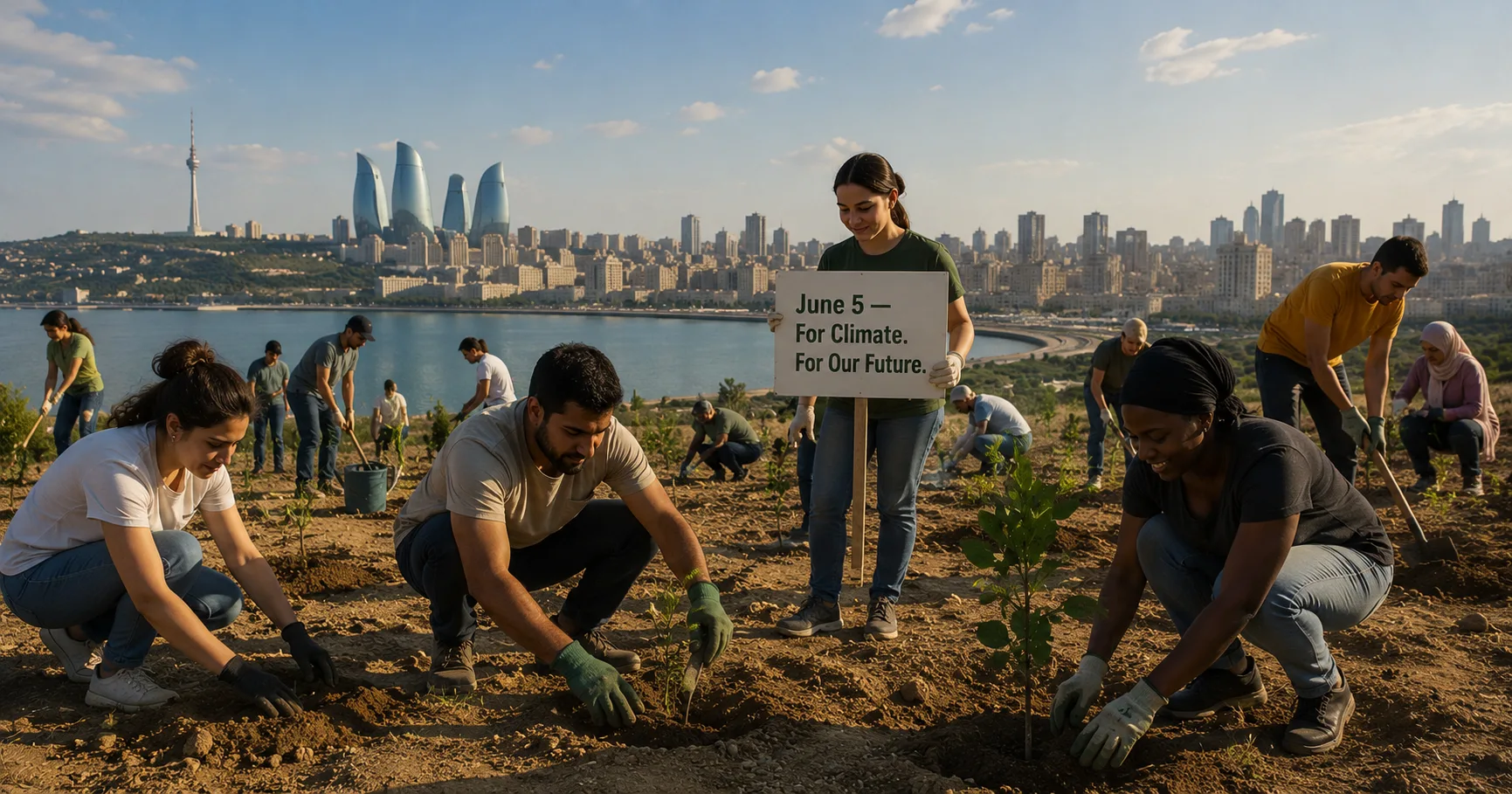 The 2026 campaign points to something important: positive tipping points are already happening. Solar panels are spreading. Cities are being redesigned. Forests are being replanted. The goal of World Environment Day 2026 is to accelerate those signals.
History: How It All Started in 1972
The origin of World Environment Day goes back to a moment of genuine global alarm.
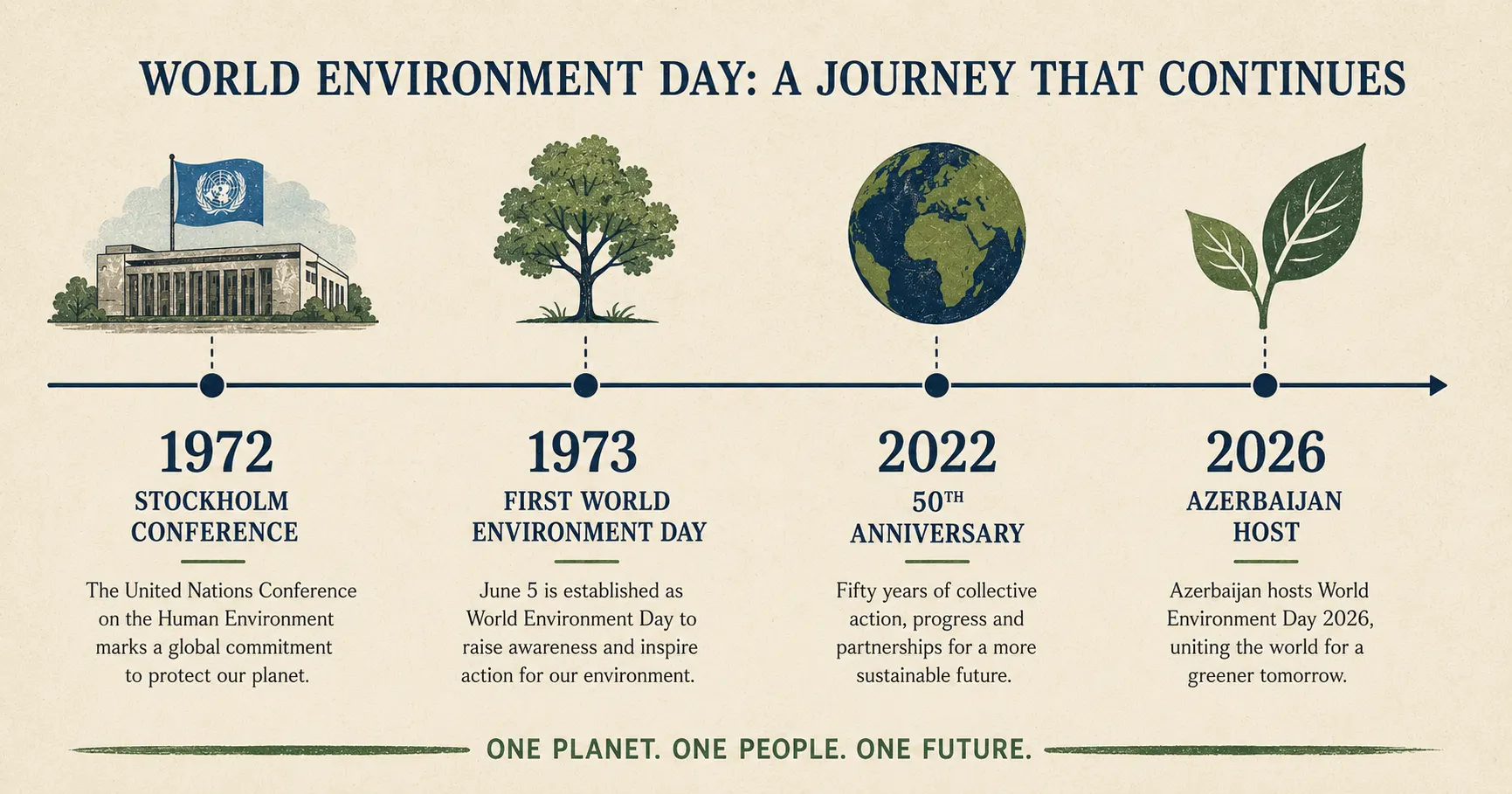 In June 1972, the United Nations held the Stockholm Conference on the Human Environment the first major international meeting to treat environmental protection as a political priority. Leaders from 113 countries gathered in Sweden to acknowledge that pollution, habitat loss, and resource depletion were not local problems. They were threats to human civilization itself.
That same year, the UN General Assembly passed a resolution establishing June 5 the opening day of the Stockholm Conference as World Environment Day. The first official celebration took place in 1973, with the theme “Only One Earth.”
That theme, chosen over 50 years ago, remains painfully relevant today.
Since then, World Environment Day has grown from a symbolic gesture into a genuine policy driver. Many of the world’s most important environmental laws and agreements have been signed or pushed forward in the weeks surrounding June 5.
Past Themes That Shaped Global Policy
Each year’s theme tells you what the world was most worried about at that moment. Here is a selection:
- 1973 – Only One Earth – The founding theme. A call to treat the planet as a shared responsibility.
- 1997 – For Life on Earth – Focused on biodiversity at a time of rising extinction rates.
- 2011 – Forests: Nature at Your Service – Brought global attention to deforestation when tropical forest loss was accelerating sharply.
- 2013 – Think. Eat. Save. – Addressed food waste, which was producing enormous unnecessary carbon emissions.
- 2019 – Beat Air Pollution – Highlighted that 7 million people die from air pollution-related causes each year.
- 2022 – Only One Earth – Revisited the original theme exactly 50 years later, a reminder that the core problem had not been solved.
- 2023 – Beat Plastic Pollution – Aligned with global negotiations for a binding international plastics treaty.
- 2025 – Our Land. Our Future. – Focused on land restoration and halting desertification.
- 2026 – Inspired by Nature. For Climate. For Our Future. – A call for urgent, collective climate action.
Why World Environment Day Still Matters
Some people ask whether these annual awareness days actually change anything. It is a fair question. Here is the honest answer: they do not automatically change things. But they create the political and cultural pressure that makes change possible.
Three concrete reasons World Environment Day still matters:
- Policy timing: Governments often time the announcement of major environmental legislation and targets to coincide with June 5, because the global media coverage amplifies the message.
- Corporate commitments: Companies under pressure from consumers and investors use World Environment Day as a deadline to announce sustainability pledges. Those pledges, when tracked publicly, get enforced.
- Education at scale: Hundreds of millions of students worldwide participate in World Environment Day activities. Research consistently shows that children who engage with environmental issues early are more likely to support conservation policies as adults.
The day alone does not save forests. But it builds the awareness and the social pressure that eventually forces decision-makers to act.
World Environment Day vs Earth Day vs World Nature Conservation Day
Many people confuse these three observances. They are related but distinct.
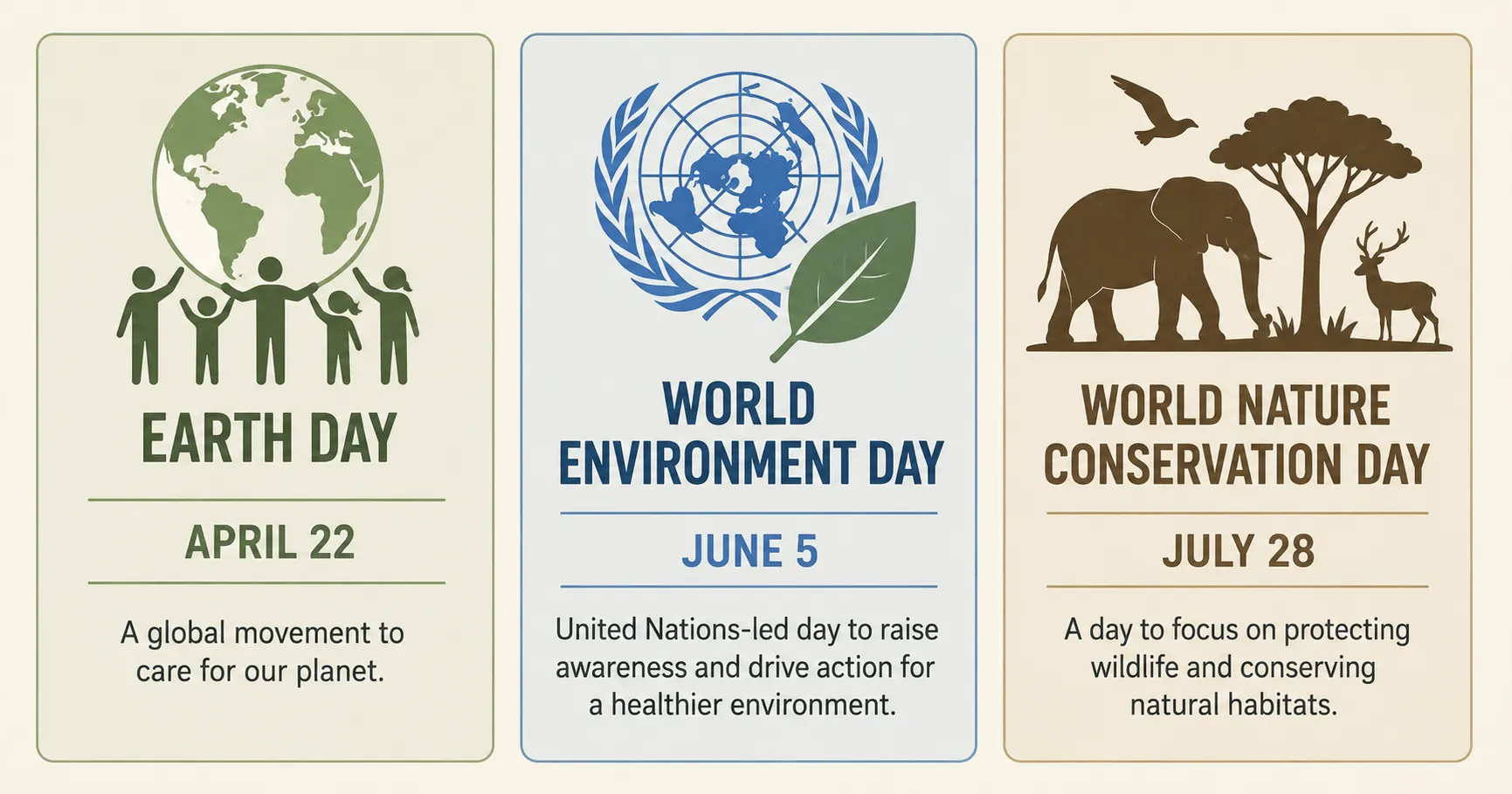
| Day | Date | Founded By | Primary Focus |
|---|---|---|---|
| World Environment Day | June 5 | United Nations (1972) | Broad environmental action, climate, policy |
| Earth Day | April 22 | U.S. Senator Gaylord Nelson (1970) | Civic engagement, public awareness, clean energy |
| World Nature Conservation Day | July 28 | IUCN / UN origins (late 1990s) | Protecting biodiversity and natural resources |
Earth Day came first, born from grassroots activism in the United States in 1970. Its 2026 theme is “Our Power, Our Planet,” emphasizing community-led action and renewable energy. You can read a detailed guide on Earth Day activities and how to celebrate World Earth Day.
World Environment Day is bigger in terms of UN backing and international government participation.
World Nature Conservation Day is more narrowly focused on protecting species, ecosystems, and natural resources – rather than the full spectrum of environmental issues.
All three reinforce each other. Think of them as different angles on the same problem.
What Is World Nature Conservation Day?
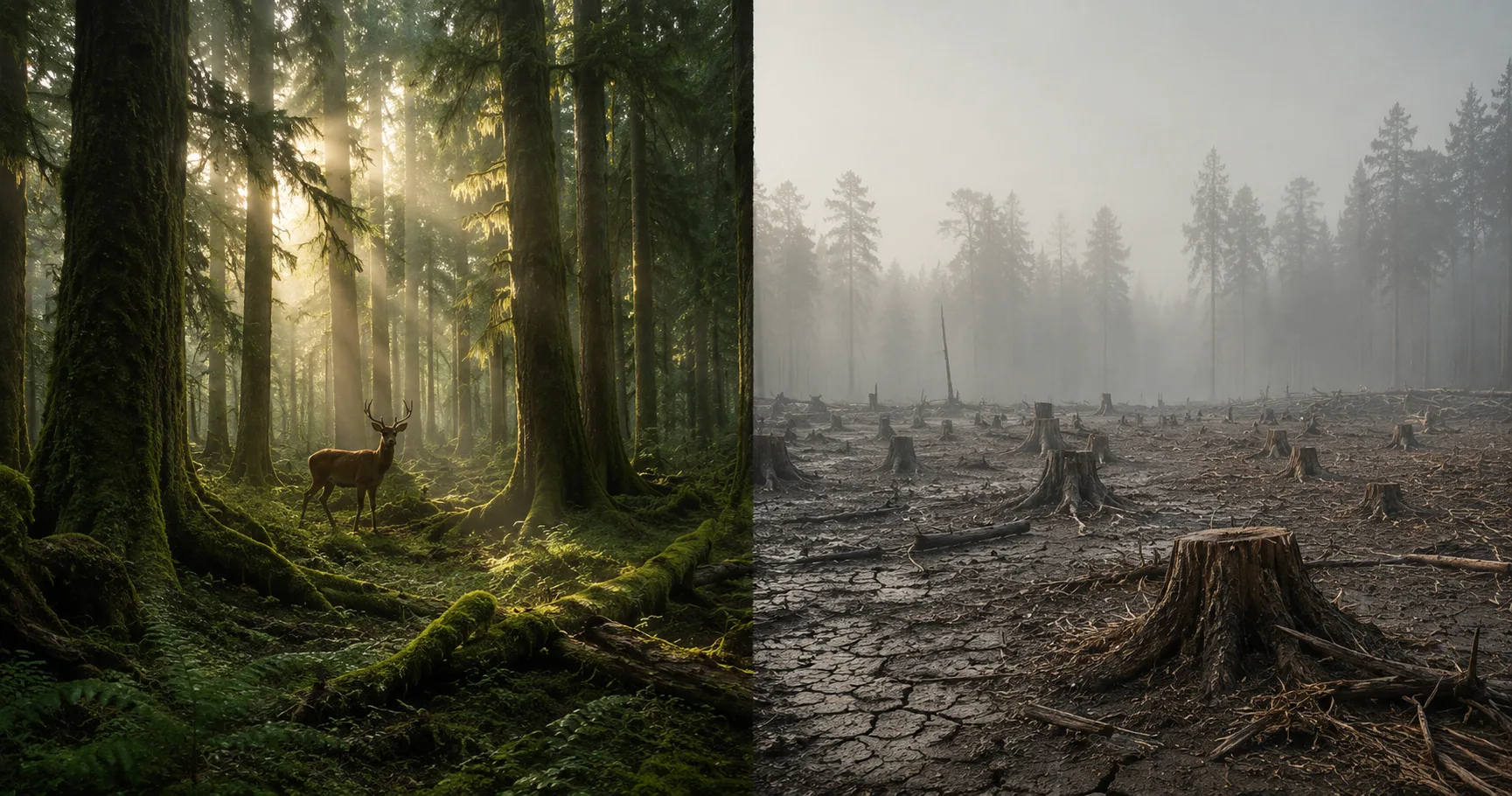
World Nature Conservation Day falls on July 28 each year. It specifically highlights the need to protect natural resources – forests, water, soil, air, wildlife, and biodiversity.
The day was formally established after growing global concern in the late 1990s about accelerating species loss and habitat destruction. The International Union for Conservation of Nature (IUCN) declared July 28 as the designated date to raise awareness about human impact on nature.
 Its roots trace back to the same 1972 Stockholm Conference that gave birth to World Environment Day both emerged from that landmark moment in global environmental politics.
The key focus areas of World Nature Conservation Day include:
- Saving endangered species – over 44,000 species are currently listed as threatened with extinction according to the IUCN Red List.
- Protecting forests and wetlands – these ecosystems absorb carbon, regulate rainfall, and support millions of species.
- Promoting sustainable resource use – ensuring that logging, fishing, and mining do not permanently destroy ecosystems.
- Educating future generations – building a culture of conservation through schools and communities.
Conservation and preservation are not the same thing. Conservation allows for sustainable human use of resources. Preservation means protecting nature from human use entirely. World Nature Conservation Day advocates for the former — responsible use, not zero use.
If you want to go deeper into green practices connected to conservation, the Van Mahotsav 2026 guide is worth reading — it covers India’s annual tree-planting festival and its role in national conservation.
Powerful Earth Day Quotes to Share in 2026
Words have moved people to act before. These quotes are worth sharing on social media, in speeches, or in classrooms around World Environment Day and beyond.
Mahatma Gandhi: “Earth provides enough to satisfy every man’s needs, but not every man’s greed.” One of the most quoted lines in conservation history because it identifies the root problem so precisely.
Dalai Lama: “It is our collective and individual responsibility to preserve and tend to the world in which we all live.” Shifts the conversation from blame to responsibility.
David Attenborough: “No one will protect what they don’t care about; and no one will care about what they have never experienced.” The strongest argument for nature education and outdoor experiences.
Theodore Roosevelt: “Conservation is a great moral issue, for it involves the patriotic duty of ensuring the safety and continuance of the nation.” Remarkably modern for a statement made in the early 1900s.
Rachel Carson: “In every walk with nature, one receives far more than he seeks.” Carson’s Silent Spring (1962) arguably launched the modern environmental movement.
These quotes work well for World Environment Day posts, school projects, and awareness campaigns. Use them but pair them with action.
What Can You Actually Do on Environment Day 2026?
Awareness without action is just noise. Here are concrete things individuals can do on and around June 5, 2026 — ranked by impact:
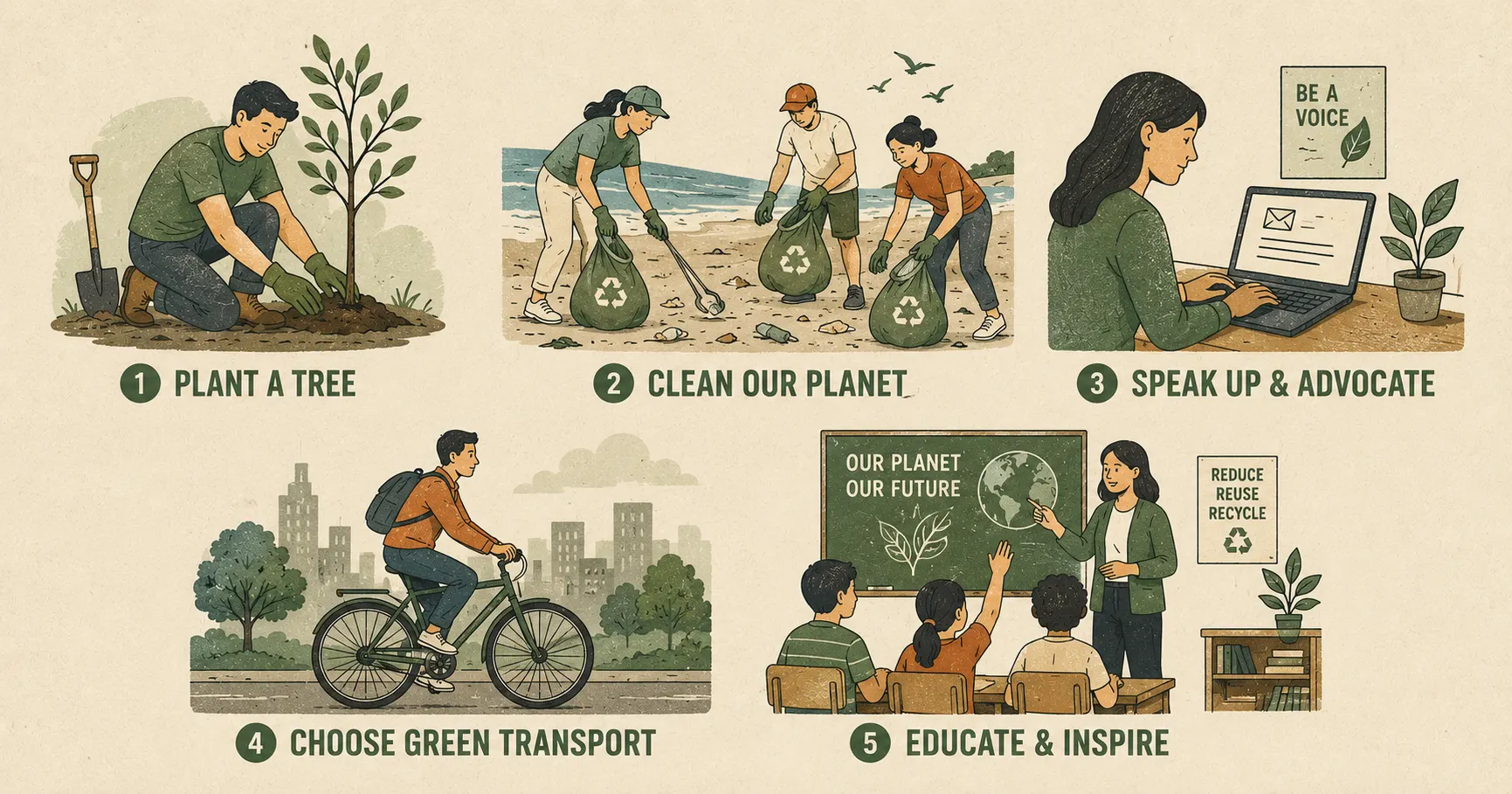 1. Plant a tree and document it. Tree planting is symbolic, but it adds up. One mature tree absorbs around 22 kg of CO₂ per year. More importantly, sharing what you planted on social media creates peer pressure that leads others to do the same.
2. Join or organize a local clean-up. Community clean-ups are one of the most direct forms of environmental action. They remove plastic before it reaches waterways, build community bonds, and generate local media coverage. You can get ideas for organizing one through the World Cleanup Day guide.
3. Cut one high-carbon habit for 30 days. Driving less, reducing red meat consumption, or switching to a renewable energy tariff pick one and commit to 30 days. Studies show 30-day habits tend to stick.
4. Contact an elected representative. One email or phone call to a local politician about a specific environmental issue a planned development near a forest, a recycling program, or an air quality standard has more impact than ten social media posts.
5. Educate someone who does not already agree with you. Talking to people who share your views does nothing for the environment. Talking calmly and specifically to someone skeptical a family member, a colleague does.
What Schools and Organizations Can Do
World Environment Day is particularly powerful when it moves beyond individuals to institutions. Schools and organizations have scale.
Schools can:
- Run an environmental quiz or debate covering current issues like climate finance, plastic treaties, or biodiversity loss.
- Set up a classroom composting station and track how much food waste is diverted from landfill over the school year.
- Start a tree nursery growing seedlings from local native species that students can plant in the community.
- Organize an eco-art competition where students create posters or sculptures from recycled materials.
Organizations and businesses can:
- Conduct a waste audit and publish the results transparency creates accountability.
- Partner with a local conservation group for a habitat restoration project.
- Commit to a measurable target: percentage of renewable energy used, single-use plastics eliminated, or water consumption reduced.
- Give employees one paid day off to volunteer on an environmental project.
The key is specificity. A vague commitment to being “greener” means nothing. A target “we will eliminate single-use plastic packaging from our offices by December 2026” can be measured, reported on, and held to.
The Angle Most Articles Miss: Local Action Has Global Weight
Most World Environment Day coverage focuses on global statistics and international agreements. Those matter. But there is something those articles often miss: the global numbers are made up of local actions.
The 2026 campaign theme “Inspired by Nature. For Climate. For Our Future.” contains a word that deserves attention: inspired. It is not informed by nature or warned by nature. It is inspired.
That choice is deliberate. UNEP’s research consistently shows that people who have had meaningful personal experiences in nature forests, rivers, coastlines, even urban parks are far more likely to take environmental action than those who have only read about environmental problems.
This is why events like Van Mahotsav in India, where millions of trees are planted every July, matter beyond the carbon math. They put people in contact with nature. They build the emotional case for conservation that no data point can.
It is also why World Cleanup Day which mobilizes people in over 190 countries for a single weekend of action is so effective. People who pick up plastic from a beach once tend to stop littering themselves. The experience changes behavior in a way that statistics alone do not.
The takeaway: do not wait for a government to act. Go outside. Engage with the natural world. Then act from that place.
FAQ: World Environment Day
Q: When is World Environment Day celebrated? World Environment Day is celebrated every year on June 5. The date marks the opening of the 1972 Stockholm Conference on the Human Environment, which was the first major UN conference to treat environmental protection as a global priority.
Q: What is the theme for World Environment Day 2026? The theme for World Environment Day 2026 is “Inspired by Nature. For Climate. For Our Future.” It focuses on climate action, with Azerbaijan hosting the global observance in Baku. The campaign hashtag is #NowForClimate.
Q: What is the difference between World Environment Day and Earth Day? Earth Day (April 22) started in 1970 as a US grassroots movement and focuses heavily on civic engagement and public awareness. World Environment Day (June 5) is organized by the United Nations and involves more direct government and policy participation at an international level. Both matter, and both are worth observing.
Q: What is World Nature Conservation Day and when is it? World Nature Conservation Day falls on July 28 every year. It focuses specifically on protecting biodiversity, natural resources, and endangered species. It is distinct from World Environment Day but shares the same underlying goal: keeping the planet’s natural systems intact for future generations.
Q: How can students participate in World Environment Day? Students can participate through school clean-ups, tree planting, eco-art projects, environmental debates, or simply by learning about one specific issue plastic pollution, deforestation, or water scarcity and sharing what they learn with others. The most effective student actions are specific, documented, and shared publicly to inspire peers.
World Environment Day is not a day off from thinking about the planet. It is a day to start thinking about it differently and then to keep going.

Abhay Ramola researches world festivals across primary sources, local accounts, and on-ground reporting. He founded Dionfest to cover what gets missed when festivals become tourism content the history, the ritual, and the people behind it.







2 thoughts on “World Environment Day 2026: Date, Theme, History & How You Can Actually Help”