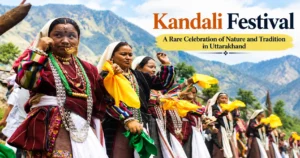
Kandali Festival: Why Rung Women Uproot a 12-Year Flower
Mahiman Singh Hyanki, 86, from Sirkha village, has now seen the Kandali Festival six times. That is not unusual for a festival that returns only about once in 12 years. In October 2023 he told a reporter from The Northern Gazette that the enthusiasm had been the same at every one of them.
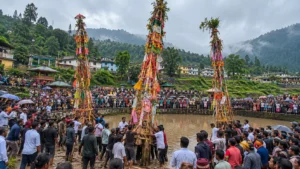
That year, villagers of the Chaundas Valley in Pithoragarh gathered at Chidangyar ground, roughly 1.5 km from Sirkha, in ceremonial dress. They walked to the forest, uprooted the Kandali plants that had flowered, and came back congratulating each other on the victory.
The Kandali Festival (कंडाली पर्व) is a victory festival of the Rung (Shauka) community in the Chaundas Valley of Pithoragarh, Uttarakhand. It is held when the Kandali plant flowers, about once every 12 years, and it ends with the ceremonial uprooting of the plant. The most recent edition took place in October 2023. No date has been announced for the next one.
Kandali Festival at a glance
| Festival name | Kandali Festival (also spelled Kangdali); Kandali Parv or Mahotsav in Hindi |
| Celebrated by | The Rung (Rang) community, often called Shauka in official texts |
| Location | Chaundas Valley, Dharchula tehsil, Pithoragarh district, Uttarakhand |
| Frequency | About once every 12 years, when the Kandali plant flowers |
| Most recent edition | October 2023 (main day reported on Saturday, 28 October) |
| Earlier editions | 2011 and 1999 |
| Next edition | Not announced as of October 2026. Around 2035 if the 12-year rhythm holds (a projection that Lonely Planet also gives) |
| Season | Late summer to autumn; official listings say August to October |
| Duration | About a week; some listings say 5 to 7 days |
| Type | Community victory and ritual festival |
What is the Kandali Festival?
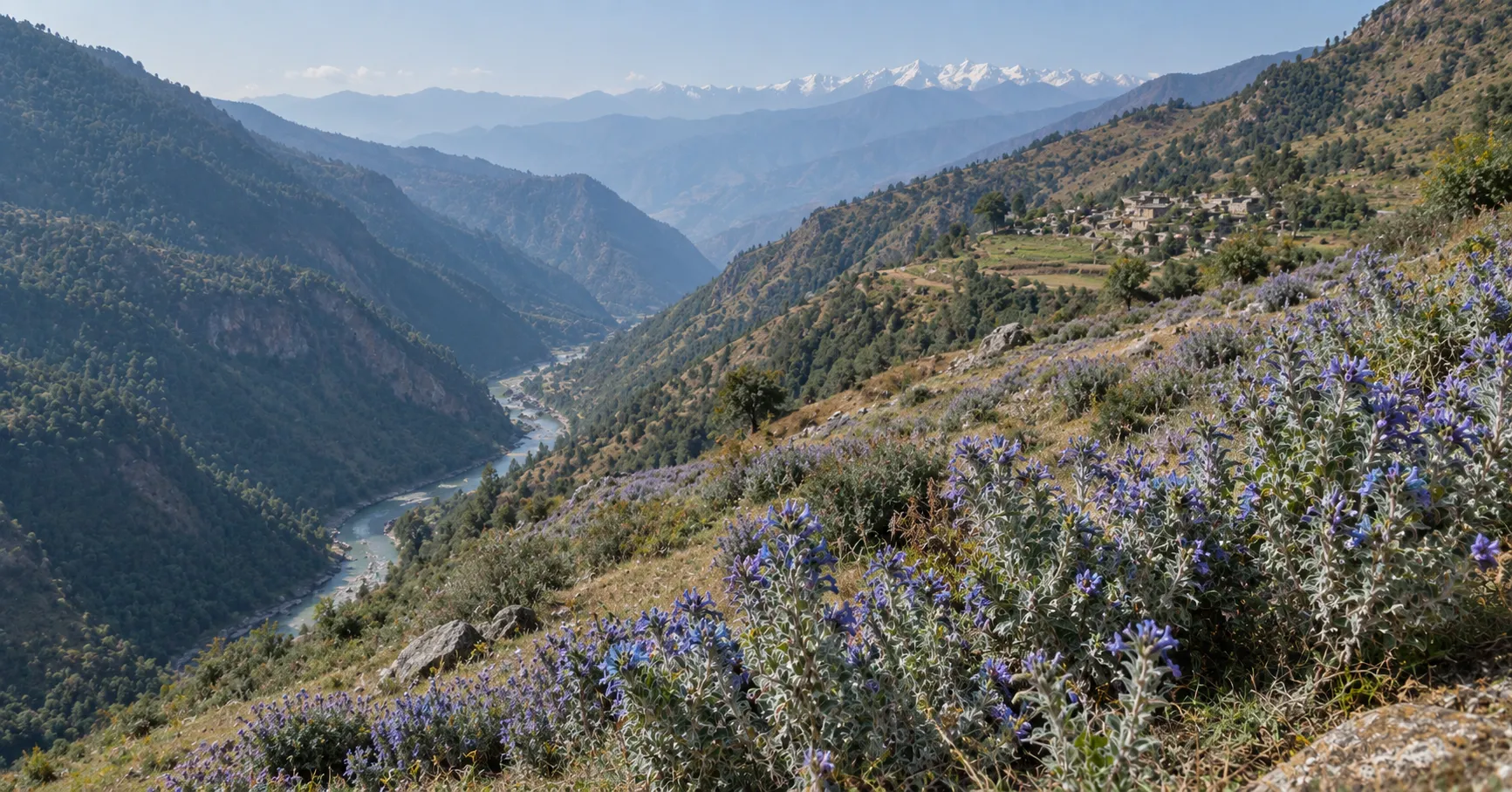 The Rung, also written Rang, are one of the Bhotia communities of Pithoragarh’s border valleys. Government and tourism pages usually call them Shauka. Chaundas Valley lies in the Dharchula region between the Kali and Dhauli rivers. Organisers of the 2023 edition said 14 villages of the valley take part.
Kandali has no fixed date in any calendar, because it waits for a plant to flower. Its central act is also unusual. Instead of offering something to a deity, the community destroys something together.
How does the Kandali Festival unfold?
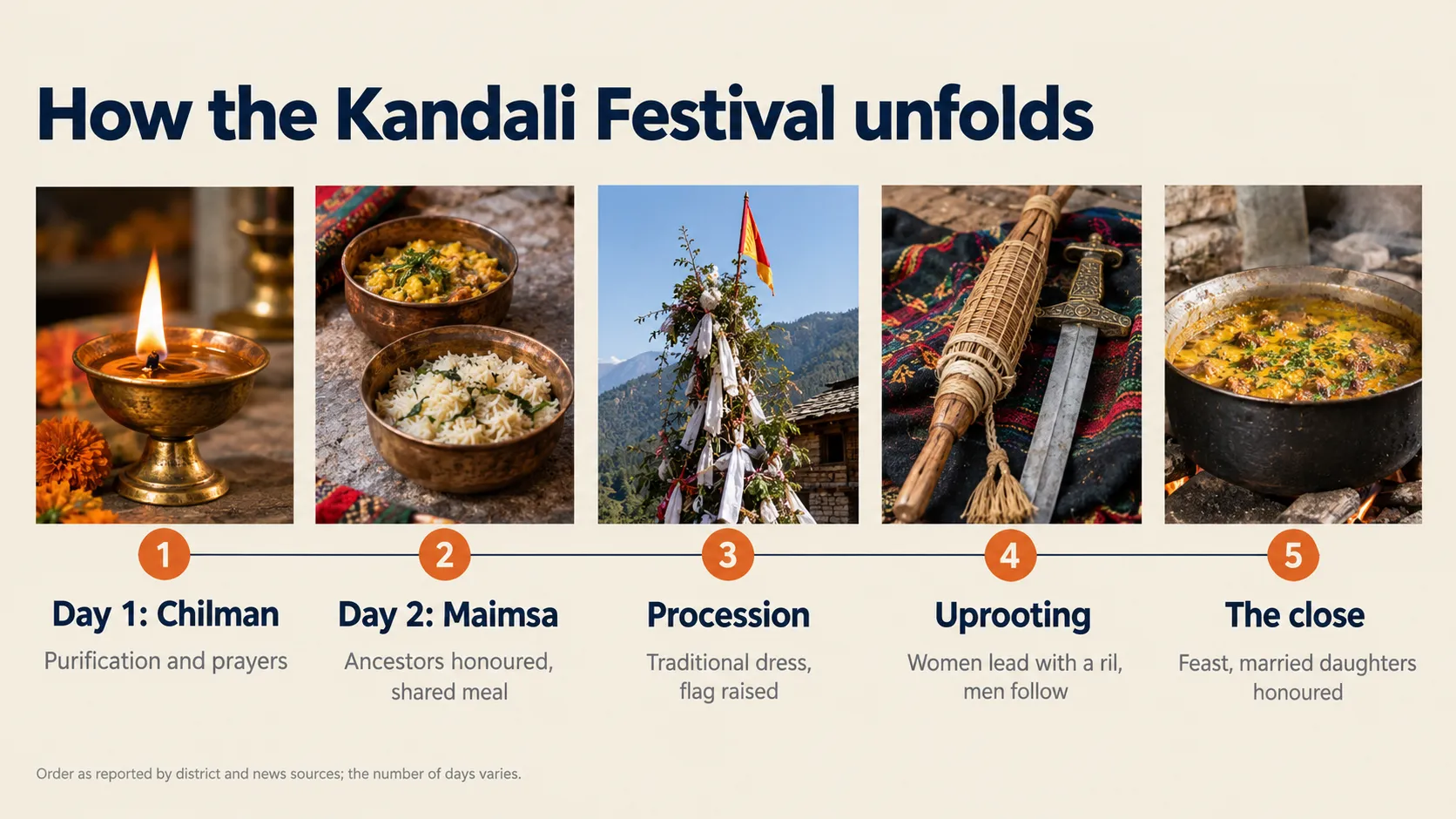 Sources differ on the length. The Kumaon government calls it week-long, and Lonely Planet gives five to seven days. The sequence below is pieced together from the Pithoragarh district heritage page and a 2022 Hindi report from ETV Bharat, so treat the day numbers as a guide rather than a timetable.
Day one: chilman
Prayers call on Syandsai (the Rung name for Shiva), Gabla (Ganesh), family and village deities, and ancestors. The day opens with chilman, a rite of purifying body and mind. According to the district heritage page, each household worships at a decorated corner of its courtyard, using a Shiva linga made from a mix of barley and buckwheat flour. Local liquor is traditionally part of the festival, and people pray for prosperity.
Day two: maimsa
This day is for ancestors. People sing the glory of their forebears and try to feel a mental bond with them. Traditional dishes are served, and a communal meal follows the personal worship.
The procession
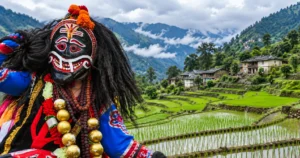
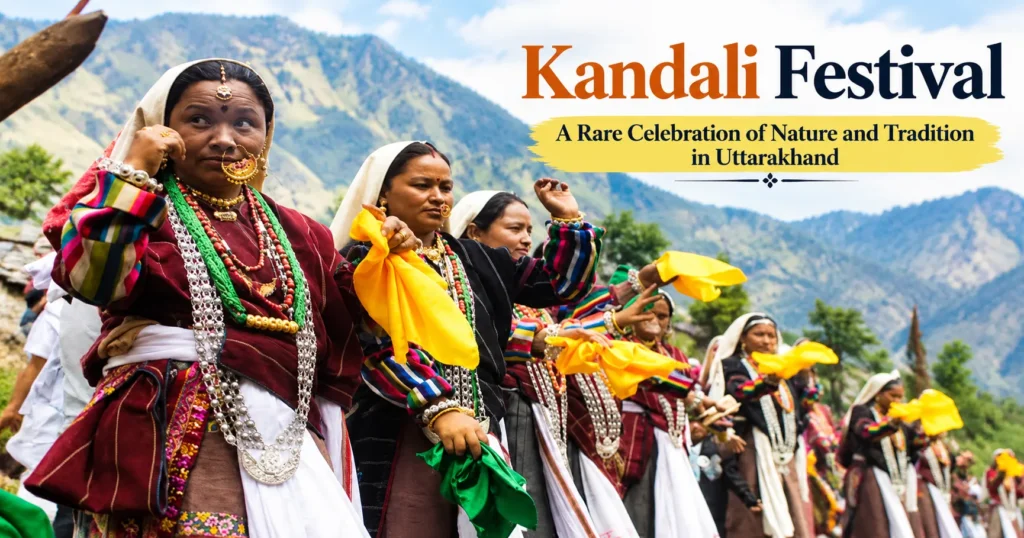
Men and women gather in traditional dress and gold and silver jewellery around a tree on sacred ground, where strips of white cloth are tied and a flag is raised, according to the Kumaon government’s festival page. Lonely Planet’s writer describes women in silver coin necklaces and striking nose pins, and men in white turbans. The Hindi report calls the dress one of the main attractions of the festival.
The uprooting
The procession heads for the flowering plants. Women lead, carrying a ril, a tool used in carpet weaving. Men follow with swords. Children, elders and women dance and sing as the plants are cut down and pulled up by the root. The uprooted plants are carried home. According to the Ministry of Tourism’s Incredible India listing, half are cooked as a curry and eaten with rice at the feast, and the other half are thrown into the sky as a sign of victory over the invader. Lonely Planet describes the men moving through the forest in coordinated steps, swords swinging.
The close
The 2023 edition ended with a different kind of ceremony. Villagers honoured more than 50 married daughters of the valley, together with their husbands. Senior members of the Rung community living in Changru, Nepal, also took part. The Dharchula MLA, Harish Dhami, inaugurated the festival.

Words you will meet
| Word | Meaning |
|---|---|
| Kandali | The plant, and the festival named after it. Also spelled Kangdali |
| Kandali Parv, Kandali Mahotsav | Hindi names for the festival. A 2022 report says it is now celebrated as a mahotsav |
| Kirji | The same plant’s name in Bundi, according to the Hindi report |
| Jontila | Another local name reported for the flower |
| Ril | The carpet-weaving tool women carry to uproot the plant |
| Chilman | The first-day rite of purification |
| Maimsa | The second-day rite of honouring ancestors |
| Syandsai and Gabla | Rung names for Shiva and Ganesh |
Why do they destroy the plant? Two stories, several versions
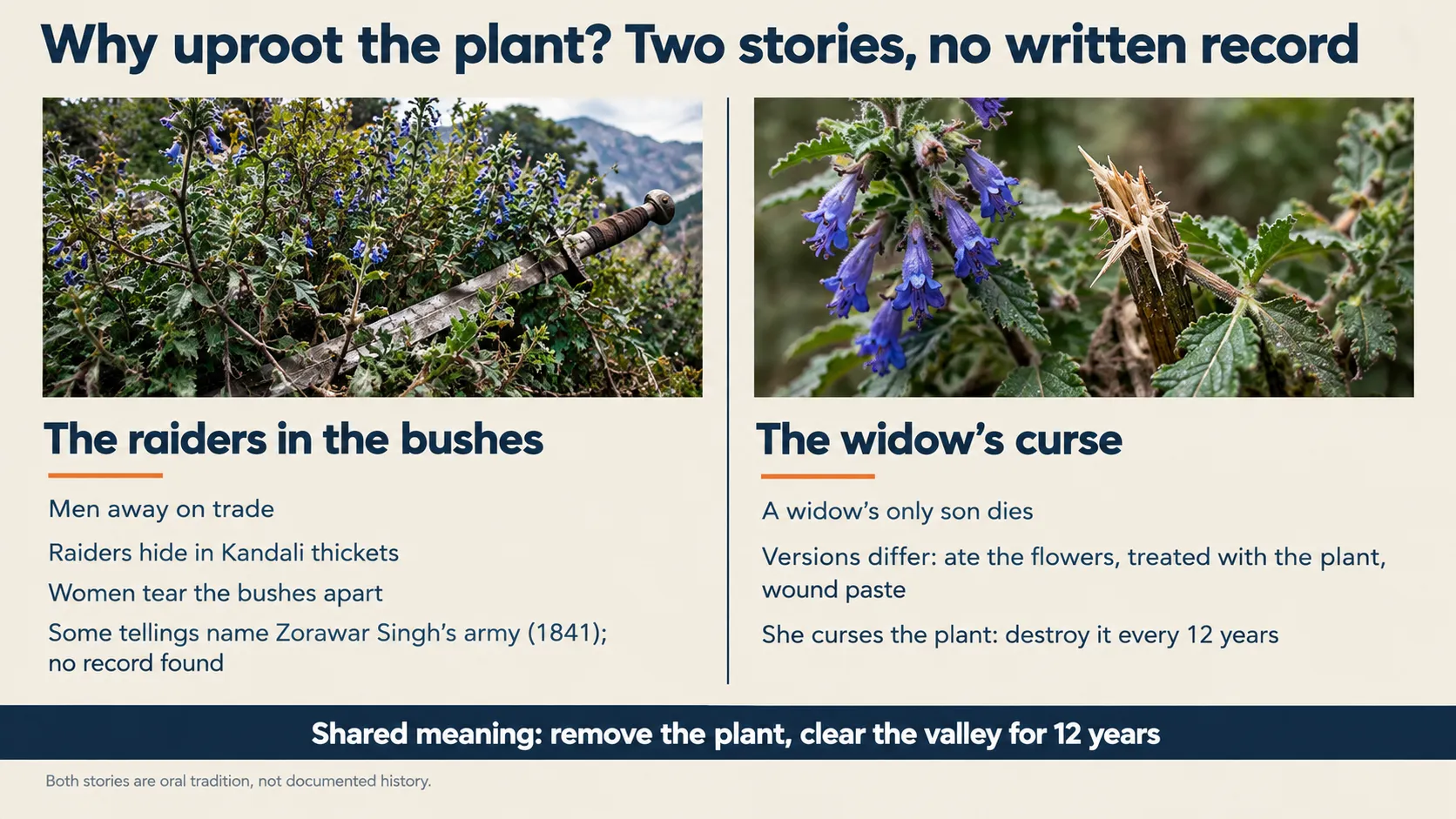 Every account agrees that the uprooting is deliberate and symbolic. The reasons given are different, and none of the accounts we found points to a written historical record. They are best read as oral tradition.
The raiders in the bushes
In the first telling, the men of the valley were away on trade when raiders attacked and hid behind thickets of Kandali. The women went out with their rils, tore the bushes apart and exposed the intruders, and the men chased them off.
Wikipedia and many tourism pages say these intruders were the army of Zorawar Singh, which supposedly came from Ladakh in 1841. Zorawar Singh was a real Dogra general whose forces campaigned in Ladakh and western Tibet around that year. We found no historical source that places his troops in Chaundas. Some pages even place the attack in the “late 19th century”, which is not when he lived. The story may be a local memory attached to a famous name.
The widow’s curse
In the second telling, an old woman’s only son died, and the plant was blamed. The versions disagree on how.
- An organiser quoted in 2023 said the boy, 12 years old, died about 400 years ago after eating Kandali flowers. The Pithoragarh district heritage page also says the widow’s only son died after tasting the flower, which it calls poisonous.
- A 2022 Hindi report says he fell ill and was treated with the plant, and died.
- Other accounts, including the Incredible India listing, say he died after a wound was treated with a paste made from the plant. The listing adds that the plant was never fully destroyed and kept growing back, which is why the tradition continues.
In all versions, the grieving mother cursed the plant and asked that it be destroyed every 12 years. The Hindi report adds the wording of the curse: when the plant’s branches number twelve, in its twelfth year, it will be destroyed too. The number twelve appears in the boy’s age, in the curse and in the cycle itself.
Whichever story a family prefers, the meaning of the act is similar. The plant stands for harm, and removing it is seen as clearing the valley of troubles for the next twelve years.
Why does a 12-year gap matter?
A festival that returns once in twelve years skips a generation’s worth of ordinary life between editions. Anyone who was a newborn at the 2011 edition was about twelve at the 2023 one. Hyanki’s six festivals cover most of an adult life.
The reports we found point to a homecoming as much as a ritual. The 2022 Hindi report says many locals travel back to the valley for the festival, and that the community keeps working to introduce the younger generation to the heritage. A tourism page makes the same point from the other side, saying the festival reunites relatives who live elsewhere in the country.
The same impulse shows up outside the festival. At a Rung language day event in Dharchula, reported by Amar Ujala, a community leader said efforts to create a Rung script were continuing, and that children are being taught the Rung language and young men how to tie the turban. Taken together, these reports suggest Kandali works partly as the one fixed date that pulls a scattered community back to the valley.
What is Kandali, botanically?
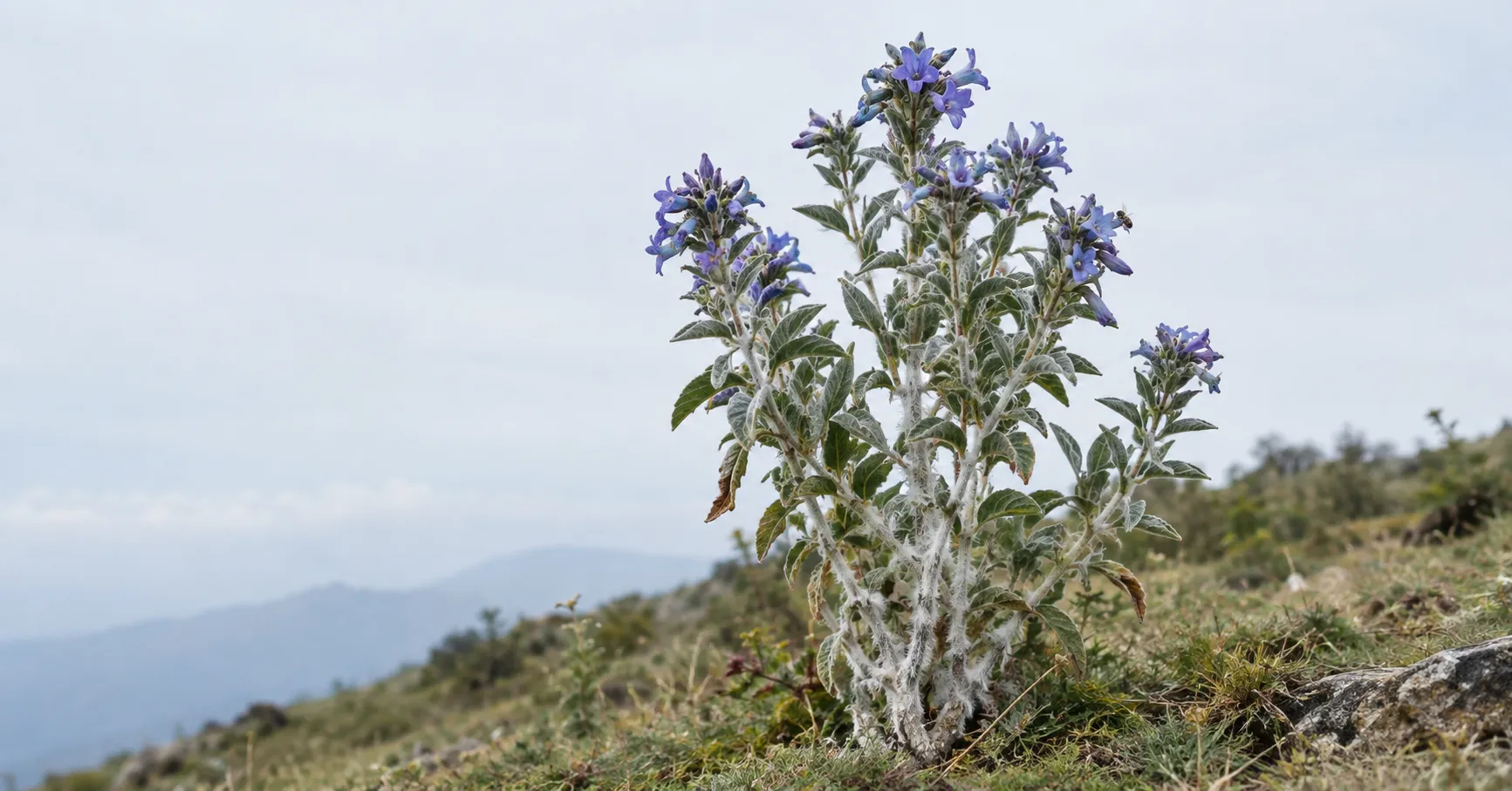
This is where the sources split. Search for the Kandali flower and you will find at least three different identifications.
| Source | What it calls Kandali |
|---|---|
| Incredible India (Ministry of Tourism listing) | Stinging nettle, and says the plant is routinely cooked in meals |
| A 2023 English news report and a June 2022 Hindi report | Nettle, Urtica dioica |
| Pithoragarh district and Kumaon government pages, Wikipedia, Lonely Planet | Strobilanthes wallichii |
| A September 2023 Hindi news report | Aechmanthera gossypina, locally also called Jontila, and explicitly not bichhu ghas |
| A 2000 botanical paper by S. S. Garbyal | Aechmanthera gossypina (kandali), flowering gregariously in Chaudans Valley |
| A 2016 paper in Indian Forester by Forest Research Institute botanists | Strobilanthes tomentosa (synonym Aechmanthera gossypina), with a 12-year bloom in Chaudans that starts the Kangdali festival |
The nettle label deserves a fair hearing. The Incredible India listing says the uprooted plants are cooked and eaten, and that the plant is routinely cooked in meals. That is how Himalayan nettle is used, and in everyday Kumaoni speech kandali is also a word for nettle, more commonly called bichhu ghas or sinsaun. Even the Hindi report that argues the two plants are different opens by listing all three names together, which shows how tangled the everyday words are.
Four things point the other way. A common nettle flowers in most years, so it cannot explain a festival timed to a 12-year bloom. A 2000 botanical paper and a 2016 paper by Forest Research Institute botanists both tie the Chaudans bloom to an acanthus-family shrub that flowers all at once. The 2023 Hindi report says outright that Kandali is not bichhu ghas. And the 2022 Hindi report that calls it nettle tries to square the cycle with a folk belief that the plant bears one flower a year and twelve in its twelfth year, which is a belief, not botany. One possibility is that local use blends two plants under one name, but we found no source that says so directly.
The best-supported identification is Strobilanthes tomentosa, also written under its older name Aechmanthera gossypina. The 2016 paper in Indian Forester treats the two names as one plant and describes a 12-year gregarious flowering cycle with records from the Uttarakhand Himalaya. It says the Kangdali festival starts in Chaudans when the plant blooms, and that honey production rises during the bloom. The district and Kumaon pages name Strobilanthes wallichii instead. Both belong to the acanthus family, so the two names disagree on the species, not on the kind of plant. Descriptions of A. gossypina match what the festival needs: a shrub up to about 1.2 m tall with white, woolly lower branches and blue-violet flowers that open between August and October.
Plants of this group are known for mass flowering at long intervals, called plietesial flowering. Most known species take 10 to 15 years, usually 12. The best-known example is Neelakurinji in the Western Ghats, which also blooms on roughly a 12-year rhythm. Kandali is the Himalayan cousin of a far more famous flower.
Official pages still say wallichii, and the tourism listing still says nettle. Until those pages catch up with the botanical papers, expect to see all three names online.
When was the last Kandali Festival, and when is the next?
The last Kandali Festival was held in October 2023. Many pages still say 2011, and the Pithoragarh district’s own heritage page still reads “last in 1999 and next in 2011”. Those pages are out of date.
| Year | What the record shows |
|---|---|
| 1975 and 1987 | Photographer Anup Sah says he saw the bloom in both years |
| 1999 | Government and local sources record a bloom |
| 2011 | Festival held in Chaundas Valley; Indian Forester records 2011 as the last flowering before 2023 |
| 2023 | Plants reported in flower by mid-September; festival in late October |
In 2023 the bloom was also seen outside Pithoragarh, in Nainital and Champawat, according to the Hindi report. The 2016 Indian Forester paper says the festival begins in October after Dussehra, and that honey production rises while the plant is in bloom.
If the 12-year rhythm holds, the next bloom would fall around 2035. Lonely Planet gives the same year. It is still a projection, not an announcement, and we found no announcement of any edition in 2026 or 2027. Wild plants rarely flower in perfect lockstep, and the whole valley starts the festival on a single date that the community fixes. Watch Pithoragarh district announcements and Dharchula local news closer to the time.
Festivals that follow a flower or a season
Kandali is one of several Himalayan festivals whose date comes from nature or from a long cycle rather than a fixed day.
| Festival | Place | What sets the date | Treatment of the flower or season |
|---|---|---|---|
| Kandali | Chaundas Valley, Pithoragarh | Mass flowering of the Kandali plant, about every 12 years | The plant is uprooted |
| Phulaich | Kinnaur, Himachal Pradesh | Blooming of the ladra flower, held each September | The flowers are offered to ancestors |
| Hilljatra | Kumaur village, Saur Valley, Pithoragarh | Month of Bhadra, eight days after Gor-Maheshwar; tied to paddy planting (Kumaon government) | Masked dramas of farm life; in 2026 held on 24 August (PTI via ThePrint) |
| Naropa | Ladakh | A 12-year cycle honouring a Buddhist saint | Relics and a large thangka displayed; next expected 2028 |
Phulaich and Kandali both mark a flowering, and they treat it in opposite ways. One community offers its flower to its ancestors, and the other pulls its plant out by the roots. The Phulaich and Naropa details come from Lonely Planet’s guide to rare Himalayan festivals. A 2022 Hindi report compared the Kandali cycle to the Kumbh, since both return every twelve years.
For a Garhwal contrast, see our guide to the Danda Devrana Mela in Uttarkashi.
Planning to visit Chaundas Valley?
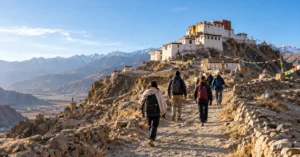
Nothing is due before the next bloom, so there is no festival to attend in the near term. The valley itself lies beyond Tawaghat in Dharchula tehsil, along a stretch that includes Pangu, Sosa, Sirkha, Narayan Ashram, Sirdang and Gala. Border areas can have access rules, so check permit requirements and road conditions with the Pithoragarh district administration before planning a trip. DionFest has not verified the current rules.
Quick answers
Is there a Kandali Festival in 2026?
No edition has been announced for 2026. The most recent Kandali Festival was held in October 2023, and the next is expected around 2035 if the 12-year cycle holds. The date follows the flowering of the Kandali plant, so the community sets it.
When is the next Kandali Festival?
No date is announced. If the plant keeps its 12-year rhythm, the next bloom is expected around 2035. Lonely Planet gives the same year. Check Pithoragarh district announcements and local Dharchula news closer to the time.
How often is the Kandali Festival held?
About once every 12 years. It is timed to the mass flowering of the Kandali plant, which blooms on a long cycle. Recorded bloom years include 1975, 1987, 1999, 2011 and 2023.
Where is the Kandali Festival held?
In the Chaundas Valley of Dharchula tehsil in Pithoragarh district, Uttarakhand, between the Kali and Dhauli rivers. Organisers of the 2023 edition said 14 villages of the valley take part.
Why is the Kandali plant uprooted?
Local tradition gives two reasons. In one, women destroyed the bushes in which raiders were hiding. In the other, a grieving widow cursed the plant after her only son died. Uprooting it is believed to free the valley from troubles for the next twelve years.
What happens during the Kandali Festival?
It opens with worship and a rite of purification called chilman, followed by a day honouring ancestors called maimsa. After a communal meal, villagers in traditional dress walk to the forest and uproot the plants, with women leading. According to the Ministry of Tourism listing, half the uprooted plants are cooked for the feast and half are thrown into the sky as a sign of victory.
Is Kandali the same as stinging nettle?
Sources disagree, but the botanical evidence leans against it. The Ministry of Tourism listing and some news reports say stinging nettle. Two botanical papers, one by Forest Research Institute botanists, identify a shrub of the acanthus family, Strobilanthes tomentosa (also written Aechmanthera gossypina), that flowers together every 12 years. Official district pages name a related species, Strobilanthes wallichii.
Who celebrates the Kandali Festival?
The Rung (Rang) community, also called Shauka, of the Chaundas Valley. Rung people from Nepal also joined the 2023 celebration.
Can tourists attend the Kandali Festival?
Official tourism listings present it as an event, but it is organised by village committees and nothing is scheduled before the next bloom. Check access rules with the Pithoragarh district administration before planning a trip.

Abhay Ramola researches world festivals across primary sources, local accounts, and on-ground reporting. He founded Dionfest to cover what gets missed when festivals become tourism content the history, the ritual, and the people behind it.