Hilljatra Festival: The Masked Agricultural Festival of Pithoragarh, Uttarakhand
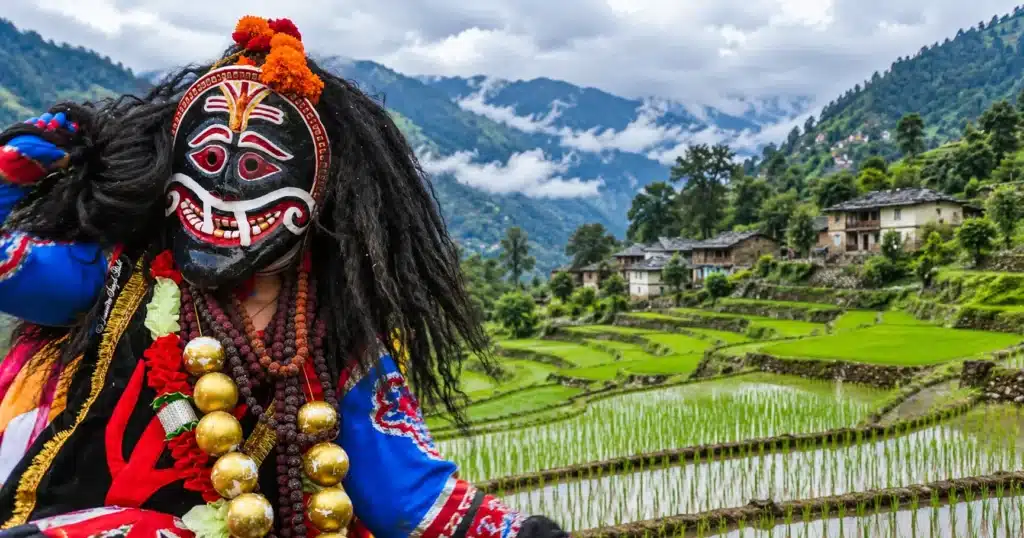
In the Sor Valley of Pithoragarh, a man puts on a mask taller than himself, a fierce, wide-eyed face called the Lakhiya Bhoot, and becomes something other than a farmer for one night a year. Around him, other performers become a deer, a leopard, a ploughman, acting out the entire cycle of planting rice, not as metaphor, but as literal, physical drama performed for a community that has just finished transplanting its own paddy fields days earlier. Hilljatra doesn’t symbolise agricultural life. It re-enacts it, in front of the people who just lived it.
This guide covers what Hilljatra actually is: where in Uttarakhand it’s celebrated, the masked characters at its centre, what’s genuinely documented about its history versus what’s passed down as local memory, and the specific question most coverage of the festival never quite answers, why an agricultural community would choose to represent its own farming labour through masked performance rather than simply celebrating the harvest directly.
Fast facts
- What it is: A Kumaoni masked folk festival from Pithoragarh district, Uttarakhand, performed shortly after paddy transplantation, combining ritual theatre, animal and deity masks, and agricultural drama
- Where: The Sor Valley in Pithoragarh district, with Kumaur village most closely associated with its origin and continued celebration
- When: Held around the Bhadrapad month of the Hindu calendar (roughly August-September), timed to the local agricultural cycle rather than a single fixed civil date
- Central mask: The Lakhiya Bhoot, a large, fierce-featured mask representing a guardian spirit, alongside animal masks including deer and other wildlife, and human character masks depicting farmers and labourers
- Claimed age: Widely reported in 2026 national coverage as “over 500 years old,” a figure that traces to local oral tradition and community memory rather than a single documented historical record
- 2026 attention: National media, including PTI, covered the festival again in August 2026, drawing renewed public and political attention to a tradition long celebrated primarily within Pithoragarh itself
Hilljatra is a centuries-old Kumaoni tradition in which a farming community performs its own agricultural labour, planting, herding, harvest, back to itself through masked drama, staged just after the physical work of paddy transplantation is done. It’s centred on Pithoragarh’s Sor Valley, tied to the agricultural calendar rather than a fixed date, and its age is best described as very old and orally attested rather than precisely documented.
What is Hilljatra?

Hilljatra is a folk festival native to the Kumaon region of Uttarakhand, most strongly rooted in Pithoragarh district’s Sor Valley. At its centre is a masked performance in which villagers, almost always men, take on the roles of animals, spirits, and farm labourers to dramatise the agricultural cycle the community has just lived through.
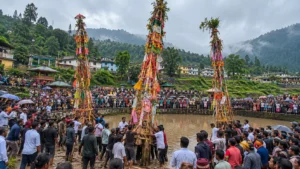
The festival is timed deliberately: it takes place shortly after paddy transplantation is completed, when rice seedlings have been moved from nursery beds into the flooded main fields, one of the most physically demanding points in the farming year. Rather than simply marking the end of that labour with a harvest celebration, Hilljatra restages it. Performers playing a ploughman, a farmer’s wife, and working animals act out ploughing, sowing, and tending crops, while masked deer, leopards, and other wildlife characters move through the same performance space, all building toward the appearance of the festival’s central figure, the Lakhiya Bhoot.
Where is it celebrated?
Hilljatra belongs specifically to Uttarakhand’s Kumaon region, and within Kumaon, to Pithoragarh district’s Sor Valley. Kumaur village is where the festival was first established in the valley and remains its most prominent site of celebration, with the tradition later spreading to Bajethi, Satgaarh, and Didihaat, and, in a modified form known locally as Hiran Chital, to Kanalichhena and Askot.
Pithoragarh sits in the eastern part of Kumaon, close to Uttarakhand’s borders with Nepal and Tibet, a geography that matters directly to the festival’s own origin story, covered in more detail below. The Sor Valley’s farming villages share the broader Kumaoni pattern of tightly-knit agricultural communities where festivals are built directly around the seasonal rhythm of planting and harvest rather than a fixed civil calendar, which is part of why Hilljatra’s exact date moves year to year with the timing of the local paddy transplantation season rather than falling on a single fixed day.
The masks and characters of Hilljatra
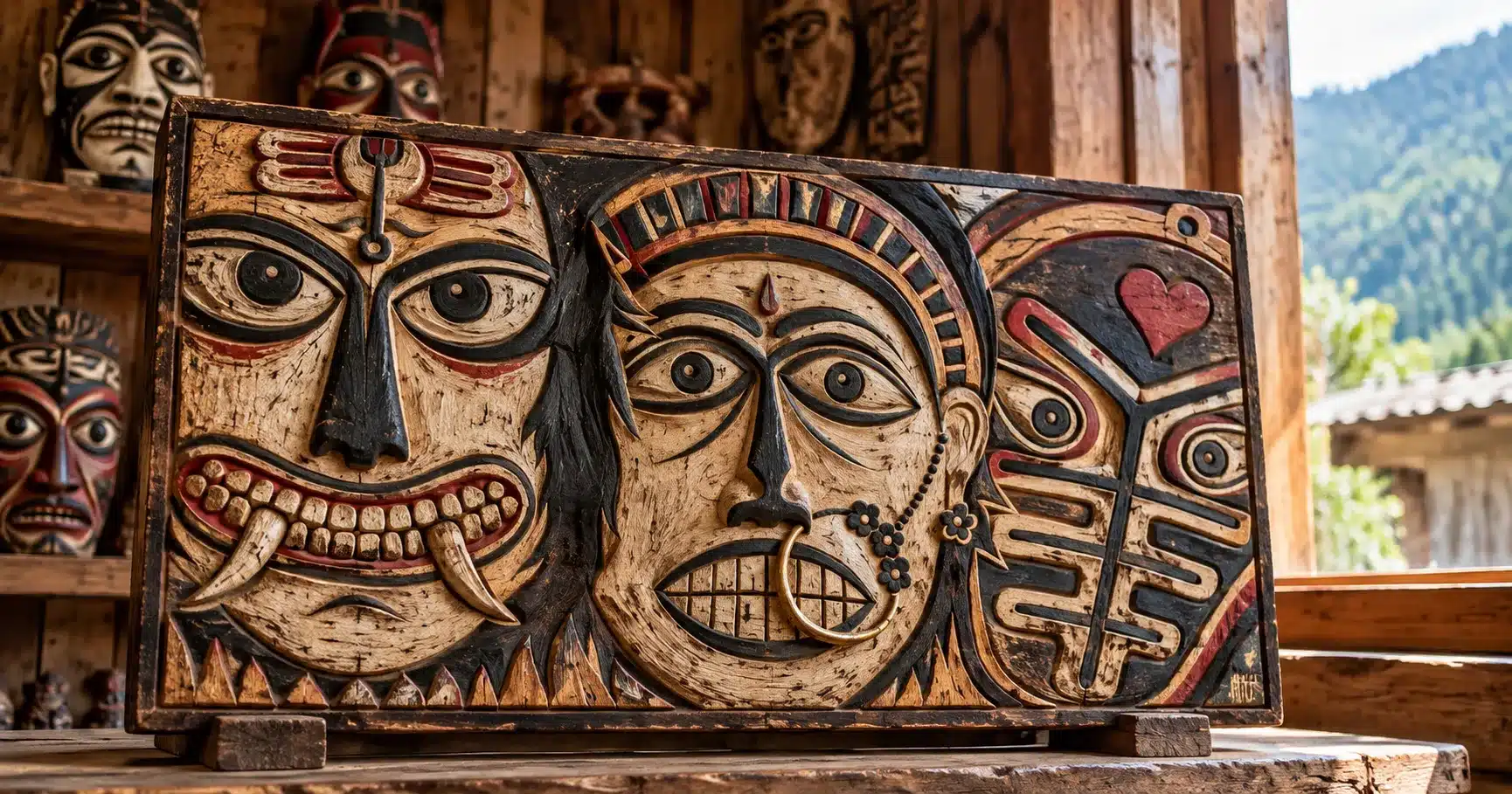 The masks of Hilljatra aren’t decorative additions to the performance. They’re how the festival tells its story, since the drama itself is performed with minimal or no spoken dialogue, relying on costume, mask, and movement to carry the narrative.
The Lakhiya Bhoot is the festival’s defining figure: a large mask with an intentionally fierce, exaggerated face, regarded in local tradition as the chief of Lord Shiva’s ganas, the attendant spirits of Shiva, whose arrival at the climax of the performance is considered highly auspicious and is believed to bless the community with prosperity and a good harvest. Alongside it, performers wear animal masks representing deer, leopards, and other wildlife native to the region’s forests, acting out the presence of the natural world around the farmed valley. Human character masks and costumes depict the Halwaha, the ploughman, along with other farming figures, staging the physical labour of transplantation and cultivation directly rather than referring to it abstractly. The masks themselves are typically carved locally, and in villages where the tradition remains active, mask-making and the knowledge of how each character should move are skills passed down within specific families or performer lineages rather than taught as general craft.
History of the Hilljatra Festival: what’s documented and what’s remembered
Hilljatra’s history follows a familiar pattern for festivals rooted in oral tradition rather than written record: real, sustained age alongside a headline number that’s harder to verify than the coverage repeating it usually admits.
National media, including PTI, reported again in August 2026 that Hilljatra has been celebrated for over 500 years, a figure that circulates consistently across coverage of the festival and is generally treated as community memory and oral tradition rather than a precisely documented date. What is more independently anchored is the festival’s connection to real historical rulers: the Government of India’s own official tourism portal describes Hilljatra’s historical significance as intertwined with the Champawat rulers, part of the Chand dynasty that governed the Kumaon region for centuries, a lineage that is independently documented in regional history even where the exact founding date of the festival itself isn’t. Pithoragarh district’s own government heritage page credits a Chand-era figure named Kuru with introducing the festival to Sor Valley, though sources vary on whether he acted as the Chand ruler himself or on a ruler’s behalf. Most detailed retellings agree on the shape of the story even where they differ on that detail: Kuru travelled to the Sorar region of West Nepal, took part in a local celebration there involving a ritual buffalo sacrifice, pleased the community enough to be given four ceremonial gifts, the Halwaha figure, two bullock characters, a traditional Nepali plough, and the Lakhiabhoot mask, and brought the festival back to introduce in Kumaur village, from where it later spread to Bajethi, Satgaarh, Didihaat, and, in a modified form known locally as Hiran Chital, to Kanalichhena and Askot.
The honest summary: Hilljatra is genuinely old, genuinely local to Pithoragarh, and its “500 years” is best treated as an expression of deep, sustained community memory rather than a verified date.
Why do people perform farming through masks and drama?
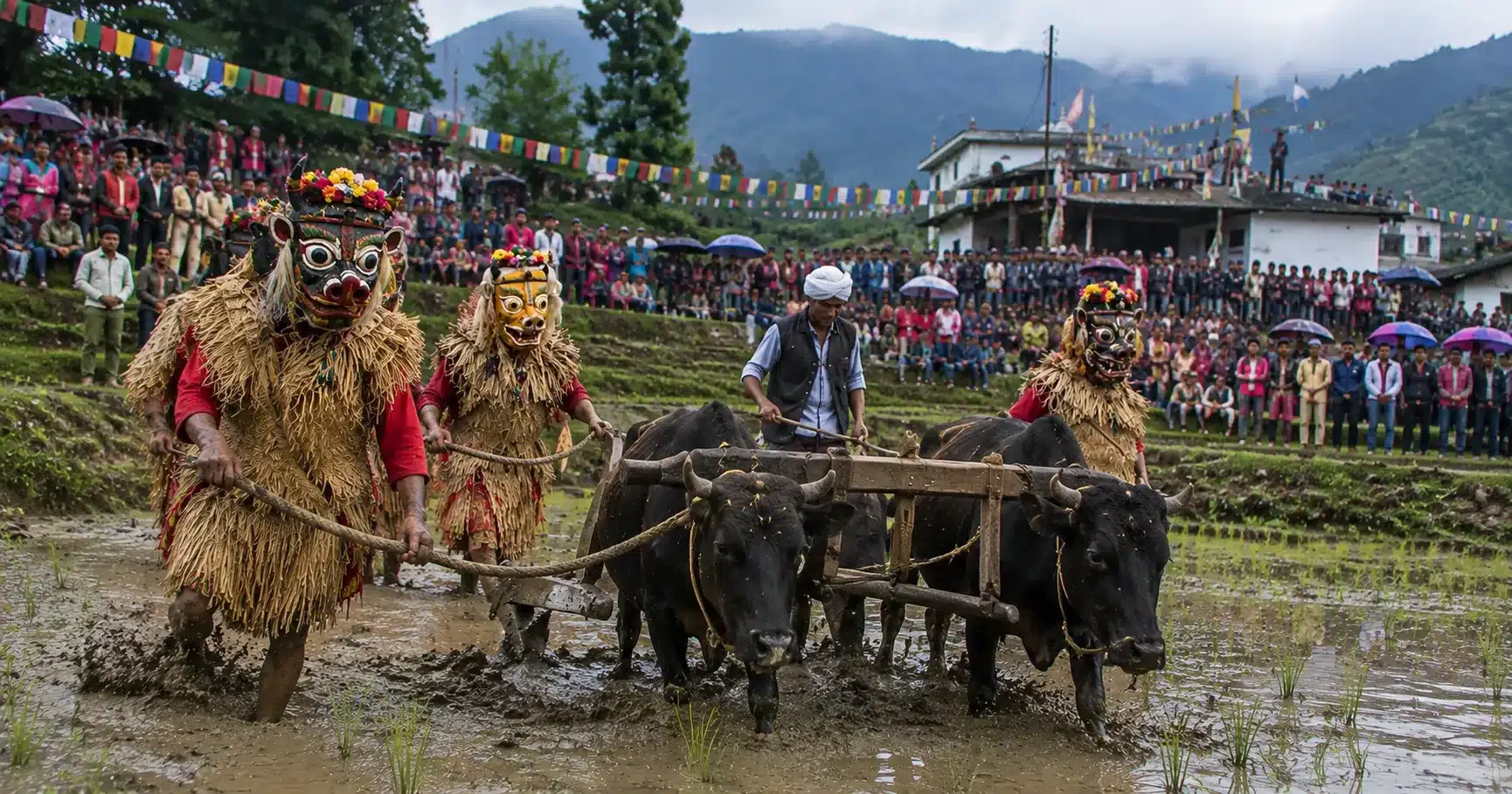 This is the question most coverage of Hilljatra skips past on the way to describing the masks, and it’s worth sitting with directly, because the answer says something real about how agricultural communities historically related to their own labour.
Re-enacting farm work as performance, rather than simply resting or feasting after it’s done, does something a straightforward harvest festival doesn’t: it turns the community’s own physical labour into a shared, watchable story, told back to the people who did the work. Performing the ploughman, the transplanting, the presence of deer and leopards at the edge of the fields, as drama gives the community a way to process and honour the specific, repetitive, physically hard tasks of the agricultural cycle, rather than treating that labour as something to simply finish and move past. The Lakhiya Bhoot’s guardian-spirit presence situates that labour inside a protective, watched-over frame, the fields are worked, but not alone; something is understood to be watching over the harvest’s success. Framed this way, the masks aren’t a costume layered on top of a celebration. They’re the mechanism by which the celebration actually works: distance, provided by the mask and the performance, that lets a community look at its own hardest labour and turn it into something communal and meaningful rather than simply exhausting.
Traditions and rituals
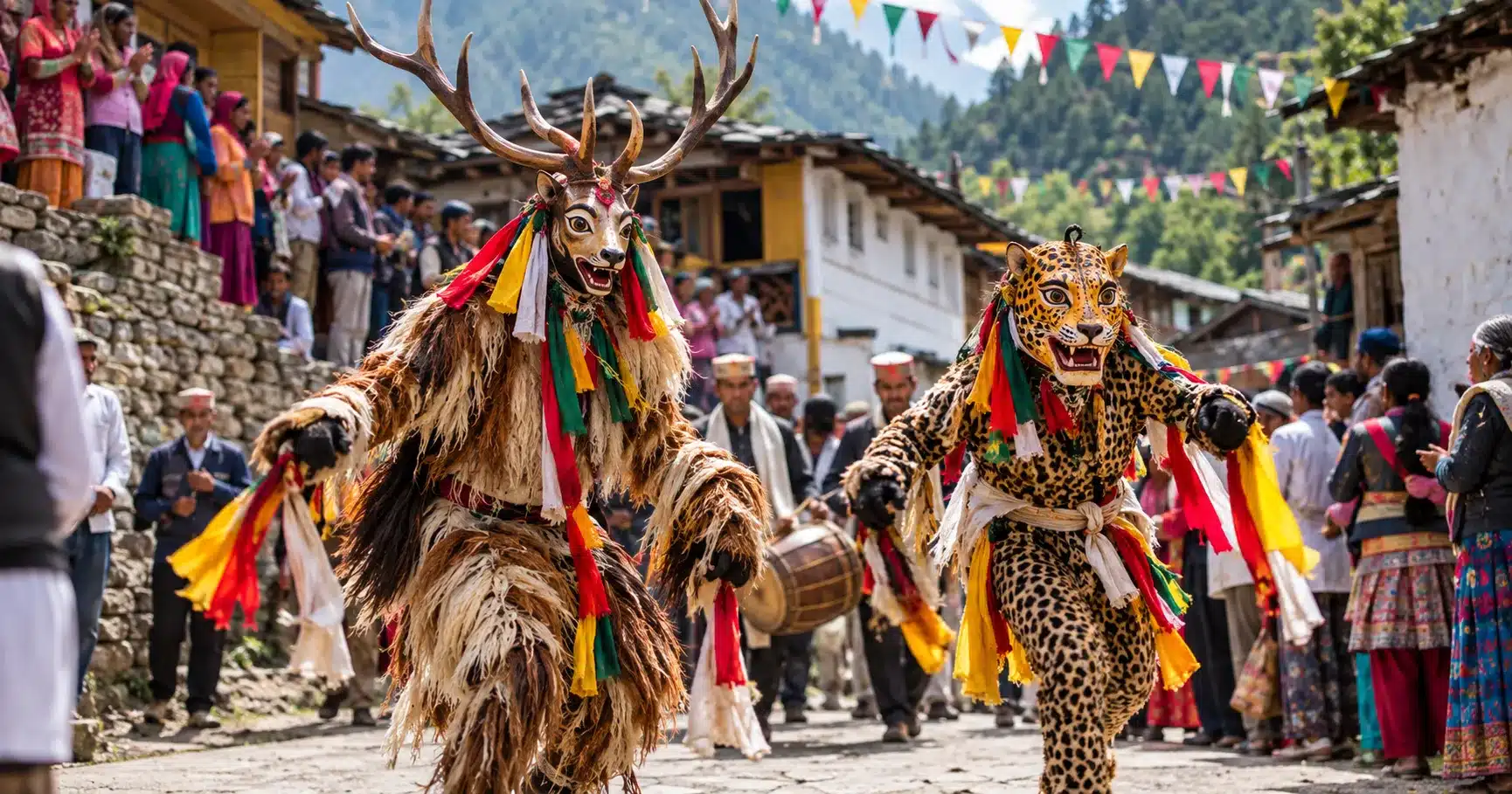 Hilljatra’s performance follows a structure built around procession and staged agricultural scenes rather than a single fixed ritual act, unfolding across the village as much as within any one temple or courtyard.
Hilljatra’s performance follows a documented three-part structure, moving from ritual, to drama, to open celebration, rather than a single fixed ritual act. The name itself reflects the festival’s grounding in the physical work of the season: “Hill” refers to mud and “Jatra” to a procession or fair, making Hilljatra literally the “festival of mud,” tied to the rain-soaked paddy fields the whole celebration is built around.
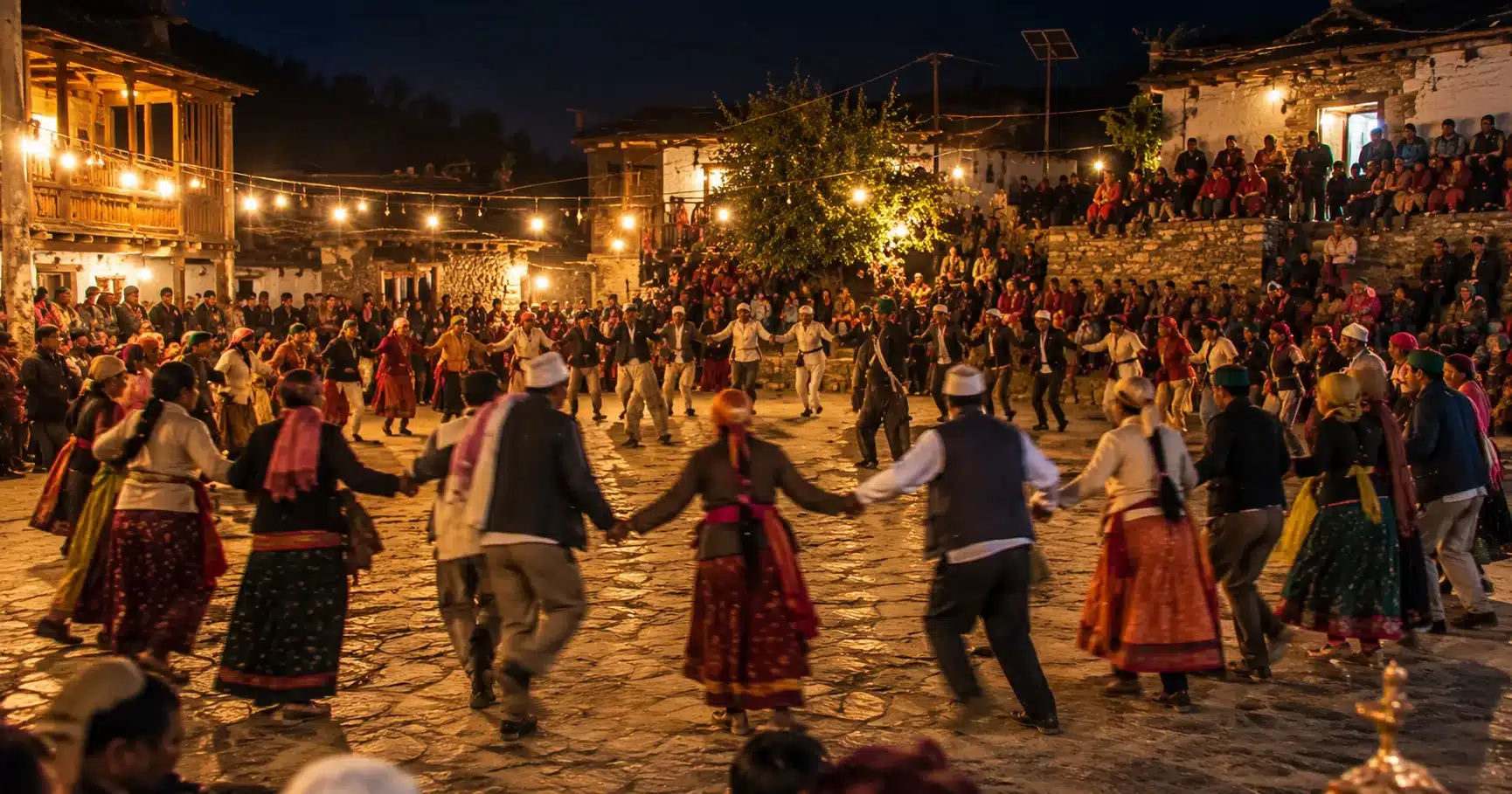
The first part centres on worship and a ritual animal sacrifice, most commonly a goat, performed to appease local deities and secure a successful season; some accounts describe an accompanying tradition of worshipping a white-clothed deer as a regional protective figure. The second part is the dramatic core most visitors associate with the festival: performers in masks and costume act out ploughing, sowing, herding, and the presence of forest wildlife, building toward the arrival of the Lakhiya Bhoot. The third part shifts from performance to open community celebration, with traditional and contemporary folk songs and a circle dance known as Chanchari continuing late into the night. Additional elements, including a rite called Aathon, observed on the eighth day of the Bhado month, and a Gaura Visarjan ceremony, have become woven into the wider festival over time in some villages. As with many festivals tied to a lived agricultural calendar rather than a fixed civil date, the specific day Hilljatra falls on shifts from year to year with the local paddy transplantation timeline, which means visiting requires checking that year’s timing locally rather than assuming a set date.
How visitors can experience it
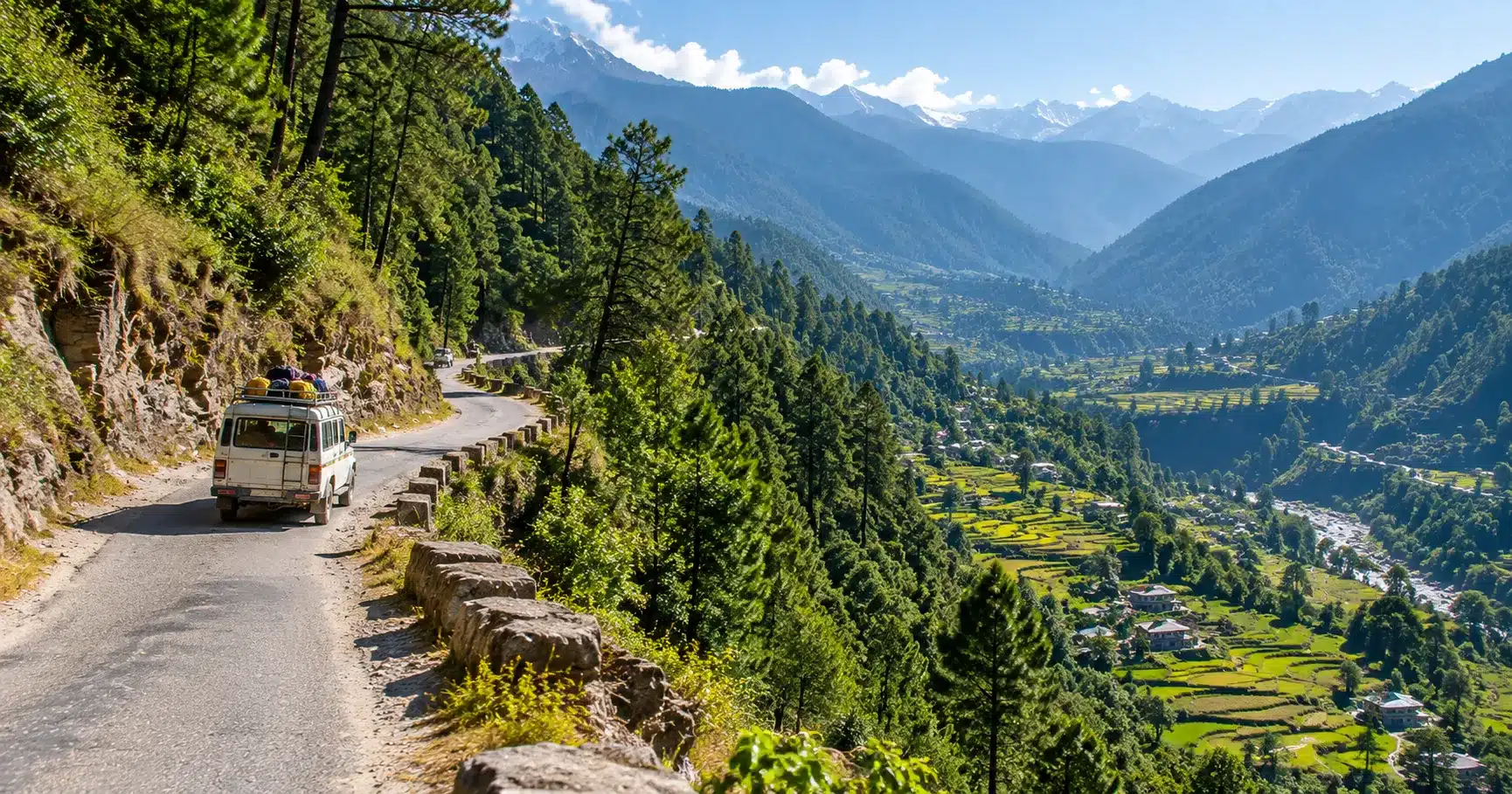 Hilljatra remains, first and foremost, a village-level community tradition rather than an event built for outside audiences, and that shapes what a respectful visit actually looks like.
Pithoragarh town is the nearest major access point for travel into the Sor Valley and onward to villages including Kumaur, and visitors interested in the festival should expect to travel to a specific village celebration rather than a single centralised event. Because the date moves with the agricultural calendar, confirming timing locally, through district tourism information or direct contact with the region, is more reliable than assuming a fixed annual date. As with other living festival traditions covered on this site, including Kinnaur’s Raulane festival, the most useful advice for an outside visitor is to approach the performance as a guest at a community’s own occasion: ask before photographing performers closely, follow the lead of local attendees on where to stand and when to move, and treat the mask performers with the same respect due any ritual performer mid-ceremony, since for the community itself this is a continuation of lived agricultural life, not a show staged for visitors.
FAQ
What is the Hilljatra Festival?
Hilljatra is a Kumaoni masked folk festival from Pithoragarh district, Uttarakhand, in which villagers perform the region’s agricultural cycle, ploughing, transplanting, and farm labour, through masked drama, staged shortly after paddy transplantation is completed each year.
Where is Hilljatra celebrated?
Primarily in Pithoragarh district’s Sor Valley in Uttarakhand’s Kumaon region, with Kumaur village most closely associated with the festival’s origin and its most prominent ongoing celebration. Nearby villages in the valley observe local variations of the tradition.
When does Hilljatra take place?
Around the Bhadrapad month of the Hindu calendar, roughly August to September, timed to the local paddy transplantation cycle rather than a single fixed civil date. Exact timing should be confirmed locally each year.
What is the Lakhiya Bhoot?
The Lakhiya Bhoot is Hilljatra’s central mask and figure, a large, deliberately fierce-featured mask representing a guardian spirit associated with the land and the community’s protection during the agricultural season.
Is Hilljatra really over 500 years old?
That figure circulates widely, including in PTI’s August 2026 coverage, but it traces to community oral tradition rather than one precisely documented date. What’s independently anchored is the festival’s connection to the historical Champawat rulers of the Chand dynasty, which governed Kumaon for centuries, a real, documented lineage even where the festival’s exact founding year isn’t pinned down as precisely.
Why do performers wear masks instead of just celebrating the harvest normally?
The masked performance lets the community re-enact its own agricultural labour as shared, watchable drama rather than simply resting after it, turning hard physical work like paddy transplantation into something communal and meaningful. The mask also provides a distancing effect that allows performers to embody guardian spirits and animals believed to watch over the fields.
How is Hilljatra different from a typical harvest festival?
Most harvest festivals celebrate the result of agricultural labour, the crop itself. Hilljatra instead re-enacts the labour and the surrounding natural world, ploughing, transplanting, the presence of forest animals, as performed drama, which is a structurally different way of marking the same agricultural season.
Can tourists attend Hilljatra?
Outside visitors do sometimes attend, but the festival remains a community-level tradition rather than a tourism-oriented event, similar to other living Himalayan festivals covered on this site. Visitors should treat it as a guest at a local occasion, confirm timing locally given its variable date, and follow local guidance on photography and conduct during the performance.
The bottom line
 Hilljatra’s renewed national attention in 2026 puts a spotlight on a festival that has, for most of its history, been a Sor Valley matter rather than a national one. What’s actually worth taking from the coverage isn’t the “500 years” headline, which is memory rather than measurement, but the underlying practice it’s attached to: a farming community that chooses, every year, to turn its hardest physical labour into performance, watched by the same people who did the work. That’s a different relationship to agricultural life than a simple harvest celebration offers, and it’s the part of Hilljatra worth understanding on its own terms, mask and all.

Abhay Ramola researches world festivals across primary sources, local accounts, and on-ground reporting. He founded Dionfest to cover what gets missed when festivals become tourism content the history, the ritual, and the people behind it.