
How Holi Colors Affect Rivers – A Look at Yamuna After Holi
How Holi Colors Affect Rivers A Look at Yamuna After Holi
Over 300 million litres of Holi water drain into India’s rivers every year, carrying lead, mercury, and industrial dyes. The Yamuna was already at zero dissolved oxygen before Holi began. This is what happens next.
Key Facts
| Festival | Holi — Festival of Colors |
| 2027 Date | March 3, 2027 |
| Celebrated In | India, Nepal, and worldwide |
| Traditional Colors | Turmeric, Palash flowers, Neem, Hibiscus |
| Common Colors Today | Synthetic dyes with industrial chemicals |
| Chemicals of Concern | Lead oxide, mercury sulfide, malachite green, copper sulfate, rhodamine B |
| River Most Affected | Yamuna (Delhi stretch |
| Water Usage Spike | 30–40% increase in some cities during Holi |
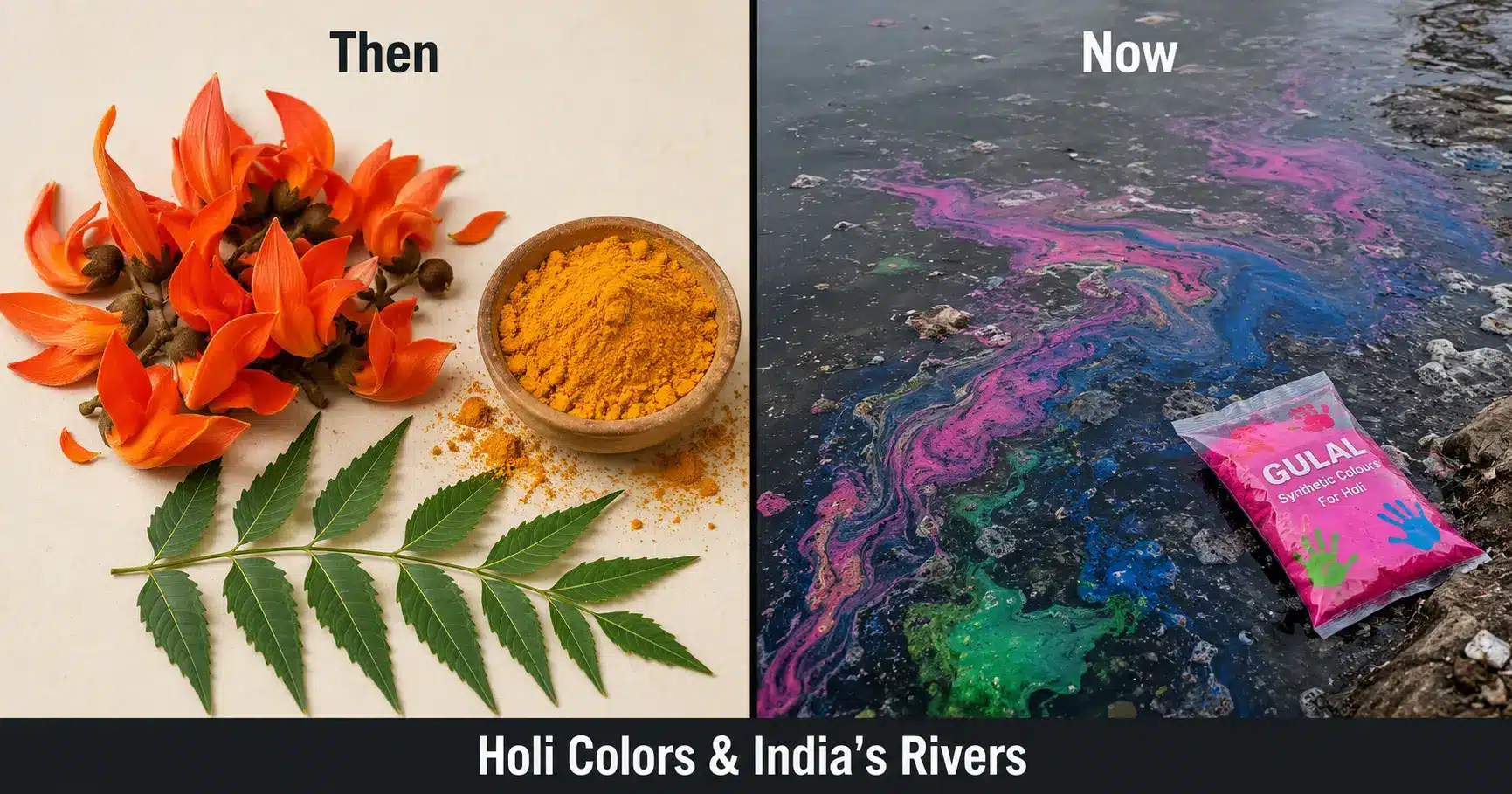
The day after Holi, if you walk to the Yamuna ghats in Delhi, the water looks different. Blues and pinks swirl at the surface like spilled ink. A thin chemical film catches the morning light. Plastic gulal packets drift near the banks. It smells sharp not the sweet smell of Tesu flowers that colored this festival for thousands of years, but something that didn’t come from the earth.
Over 300 million litres of water are used during Holi celebrations across India every year. Much of that water drains into rivers carrying synthetic dyes, heavy metals, and industrial compounds. The Yamuna gets the most attention, partly because it flows through the capital, and partly because of what it used to be one of the holiest rivers in Hindu tradition, now one of the most polluted rivers on the planet.
This article covers what happens to rivers after Holi, why synthetic colors are harmful, what Holi looked like before these chemicals existed, and what you can actually do about it.
A note from the author: I’ve never stood at the Yamuna ghats in Delhi. But I know a different part of this river. The Yamuna starts at Yamunotri, in Uttarakhand, about 200 km from where I live. Up there it’s glacier water cold enough to numb your hands in seconds. Clear enough to see the riverbed. People drink from it without thinking twice. That’s the same river that turns dark gray by the time it reaches Delhi. Same source. Very different fate. That gap always stays with me when I read about what Holi does to it downstream.
What Did Ancient Holi Colors Look Like?
Before synthetic chemistry arrived, Holi was completely natural and deliberately so.
Ancient texts describe colors made from Palash flowers (called Tesu or Flame of the Forest), turmeric, neem leaves, henna, marigold petals, hibiscus, red sandalwood, indigo, and saffron. They weren’t just colorful. Turmeric is anti-inflammatory. Neem is antibacterial. Sandalwood cools the skin. Holi falls right at the shift between winter and spring, when temperatures swing and the body is vulnerable. These plant-based colors were partly seasonal medicine.
In Vrindavan, where tradition says Krishna himself played Holi, some celebrations still use actual flower petals: rajnigandha, rose, marigold. The Caitanya Prem Sansthan ashram there has banned synthetic colors entirely. Every year only natural pigments, only flowers.
When those natural colors washed into rivers, the rivers handled them. Turmeric dissolves. Flower pigments break down. The river moved on. What comes off synthetic gulal packets doesn’t.
What Are Synthetic Holi Colors Made Of?
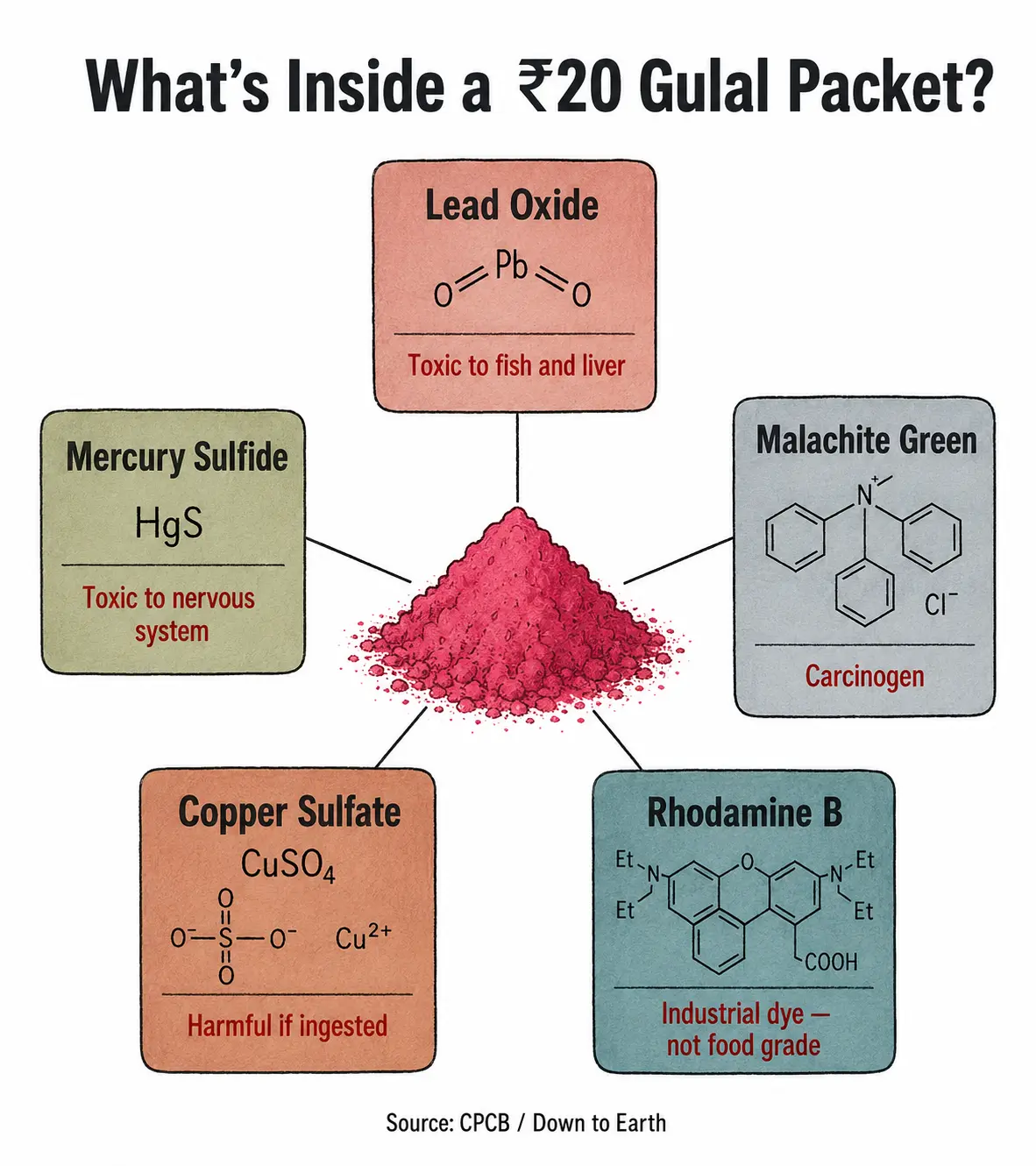 Starting in the 20th century, demand grew faster than natural production could keep up with. Synthetic dyes from the textile and paint industries filled the gap cheaply. Most low-cost Holi colors sold on Indian streets today contain some combination of:
Heavy metals:
- Lead oxide (red and orange)
- Mercury sulfide (red shades)
- Chromium iodide (green)
- Copper sulfate (an agricultural poison used as a colorant)
Industrial dyes:
- Malachite green – toxic to aquatic life, and to the liver and thyroid
- Rhodamine B – classified as a carcinogen
- Auramine O – also a known carcinogen
Other fillers:
- Ground glass
- Asbestos particles
- Mica granules
- Talc
Many packets sold at roadside stalls carry the label “for industrial use only.” That label doesn’t stop them from being sold as Holi gulal, and it doesn’t stop people from buying them.
How Do Holi Colors Reach the Rivers?
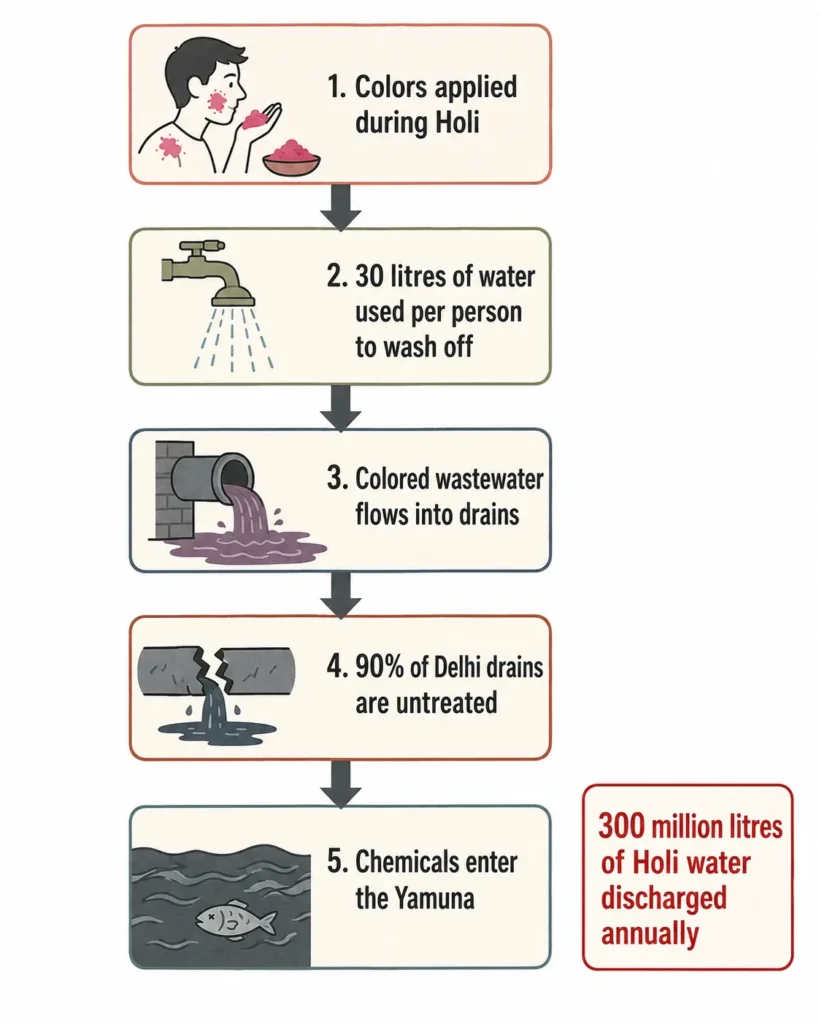 It’s a short chain:
- Colors are applied and thrown during celebrations
- People wash off afterward – around 30 litres per person just for cleanup
- That colored wastewater goes into household drains
- In most Indian cities, those drains connect to sewage treatment plants that are either at capacity or non-functional, or they connect directly to rivers
- Chemical compounds that don’t break down – lead, chromium, mercury – stay in the water
In Delhi, at least 90% of domestic wastewater flows into the Yamuna. A large portion of it is untreated before it gets there. During Holi weekend, cities report 30–40% higher water consumption than usual, which means a proportional spike in chemical load hitting the river.
Water balloons are a separate problem. Plastic. Non-biodegradable. Millions of them clog drains and end up in water bodies every single Holi.
What Happens to the Yamuna After Holi?
 The honest answer is that Holi makes a terrible situation worse.
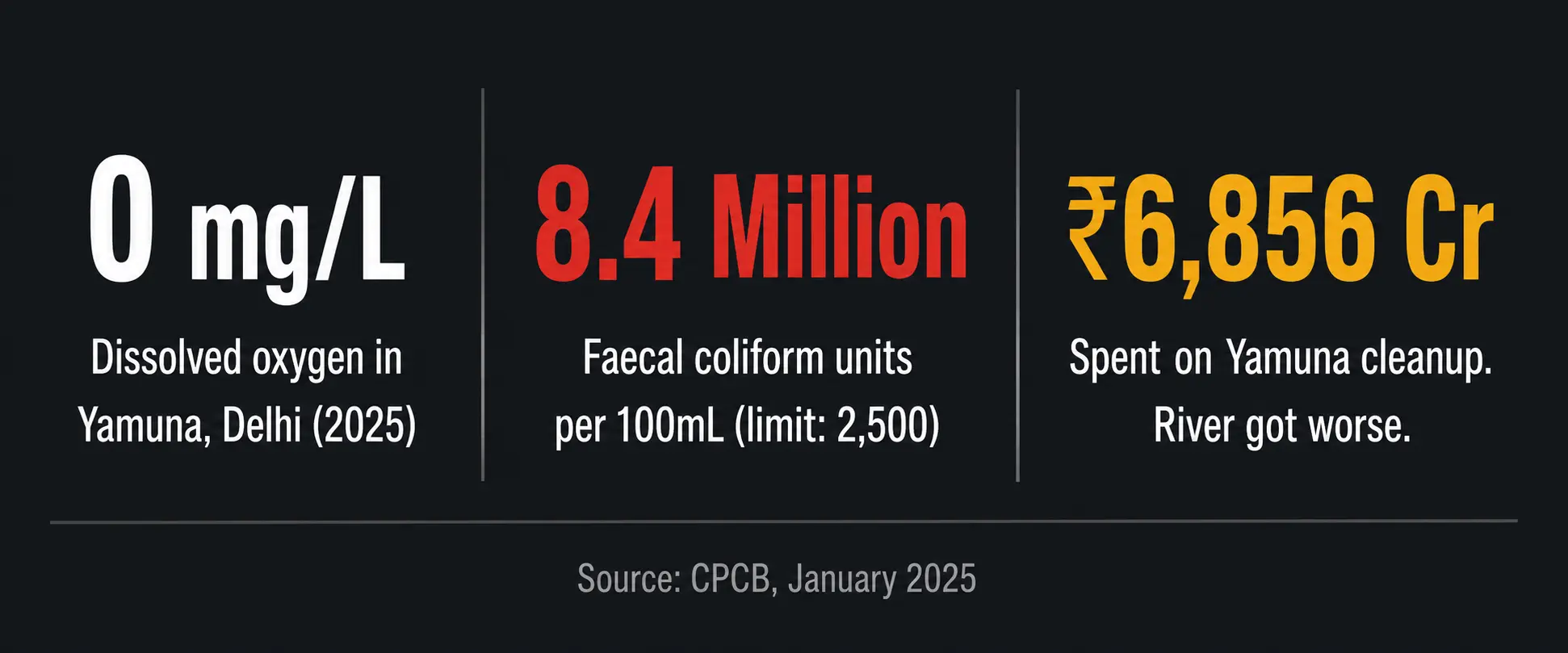
The 22-kilometre stretch of the Yamuna flowing through Delhi was already at zero dissolved oxygen before Holi 2025 began. Zero. The river couldn’t support any aquatic life before a single packet of synthetic gulal entered it. Faecal coliform was at 8.4 million MPN per 100 ml against a permissible limit of 2,500 units. Biochemical Oxygen Demand was sitting at 70 mg/L when the required level is under 3 mg/L.
Holi adds synthetic dyes to that.
The organic material in those dyes consumes whatever trace oxygen remains as it breaks down. Lead, mercury, and chromium don’t dissolve or degrade they settle into the river sediment. From there they move up the food chain the slow way: algae absorb them, small fish eat the algae, larger fish eat those fish. Each step concentrates the poison. The pH shifts further. And the river, which already couldn’t recover even during monsoon season, gets pushed a bit further from anything resembling a functioning ecosystem.
Dead fish at Kalindi Kunj Ghat has become something people expect around this time every year. Not news anymore. Just what happens.
Voices from the River
These are people who actually stood at the Yamuna lived near it, fished from it, or spent years trying to save it.
Raman Haldar — Yamuna fisherman, Delhi. He has lived and worked on this river his entire life. When a journalist visited, he scooped water in his palm to show what it had become:
“The water was as clear as glass – when the drains were cleaner till 20 years ago. A coin fallen in could be seen from above. We could drink directly from the Yamuna.”
He then let the water run off his fingers. He did not drink it.
Srivatsa Goswami — head of Caitanya Prem Sansthan ashram, Vrindavan. His ashram sits directly on the Yamuna’s banks. He has banned synthetic Holi colors entirely. When asked why:
“We are fighting for the life of the Yamuna, because the Yamuna is our life.”
His son Suvarna grew up watching the river change. He’s less philosophical about it:
“We don’t call it the Yamuna right now. This dirty water, this is not the Yamuna. This is sewage water.”
(Source: Sierra Club)
Pranjal Sharma — school student, Delhi. After playing Holi with synthetic colors, she tried to wash them off. She told Down to Earth:
“After the last Holi, I have decided never to play Holi with colours again.”
She was talking about what it did to her skin. The colors she washed off went down the drain, and from there into the Yamuna.
Manoj Misra — late convener of Yamuna Jiye Abhiyan (Long Live Yamuna). A retired Indian Forest Service officer who spent over a decade in courts and on riverbanks trying to save this river. He passed away in June 2023, still working on it. To CBS News:
“Yamuna is not a river anymore.”
After standing at the ghats during a festival immersion:
“We could hardly stand and watch because the stench was unbearable.”
After ten years of legal campaigns, petitions, and public advocacy, he reflected: “The fact that even a decade long sustained advocacy has made little difference if any to the overall health of the river underscores the complexities and the challenges involved in such tasks.”
He kept going anyway.
Praveen K. Chaudhry — Professor of Social Sciences, Fashion Institute of Technology, New York. He spent a month in Delhi photographing the Yamuna. After:
“I cannot even explain to you how polluted this water is. I would not even stick my finger in… but then you see people making TikToks on it, people taking their wedding photos.”
Jasraj — 70-year-old retired government clerk, Delhi. He has come to the Yamuna ghats for ritual bathing since 1980. When asked about the toxic foam:
“I worship the river as a mother, and there is no question of its being clean or dirty. It’s dirty on the surface but clean below the top.”
He still bathed in it.
A man who knows the water is toxic, calls it his mother, and wades in anyway. That’s not irrational. That’s what happens when faith and ecological collapse occupy the same body of water for long enough.
Yamuna’s Bigger Problem
Blaming Holi alone would be dishonest.
The Yamuna’s crisis runs year-round. The Najafgarh drain alone carries roughly 800 million gallons of sewage per day into the river. Twenty-two drains between Wazirabad and Okhla discharge domestic waste and industrial effluent continuously. The phosphate concentration 0.51 mg/L against a safe standard of 0.005 to 0.05 mg/L produces the thick white foam that has become a permanent feature of Delhi’s Yamuna. Over ₹6,856 crore was spent on cleanup projects in the decade up to 2025. The river is worse now than when the spending started.
So Holi isn’t a singular disaster. It’s one spike in a graph that never comes down.
That said it’s a spike we can actually control, unlike industrial discharge.
Which Other Rivers Are Affected?
The Yamuna gets the attention because it flows through Delhi. But other rivers carry the same problem.
Sabarmati (Gujarat): Gets Holi runoff from Ahmedabad and surrounding cities.
Ganga (UP and Bihar): Receives Holi runoff in Varanasi, Prayagraj, and dozens of smaller towns. The same stretch where Kumbh Mela pilgrims bathe in tens of millions sees its already strained water quality worsen further each festival season.
Musi River (Hyderabad): Among India’s most polluted urban rivers, takes additional chemical load post-Holi.
Cooum and Adyar (Chennai): Urban rivers that collect festival runoff through storm drains.
Holi isn’t the only festival that does this. Ganesh Chaturthi idol immersions in Mumbai and Hyderabad put lead-based paints and non-biodegradable materials into water bodies every year. Durga Puja immersions do the same in Kolkata. Each festival adds its own load to rivers that are already struggling.
What Can You Actually Do?
 Not a lecture. Just what works.
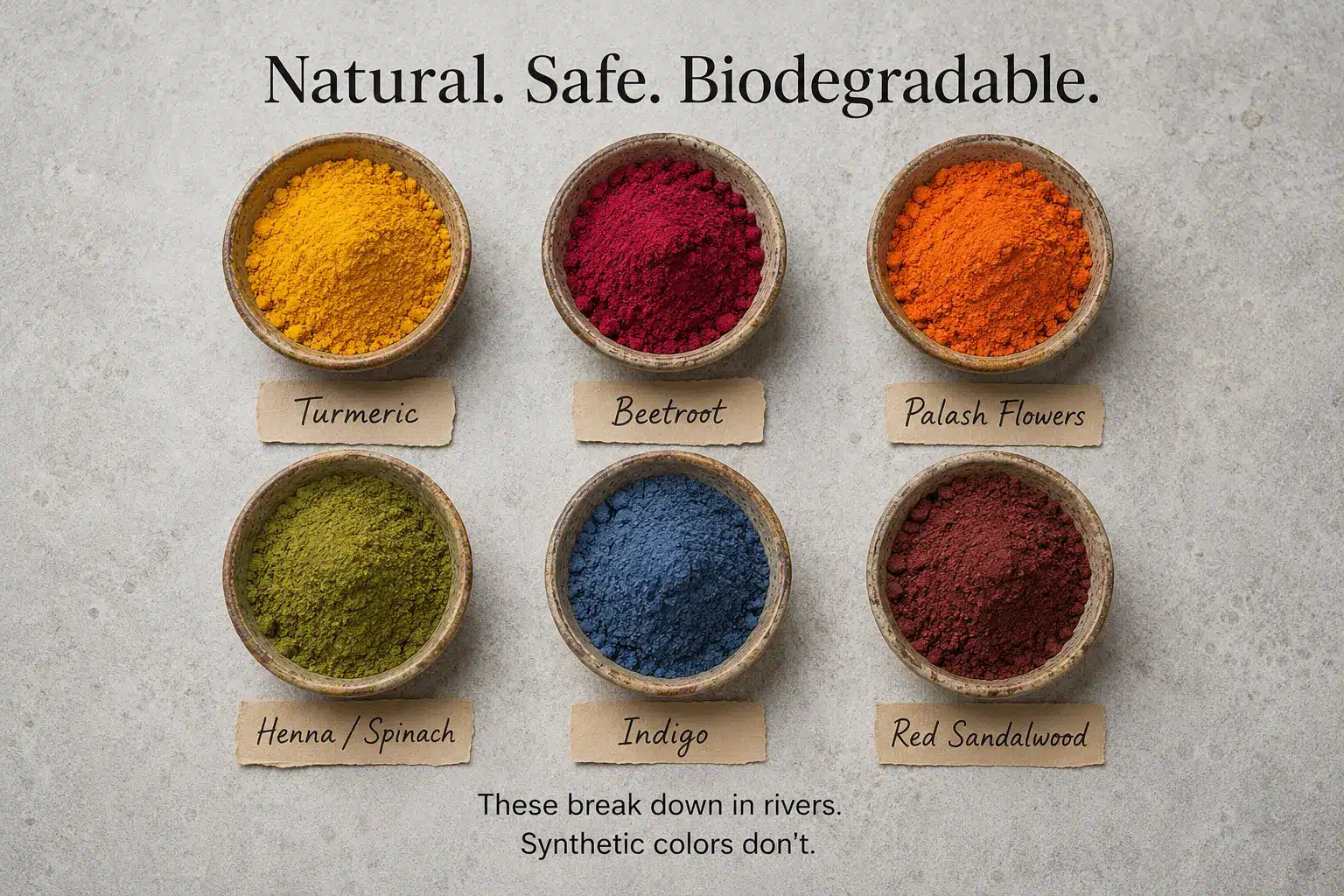
Use natural colors:
- Yellow: Turmeric powder mixed with rice flour
- Red/Pink: Dried hibiscus petals or beetroot powder
- Orange: Palash/Tesu flowers soaked overnight in water
- Green: Henna powder or dried spinach
- Blue: Indigo powder
These break down in water. They don’t build up in river sediment or travel up the food chain.
Brands that actually verify their ingredients: Phool, Help Us Green, eCoexist. Sourced from temple flower waste and verified plant materials. They cost 5 to 8 times more than street synthetic colors. That price gap is the real obstacle, not awareness. Most people already know synthetic colors are bad.
Play dry Holi or just use less water. Each person playing water-based Holi uses roughly 30 litres minimum just to clean up. A dry gulal Holi cuts that to near zero.
Drop the water balloons. Plastic. They don’t decompose. They block drains and end up in rivers.
Tilak Holi is worth considering apply organic gulal as a small tilak on the forehead instead of the full drenching version. Almost no water, still the spirit of it.
Don’t celebrate near riverbanks or lakes. Colors thrown near open water go straight in. A few metres of distance matters more than it sounds.
A Few Things Worth Knowing
- Ancient Holi colors were applied partly because of when the festival falls. The shift from winter to spring is when the body is most prone to seasonal illness. Turmeric, neem, and sandalwood weren’t just dyes. They were what was available and what worked.
- Some of the most toxic synthetic colors sold at Holi stalls carry a label that says “for industrial use only.” They’re still there, still cheap, still being bought.
- A fisherman who spent his whole life on the Yamuna says the water used to be clear enough to spot a coin at the bottom. He now scoops it in his palm to show journalists what it looks like, then lets it drain off his hand without drinking.
- The Central Pollution Control Board grades all assessed stretches of the Delhi Yamuna as Priority I — the worst classification in their system. The Ganga, for comparison, mostly falls under Priority IV or V.
- Faecal coliform in the Yamuna hit 4.9 million MPN/100 mL in January 2025. The safe standard is 500 units. That’s nearly 10,000 times over.
FAQ
Does Holi cause river pollution?
It contributes to it. Synthetic Holi colors contain heavy metals and industrial dyes lead oxide, mercury sulfide, malachite green, copper sulfate that wash into rivers when people clean up. Over 300 million litres of water go into celebrations across India every year, and much of that colored wastewater reaches rivers through unmanaged drains. But the Yamuna was in crisis long before Holi. The festival adds a spike to a problem that runs 365 days a year.
What chemicals are in synthetic Holi colors?
Lead oxide, mercury sulfide, chromium compounds, copper sulfate, malachite green, rhodamine B, and auramine O are among the more common ones. Several are classified as carcinogens. Others are acutely toxic to aquatic life. None of them break down easily, which is why they accumulate in river sediment rather than washing through.
What happened to the Yamuna after Holi 2025?
The river’s Delhi stretch already had zero dissolved oxygen before Holi began — meaning no aquatic life could survive in it at baseline. BOD was 23 times above permissible limits. Holi added synthetic dye runoff on top of that. Dead fish near Yamuna ghats were reported, as they are most years around this time. Attributing deaths specifically to Holi versus the year-round pollution is difficult, but the data on the spike is consistent.
Were ancient Holi colors safe for rivers?
By any measure, yes. They came from turmeric, neem, Palash flowers, hibiscus, henna, marigold, and beetroot. Plant-based, biodegradable, they broke down naturally when they hit water. They didn’t bioaccumulate or affect aquatic ecosystems. The rivers handled them the same way they handle anything organic.
What’s the most eco-friendly way to play Holi?
Dry Holi with plant-based organic colors is the lowest-impact option. No water balloons, no chemical gulal, and ideally not near any open water body. If you want to use water, verified organic brands like Phool are a better choice than street colors — they’re more expensive, but they don’t leave heavy metals in the drain.
How much water gets used during Holi?
Over 300 million litres across India annually is the commonly cited estimate. A single person typically uses around 30 litres just to wash colors off. Some cities see water consumption go up by 30 to 40 percent during Holi weekend compared to a normal day.
Is the Yamuna safe to touch after Holi?
The Yamuna in Delhi isn’t really safe to come into contact with at any point in the year. Faecal coliform exceeds safe bathing limits by thousands of times on a regular day. Holi adds heavy metals and chemical dyes to that baseline. People do bathe in it — for religious reasons, out of habit, or because they have no other option but the water itself carries serious health risks regardless of the time of year.
Are organic Holi colors actually better for rivers?
Yes, straightforwardly. Plant-based colors break down in water. They don’t settle as heavy metals in river sediment, they don’t move up the food chain, they don’t persist. The issue is cost organic colors run 5 to 10 times more than synthetic street colors. Until that gap closes, the environmental argument alone isn’t enough for most people.
Conclusion
The Yamuna was being killed long before anyone started blaming Holi. Decades of untreated sewage, industrial discharge, and failed cleanup projects got it to where it is. But Holi is one of the few points in the year where what individuals choose to buy and how they celebrate has a direct, traceable connection to river health. That’s rare. Most pollution is diffuse and institutional hard to point at, hard to change. This one isn’t.
Choosing natural colors doesn’t save the Yamuna. But it stops one of India’s oldest festivals from making one of its oldest rivers a little worse than it already is. That’s not nothing.

Abhay Ramola researches world festivals across primary sources, local accounts, and on-ground reporting. He founded Dionfest to cover what gets missed when festivals become tourism content the history, the ritual, and the people behind it.




1 thought on “How Holi Colors Affect Rivers – A Look at Yamuna After Holi”