
What Happens to Festival Plastic After the Celebration Ends?
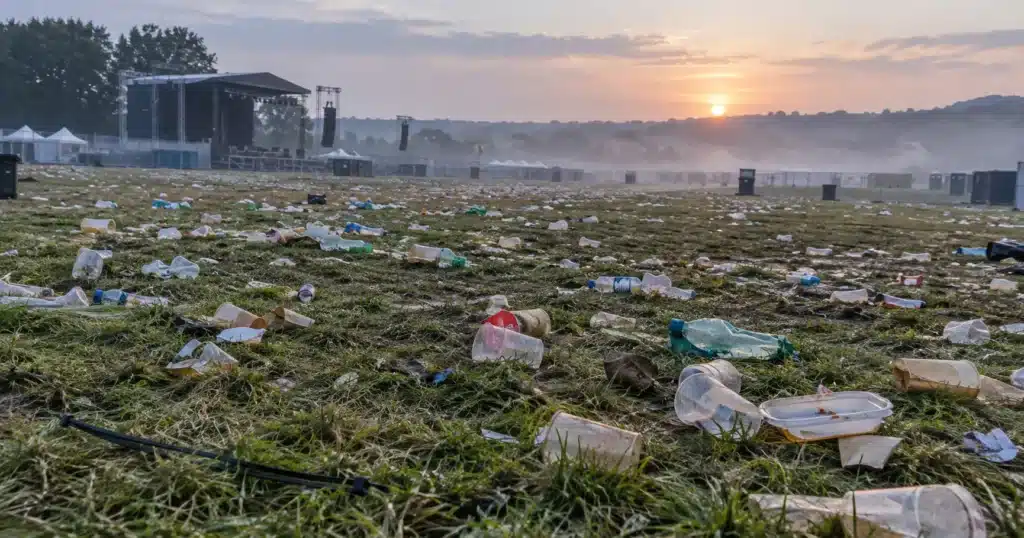
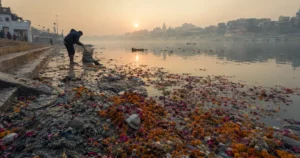
By the time the last band finishes, a festival field looks like a plastic tide went out and forgot to take anything with it. Cups, bottles, food trays, snapped banner cord, the confetti nobody swept up. Within a day or two at most events, sometimes within hours at a small one, most of it is gone, bagged, trucked out, and sorted somewhere the average attendee never sees. What happens at that sorting point decides almost everything: whether a cup becomes a new cup, or whether it becomes landfill next to the food scraps it never should have been near in the first place.
This article follows festival plastic through that exact chain, collected, sorted, then split between recycled and contaminated, and from there either back into the supply chain or into landfill and the wider environment. The section on why so much of it fails the recycling step, despite everyone’s best intentions, is the part most festival waste coverage skips entirely.
Fast facts
- In a single-stream system, less than half of collected material typically survives MRF sorting; the rest is diverted to landfill due to contamination
- Ultra Music Festival’s sustainability programme has eliminated an estimated 1 million plastic cups, 1.2 million plastic bottles and 450,000 plastic straws since 2019
- A large-scale religious pilgrimage (Arba’een, Iraq, 2023) generated 4,000 tonnes of plastic waste, 0.18 kg per pilgrim, alongside 7,900 tonnes of food waste
- Food residue is one of the most common reasons a recyclable plastic item gets rejected at a materials recovery facility, because it interferes with optical sorting equipment
- Deposit-return cup schemes at festivals including Roskilde, Tomorrowland and Primavera Sound have measurably increased return rates by giving attendees a financial reason to bring cups back
Festival plastic follows a short, high-stakes chain: collection within a tight, contractually-driven window after the event ends, sorting at a materials recovery facility or a temporary on-site station, and then a split between what’s clean enough to recycle and what’s contaminated enough to be landfilled or, in poorly managed systems, left to leak into the surrounding environment. The contamination step is where most festival plastic actually loses, not the collection step, which is the opposite of what most attendees assume.
What actually happens: collected, sorted, then split

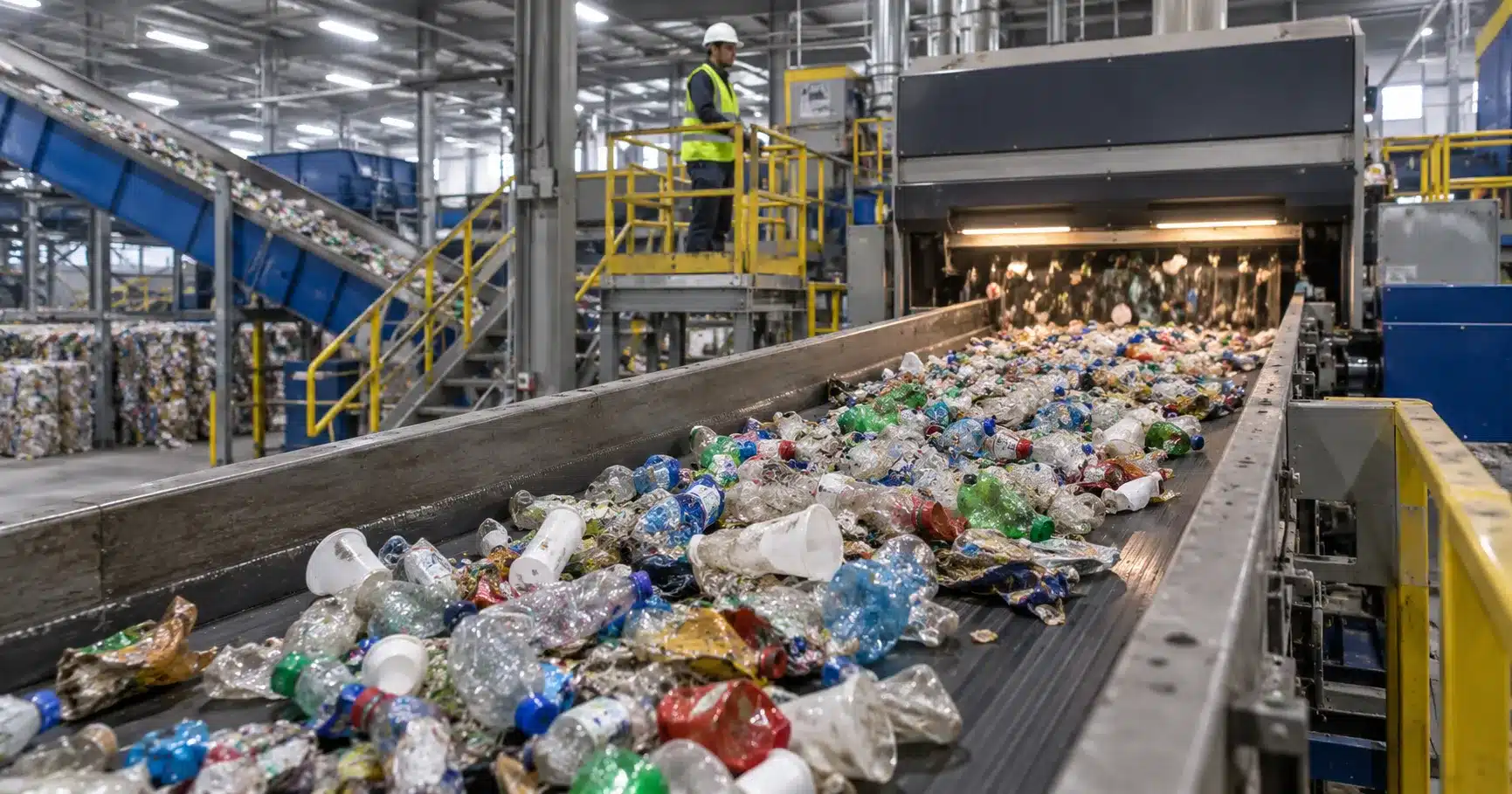
The journey starts with a compressed collection window that most municipal recycling systems never have to deal with: an entire event’s worth of waste, generated over two to five days, has to be cleared to meet a deadline fixed in the venue or land-hire agreement. Common contractual deadlines run 24 to 72 hours after the event ends, though the range is wide: small venues can be cleared in a few hours, while the largest camping festivals negotiate far longer windows, Burning Man’s cleanup permit runs a full 26 days. Whatever the deadline, the practical effect is the same: sorting has to happen fast, under time pressure most permanent recycling infrastructure never faces.
Waste gets collected either into colour-coded streams, general, recycling, compost, sorted at source by attendees and Green Team volunteers, or into a single mixed stream that gets sorted later at a facility. What happens next depends entirely on which of those two paths was chosen. Source-sorted material that stays reasonably clean has a real shot at recycling. Mixed material heads to what the waste industry calls a materials recovery facility, or MRF, where mechanical and manual sorting separate plastics, metals, paper and organics from everything else. In a single-stream system, less than half of the material processed at a typical MRF is actually recovered for recycling; the rest, largely due to contamination, is diverted to landfill. Festival waste, collected in a rush, by volunteers, in the dark, after several days of parties, tends to sit at the worse end of that range rather than the better one.
Cups, bottles and water bottles
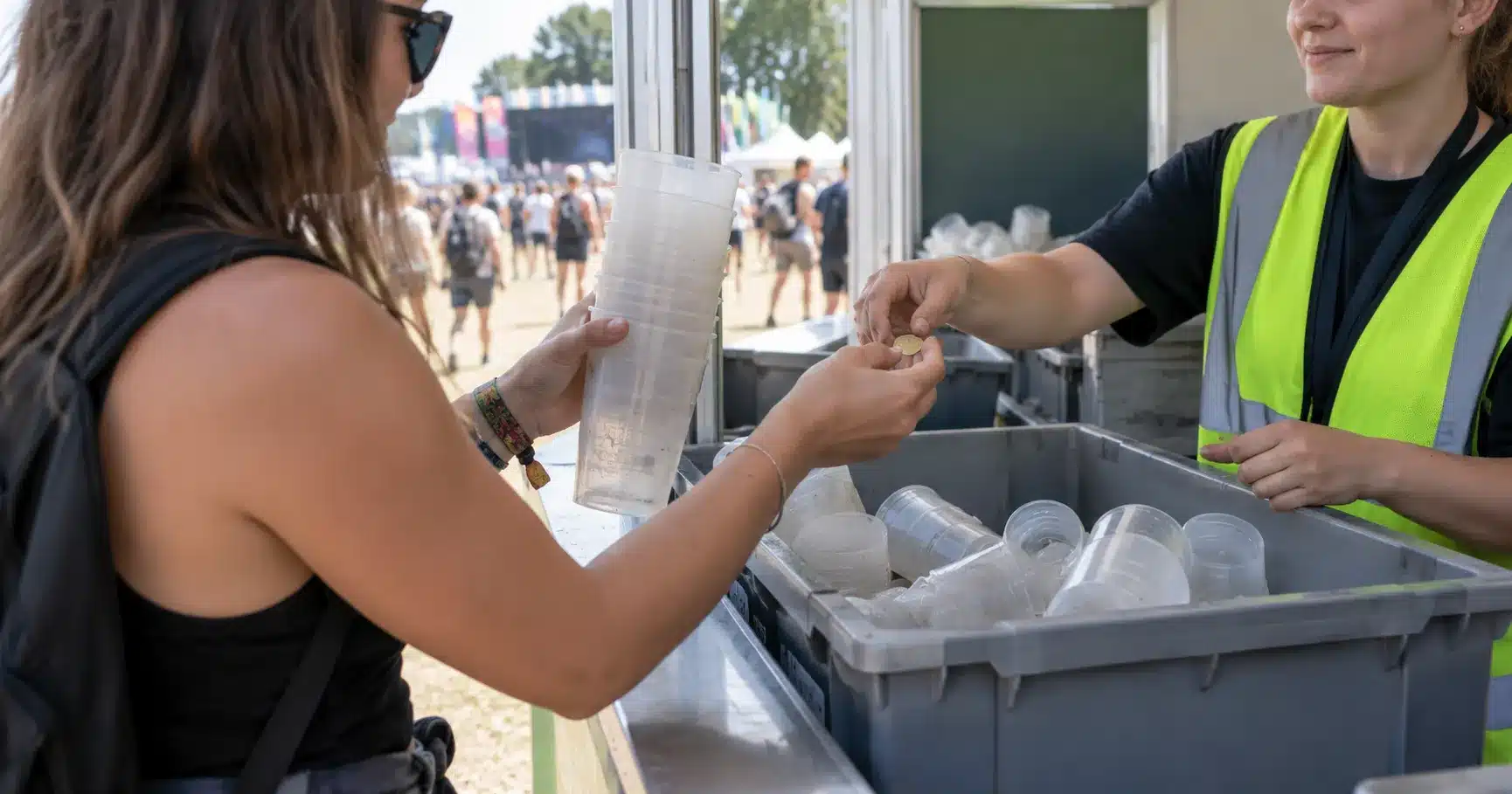
Cups and bottles are the highest-volume plastic item at almost any festival, and the category where reuse, not recycling, has produced the clearest measurable results.
Roskilde, Tomorrowland and Primavera Sound all run deposit-return schemes for drink cups: attendees pay a small deposit on a durable reusable cup, refundable when they bring it back to a collection point. The economics do the work that signage alone can’t, since nobody wants to simply throw away something they paid for. Miami’s Ultra Music Festival took a more restrictive approach through its Mission: Home programme, eliminating an estimated 1 million plastic cups and 1.2 million plastic bottles from the event since 2019 by permitting only reusable containers and champagne flutes on site, alongside 450,000 plastic straws avoided through similar restrictions. Water bottles specifically have become one of the easiest wins in this category: switching to on-site refill stations removes an entire product category from the waste stream before it’s even generated, which is a fundamentally different, and more reliable, strategy than hoping a plastic bottle gets correctly sorted after the fact.
Food packaging and plastic plates
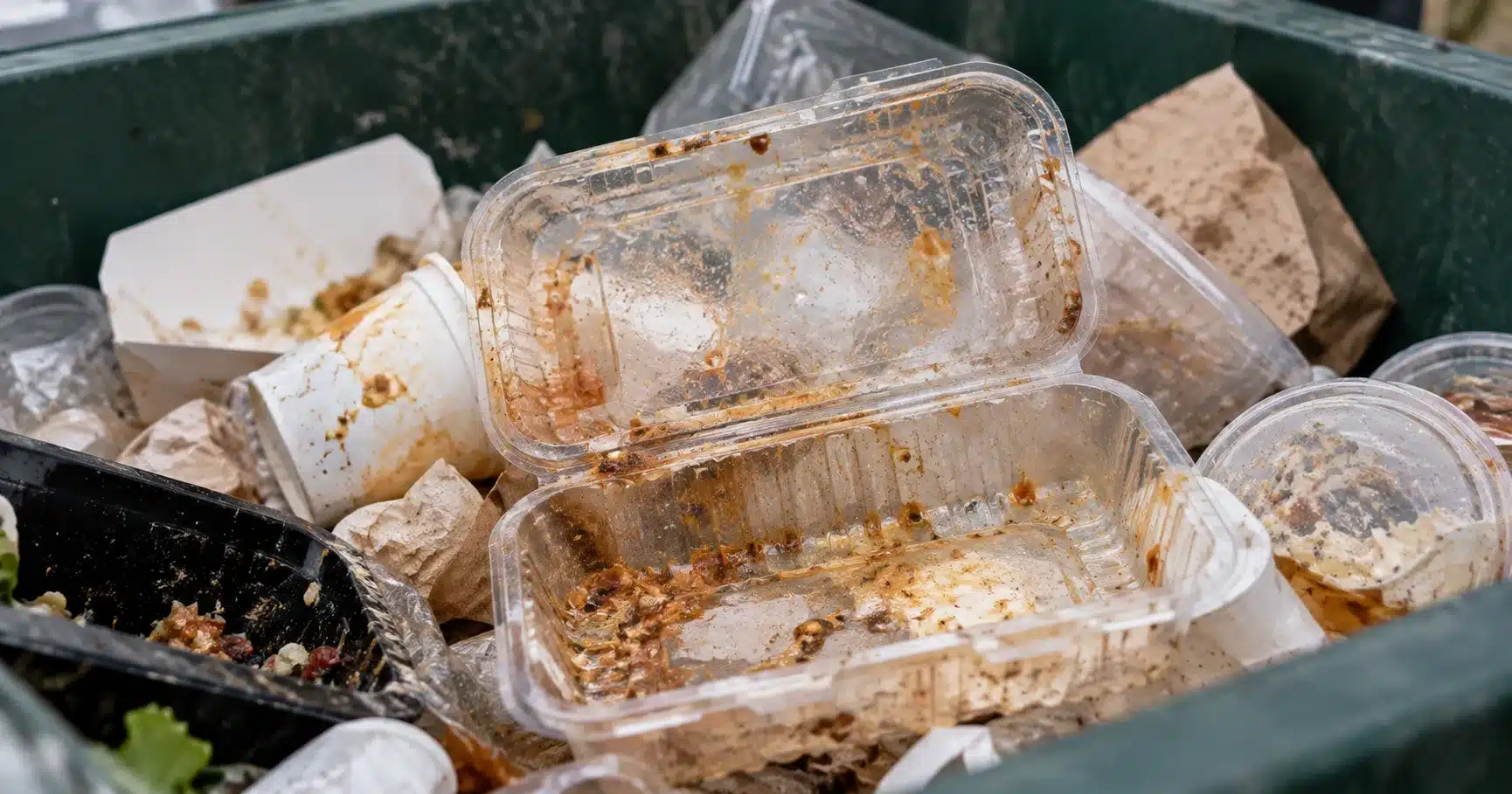
Food packaging is the category most responsible for contaminating everything else, because it’s the one type of festival plastic that almost always arrives at a bin with food still on it.
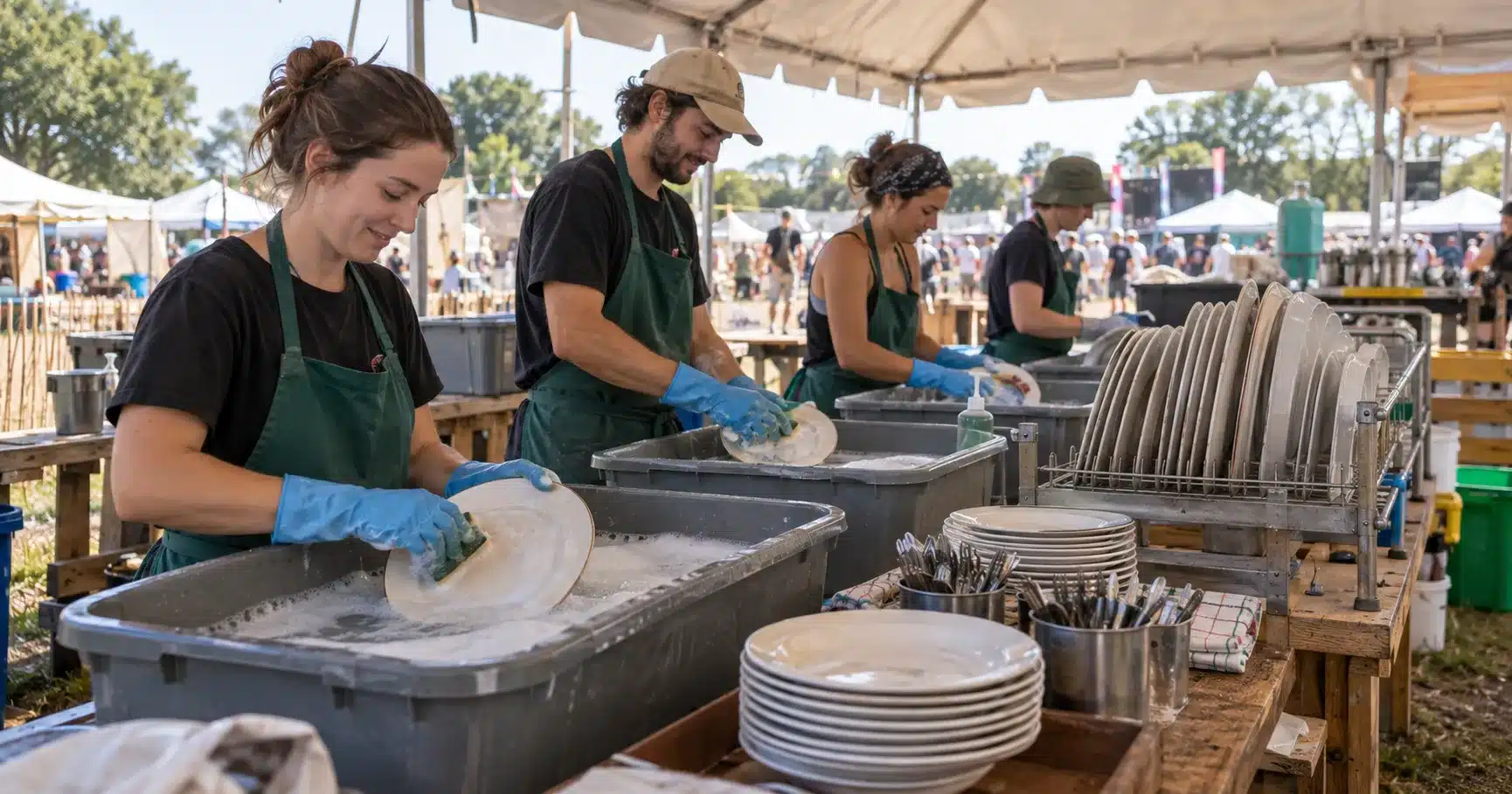
Clamshell containers, plates, cutlery, and the plastic film wrapped around individual portions all share the same structural problem: they’re single-use by design, cheap enough that vendors default to them, and nearly impossible to fully clean in the middle of a food service rush. Recycling contamination guidance is consistent on this point: containers with food residue, oil, or grease are treated as contaminants unless a facility has specifically agreed to accept them that way, and a batch contaminated enough gets rejected wholesale rather than partially recovered. Some festivals have sidestepped the problem entirely by removing conventional plastic from food service altogether. Green Man Festival requires all food vendors to use only compostable serveware, and Canada’s Hillside Festival bans plastic on site completely, running a volunteer dishwashing station, heated with solar power, so plates and cutlery get reused rather than replaced.
Decorations and banners
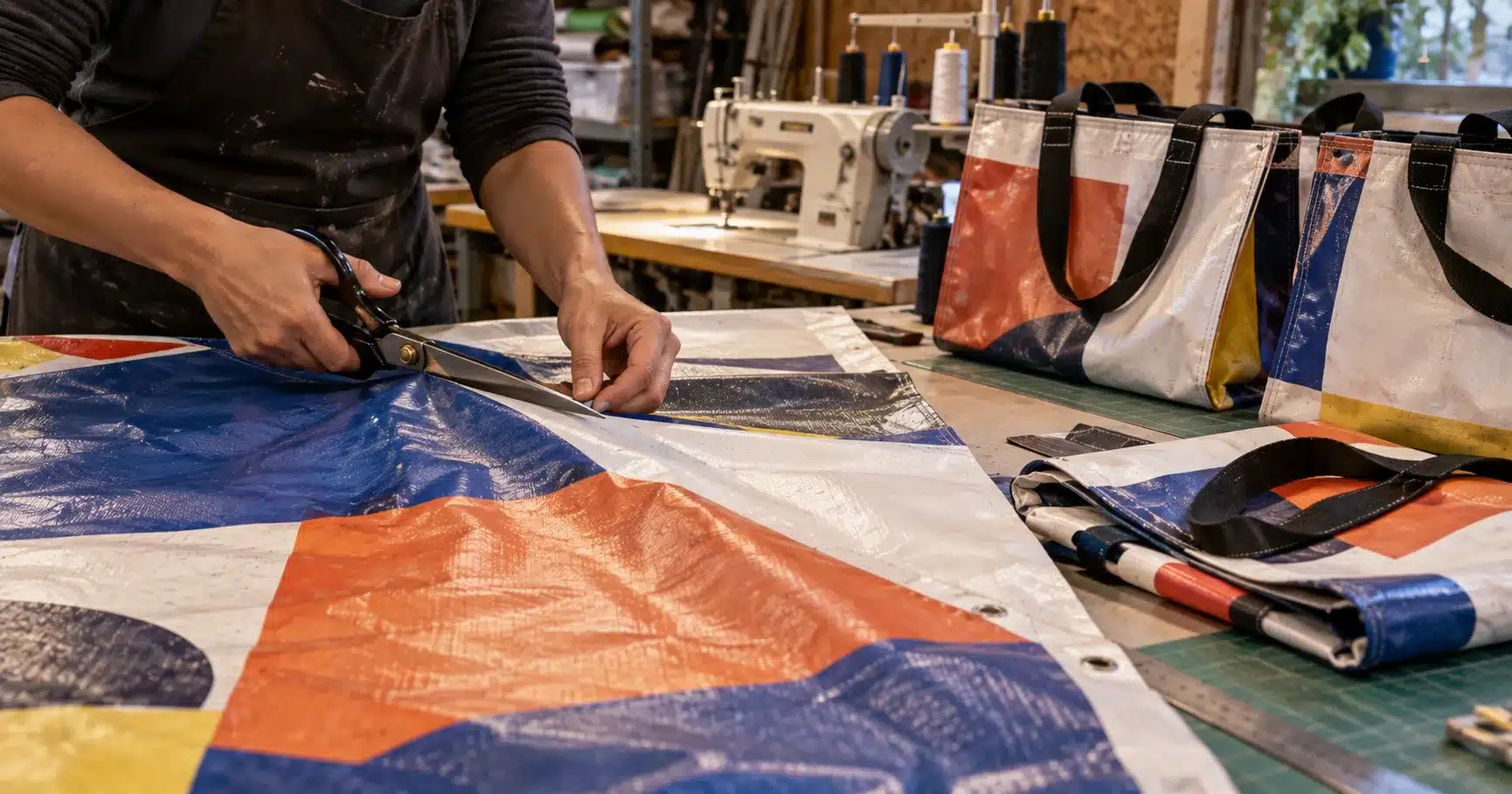
Decorations and banners are a small fraction of total festival plastic by weight, but they’re some of the most visible litter left behind, and some of the most straightforward to actually reuse rather than discard.
Vinyl banners, in particular, are close to impossible to recycle through conventional streams, since the material is a composite that doesn’t break down cleanly into a single recyclable category, and most local recycling programmes don’t accept PVC at all. The more common fix isn’t recycling at all: several event waste guides specifically recommend upcycling old banners into tote bags or other durable goods rather than attempting to recycle the vinyl itself. Biodegradable glitter and confetti bans have also spread quickly across the festival circuit, Burning Man prohibits conventional glitter outright, alongside dozens of British music festivals, driven less by volume than by the fact that traditional glitter is a microplastic that resists cleanup almost entirely once scattered, clinging to skin, fabric and ground in a way loose paper or plastic simply doesn’t.
Single-use items
Beyond cups, food packaging and decorations, festivals generate a long tail of smaller single-use plastic: wristbands, ponchos, cutlery, straws, and the shrink-wrap and packaging that arrives with vendor deliveries before a single attendee walks through the gate.
Individually, none of these register as a major waste category. Collectively, and multiplied across tens of thousands of attendees, they add up in the same way merchandise does in a festival’s broader footprint. France’s anti-waste law now bans single-use plastic tableware at public events outright, requiring reusable dishes and prohibiting plastic confetti specifically, a regulatory approach that removes the sorting problem by removing the product before it exists rather than trying to catch it afterward. Boulder, Colorado takes a similar but less absolute approach, requiring events on city property to use recyclable or compostable food ware and hit a minimum 50% diversion rate.
Why festival plastic is harder to recycle
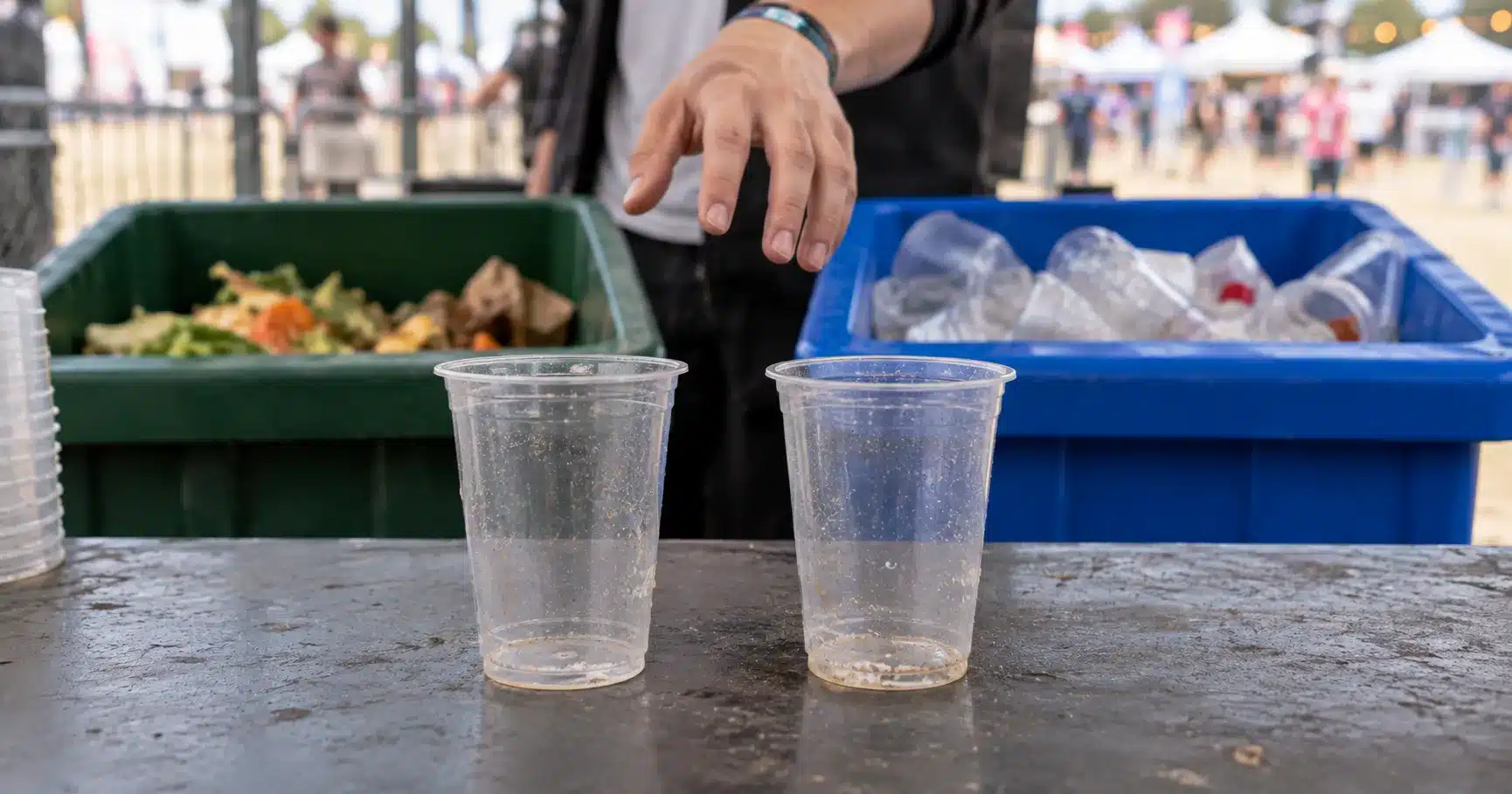
Recyclable plastic and actually-recycled plastic are two different things, and the gap between them is wider at festivals than almost anywhere else waste gets generated.
Contamination is the biggest single factor. Food residue, drink spills, and grease don’t just dirty one item, they compromise everything packed against it in the same bag or bin. Optical sorting equipment at a MRF identifies plastics by their surface properties, and food residue physically interferes with that identification, reducing the purity, and therefore the resale value, of the entire batch it ends up in.
Mixed and composite materials compound the problem. Wax-lined cups, foil-lined snack bags, and vinyl banners are technically plastic but aren’t the single, uniform resin type that recycling facilities are built to process. A cup that looks like plastic but is actually a plastic-paper laminate often can’t go through either the paper stream or the plastics stream cleanly, and ends up rejected from both.
Temporary collection systems lack the consistency permanent infrastructure has. A city’s household recycling programme runs the same way every week, with residents who’ve had years to learn the rules. A festival’s waste system exists for a handful of days, staffed partly by volunteers, used by attendees who’ve never seen that specific site’s bin colours or sorting instructions before, often in the dark, often after drinking. Even well-designed signage can’t fully compensate for a system nobody has had time to learn.
Compostable alternatives create a newer, less obvious version of the same problem. As more festivals switch to compostable cups and cutlery to solve the plastic problem, a different contamination issue has emerged: compostable plastic looks nearly identical to conventional plastic, so it frequently ends up in the wrong stream, either contaminating a plastics recycling batch it can’t actually be processed alongside, or ending up in general trash when it could have been composted. Solving one contamination problem has partly recreated it in a different bin.
The combined effect is that festival plastic, even when correctly identified as recyclable material, frequently fails to actually get recycled for reasons that have nothing to do with the plastic itself and everything to do with the speed, scale, and conditions it was collected under.
What actually works
The festivals with genuinely low plastic waste don’t generally have better recycling. They have less plastic to begin with.
Outside Lands in San Francisco uses compostable cutlery and containers across the board, helping divert over 90% of festival waste from landfill. Green Man’s compostable-only vendor policy and Hillside’s total plastic ban both remove the sorting problem at the source rather than trying to solve it after the fact. This mirrors a pattern that shows up across festival food waste and the broader carbon footprint of festivals alike: interventions decided during vendor contracting and site planning consistently outperform ones aimed at changing attendee behaviour in the moment. Deposit-return cup schemes work for the same underlying reason. They don’t rely on someone choosing to recycle correctly at 2am; they use a financial incentive to make the correct outcome the path of least resistance. For the fuller picture of how plastic compares to other waste categories at scale, our comparison of waste across festival types breaks down where plastic actually sits in the total footprint.
FAQ
What happens to plastic cups and bottles after a festival ends?
They’re collected, on a deadline set by the venue agreement, commonly 24 to 72 hours after the event but ranging from a few hours at a small venue to weeks at the largest camping festivals, then either sorted on-site into clean recycling streams or sent to a materials recovery facility as mixed waste. Clean, correctly sorted items have a reasonable chance of recycling; contaminated or mixed material is typically diverted to landfill.
Why is festival plastic harder to recycle than household plastic?
Four compounding factors: food and drink contamination, mixed or composite materials like wax-lined cups and vinyl banners, temporary collection systems that lack the consistency of permanent infrastructure, and confusion between compostable and conventional plastics that look identical but require different disposal streams.
Do festival recycling programmes actually work?
Results vary enormously by festival. Programmes built around removing plastic at the source, compostable-only vendor policies, total plastic bans, deposit-return cup schemes, consistently outperform programmes that rely on attendees sorting correctly after the fact.
What percentage of festival plastic actually gets recycled?
There’s no single reliable global figure, since methodology and festival type vary widely, but general single-stream MRF data suggests less than half of mixed material typically survives sorting for recycling, with the rest diverted to landfill due to contamination.
Can compostable cups and plastic cups be recycled together?
No, and mixing them is a common, underappreciated cause of contamination. Compostable plastic looks similar to conventional plastic but requires industrial composting conditions to break down, so it doesn’t belong in a plastics recycling stream, and conventional plastic doesn’t belong in a compost stream either.
What happens to festival banners and decorations?
Most aren’t recycled through conventional streams, since materials like vinyl are composites that don’t separate cleanly into a single recyclable category. The more common and more effective approach is upcycling, banners into tote bags being one widely used example, rather than attempting to recycle the original material.
How much plastic does a large religious festival generate?
The 2023 Arba’een pilgrimage in Karbala, Iraq, one of the world’s largest annual religious gatherings, generated an estimated 4,000 tonnes of plastic waste, or 0.18 kg per pilgrim, alongside 7,900 tonnes of food waste, according to a 2025 peer-reviewed waste audit.
Is banning single-use plastic at festivals more effective than improving recycling?
Based on the available evidence, generally yes. France’s national ban on single-use plastic tableware at public events and individual festivals’ compostable-only or plastic-free vendor policies remove the contamination and sorting problem entirely, rather than trying to manage it after the waste has already been generated and mixed.
The bottom line
Most festival plastic doesn’t fail at the collection stage. It fails at the sorting stage, undone by food residue, mixed materials, and a collection window measured in hours rather than years of learned habit. That’s actually good news for anyone trying to fix it, because it means the highest-leverage interventions aren’t about getting attendees to try harder. They’re about removing plastic from the site before it’s generated, or making reuse the default rather than the effortful choice. The festivals doing this well aren’t recycling their way to a clean field. They’re simply putting less there to begin with.

Abhay Ramola researches world festivals across primary sources, local accounts, and on-ground reporting. He founded Dionfest to cover what gets missed when festivals become tourism content the history, the ritual, and the people behind it.






1 thought on “What Happens to Festival Plastic After the Celebration Ends?”