
What Happens to Festival Flowers After They’re Thrown Away?
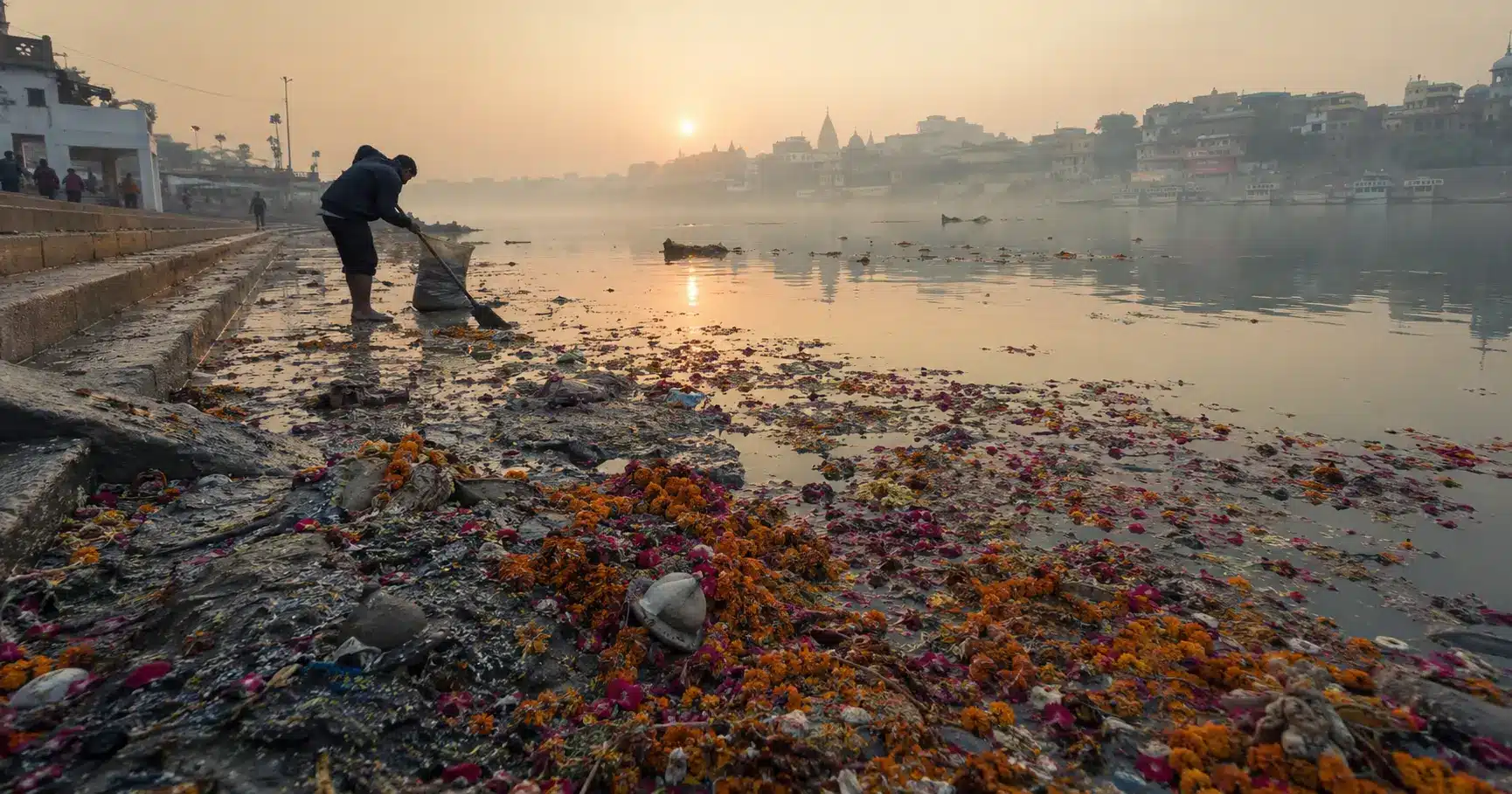
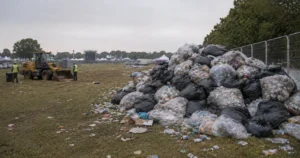
The morning after Ganesh Visarjan, the ghats look nothing like the night before. The drums are gone, the crowd is gone, and what’s left is a tide line of marigold and rose petals, soggy and browning, tangled with incense ash and bits of clay from idols that didn’t fully dissolve. Nobody organised this mess. It’s just where the flowers ended up, the same place they end up after almost every puja in India: a river, a drain, or a garbage heap outside a temple gate.
That’s the part of the festival nobody photographs. Millions of tonnes of flowers move through India’s temples, pandals, and homes every year, and festival flower waste is treated less like waste and more like something that has to disappear quietly, usually into a river. Here’s where it actually goes, why that’s a problem, and who is quietly turning it into something else.
Fast facts
- What it’s called: Nirmalya — flowers, leaves, and other items offered in worship, considered too sacred for a regular dustbin
- Where it mostly ends up: rivers, ponds, and open dumps near temples
- Estimated flower waste dumped in India’s rivers each year: around 8 million tonnes (2016 estimate, still the most-cited figure)
- Estimated national flower waste generated daily: 300+ tonnes, rising sharply during major festivals
- Main festivals driving it: Ganesh Chaturthi, Durga Puja, Navratri, Diwali, plus year-round temple offerings
- What it’s being turned into: incense, vermicompost, natural dye, biodegradable leather and packaging, perfume
Across India, flowers offered at temples and during festivals like Ganesh Chaturthi and Durga Puja are treated as too sacred for household waste. Most get dumped into rivers or open land instead. An estimated 8 million tonnes end up in Indian waterways every year, though a small but growing network of recyclers is now converting that waste into incense, dye, and compost.
What actually happens to flowers after a festival ends?
 Most festival flowers follow one of three routes, and which one depends entirely on where the flower was offered.
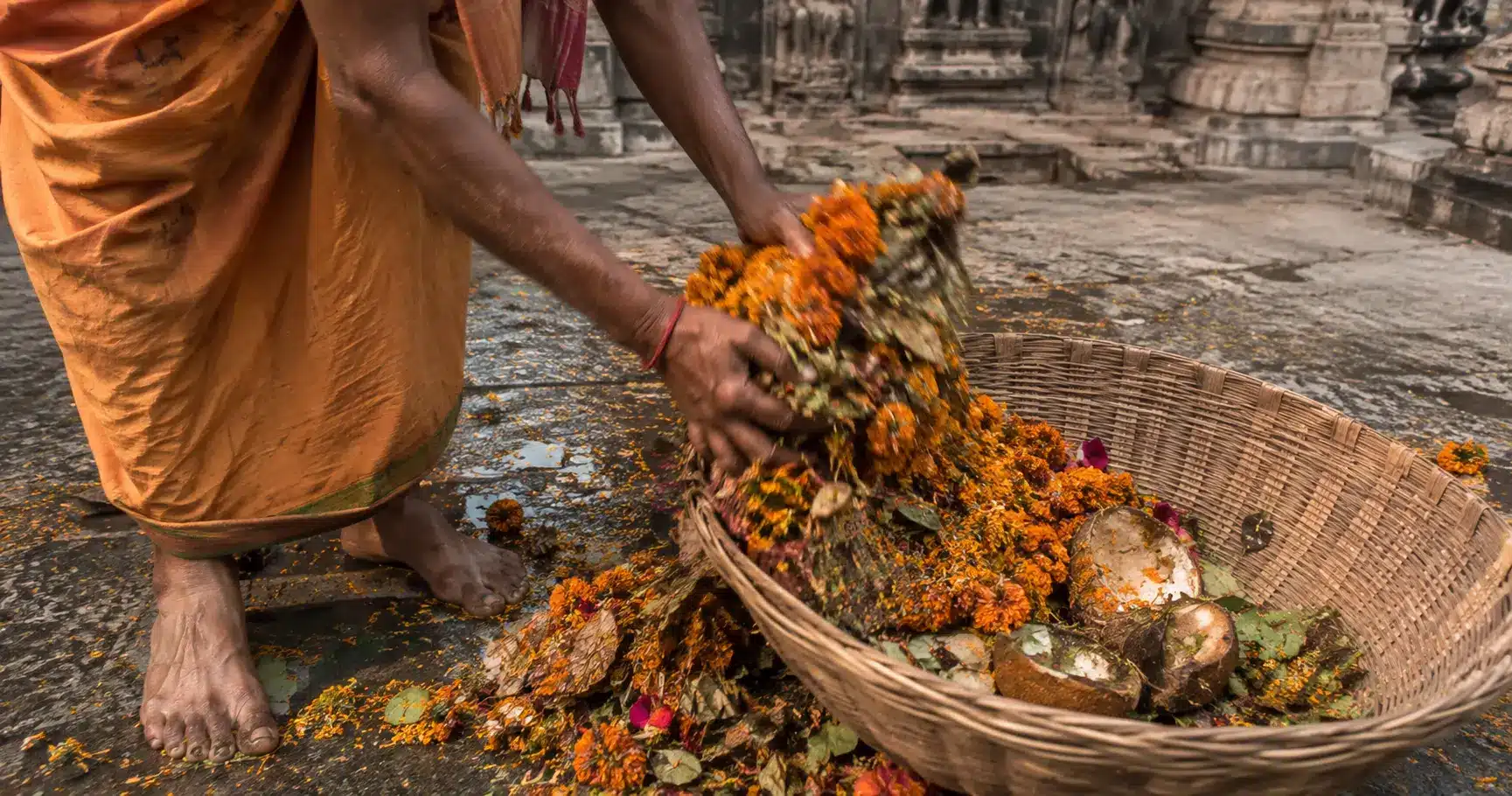
At a home altar, flowers are usually removed after a day or two and set aside separately from household rubbish, often in their own bag or basket, because mixing them with regular trash is considered disrespectful. At a neighbourhood temple, the volume is bigger: priests or temple staff sweep out garlands and loose petals daily, and in a country with close to two million temples, that adds up fast. Researchers studying four temples in Guwahati alone found the daily haul included flowers, fruit, and even discarded milk packets, all lumped together as one undifferentiated pile.
Festival-specific flowers move differently again. Ganesh Chaturthi and Durga Puja idols are dressed in garlands that go into the water with them at immersion. Ayodhya’s roughly 10,000 temples reportedly generate 10 to 15 quintals (1,000 to 1,500 kg) of floral waste on an ordinary day, a figure that climbs during festival weeks. None of this is sorted at the source. Flowers, leaves, coconut shells, plastic wrapping, and incense stubs typically leave the temple gate as one mixed load, which is exactly why they’re hard to recycle later.
Why don’t festival flowers just go in the bin?
The short answer: because they were offered to a deity, and throwing something sacred in with kitchen scraps feels wrong to a lot of people, even when there’s no religious rule that technically forbids it.
The Sanskrit term for this category of waste is nirmalya anything left over from worship, including wilted flowers, burnt camphor, and melted wax. One devotee’s household guide, published on a Krishna-consciousness devotional site, is specific about the practice: keep nirmalya separate from ordinary trash, and if you can’t compost or burn it, wrap it and dispose of it with some care rather than tossing it loose. It’s one household’s system, not a universal rule, but the underlying instinct is common across worship traditions in India: water has traditionally been seen as a natural, purifying place to return an offering. That instinct made sense when flower volumes were small and communities lived close to the water they used it in. It stops making sense at the scale India operates at now.
Where festival flower waste ends up, and what it does to rivers
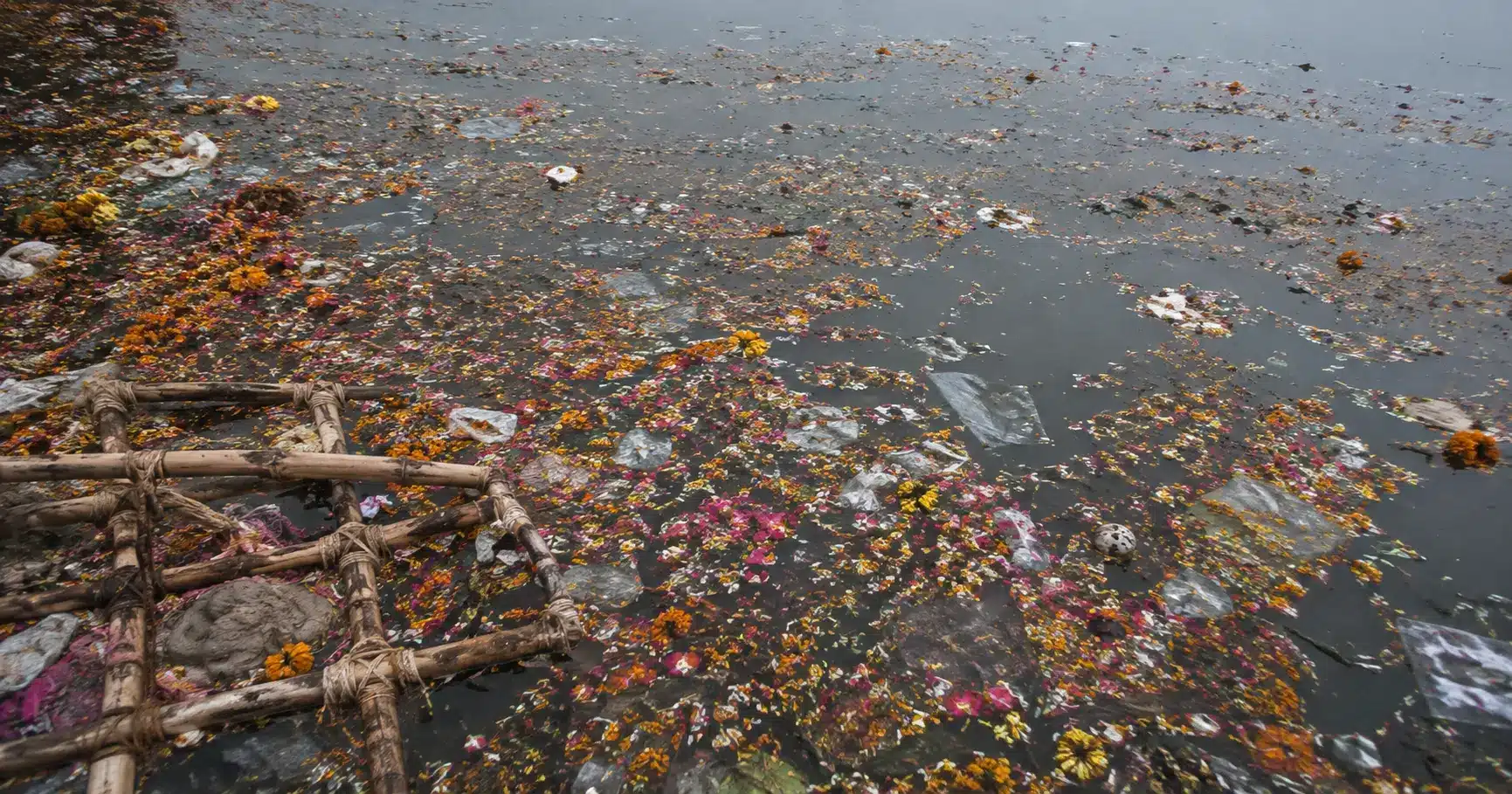 Rivers absorb the bulk of it. Multiple independent studies put the figure at roughly 8 million tonnes of floral waste dumped into Indian rivers and water bodies annually, a number that traces back to 2016 research and keeps getting cited because nobody has produced a more current national count. A separate, more recent estimate from Mongabay India put daily national generation at over 300 tonnes as of mid-2025. The two figures measure different things (all floral waste generated versus the share that specifically reaches rivers) and neither is a precise census, which is itself worth knowing: nobody is currently tracking this with real accuracy.
Flower waste alone would rot and cause a smell, but not much else. The bigger issue is what travels with them. Commercially grown marigolds and roses are typically treated with pesticides that don’t wash off, and during Ganesh Chaturthi and Durga Puja specifically, flowers go into the water alongside idols made of Plaster of Paris and painted with pigments containing lead, mercury, and other heavy metals. A 2019 study of the Hooghly river in Kolkata found heavy metal concentrations rose sharply at six sites after immersion, pushing past safe drinking-water thresholds in a river that supplies drinking water to millions downstream. Delhi’s Yamuna has been the subject of National Green Tribunal orders on exactly this problem since 2015, and idol immersion is now banned there outright, with artificial ponds offered as an alternative.
Read more: our Ganesh Chaturthi 2026 guide covers the festival itself, including the Anant Chaturdashi immersion day where most of this waste enters the water in a single 24-hour window.
Flower-driven river pollution isn’t unique to Ganesh Chaturthi and Durga Puja, either. Our piece on how Kanwar Yatra affects North India’s rivers documents a similar pattern during a different festival: large gatherings at ghats, a spike in waste that outpaces cleanup capacity, and very little real-time water quality monitoring to show how bad it actually gets.
The recycling response: composting and vermicomposting
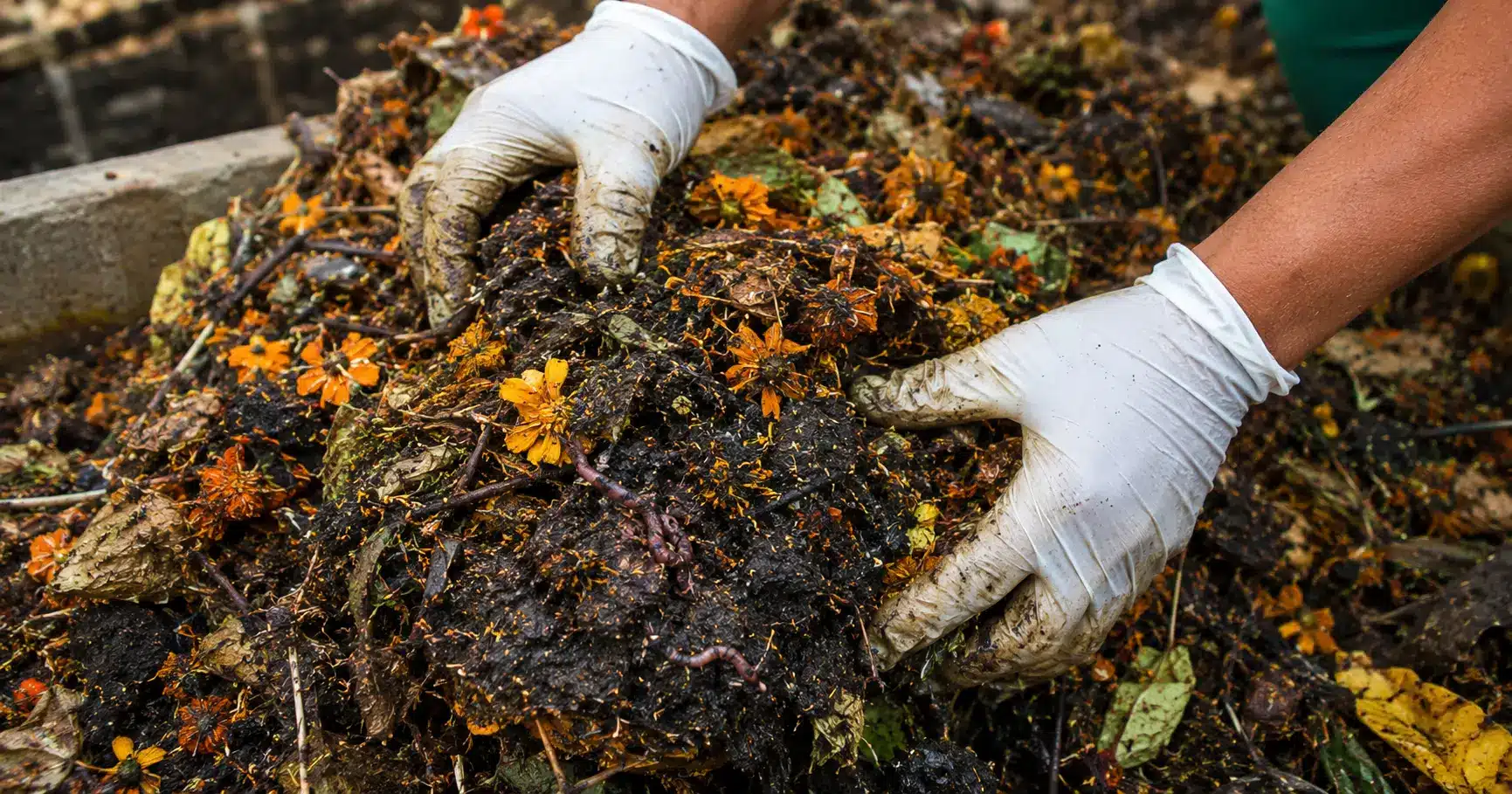 Composting is the most basic fix, and it’s spreading through municipal corporations faster than most people realise. In Punjab, the Phagwara Municipal Corporation opened a floral-waste compost counter at a local temple in 2025, turning offerings straight into free soil amendment for residents. Chandigarh runs a similar operation at a larger scale, collecting an estimated 450 kg of floral waste a day, rising to 700 kg during festival season, from 156 sites across the city.
Vermicomposting, which uses earthworms (usually the species Eisenia fetida) to break the material down faster, has been studied specifically for temple waste in Jaipur, Agra, and Guwahati. Researchers in Agra sourced marigold and rose waste directly from city temples and mixed it with cow dung from a local gaushala; the resulting compost met standard fertility benchmarks for agricultural use. None of this is exotic technology. It’s closer to a plumbing fix than an invention, which is probably why it’s spreading through small-city municipal programmes rather than requiring venture funding.
From temple floor to incense stick
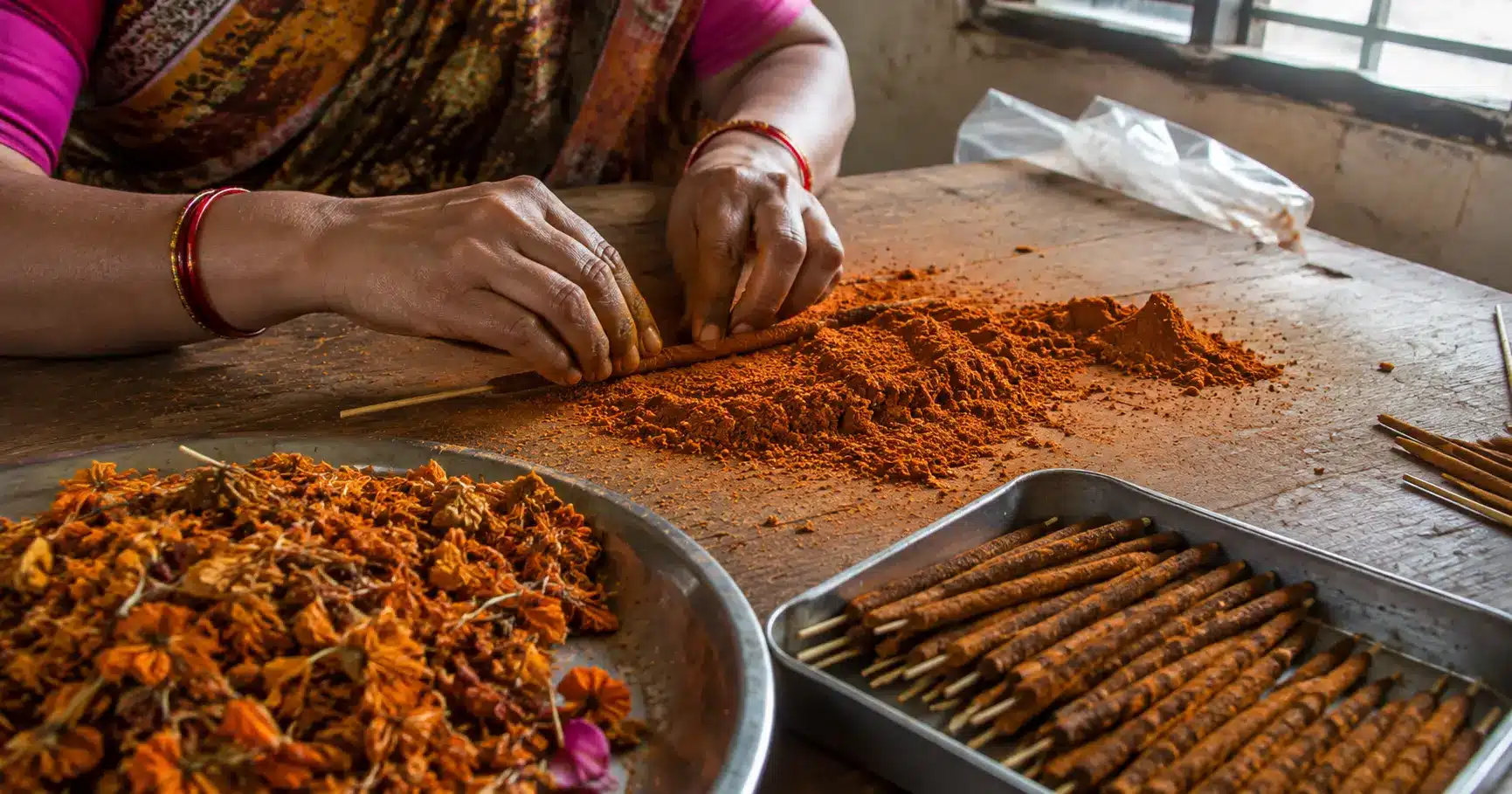 The best-known name in this space is Phool (the Hindi word for “flower”), founded in Kanpur in 2017 by Ankit Agarwal and Prateek Kumar after Agarwal spent a winter morning watching flower waste pile up along the Ganges. The company now collects floral waste from temples in cities including Ayodhya, Varanasi, Bodh Gaya, and Badrinath, and has recycled more than 11,000 metric tonnes of it since starting. The flowers are dried, ground, and hand-rolled into charcoal-free incense by women employees, many of whom previously worked as manual scavengers. In 2018, the operation won the UN’s Momentum for Change award at COP24, in the Women for Results category.
Phool isn’t alone. Aaruhi Enterprise, founded by Poonam Sehrawat, runs a similar charcoal-free incense operation employing close to 200 women. In Ayodhya, a university partnership between Dr Ram Manohar Lohia Avadh University and the government’s Fragrance and Flavour Development Centre in Kannauj is working on turning temple floral waste into itra, the traditional Indian perfume, on top of incense and scented havan material. Chandigarh’s municipal corporation has talked about doing the same after a study trip to Ujjain, where some temples already run flowers through a waste converter to make manure.
Flowers become colour: the Holi connection
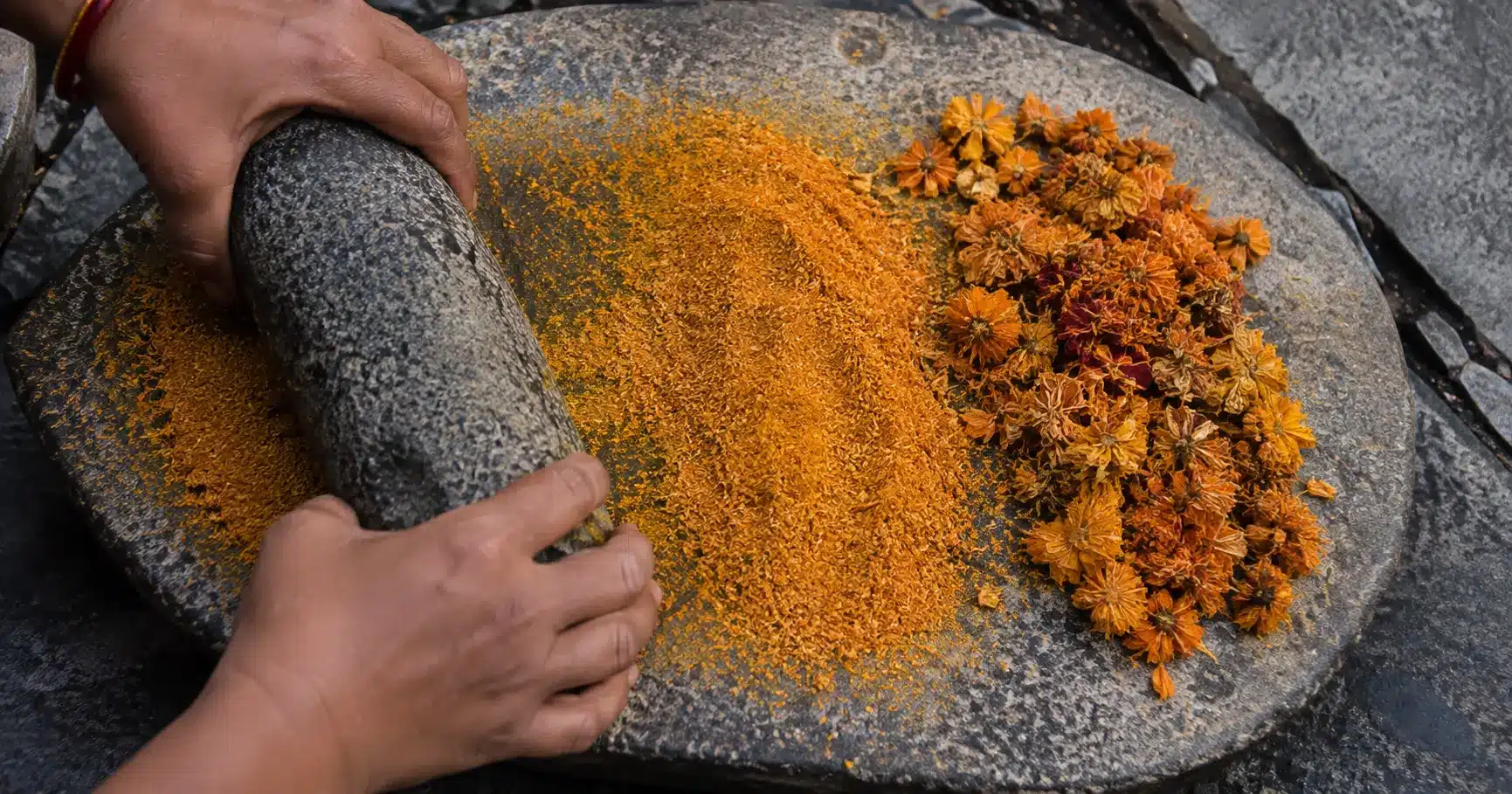 Holi’s synthetic colours have a genuine health problem behind their bright shades. Compounds like copper sulfate, mercury sulfite, and chromium iodide have turned up in commercial gulal, and they’ve been linked to skin allergies and respiratory irritation. Recycled festival flowers are one of the more direct fixes: marigold and rose waste, dried and ground, can be processed into organic gulal without the industrial dye. It’s a smaller-scale effort than the incense side of the business, more workshop than factory, but it closes a loop that’s easy to miss: the same flowers dumped after one festival can become the powder thrown at the next one.
For the fuller picture of what the festival involves beyond the colours, see our guide to Holi.
Beyond incense: leather, paper, and packaging
Flower waste breaks down into cellulose, and cellulose is useful for more than compost. Phool’s Fleather is a vegan leather alternative made from floral biomaterial, and its Florafoam is a biodegradable substitute for polystyrene packaging. Separately, a student research project at NIT Rourkela — led by Souvik Mandal, Sudipta Pahari, and Abhijit Behera under professor Raj Kishore Patel — spent 2022 developing biodegradable packaging material from flower-waste cellulose after surveying the city’s own waste stream, which they found ran to roughly 2.5 tonnes of used flowers a day, a figure that climbs further during festivals.
None of these are large-scale industries yet. Most operate at the scale of a workshop or a small factory, not a national supply chain. What they demonstrate is that raw material was never the constraint: there’s more flower waste than anyone currently has the capacity to process. The actual bottleneck is collection infrastructure and steady buyers for the finished product.
What can you actually do with puja flowers at home?
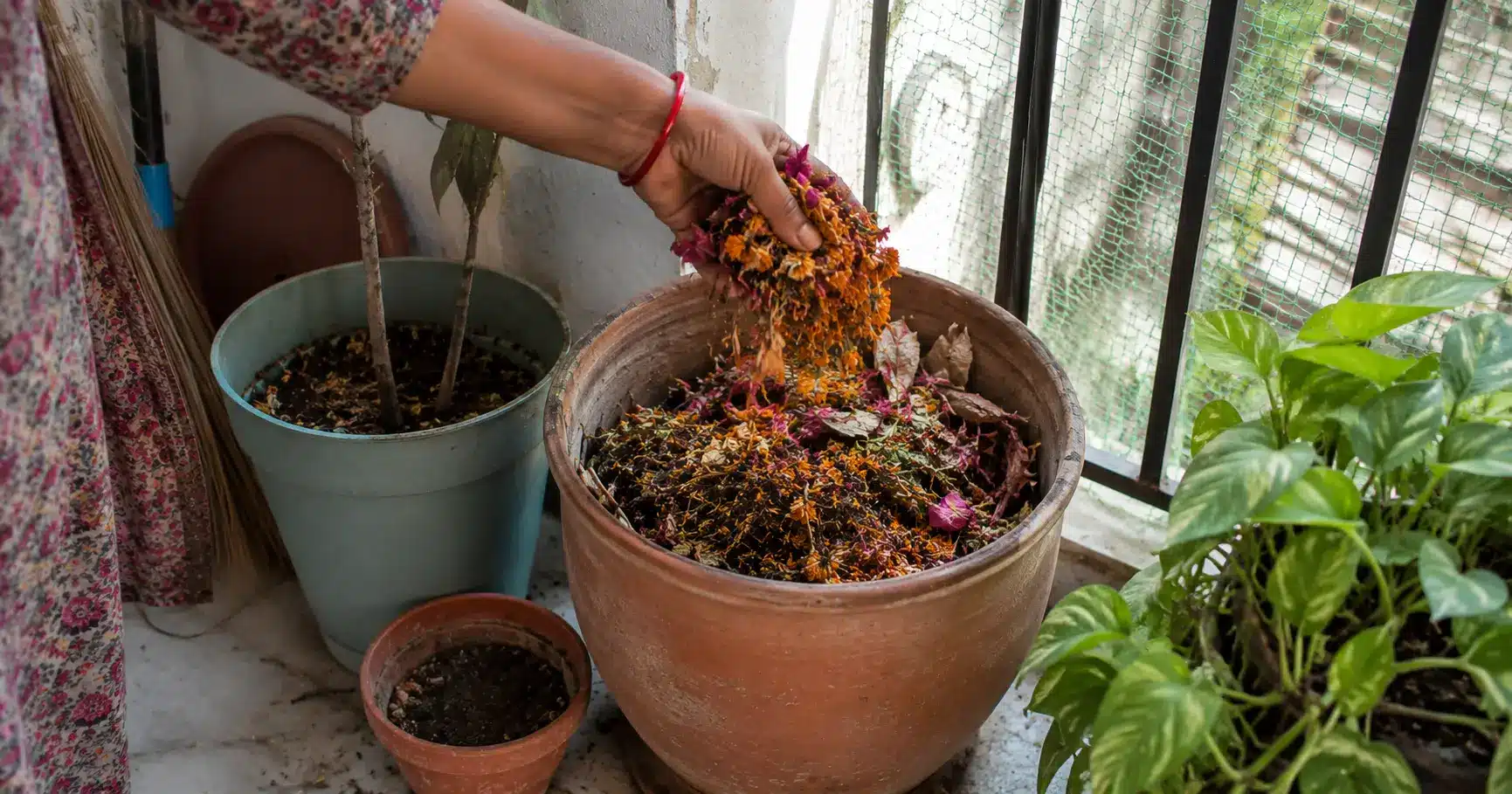 If you’re not near an organised collection scheme, the options are more limited but not nonexistent.
Home composting works if you have any outdoor space at all. Flowers break down faster than most kitchen waste, and mixing them with dry leaves or a bit of soil speeds things up further. If composting isn’t practical, the same household devotional guide cited earlier suggests drying the flowers and burning them separately from other refuse, rather than in an open pile, and using a water body only as a last resort, in a bag, well away from where the water is drawn for other use. It’s worth checking whether your city or a local temple already runs a flower-collection scheme; several municipal corporations now do, and dropping wilted garlands there beats putting them anywhere near a drain.
None of this requires giving up the practice. It just means treating the flowers as compostable material with a religious history, rather than as something that has to disappear into moving water to count as properly disposed of. If you want a lower-effort way to think about festival waste generally, World Cleanup Day in September is built around exactly this kind of small, local action.
FAQ
What happens to flowers after a puja or festival?
Most are removed within a day or two and treated separately from household waste, because they’re considered too sacred for a regular bin. At scale, they’re usually dumped in a river, pond, or open ground near the temple; a much smaller share is composted, dried into incense, or processed into dye by dedicated recycling operations.
Why do people throw flowers into rivers instead of the bin?
Flowers offered to a deity are seen as sacred, and mixing them with ordinary trash feels disrespectful to many worshippers. Water has traditionally been viewed as a natural, purifying place to return an offering, a practice that predates the scale of flower waste modern festivals now produce.
How much flower waste does India generate every year?
Estimates vary by methodology. The most-cited figure puts flower waste dumped in India’s rivers and water bodies at around 8 million tonnes a year, based on 2016 research. A separate 2025 estimate put national daily floral waste generation at over 300 tonnes, rising during festival season.
What is nirmalya?
Nirmalya is the Sanskrit and Hindi term for anything left over from worship: wilted flowers, burnt camphor, melted wax, and similar offerings. It’s treated as distinct from regular waste and is traditionally not thrown out with household rubbish.
What happens to flowers after Ganesh idol immersion?
Garlands and loose flowers go into the water along with the idol during visarjan. Unlike the idol’s Plaster of Paris and paint, the flowers themselves are biodegradable, but they still add to the organic load and often carry pesticide residue from commercial cultivation.
Can puja flowers be composted at home?
Yes. Flowers break down faster than most kitchen scraps, and mixing them with dry leaves or garden soil speeds up the process. A small outdoor compost bin or even a covered pit is enough for household quantities.
What company recycles temple flowers into incense?
Phool, a Kanpur-based company founded in 2017, is the best-known example. It collects floral waste from temples in several Indian cities and converts it into charcoal-free incense, vermicompost, and biomaterials, employing women who previously worked as manual scavengers.
Is festival flower waste different from regular floral waste?
The material is the same, but the disposal problem is bigger and more concentrated. Wedding or florist flower waste is treated as ordinary organic waste and usually goes to landfill or compost. Temple and festival flowers are treated as sacred, which routes most of them to rivers and open dumps instead of standard waste systems, making the pollution more geographically concentrated around temples and immersion sites.
Is it disrespectful to throw puja flowers in a regular dustbin?
Many worshippers believe so, which is exactly why rivers and open ground became the default instead. Composting or using a dedicated flower-collection scheme, where available, avoids that concern while keeping the flowers out of the water.
The bottom line
Festival flowers were never the problem. Scale is. A practice that made sense for a village temple and a handful of garlands doesn’t hold up when it’s millions of tonnes moving through rivers that supply drinking water downstream. The fix already exists in pieces: municipal composting, flowercycling startups, small perfume and dye operations, and clearer guidance for households on what to do instead of the nearest drain. What’s missing is coordination between them, and a lot more collection points than currently exist.

Abhay Ramola researches world festivals across primary sources, local accounts, and on-ground reporting. He founded Dionfest to cover what gets missed when festivals become tourism content the history, the ritual, and the people behind it.





2 thoughts on “What Happens to Festival Flowers After They’re Thrown Away?”