
Dragon Boat Festival 2026: Complete Guide
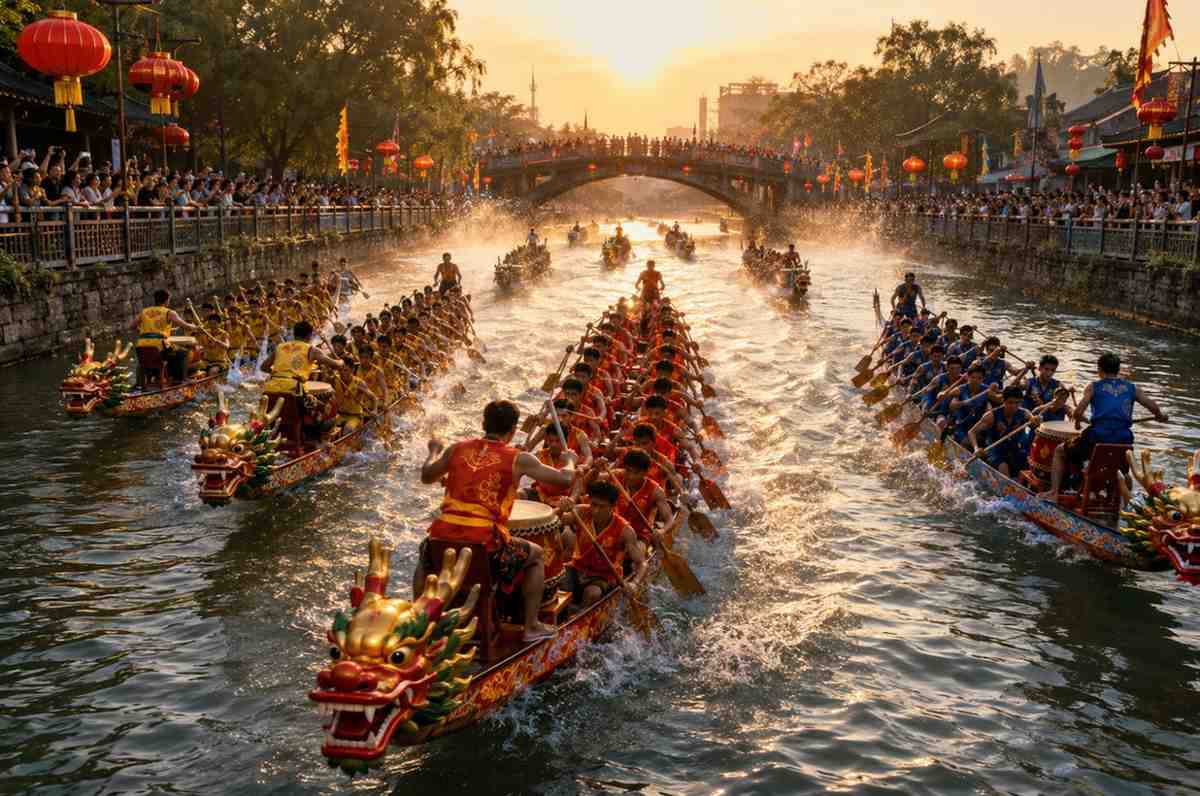
The drums hit you before the boats do. One moment the water is calm — the next, 20 paddlers are moving like a single machine, every stroke synchronized, the drummer setting the heartbeat. Dragon Boat Festival is 2,000 years old, born from a poet who chose death over silence. The boats, the dumplings, the rituals they all trace back to that one decision.
What Is the Dragon Boat Festival?
The Dragon Boat Festival is a Chinese public holiday observed on the fifth day of the fifth month of the lunar calendar. In 2026, that lands on Friday, June 19.
It goes by several names. In Mandarin it’s Duānwǔ Jié (端午节). You’ll sometimes see it called the Double Fifth Festival, because of that fifth-day, fifth-month timing. Outside China, “Dragon Boat Festival” has stuck as the common English name — mostly because the boat racing is the part that travels well across cultures.
The holiday is 2,000-plus years old. It’s listed by UNESCO as an Intangible Cultural Heritage of Humanity, a designation added in 2009. Taiwan, Hong Kong, and Macau observe it as a public holiday. Significant celebrations also happen in Vietnam (where it’s called Tết Đoan Ngọ), South Korea, and wherever large Chinese diaspora communities exist — from San Francisco to Sydney to London.
The History Behind the Holiday
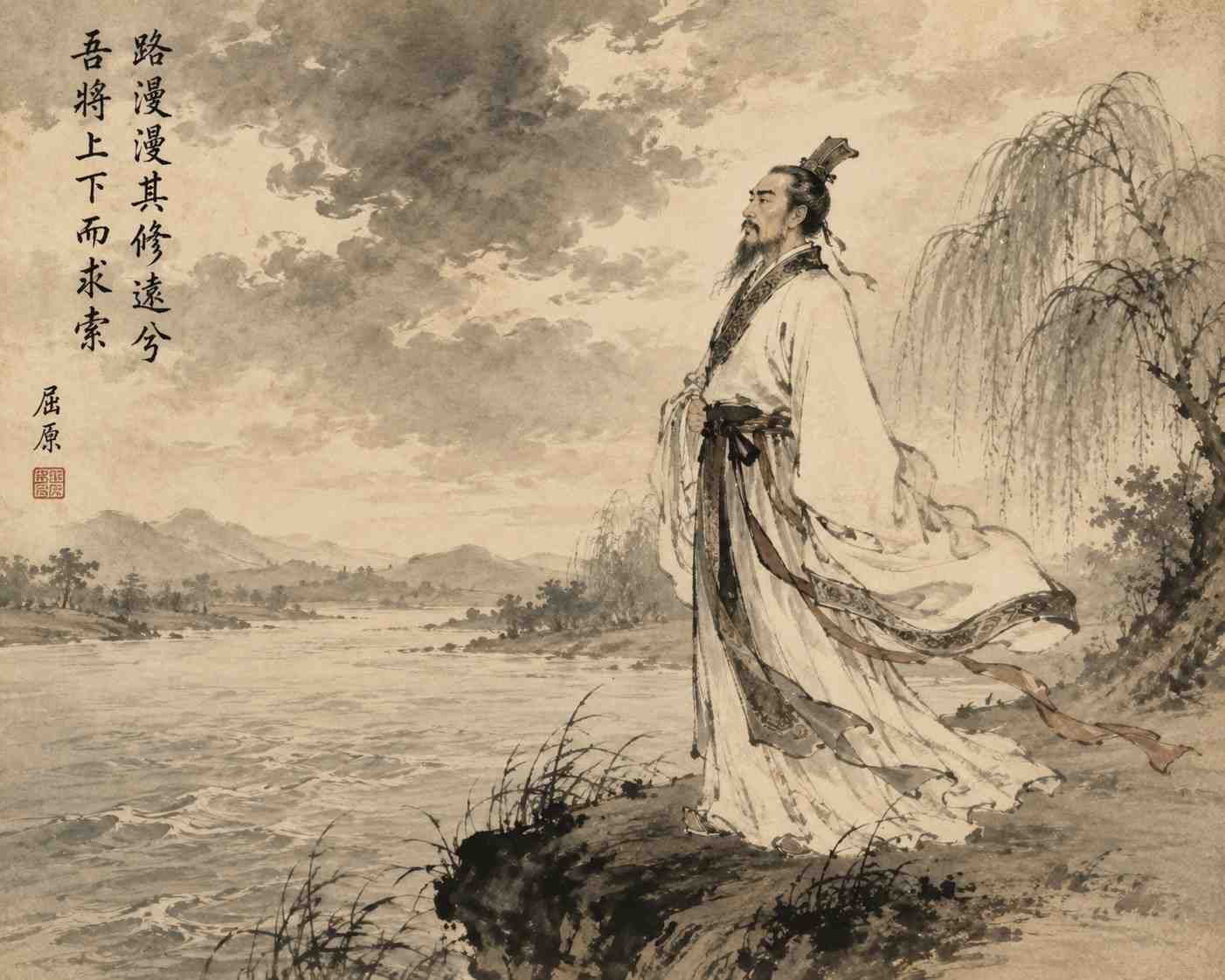 Most people know one origin story: the poet Qu Yuan.
Qu Yuan (屈原) was a minister and poet in the state of Chu during the Warring States period, around 278 BCE. He opposed his king’s alliance with the rival Qin state. He was right — Qin later conquered Chu — but before that happened, Qu Yuan was exiled for speaking up. When Chu’s capital fell to Qin forces, he drowned himself in the Miluo River in despair.
The people who respected him raced out in boats to recover his body. They beat drums to scare fish away and threw rice wrapped in bamboo leaves (now called zongzi) into the water so the fish would eat that instead of him. They failed to find the body, but the rituals stuck.
That’s the dominant origin story, and it’s genuinely moving — a patriot who chose death over watching his country fall. But there are competing explanations. Some historians link the date to the death of Wu Zixu, another political figure who drowned at state order. In parts of southern China and among the Yue people, the boat dragon traditions predate the Qu Yuan connection and tie to agricultural rituals and rain prayers.
The honest answer is: the holiday absorbed multiple older traditions over centuries, and the Qu Yuan story gave them a narrative anchor that stuck.
Dragon Boat Racing: How It Actually Work
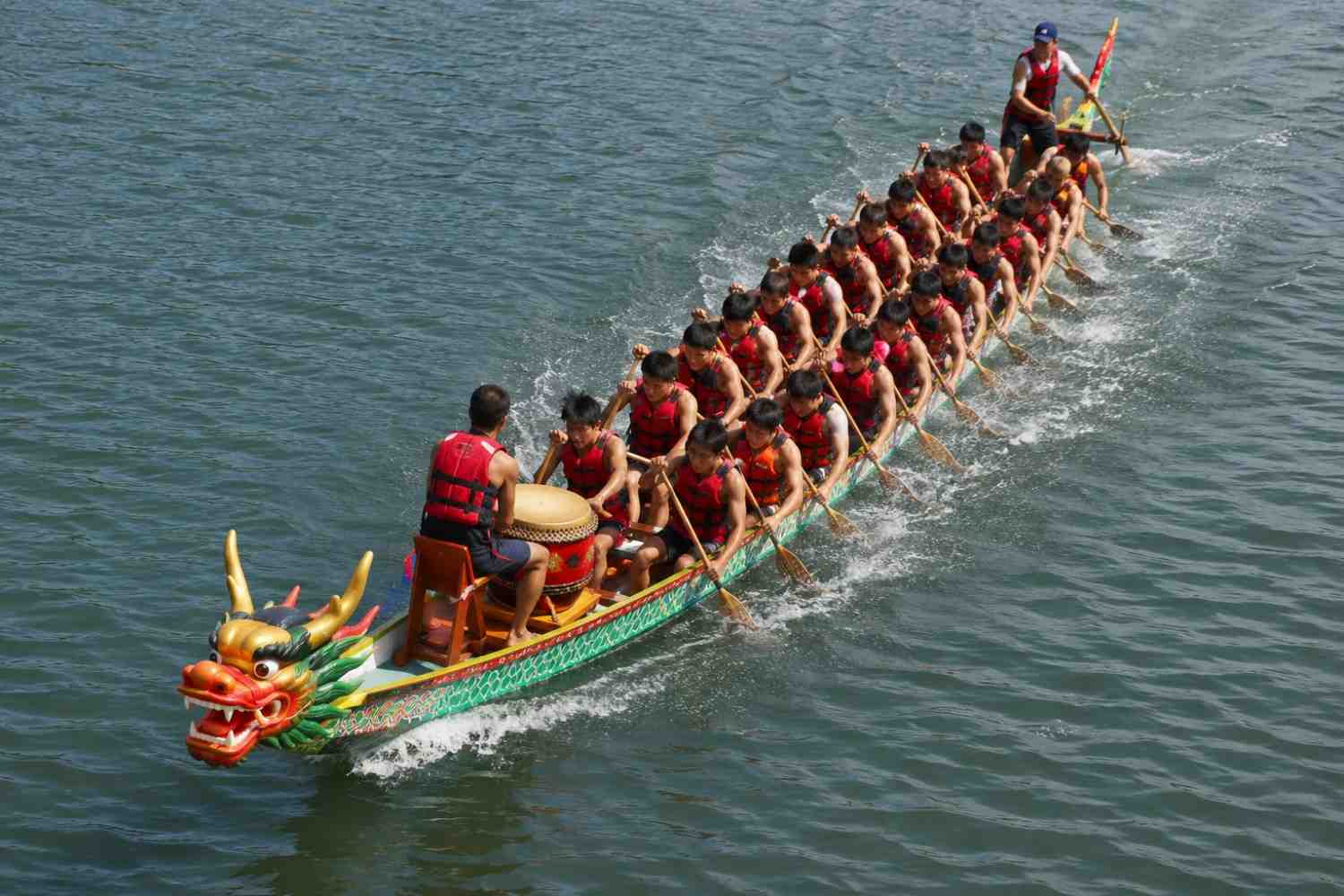
This is the part most people outside Asia have encountered — and it’s genuinely worth watching, because it’s fast, loud, and physically demanding in ways that aren’t obvious from a distance.
The boats
A standard competition dragon boat is 12 to 14 meters long and seats 20 paddlers in two columns of 10. There’s also a drummer at the front and a sweep (the person steering with a long oar) at the back. The boat is carved or molded to look like a dragon, with a painted head at the bow and a tail at the stern — hence the name “boat dragon” in some translations from Chinese.
Boats vary in size. Some international competitions run 10-person and 22-person categories. Club-level boat racing sometimes uses shorter “small boat” formats with 8 paddlers.
The race
Standard sprint distance in international competition is 500 meters. Major events also run 200m (very fast, about 45 seconds at elite level), 1,000m, and 2,000m races. The paddlers use short, straight paddles — not the curved oar style you might expect. Technique matters enormously. Elite teams synchronize every stroke so precisely that the paddle sounds merge into a single rhythm. The drummer doesn’t set the pace — the paddlers set the pace and the drummer amplifies it.
The competitive structure
The International Dragon Boat Federation (IDBF) governs competitive boat racing at the world level. The IDBF World Dragon Boat Racing Championships happens every two years. China dominates in sprint events; Australia, Canada, and the US have strong open and women’s divisions.
At the club level, dragon boat racing has spread far beyond Asia. There are active clubs in Germany, the UK, South Africa, Brazil, and dozens of other countries. The sport grew significantly through breast cancer survivor paddling groups — a movement that started in Vancouver in 1996 under Dr. Don McKenzie, who studied whether paddling was safe for women post-mastectomy (it was). That community is now a significant part of the sport globally.
2026 Major Dragon Boat Festivals and Events
Here are confirmed or historically annual events worth knowing about for 2026:
Hong Kong International Dragon Boat Races — Usually held in June in Victoria Harbour. One of the oldest international competitions, running since 1976. Teams come from across Asia, Europe, and North America.
Stanley International Dragon Boat Championships, Hong Kong — Separate from the main HK races, this event at Stanley Bay has been running for decades and draws large international participation.
Toronto Dragon Boat Festival — Held at Centre Island, Toronto. One of the largest festivals outside Asia, typically drawing 180+ teams. Usually scheduled over a weekend in June.
San Francisco Dragon Boat Festival — Held on the bay, usually in September. Among the oldest Western competitions.
Taipei Dragon Boat Festival races — Multiple events across Taiwan, including the annual competition on the Tamsui River and events at Dahu Park.
Singapore River Hongbao dragon boat events — Singapore typically holds races around the holiday period.
Check local event websites for 2026 dates — most publish schedules by March of the event year.
What People Eat: Zongzi and the Food Traditions
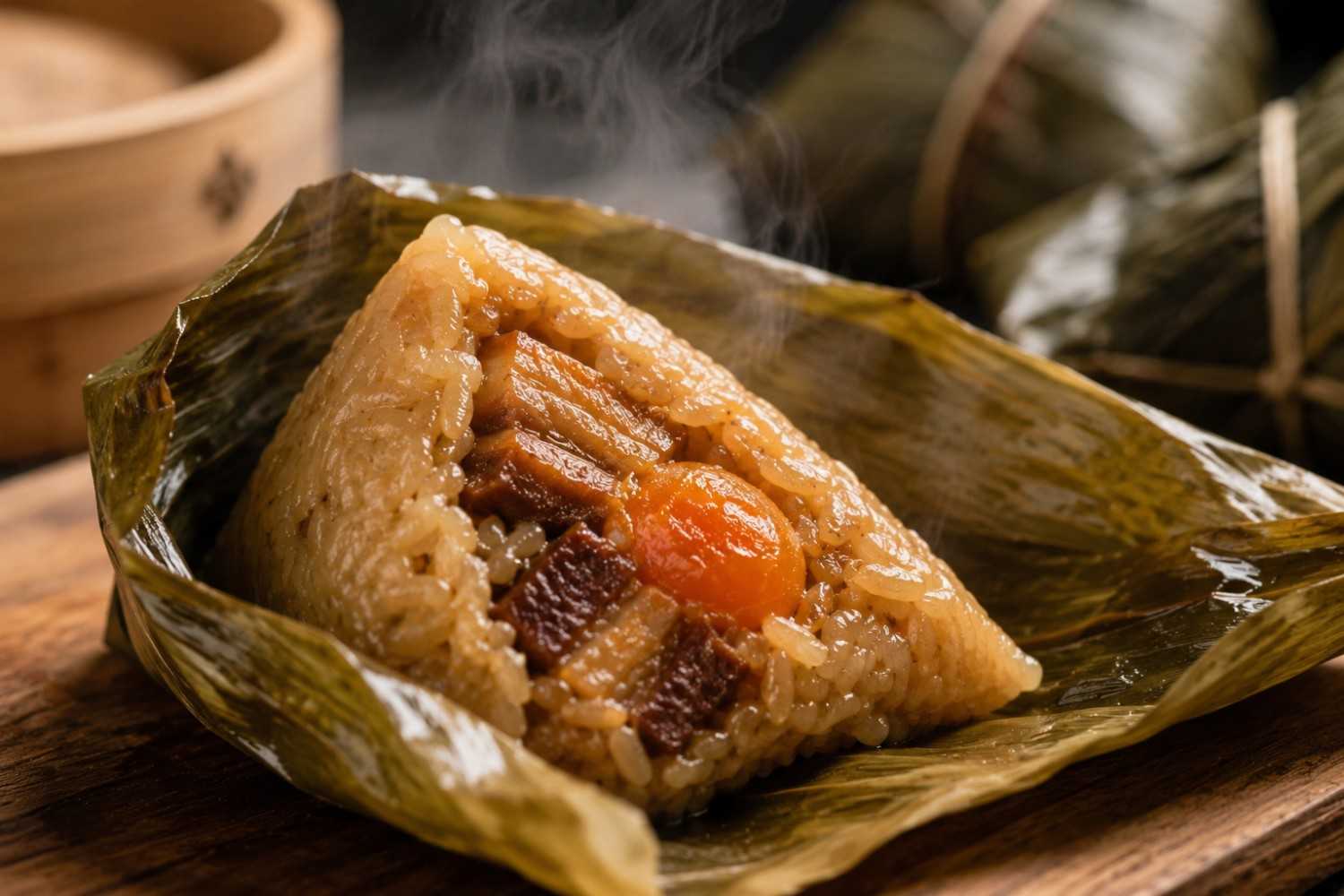 Zongzi (粽子) is the central food of the Dragon Boat Festival. It’s glutinous rice stuffed with fillings and wrapped in bamboo or reed leaves, then steamed or boiled. The result is dense, slightly sticky, and depending on the filling, somewhere between savory and rich.
The fillings split sharply by region:
Northern China: Sweet fillings. Red bean paste, jujube (Chinese dates), or just plain glutinous rice with sugar. These tend to be smaller and simpler.
Southern China: Savory. Pork belly (fatty, braised), salted egg yolk, shiitake mushroom, mung beans, sometimes chestnuts. Cantonese zongzi are often pyramid-shaped and notably rich.
Fujian and Southeast Asian variations: Can include dried shrimp, lap cheong sausage, and more complex spice profiles. Vietnamese bánh chưng (square rice cakes eaten at Tết, not the Dragon Boat holiday specifically) is a related tradition.
The savory vs. sweet zongzi debate is real and genuinely contentious among Chinese food communities — comparable in cultural heat to the pineapple-on-pizza argument in the West.
Other foods associated with the holiday:
- Realgar wine (xiónghuáng jiǔ) — traditionally drunk on this day, though consumption has declined because realgar is an arsenic compound. You’ll still see it at traditional ceremonies; drinking it as a custom is less common than it used to be.
- Five-color rice — eaten in Guangxi and some minority communities in southwest China.
- Salted duck eggs — associated with the holiday in many regions.
The Rituals People Still Practice
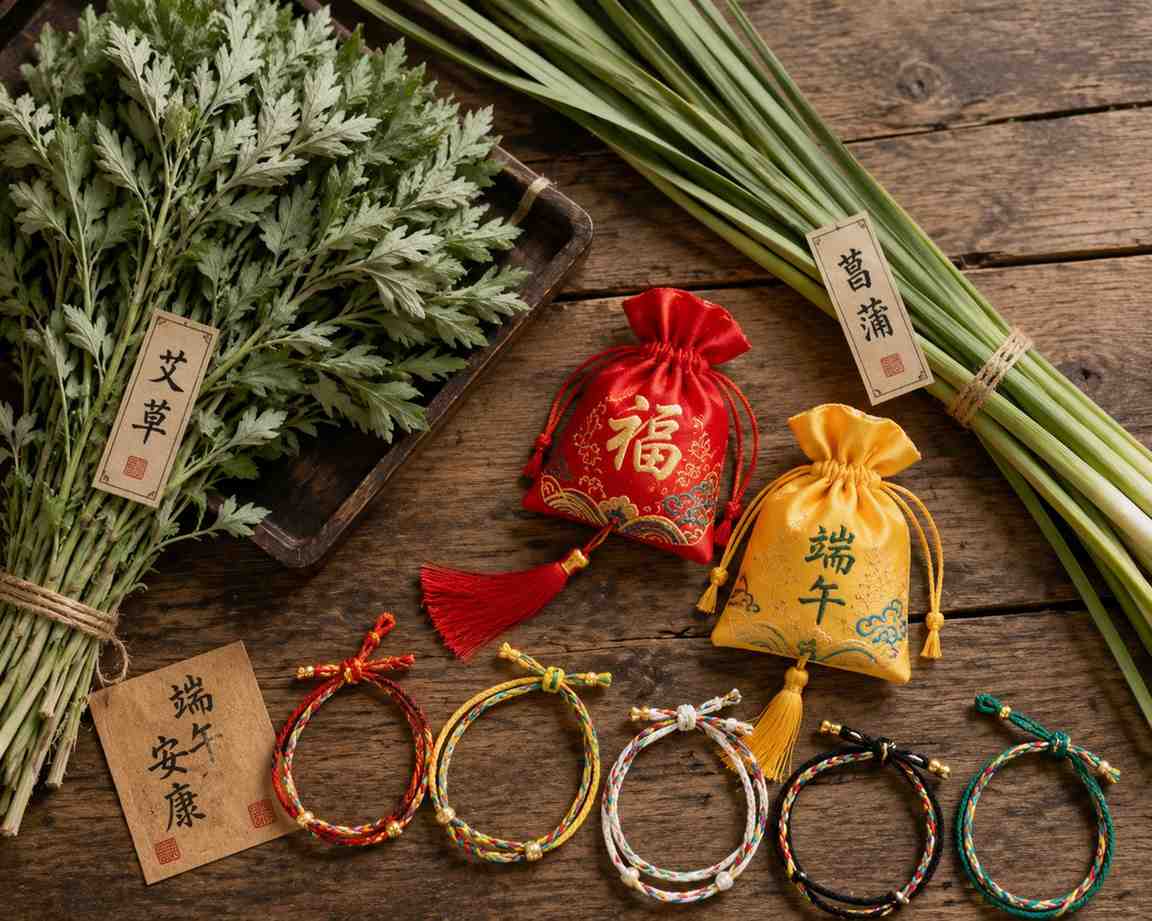 The festival has accumulated a lot of customs over two millennia. Some are widely practiced; others survive mainly in rural areas or older communities.
Hanging calamus and mugwort — Bundles of these plants are tied to doors and gates. The fifth lunar month was historically associated with pestilence and “evil spirits,” and these aromatic plants were believed to repel them. The custom persists in rural China and Taiwan more than in cities.
Wearing fragrant sachets — Small silk pouches filled with herbs and perfumed materials, given especially to children. They’re decorative now, but the original purpose was protective — the herbs were thought to ward off insects and illness.
Tying five-color silk thread — Children get wristbands or ankle bands of red, yellow, blue, white, and black thread. They’re supposed to be worn until the first rain after the holiday, then thrown into the water. Like many festival customs, the practical explanation (thread color codes for different things) is less important than the fact that families do it together.
Egg balancing — On the afternoon of the Dragon Boat Festival at exactly noon, people try to balance a raw egg upright on a flat surface. It actually works more often than you’d expect — not because of mystical alignment but because the rough texture of an eggshell combined with careful placement creates enough friction. People treat it as a good omen if you succeed. It’s one of those customs that’s become more of a fun challenge than a solemn ritual.
Dragon dances — Separate from the boat racing, traditional dragon dances with long fabric dragons on poles are performed at many street festivals.
Is It Called “Dragon Ball Festival” Anywhere?
Occasionally you’ll see “dragon ball festival” as a search term or translation. This is a mistranslation or confusion — there’s no traditional festival by that name. The term lóng zhū (龙珠) means “dragon pearl” or “dragon ball” and does appear in Chinese mythology (dragons are often depicted pursuing a flaming pearl), but the festival itself has no common name involving “ball.”
If you’ve seen “dragon ball festival” in a travel guide or article, it’s either a very loose translation of Duānwǔ Jié or a mistake. The correct names in English are Dragon Boat Festival or Double Fifth Festival.
Where to Watch Dragon Boat Racing Near You
If you want to see actual boat racing and not just read about it, your options depend on where you are.
In North America: Toronto, Vancouver, San Francisco, New York, Chicago, and Washington D.C. all have active dragon boat communities with annual festivals. The Dragon Boat Canada and American Dragon Boat Racing Association websites maintain event calendars.
In Europe: London (Dorney Lake and the Thames), Prague, Amsterdam, and Cologne have established festivals. The Club Dragon Boat UK has a race calendar covering British events.
In Australia: Sydney Dragon Boat Festival and Brisbane events are large, well-organized, and draw international teams.
In Asia: Hong Kong is the flagship destination if you want to see elite international competition. Taipei’s races are accessible and well-attended. If you’re in China, the Miluo River races in Hunan Province — near where Qu Yuan drowned — are among the most historically significant.
Search “[your city] + dragon boat festival 2026” — if a club exists near you, they almost certainly run a public event around June.
Frequently Asked Questions
When is the Dragon Boat Festival in 2026?
June 19, 2026. It falls on a Friday.
Is the Dragon Boat Festival a public holiday?
In mainland China, Hong Kong, Macau, and Taiwan, yes. In other countries, it may be observed by communities without being an official public holiday.
How long does a dragon boat race take?
A 500m sprint at elite level runs about 2 minutes. At the club and recreational level, 500m races typically take 2:30 to 3:30 depending on the team.
Do you need experience to try dragon boat racing?
No. Most clubs run “come and try” sessions where beginners can paddle in a race boat with coaching. The sport is accessible — the main physical demands are shoulder and core strength, which develop with practice.
What should I eat at a Dragon Boat Festival?
Zongzi, if you can find them. At festival events in Western cities, vendors often sell them alongside other Chinese street food. If you want to try making them, the wrapping is genuinely tricky — YouTube tutorials from Cantonese or Taiwanese cooks are more reliable than most written recipes for learning the fold.
The Thing Worth Understanding
The Dragon Boat Festival gets covered as an “exotic Asian holiday” in a lot of Western travel content, which flattens it into aesthetics — colorful boats, drumming, rice dumplings. That coverage isn’t wrong, but it misses what makes the holiday interesting to the people who grew up with it.
It’s a holiday about loyalty, loss, and the tension between speaking truth and keeping safe. Qu Yuan didn’t just drown — he drowned because he told his king something the king didn’t want to hear and paid for it. The people who raced to find him were paying respect to someone who chose integrity over survival.
That’s the story at the center of a holiday that also involves eating dumplings and watching boat races. Both things are real. The festival holds them together without making it heavy — which is maybe the most human thing about it.

Abhay Ramola researches world festivals across primary sources, local accounts, and on-ground reporting. He founded Dionfest to cover what gets missed when festivals become tourism content the history, the ritual, and the people behind it.




3 thoughts on “Dragon Boat Festival 2026: Complete Guide”