Onam Festival: History, Traditions & Significance
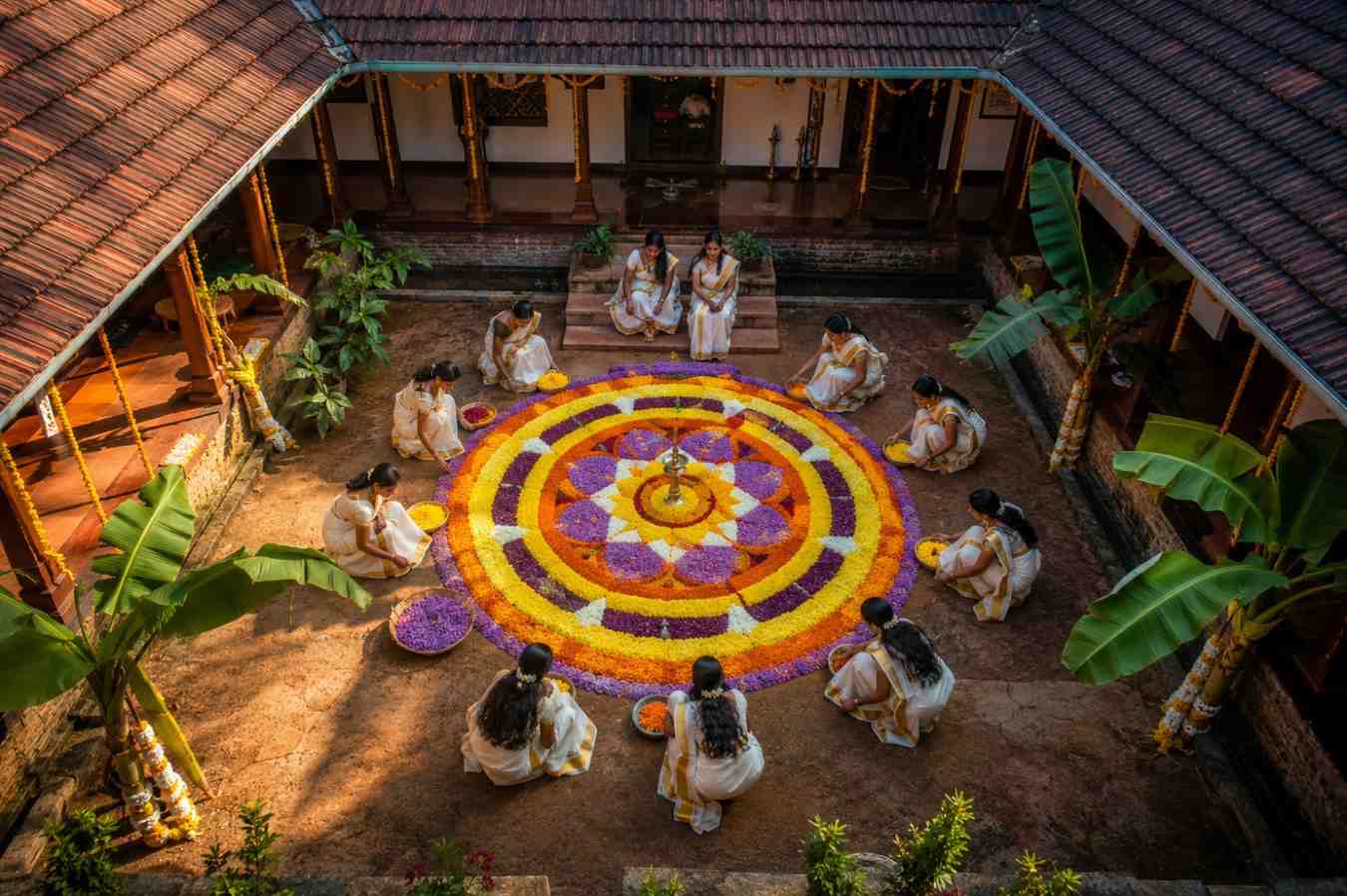
Every August or September, Kerala shuts down in the best possible way. Schools close. Offices go quiet. Families that have been scattered across cities and often countries find their way back to the same table. That table, almost always, will have a sadya on it: a meal served on banana leaf that can run to 26 dishes if the cook is serious about it.
This is Onam. Not just a harvest festival. Not just a ten-day event on the calendar. It is, for most Keralites, the one occasion that carries the weight of home.
What Is Onam Festival
Onam is the biggest festival in Kerala a ten-day celebration that marks the harvest season and the mythical annual return of King Mahabali, a beloved ruler from Kerala’s past. It falls in the Malayalam month of Chingam, which corresponds to August or September in the Gregorian calendar. Every year on Thiruvonam the main day of Onam Kerala essentially stops and celebrates together, regardless of religion or background.
Why Onam Is Celebrated in Kerala
Onam is celebrated to welcome King Mahabali back to his kingdom for one day each year. According to the legend, Mahabali was such a generous and just ruler that his subjects were entirely happy under his reign no poverty, no inequality, no dishonesty. The gods grew threatened by his power and asked Vishnu to intervene. Vishnu, in his Vamana avatar, tricked Mahabali into giving up his kingdom and pushed him into the underworld. But Mahabali was granted one wish: to visit his people once a year. Onam is that visit. The entire festival is essentially Kerala saying “welcome back” to a king they never wanted to lose.
The Story of King Mahabali and Onam
The Vamana story is central to Onam but worth understanding clearly. Mahabali was an asura a demon king but unlike most asuras in Hindu mythology, he was virtuous and loved by his people. Vamana arrived as a dwarf Brahmin and asked for three paces of land. Mahabali agreed. Vamana then grew to cosmic size and covered the earth and sky in two steps. For the third step, Mahabali offered his own head. Vishnu pressed him down into the underworld but honored his devotion by granting him the annual return. The story is about the complexity of dharma: even a just ruler can be displaced by larger cosmic forces.
The History of Onam: Where It Actually Comes From
The earliest written references to Onam appear in Sangam literature — Tamil texts from roughly 400 CE — where it is mentioned as a harvest celebration. By the 9th century CE, it had taken on a more elaborate form, with references appearing in the works of the poet Kulasekhara Alvar.
Like Onam, Pongal is another South Indian harvest festival with deep agricultural roots — though it belongs to Tamil Nadu rather than Kerala.
The festival grew considerably under the Travancore royal family, who made it a state occasion. By the 18th and 19th centuries, Onam was an organized, royally patronized event with boat races, performances, and public feasting. The colonial British administration documented it with some fascination, noting that it cut across caste lines in ways few events in India did at the time.
Kerala declared Onam the official state festival in 1961. The ten-day structure — with the first day called Atham and the main celebration on Thiruvonam — is the version most people know today.
Thiruvonam: The Day Everything Happens
 Of the ten days, Thiruvonam is the one that counts. This is when Mahabali is believed to arrive. Everything else in the ten days is preparation for this moment.
On Thiruvonam morning, families wake early. The pookalam (flower carpet) that has been built up over the previous nine days gets its final layer. The sadya is cooked. Elders give younger family members money — called onakkodi, though the word originally referred to new clothes. The meal is eaten together on banana leaves, seated on the floor.
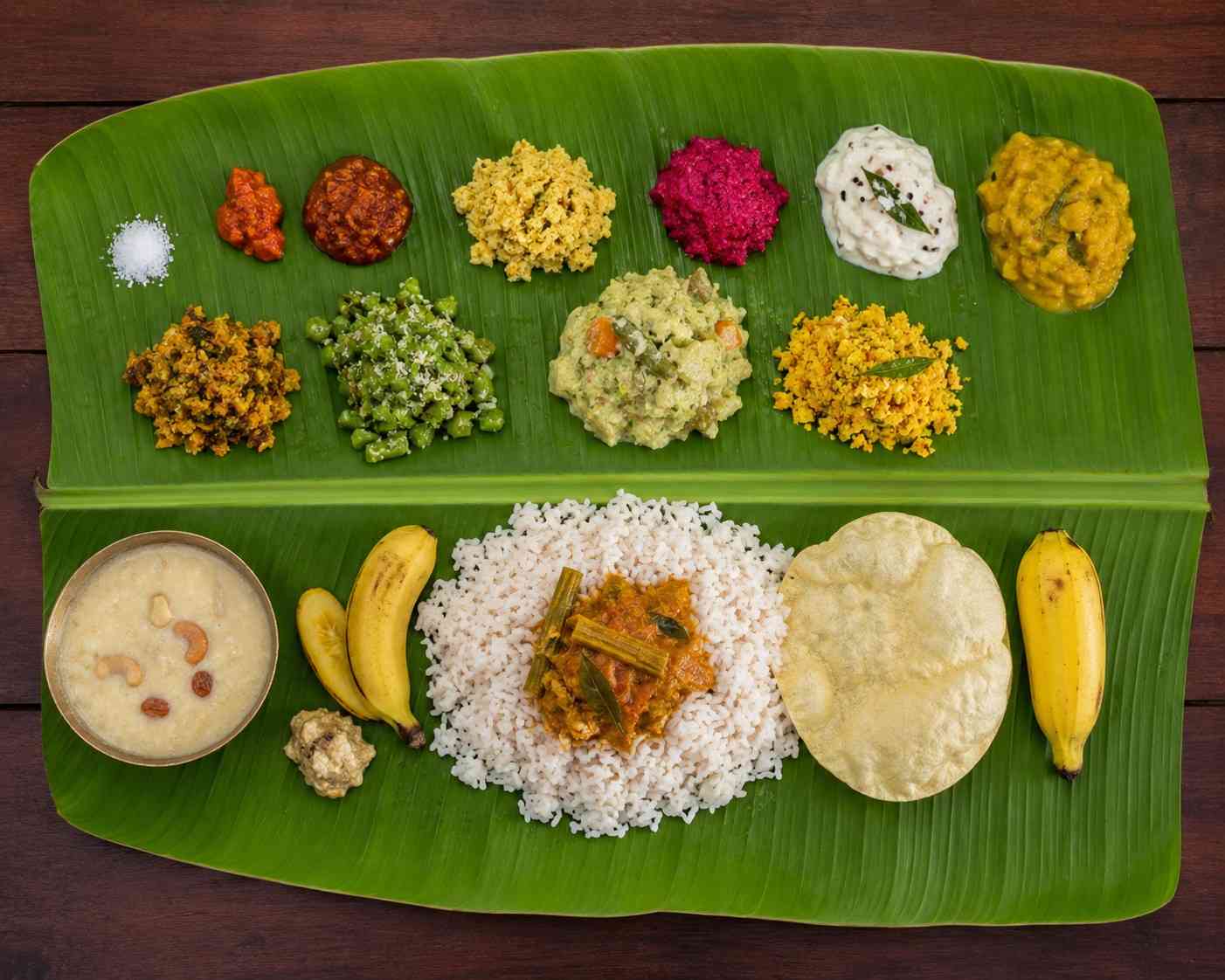
The sadya deserves a paragraph of its own. It is not a casual meal. A proper Thiruvonam sadya includes rice, sambar, rasam, avial, olan, erissery, kalan, payasam (usually two or three varieties), pickles, pappadam, and banana chips, among other dishes. Everything is arranged in a specific order on the leaf. There is a protocol to how it is served and in what sequence. People who grew up in Kerala can tell you where every dish belongs on that leaf without thinking about it.
India has several multi-day festivals built around a single climactic moment — Navratri follows a similar structure of nine nights building toward a final celebration.
Onam Flowers and the Pookalam Tradition
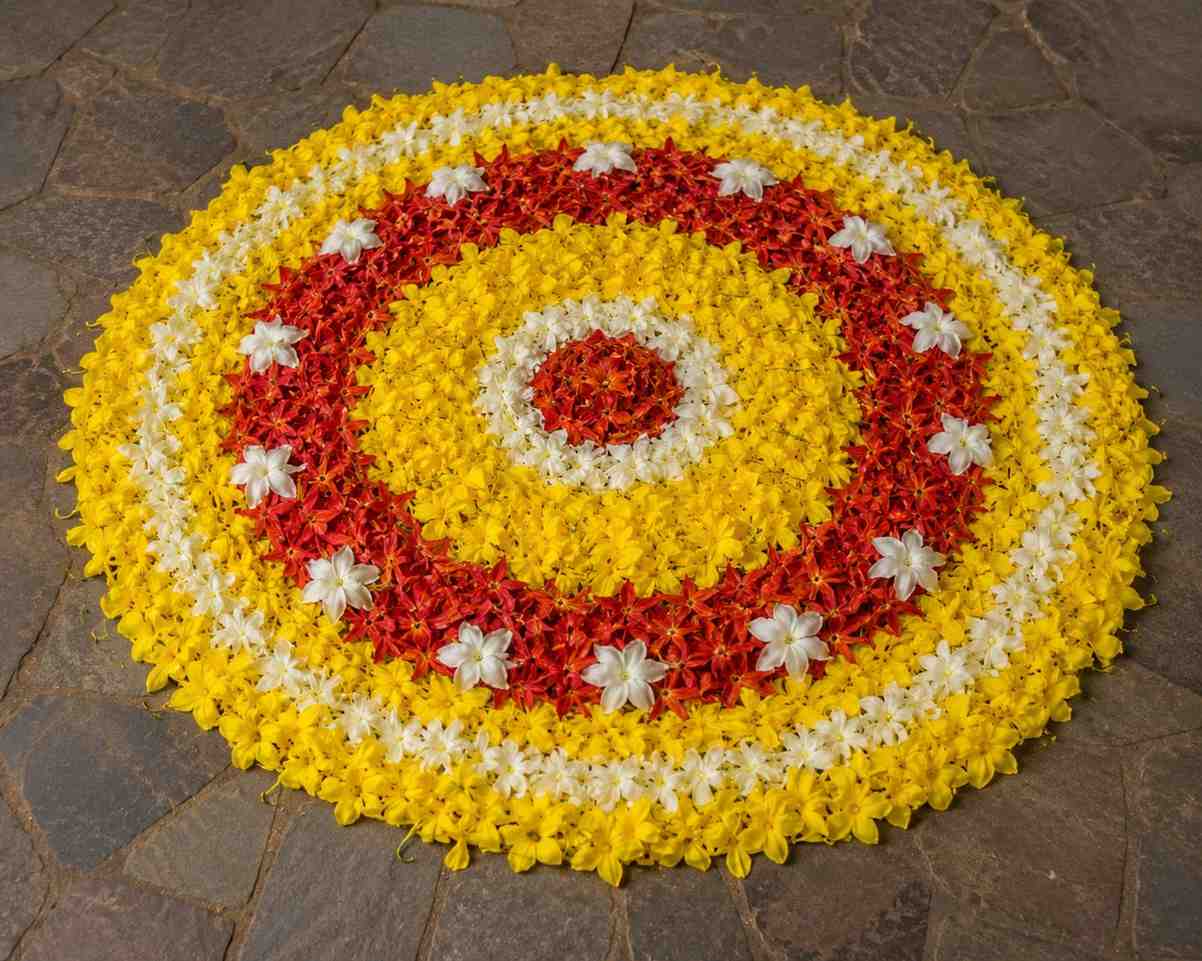 The pookalam is one of those things that photographs can’t fully capture. It is a circular arrangement of fresh flowers made on the ground, typically in the front courtyard of the house. Each of the ten days of Onam adds a new ring to the design, so by Thiruvonam it is a large, layered carpet of color.
The flowers used vary by what’s in season and what’s locally available, but the most common include thumba (white), chethi (red), mukkutti (yellow), and konna (the golden shower flower, which is also Kerala’s state flower). The konna flowers blooming is actually one of the traditional signs that Onam season has arrived.
In cities, apartment buildings often hold pookalam competitions among residents. Schools do it. Offices do it. The Kerala government runs a state-level pookalam competition in Thiruvananthapuram that draws serious participants and attracts large crowds.
The tradition of onam flowers goes beyond decoration. The pookalam is meant to welcome Mahabali — to show him that his people are thriving and that the land is fertile. Whether you take the mythology literally or not, the act of building something together over ten days has a social function that is hard to replicate any other way.
Onakalikal: The Games of Onam
 The word onakalikal refers to the traditional games played during the festival. Some are well-known. Others have become rare enough that younger generations have only seen them at cultural shows.
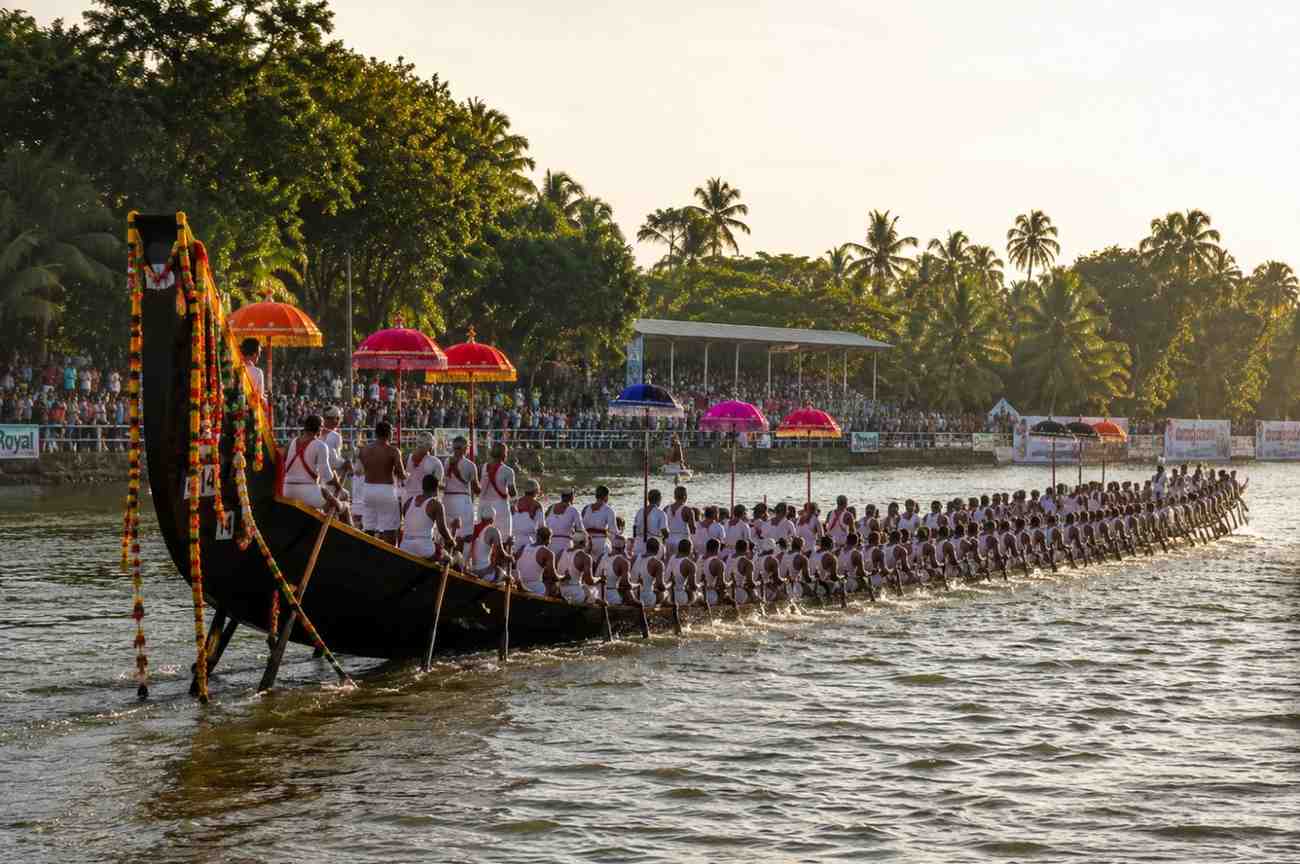
Vallamkali (snake boat race): The most famous. Long wooden boats with up to 100 rowers race on Kerala’s backwaters. The Nehru Trophy Boat Race, held on Punnamada Lake in Alappuzha, is the biggest of these events and draws international attention. The boats are shaped like cobras at the stern — hence the name. The sound of 100 oars hitting the water in unison is something people describe for years after hearing it.
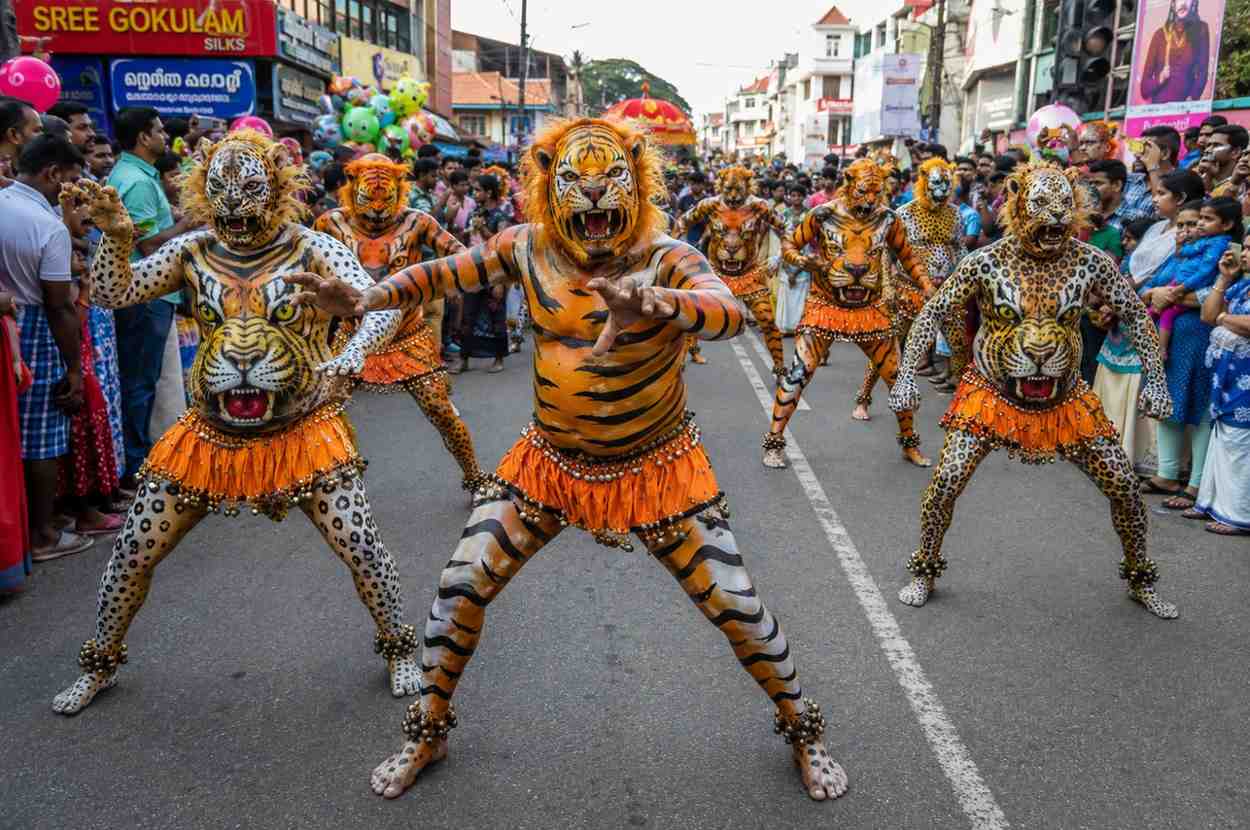
Pulikali (tiger play): Men paint their bodies to look like tigers and leopards, then dance through the streets. It is loud, chaotic, and genuinely strange to watch. The performers practice for weeks. Thrissur is the center of Pulikali celebrations.
 Thumbi Thullal: A dance performed by young women, holding thumba flowers, moving in a circle. Less common now than it was.
Kummattikali: Performers wear large, colorful masks and move through villages, often going house to house. The masks are made of wood and painted in vivid colors.
Tug of war, archery, wrestling: These were common during the Travancore-era celebrations and are still part of organized Onam events at institutions and cultural programs.
The onakalikal are not just entertainment. They were originally ways for communities to come together across different households and social groups. The boat races, in particular, required villages to pool resources and train together — they were a form of community organizing as much as sport.
Onam Celebration in Kerala
Traditions That Make Kerala Onam Unique
The Onam Sadya is the most important a vegetarian feast of 26 or more dishes served on a banana leaf, eaten in a specific order. The dishes include sambar, avial, olan, thoran, pachadi, papadom, and payasam each with its own place on the leaf. Everyone eats sitting on the floor together. Pookalam intricate floral carpets made from fresh flowers are created at home and in public spaces, growing more elaborate each day of the ten-day festival. Vallam Kali (snake boat races) on the backwaters of Kerala, particularly the Nehru Trophy Boat Race, draw massive crowds. Pulikali performers painted as tigers dancing in the streets happens in Thrissur on the fourth day.
What Onam Festival Looks Like Today
Onam has evolved from a purely agricultural and religious celebration into Kerala’s defining cultural festival. It’s observed by Hindus, Christians, and Muslims in Kerala alike the legend of Mahabali belongs to everyone in the state. The Kerala government runs state-sponsored celebrations including cultural programs, boat races, and fairs. In cities outside Kerala Bangalore, Chennai, Mumbai, Delhi large Kerala communities hold Onam celebrations with sadya and cultural performances. Outside India, Onam events happen in the Gulf countries, the UK, the US, Canada, and Australia wherever there are Malayali communities.
The Sadya in More Detail
Since the sadya is central to Onam in a way nothing else is, it is worth being specific.
The banana leaf is placed with the narrow end to the left. Salt is placed at the top left. Pickles — inji puli (ginger-tamarind), lime pickle, mango pickle — go above the center. Banana chips and pappadam go to the right. The rice is served in the center and lower half of the leaf.
Then the curries are added in order: sambar to the right of the rice, rasam to the right of that, more items filling the upper portions. The meal ends with payasam — sometimes ada pradhaman (made with rice flakes and coconut milk), sometimes palada (with rice and milk), sometimes both.
The entire meal is vegetarian. This is unusual for a Kerala celebration, where fish and meat are otherwise common. The Onam sadya is specifically a plant-based meal, which connects back to the agricultural harvest origins of the festival.
In Kerala, the sadya is served by volunteers moving along rows of seated diners and ladling dishes onto leaves. The host keeps serving until you fold your banana leaf, which signals you are done.
What Onam Looks Like Now vs. What It Used to Be
There are Kerala families who will tell you that Onam has changed significantly in the last 20 to 30 years. Some changes are practical: fewer people grow their own onam flowers, so they buy them from vendors. The pookalam that once took a family all morning to build sometimes takes 20 minutes with flowers bought in pre-sorted packets.
The sadya has gotten more expensive to make at home, so many families order it from caterers or celebrate at restaurants. Restaurants in Kerala run special Onam sadya menus every year, some of them very good. But eating it in a restaurant with strangers is not the same as eating it on your grandmother’s floor.
The onakalikal have shrunk in practice. Thumbi thullal and kummattikali survive mostly at organized cultural programs and tourism events, not spontaneously in neighborhoods.
At the same time, the festival has grown in visibility. The Kerala government promotes Onam heavily as a tourism event. The boat races get international press. The pookalam competitions have large prize money attached. Onam has, in some ways, become a production.
None of this makes it fake. People in Kerala are genuinely attached to Onam in a way that is hard to manufacture. The nostalgia is real. The food is good. The return home — even when it is just to a rented apartment in another city — means something.
Frequently Asked Questions
When is Onam in 2025? Onam 2025 falls on September 5 (Thiruvonam), with the ten-day period starting August 27 (Atham).
Is Onam a Hindu festival? It has Hindu mythological origins, but in Kerala it is widely celebrated across communities — by Christians and Muslims as well. The government and public institutions treat it as a secular state festival.
For comparison, Diwali is also celebrated across communities in India, though its scale and traditions differ significantly from Onam
What do people wear on Onam? The traditional dress is white with a golden border — kasavu. Women wear the kasavu saree (mundum neriyathum), men wear a mundu with a shirt or traditional upper cloth. Many families buy new clothes specifically for Thiruvonam.
Why is the pookalam made? To welcome King Mahabali. Each flower ring added on each of the ten days is meant to prepare the ground for his arrival on Thiruvonam.
Can tourists participate in Onam celebrations? Yes. The Kerala Tourism department organizes public events, boat races, and cultural programs during Onam season. Most families also welcome guests to join the sadya. If someone invites you, go.
Onam is a festival that holds more than one thing at once: grief for a king who was taken away, joy at his return, pride in a harvest, a reason to cook well and sit together. The mythology and the meal and the flowers are not separate parts. They are the same thing, explained in different ways.
That is probably why it survives, in Kerala and far outside it, in forms that keep changing but somehow stay recognizable.

Abhay Ramola researches world festivals across primary sources, local accounts, and on-ground reporting. He founded Dionfest to cover what gets missed when festivals become tourism content the history, the ritual, and the people behind it.