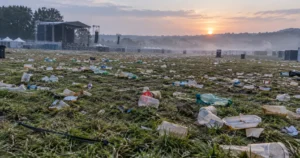
How Much Festival Waste Does a Single Event Actually Produce?
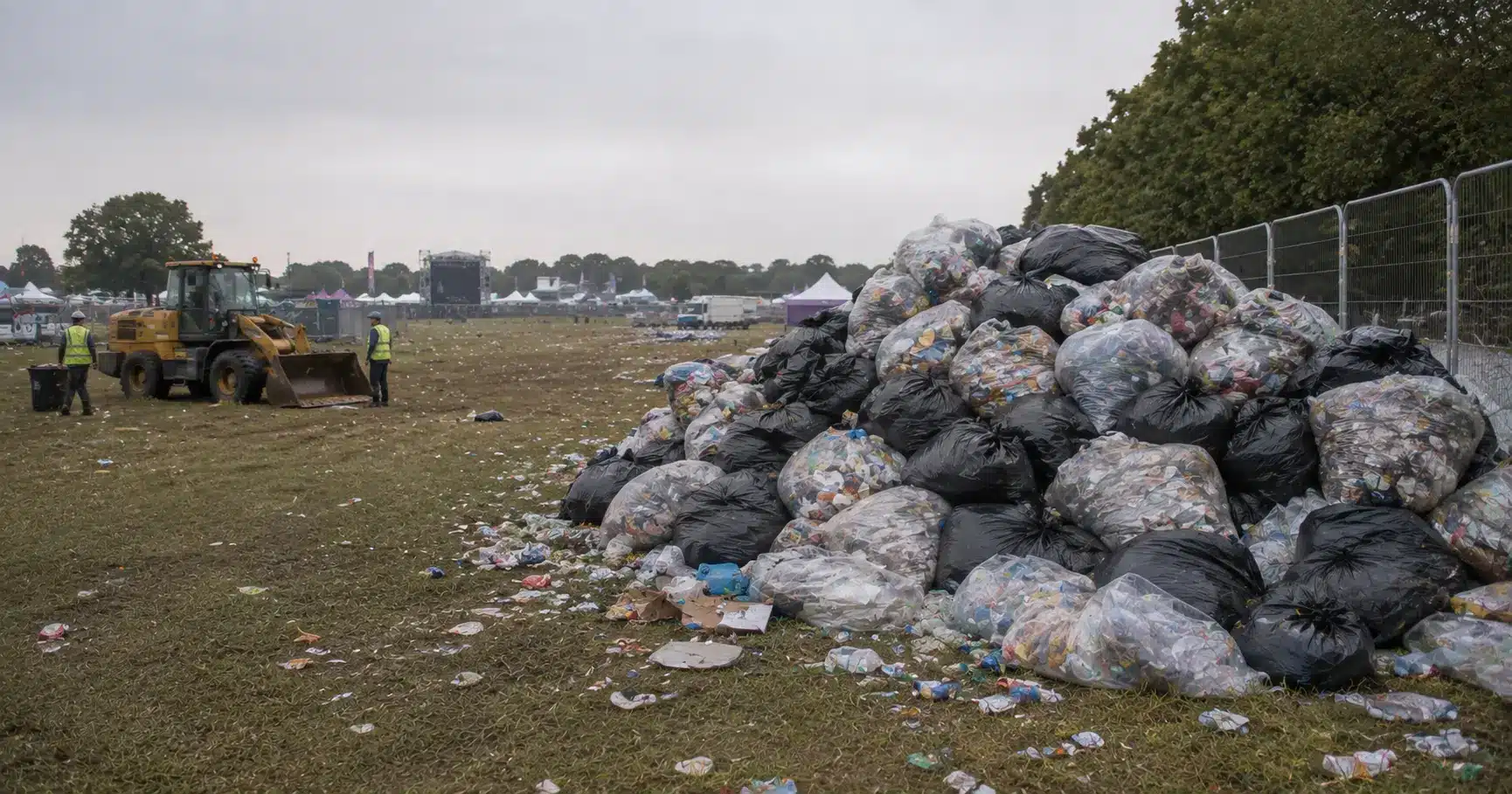
A large pile of bagged waste at a festival ground during the morning cleanup
Glastonbury draws around 200,000 people. Oktoberfest draws 6.5 million, more than thirty times as many. By raw numbers, Oktoberfest should bury Glastonbury in waste. It doesn’t: Oktoberfest generates 764 tonnes over sixteen days, while Glastonbury generates roughly 2,000 tonnes in five. A festival a fraction of the size produces more than double the waste, in a third of the time. That’s the part raw tonnage hides. The difference isn’t the festival, or even the country. It’s what people do once they’re there: walk in, eat, drink, go home, versus pitch a tent, cook, sleep on-site, and leave half of it behind.
This article compares real waste data across five festival types: music, religious, food, cultural, and street festivals, and normalizes it per attendee so the comparison actually means something. The pattern that falls out isn’t the one most “festival waste” articles lead with.
Fast facts
- Highest waste per attendee per day: camping music festivals (Coachella: ~0.78 kg/person/day; Glastonbury: ~2 kg/person/day averaged across the event)
- Lowest waste per attendee: walk-in mass events with no camping (Oktoberfest: ~0.01 kg/person/day; food festivals in academic studies: as low as 0.014 kg/person/day)
- Biggest single confirmed cleanup: Kanwar Yatra, India, 30,000 tonnes across roughly 45 million pilgrims over a month-long pilgrimage
- Best-measured event on earth, waste-wise: Oktoberfest, whose organizers publish official closing-report figures for waste, water, and energy every year
- What actually drives the gap: camping and on-site food service, not festival size or crowd behavior
Festival waste totals vary from a few hundred tonnes to tens of thousands, but total tonnage alone is close to meaningless without knowing how many people attended and for how long. Once normalized per attendee per day, camping music festivals produce roughly 100 to 270 times more waste per person than a walk-in event like Oktoberfest, primarily because of tents, bedding, and multi-day food service rather than anything intrinsic to the music itself.
The comparison, in one table
Every number below comes from an official source, published research, or municipal/organizer waste data. Where a clean per-day, per-attendee figure could be calculated, it’s shown. Where the event structure makes that math misleading, such as a month-long pilgrimage with no fixed daily headcount, the table says so instead of forcing a number that doesn’t mean anything.
| Festival type | Example | Total waste | Attendance | Duration | Waste per attendee |
|---|---|---|---|---|---|
| Music (camping) | Glastonbury | ~2,000 tonnes | ~200,000 | 5 days | ~10 kg total (~2 kg/day) |
| Music (day-visit) | Coachella | ~107 tons/day | ~125,000/day | 3+3 days | ~0.78 kg/day |
| Cultural | Oktoberfest | 764 tonnes | 6.5 million | 16 days | ~0.12 kg total (~0.01 kg/day) |
| Cultural | Rio Carnival | 1,400 tons | 8 million | ~5 days | ~0.18 kg total (~0.035 kg/day) |
| Street | Notting Hill Carnival | ~300 tonnes | ~2 million | 2 days | ~0.15 kg total (~0.075 kg/day) |
| Food | Local Italian food festival (study) | ~224 kg | 5,210 | 3 days | ~0.043 kg total (~0.014 kg/day) |
| Religious | Kanwar Yatra | ~30,000 tonnes | ~45 million | ~30 days | not meaningfully comparable per day, see below |
The gap between the highest and lowest rows isn’t small. Glastonbury’s per-person total is roughly 200 times the food festival’s. That’s not because Glastonbury attendees are worse people than food festival visitors. It’s because one group camps on-site for five days and the other walks in, eats, and leaves.
Music festivals: camping is the real cost
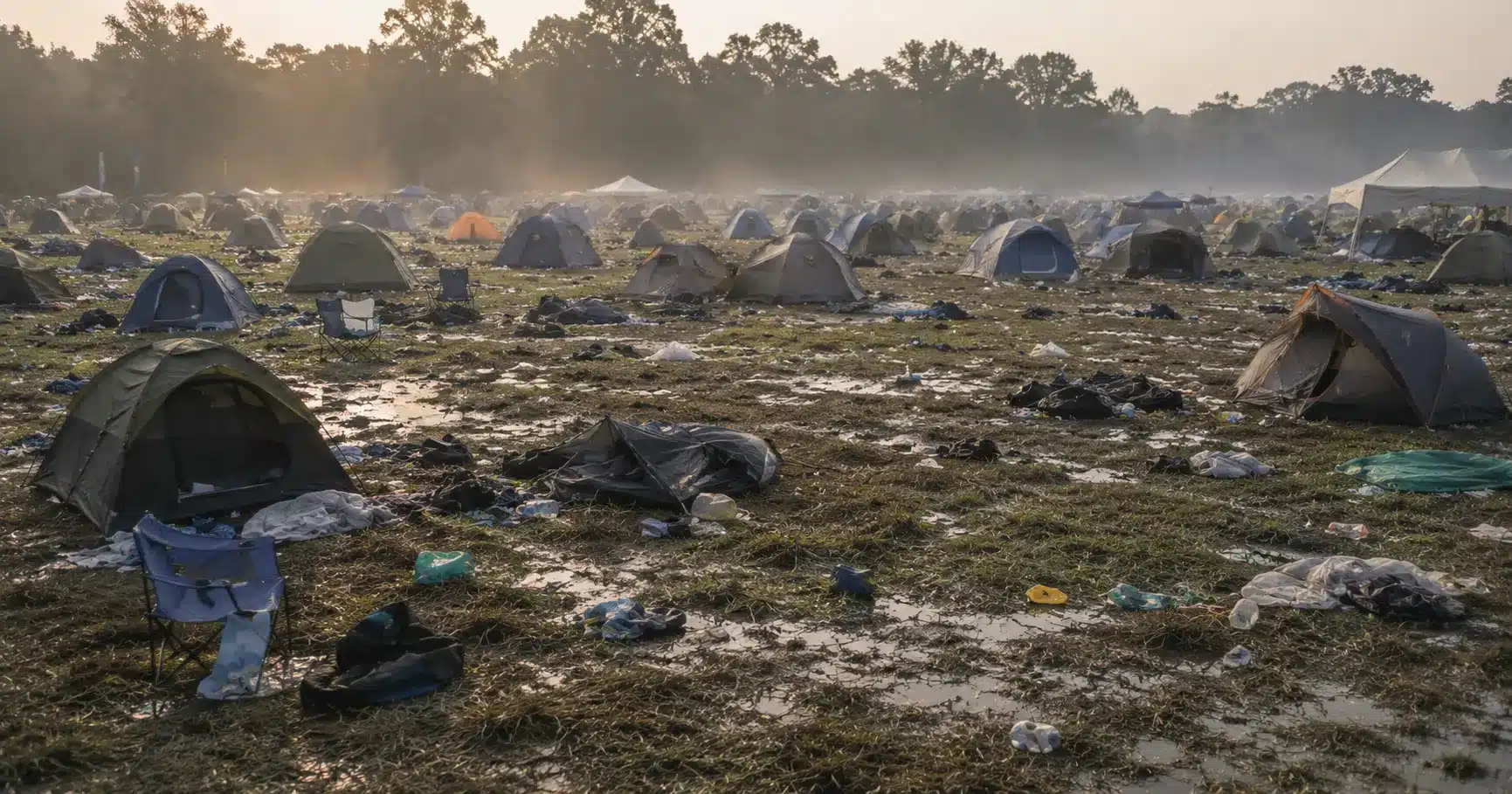
Glastonbury produces around 2,000 tonnes of waste per event, according to festival organizers, with roughly 200,000 attendees over five days. Coachella’s own reported figures put daily waste at around 107 tons for roughly 125,000 daily attendees, and a 2021 estimate put the festival’s total waste at 1,600 tonnes for the event, with only around 20% recycled. Research from the University of Manchester working directly with Glastonbury found UK music festivals collectively produced an estimated 23,500 tonnes of waste annually before the pandemic, with roughly two-thirds going to landfill.
The reason camping festivals sit at the top of this list isn’t the music, the crowd size, or even alcohol consumption. It’s tents. An estimated 90% of tents brought to UK festivals are never taken home, left instead as fabric and aluminium-pole waste that’s expensive to separate and mostly ends up incinerated or landfilled. Add sleeping bags, camping chairs, and the sheer volume of single-use food packaging required to feed a temporary city for five days, and the per-person number climbs fast. Carbon footprint follows a different pattern entirely: a Greener Future industry report found audience travel accounts for an average of 41.4% of a festival’s emissions, ranging from 18% to 76% depending on the event, with a typical festival’s carbon footprint running around 11 kg CO2 equivalent per attendee per day, separate from and not directly comparable to the solid-waste figures above.
If you want a counterexample, our own Green Man Festival guide covers a 25,000-attendee UK festival that refuses commercial sponsorship and sources most of its food from local Welsh suppliers, one of the few camping festivals actively built around a smaller footprint rather than retrofitting one onto an existing model.
Religious festivals: waste at a scale that resists per-capita math
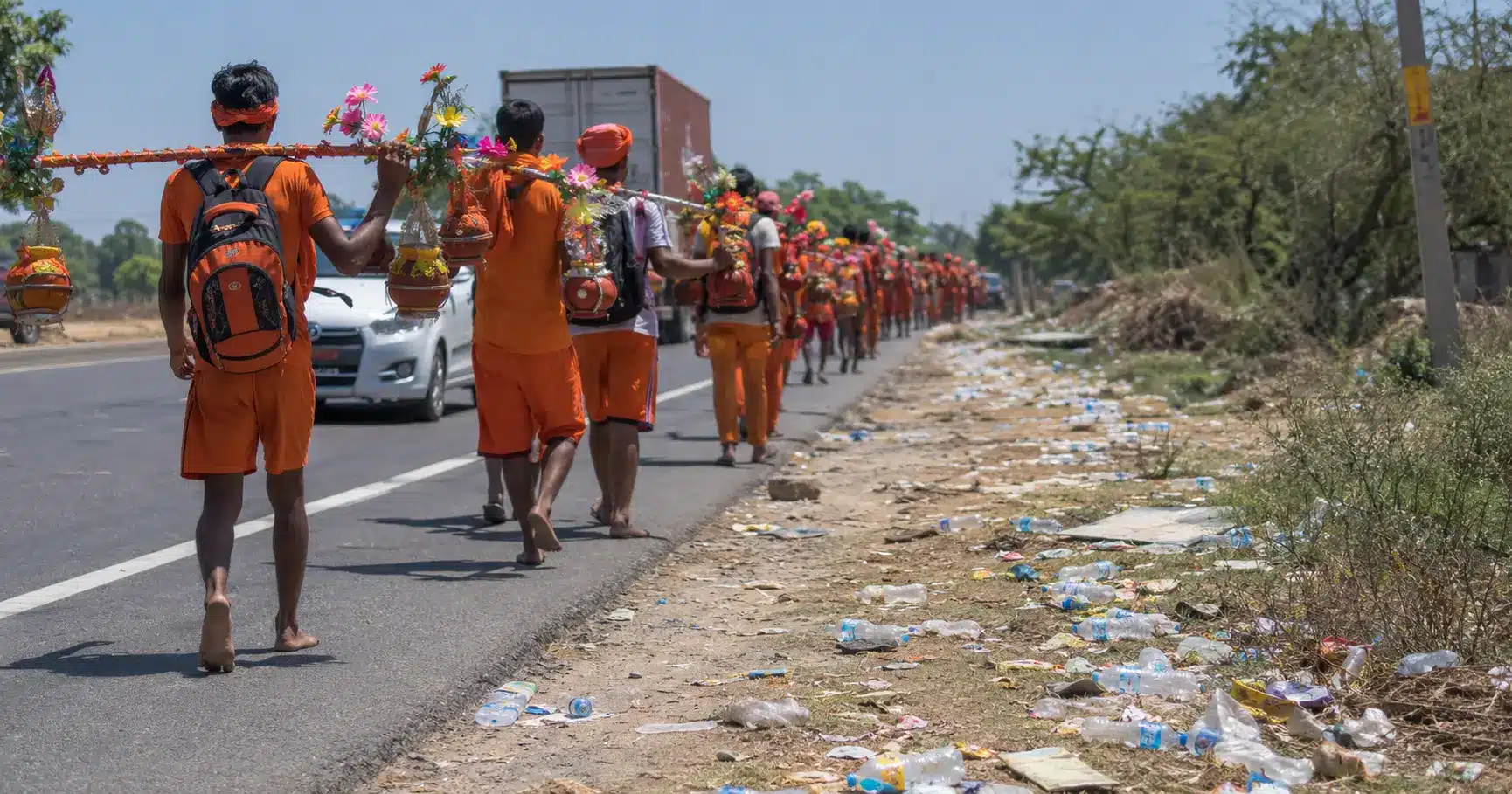
This category breaks the comparison method used everywhere else in this article, and it’s worth explaining why rather than forcing a number that would be misleading.
The Kanwar Yatra, covered in detail separately, routes an estimated 4.5 crore (45 million) pilgrims along North Indian rivers over roughly a month each July and August, generating an estimated 30,000-tonne cleanup in 2023 alone, with officials estimating at least half of that waste was plastic. Dividing 30,000 tonnes by 45 million people gives a per-capita figure under a kilogram, but that number is close to meaningless: most pilgrims pass through a given stretch of the route in hours, not days, so there’s no clean “attendee-day” denominator the way there is for a fixed festival ground.
City-level data tells a clearer story. Haridwar, one stop on that pilgrimage route, generates roughly 11 tonnes of plastic waste on an ordinary day and more than double that during festival periods, according to a UN Environment Programme river-plastic tracking project. During Ganeshotsav 2025, Pune’s SWaCH waste-picker cooperative composted 114 tonnes of nirmalya (flower and ritual waste) and diverted another 39 tonnes of dry waste and plastic through its “Nirmalya to Nisarg” campaign, figures that reflect one city’s collection effort rather than total waste generated citywide. We’ve also covered the flower and offering waste specifically generated by religious festivals in more depth, including the roughly 8 million tonnes of floral waste estimated to enter Indian rivers annually across all festivals combined, not a single-event figure but a useful sense of scale.
The honest takeaway: religious festivals in India generate enormous absolute waste volumes, but because attendance is rolling, unticketed, and spread across weeks rather than days, per-capita comparison to a fixed, ticketed event like a music festival isn’t really valid.
Food festivals: what the one academic study actually found

A peer-reviewed framework published to quantify environmental impacts at local food festivals tested its method on a three-day food festival in Italy attended by 5,210 visitors. The result: 0.043 kg of waste per capita and 16 kg of CO2 equivalent per capita across the full event, using a Life Cycle Assessment approach.
That waste figure is strikingly low compared to every other category in this article, and it’s worth being precise about why rather than treating it as representative of all food festivals. The study measured a specific, defined waste stream using LCA system boundaries, not necessarily every scrap of packaging generated by every vendor on-site, so it likely undercounts total physical waste even as it accurately captures the metric it set out to measure. The more interesting finding from the same study is on the carbon side: the highest environmental impact came from exhibitor and vendor transport, not visitor travel, since 80% of visitors were local and arrived on foot or by bike. That’s close to the opposite of the music festival pattern above, where audience travel dominates emissions. Small, local food festivals appear to have a genuinely different environmental profile than large touring music events, not just a smaller version of the same problem.
Cultural festivals: mass attendance, surprisingly low waste per head

Oktoberfest is the best-documented festival on this list because Munich’s city government publishes an official closing report every year. The 2025 edition generated 764 tonnes of waste across 6.5 million visitors over 16 days, alongside 2.8 million kWh of electricity and 81,000 cubic metres of water. Divided across the full run, that’s roughly 0.12 kg of waste per visitor for the entire event, lower per person than a single day at Coachella.
Rio Carnival produces a larger absolute total: Rio’s municipal cleaning company (COMLURB) collected approximately 1,400 tons of solid waste during the 2024 Carnival, with street parades (blocos) alone accounting for 738 tons, against roughly 8 million revelers across the celebration. Read more in our Rio Carnival guide. Both events share the same structural feature that keeps per-person waste low relative to music festivals: attendees arrive, participate for hours rather than days, and leave, without camping, cooking, or overnight infrastructure on-site.
Street festivals: the cleanup is the story
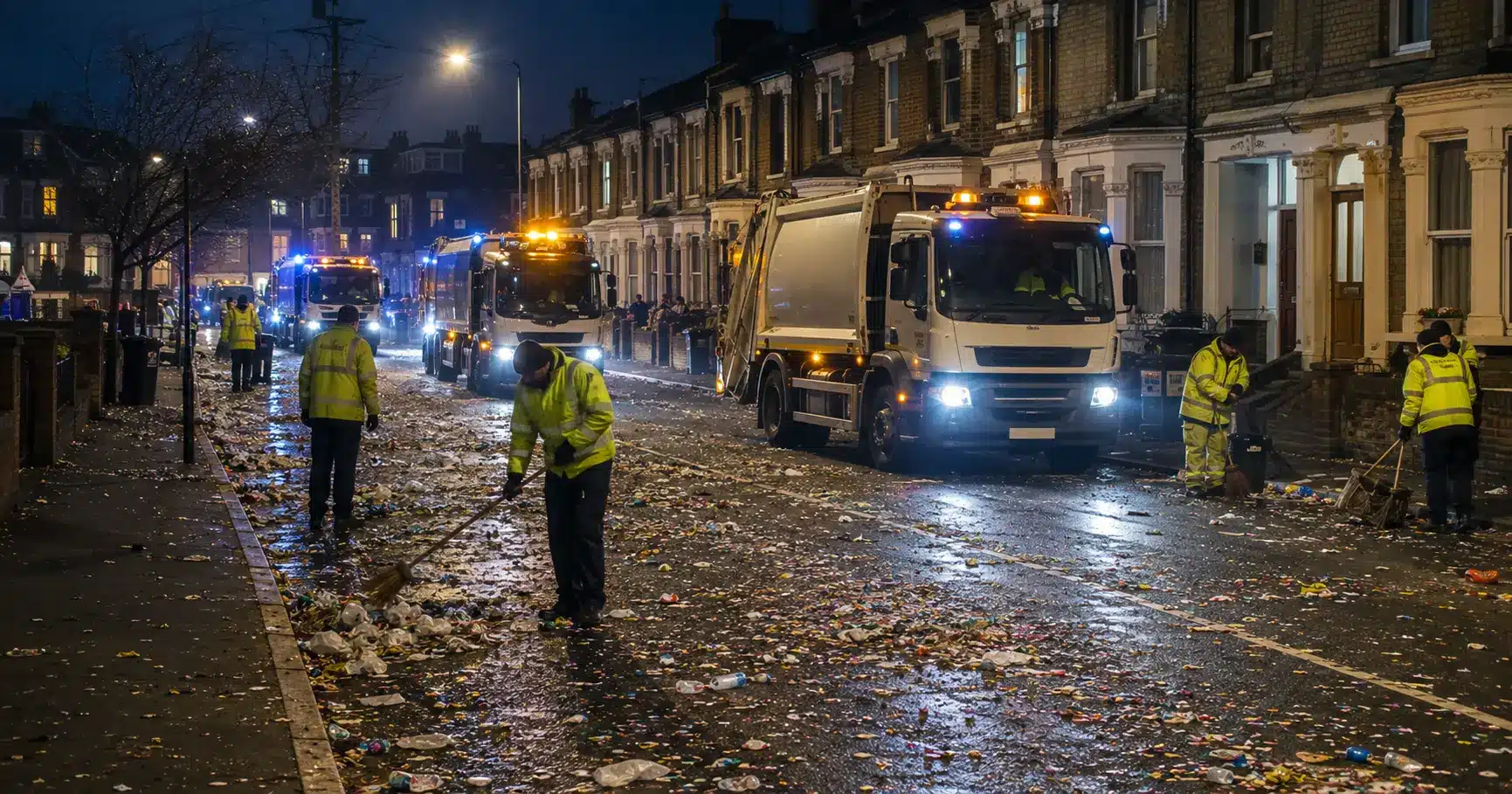
Notting Hill Carnival, Europe’s largest street festival, has produced a strikingly consistent figure across multiple recent years: roughly 300 tonnes of waste collected each year, cleared by around 200 staff and 30 to 45 refuse vehicles working through the night, according to Kensington and Chelsea Council’s own annual reporting. Around 30% of that is recycled. Roughly two million people attend across the two-day event, giving a per-attendee figure comparable to Rio Carnival’s, well below any camping music festival.
The distinguishing feature of street festivals isn’t the waste volume itself but its concentration: unlike a fenced festival ground, street festival waste lands across public roads, residential doorsteps, and drains, which is why the operational focus at events like Notting Hill is overnight speed, not sorting. Nitrous oxide canisters alone required a dedicated 13-tonne separate collection stream in one recent year, illustrating how a single trend item can complicate an otherwise well-understood cleanup operation.
Why festival waste numbers vary this much
Three factors explain most of the gap between the highest and lowest rows in the comparison table, more than festival size, genre, or even country.
Camping versus day-visiting is the single biggest driver. Every music festival in this article with a camping component sits at the top of the per-capita ranking; every walk-in event sits near the bottom, regardless of how many total people attended.
On-site food service intensity matters almost as much. Multi-day festivals feeding the same population breakfast, lunch, and dinner for five straight days generate far more packaging waste per person than an event where most attendees eat one meal and leave.
Measurement definition affects the numbers more than most coverage acknowledges. The food festival study’s 0.043 kg figure and Oktoberfest’s official 764-tonne figure are both credible, but they’re not necessarily counting the same categories of waste the same way, which is part of why this article normalizes per attendee rather than pretending every reported tonnage figure is directly comparable out of the box.
What’s actually working

The clearest fixes in this data aren’t exotic. Glastonbury’s shift to renewable-powered generators and reusable water bottle stations, Oktoberfest’s expanded on-site sorting, and Notting Hill’s dedicated hazardous-waste stream for gas canisters all target a specific, measured waste category rather than “sustainability” in the abstract. Green Man Festival’s refusal of corporate sponsorship and local food sourcing tackles the supply-chain side rather than just the cleanup side.
The pattern across every genuinely effective intervention in this research is the same: measure the specific waste stream first, then fix that stream specifically. Events that publish real numbers, like Oktoberfest’s annual closing report, consistently show more targeted, credible improvement over time than events that only make general sustainability claims. If you’re looking for ways to reduce your own footprint at an event, World Cleanup Day each September is built around exactly this kind of measurable, local action.
FAQ
Which type of festival produces the most waste per person?
Camping music festivals produce the most waste per attendee by a wide margin, though not uniformly: Coachella generates roughly 0.78 kg of waste per attendee per day (calculated from its reported 107 US tons daily against 125,000 daily attendees), while Glastonbury’s per-person total across its five-day run works out to roughly double that on a daily basis. Part of that gap is likely the camping mix itself. Glastonbury attendees overwhelmingly camp on-site for the full five days, while a large share of Coachella’s crowd stays off-site in Palm Springs-area hotels and Airbnbs and commutes in daily, which would plausibly reduce the tent and multi-day-food waste per person even within the same broad “camping festival” category. Both figures are still far higher than walk-in events like Oktoberfest or Rio Carnival.
Which festival produces the least waste per person?
Among the events with reliable data, food festivals and large walk-in cultural festivals produce the least waste per attendee. A peer-reviewed study of a local Italian food festival measured just 0.043 kg per visitor across three days, and Oktoberfest’s official figures work out to roughly 0.12 kg per visitor across its full 16-day run.
Why do music festivals produce so much more waste than other festival types?
Camping is the main driver. Music festivals that require overnight stays generate waste from tents (an estimated 90% of which are never taken home), sleeping bags, camping equipment, and multiple days of on-site food service, none of which applies to single-day walk-in events.
How much waste does Glastonbury produce?
Roughly 2,000 tonnes per event, according to festival organizers, across approximately 200,000 attendees over five days. UK music festivals collectively produce an estimated 23,500 tonnes of waste annually.
How much waste does a religious festival like the Kumbh Mela or Kanwar Yatra produce?
The Kanwar Yatra generated an estimated 30,000-tonne cleanup in 2023 across roughly 45 million pilgrims over a month-long route. Because pilgrimage-style religious events don’t have a fixed daily attendance the way a festival ground does, per-capita comparison to other festival types isn’t statistically meaningful in the same way.
Is festival carbon footprint the same as festival waste?
No, they’re related but separate measures. Waste is physical material collected on-site; carbon footprint includes travel, energy, food supply chains, and production, which often outweigh on-site waste as an emissions source. At music festivals, audience travel alone accounts for 41% of emissions on average. At the one food festival with published data, exhibitor and vendor transport outweighed visitor travel, since most attendees arrived on foot or by bike.
Are festival waste numbers actually comparable across events?
Only with real caution. Total tonnage depends heavily on attendance size and event duration, and different organizers measure different waste categories. This article normalizes figures per attendee wherever a clean per-day or per-event denominator exists, and flags the cases, like month-long pilgrimages, where that math breaks down.
What is being done to reduce festival waste?
The most effective interventions target specific, measured waste streams: renewable energy and reusable water stations at Glastonbury, expanded on-site sorting at Oktoberfest, dedicated hazardous-waste collection for gas canisters at Notting Hill Carnival, and supply-chain changes like local sourcing at events such as Green Man Festival.
The bottom line
Total festival waste tonnage makes for a dramatic headline but a poor comparison. Once normalized per attendee, the real pattern is about event structure, not festival type: camping and multi-day on-site food service drive waste up regardless of genre, while walk-in events, whether religious, cultural, or culinary, stay comparatively low no matter how many million people show up. The most useful thing any single festival can do with this data isn’t compare itself to Glastonbury or Oktoberfest. It’s measure its own specific waste streams the way Munich already does, and fix the one that’s actually largest.
“Written by Abhay Ramola, founder of DionFest. Abhay Ramola researches world festivals across primary sources, local accounts, and on-ground reporting”.
Sources consulted include peer-reviewed research via ResearchGate and ScienceDirect, official Oktoberfest municipal closing reports, University of Manchester Sustainable Futures research, Kensington and Chelsea Council and SUEZ UK press releases, UN Environment Programme river-plastic tracking data, and Sustainability Magazine.

Abhay Ramola researches world festivals across primary sources, local accounts, and on-ground reporting. He founded Dionfest to cover what gets missed when festivals become tourism content the history, the ritual, and the people behind it.