Festival Light Pollution: What Bright Night Events Mean for Birds, Insects and Wildlife
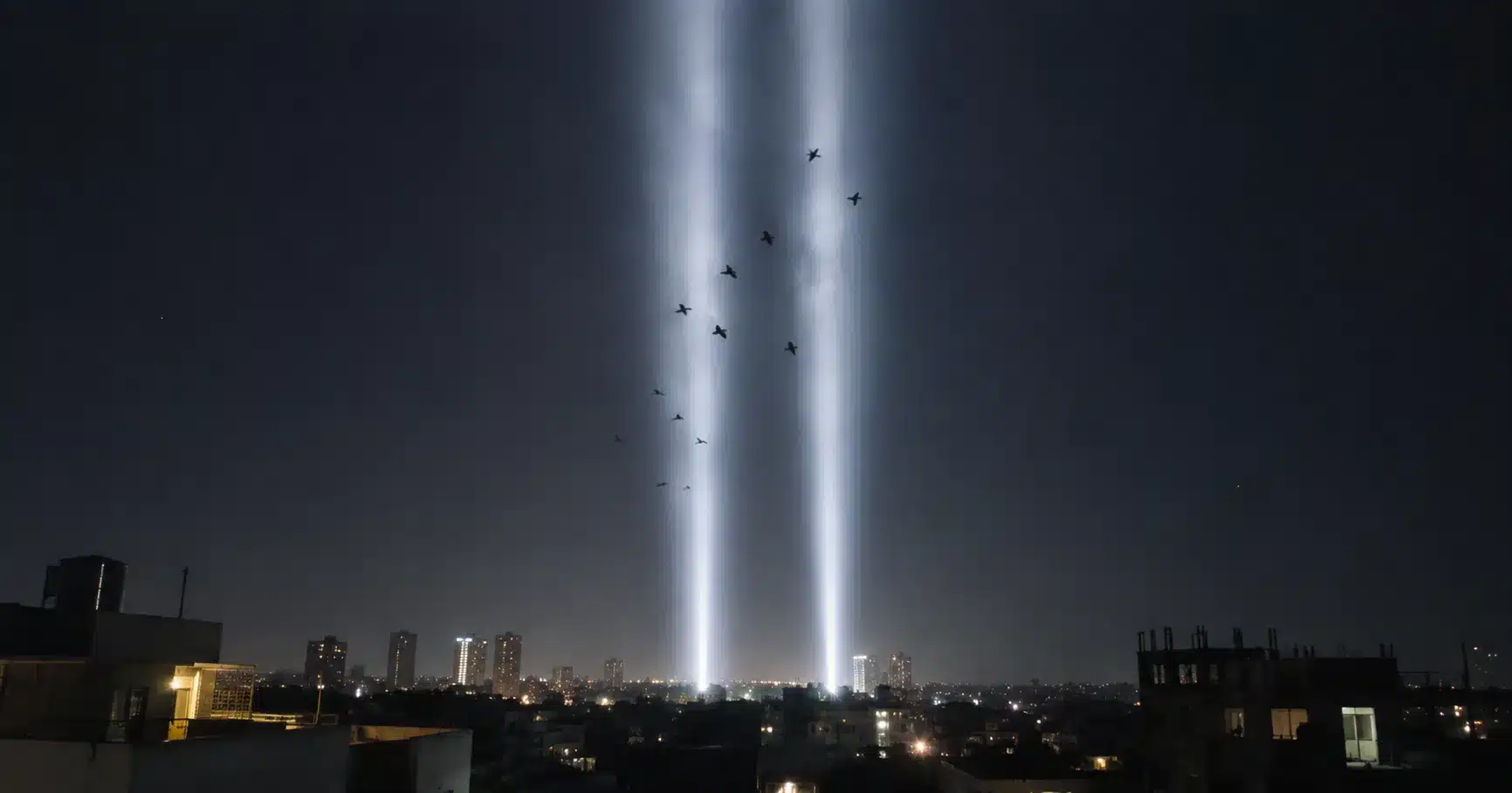
Every September 11, two beams of light rise four miles into the New York sky. Volunteers stand on a rooftop below with binoculars, counting birds. When the count passes 1,000, they radio a request, and the lights go dark for twenty minutes. This has happened for more than two decades, and it’s the closest thing festival light pollution has to a controlled experiment: turn the lights on, watch the birds get pulled in; turn them off, watch the birds disperse within minutes.
Festival light pollution gets almost none of the attention that festival noise gets, despite running on the same basic mechanism, and despite the evidence for its impact on wildlife being, in places, even more direct. LEDs, lasers, and floodlights don’t just compete with the stars. They pull migrating birds off course, drown insect populations already in decline, and disorient animals that have used darkness as a survival tool for longer than festivals have existed.
Fast facts
- Chicago exposes more migrating birds to artificial light than any other US city, according to satellite-based research, sitting directly on a major north-south flyway
- New York’s annual Tribute in Light has drawn recorded bird densities up to 150 times normal levels in the airspace above it, according to Cornell Lab of Ornithology radar tracking
- An estimated one-third of insects attracted to artificial light die before dawn, from exhaustion or predation, a mechanism researchers call the “vacuum cleaner effect”
- Sea turtle hatchlings navigate to the ocean using light cues, and artificial lighting is a leading cause of fatal disorientation on nesting beaches worldwide
- India’s first International Dark Sky Park, Pench Tiger Reserve in Maharashtra, was certified in January 2024, becoming only the fifth such park in Asia
Festival light pollution affects wildlife through the same core mechanism regardless of the source, LEDs, lasers, or floodlights: artificial light overrides the darkness that migrating birds, nocturnal insects, and countless other species rely on for navigation, feeding, and reproduction. The clearest evidence comes from temporary, high-intensity events rather than steady urban glow, because the before-and-after contrast is measurable in a single night.
LED lights

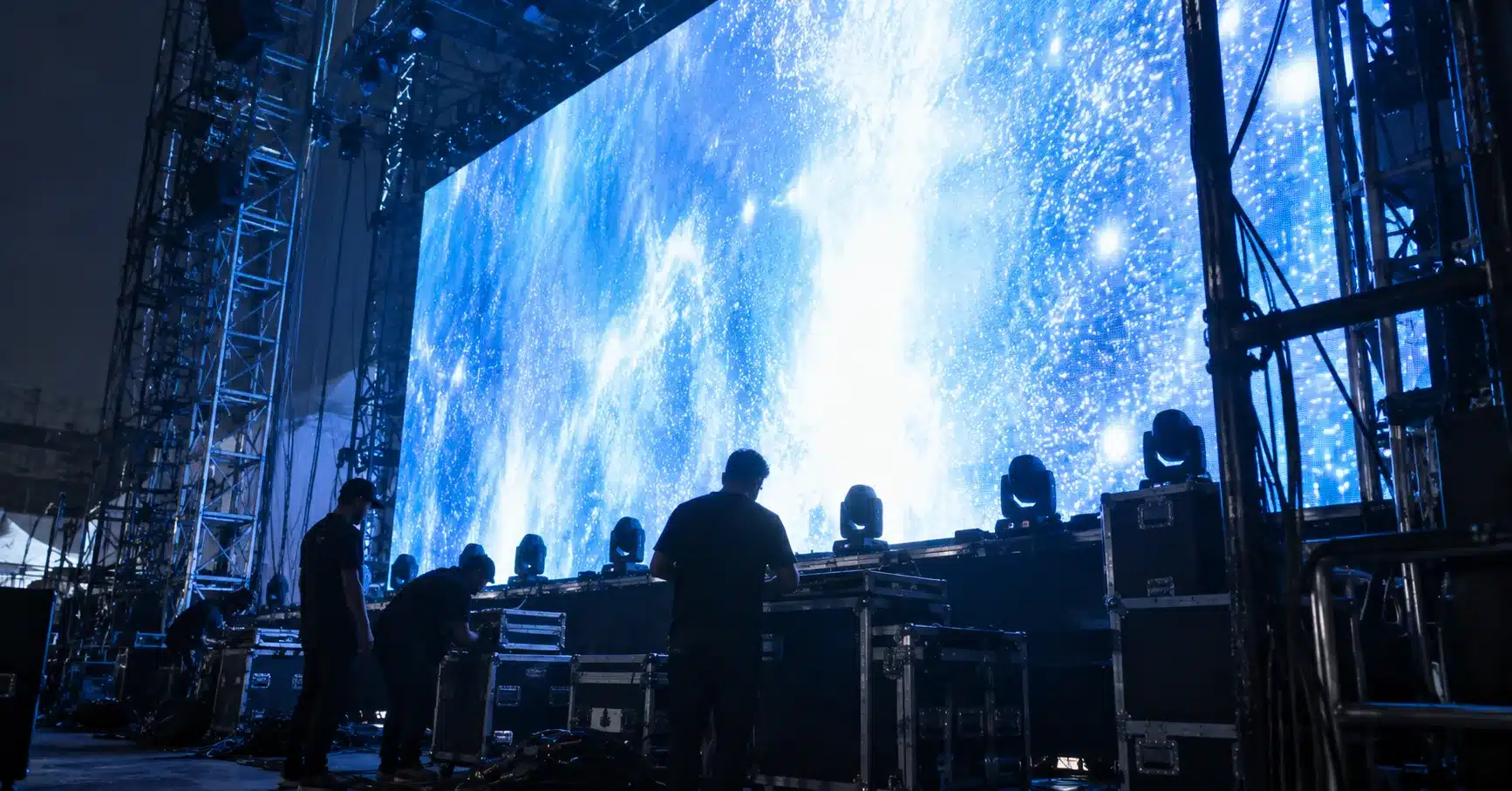
LEDs are the lighting technology behind most modern festival production, and the same efficiency that made them popular is part of what makes them a wildlife problem.
Standard white LEDs emit a spectrum richer in short, blue wavelengths than the sodium-vapor and incandescent lighting they replaced, and blue-rich light scatters more in the atmosphere, contributing disproportionately to skyglow. The wavelength itself matters beyond scattering, too: a landmark study on migratory birds found that red light specifically disrupts the magnetic compass birds use to navigate, while blue light left seasonal migratory orientation largely unaffected and green light caused only minor disturbance, a more specific and counterintuitive finding than the general “avoid blue light” advice repeated in most consumer lighting guides. For insects, the picture points the other direction: UV and blue-white wavelengths, common in many LED fixtures, sit closest to the 340-380 nanometre range insects are most strongly drawn to, making standard cool-white festival LEDs one of the more attractive light sources available to a moth or beetle on a given night.
Lasers

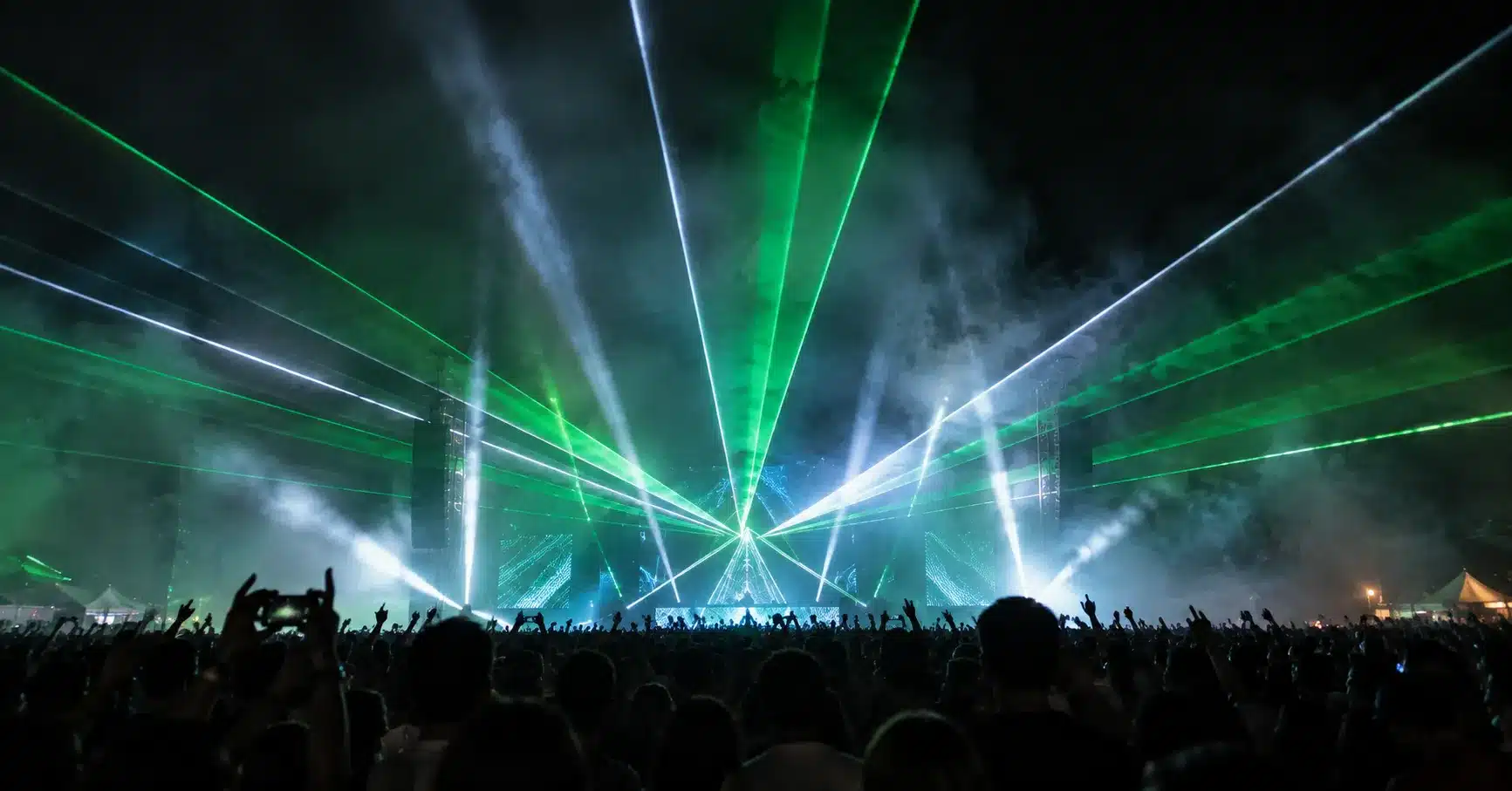
Laser displays concentrate light into a coherent, high-intensity beam rather than the diffuse glow of a floodlight or LED wall, and that concentration changes the nature of the risk rather than simply scaling it up.
The most established regulatory response to laser light isn’t wildlife-focused at all: aviation authorities in most countries restrict outdoor laser use near flight paths because a beam that reaches an aircraft cockpit can cause temporary flash-blindness, the same phototactic glare response that draws insects and disoriented birds toward any bright point source, just concentrated enough to matter to human pilots as well as wildlife. For animals, a laser behaves like an intensely bright, narrow-spectrum point light, and the same phototaxis and disorientation mechanisms documented for broad-spectrum lighting apply, with the difference that a laser’s narrow beam angle means its wildlife impact is concentrated along specific sightlines rather than spread across a wide area the way a floodlit stage is.
Floodlights
Floodlights illuminate the largest physical area of any common festival light source, which makes shielding and aim, not just brightness, the main variable that determines how much of that light actually escapes the venue.
Dark sky lighting standards treat floodlights as the clearest case for full-cutoff design: a properly shielded floodlight directs its output downward onto the intended surface, while an unshielded or poorly aimed one sends a significant share of its output sideways and upward, contributing to skyglow far beyond the festival footprint. A single unshielded floodlight on a commercial property has been documented casting usable light hundreds of feet into surrounding areas, which scales directly to a festival production running dozens of units across a multi-day event.
Temporary event lighting and festival light pollution
Temporary lighting, up for a single night or a festival weekend rather than installed permanently, produces some of the best-documented wildlife impact data available, precisely because researchers can measure the same airspace with the lights on and with the lights off.
New York’s Tribute in Light, 88 spotlights reaching four miles into the sky and visible from 60 miles away, is the clearest example. NYC Bird Alliance volunteers have monitored it for more than two decades under a protocol established in 2002: when more than 1,000 birds are counted circling in the beams, organizers turn the lights off for 15 to 20 minutes. Cornell Lab of Ornithology radar tracking during the installation has recorded bird densities in the airspace above lower Manhattan reaching 150 times normal levels when the beams are active, and in one documented instance, the bird count within half a kilometre of the site rose from 500 to 15,700 within thirty minutes of the lights coming on. When the lights go dark, birds disperse within minutes. It’s not a festival in the traditional sense, but structurally it’s identical to any large temporary light installation: high intensity, single night, migratory season, measurable effect. The same mechanism applies to any festival running comparable lighting during spring or fall migration windows.
Insects

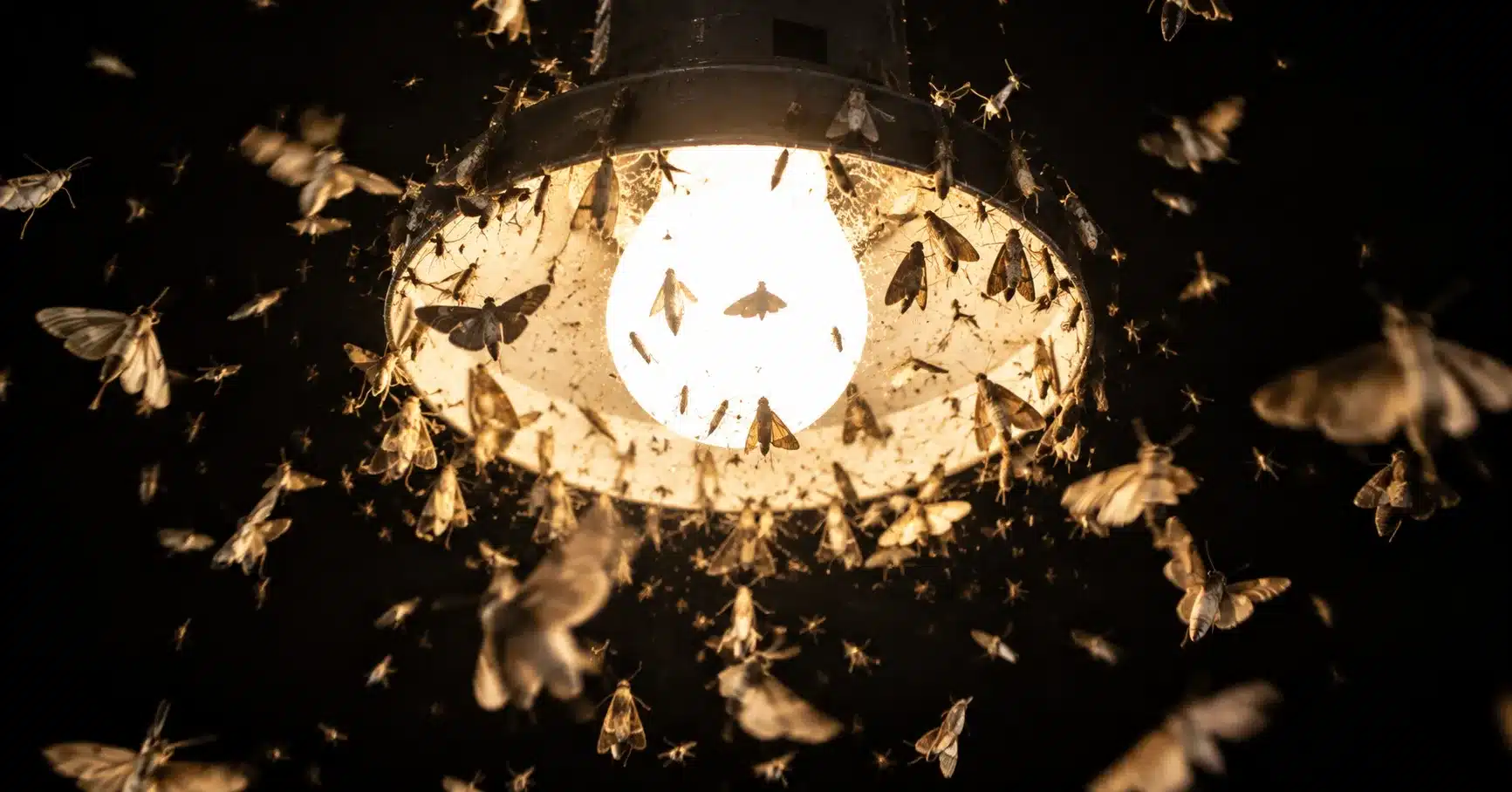
Insects respond to artificial light more predictably, and more fatally, than almost any other group affected by festival lighting.
Positively phototactic insects, the large majority of night-flying moths, beetles, and true flies, are pulled toward light sources and held there, a phenomenon researchers call the “vacuum cleaner effect”: the illuminated area continually draws insects in from the surrounding habitat, functioning as a population sink rather than a stable location. An estimated one-third of insects attracted to a stationary light source die before dawn, through exhaustion or predation by opportunistic feeders exploiting the concentration of prey. A controlled Science Advances study found street lighting reduced moth caterpillar abundance by 47% in hedgerows and 33% in grass margins compared to unlit sites, one of the more direct pieces of evidence linking artificial light specifically, not just habitat loss or pesticides, to measurable local insect decline. The effect isn’t limited to flight behavior either: a 2023 study found artificial light disrupts the bioluminescent signals male glow-worms use to locate females, interfering with reproduction in a species that doesn’t fly toward light at all.
Migratory birds
Migratory birds navigate at night using a combination of star patterns, physical landmarks, and, researchers suspect, a light-sensitive internal compass tied to Earth’s magnetic field. Exactly how artificial light disrupts this system during real migration events remains an active research question, though the wavelength-specific mechanism covered above is experimentally established.
A 2019 analysis of more than 70,000 nighttime songbird collisions in Chicago and Cleveland found that species which use nocturnal flight calls, essentially contact calls between migrating birds, collide with lit buildings far more often than silent species, because disoriented, calling birds appear to draw other nearby birds into the same collision risk. Chicago exposes more migrating birds to artificial light than any other US city, largely because it sits directly on a major flyway lined with illuminated high-rises. A more recent study along the Croatian coast found that even low-level, patchy light pollution, far short of a major city’s skyglow, measurably reduced birds’ flight altitude and airspeed near lit areas, increasing collision risk especially when combined with fog or overcast skies, evidence that festival-scale temporary lighting doesn’t need to match a city’s brightness to have a measurable effect during migration season.
Nocturnal animals
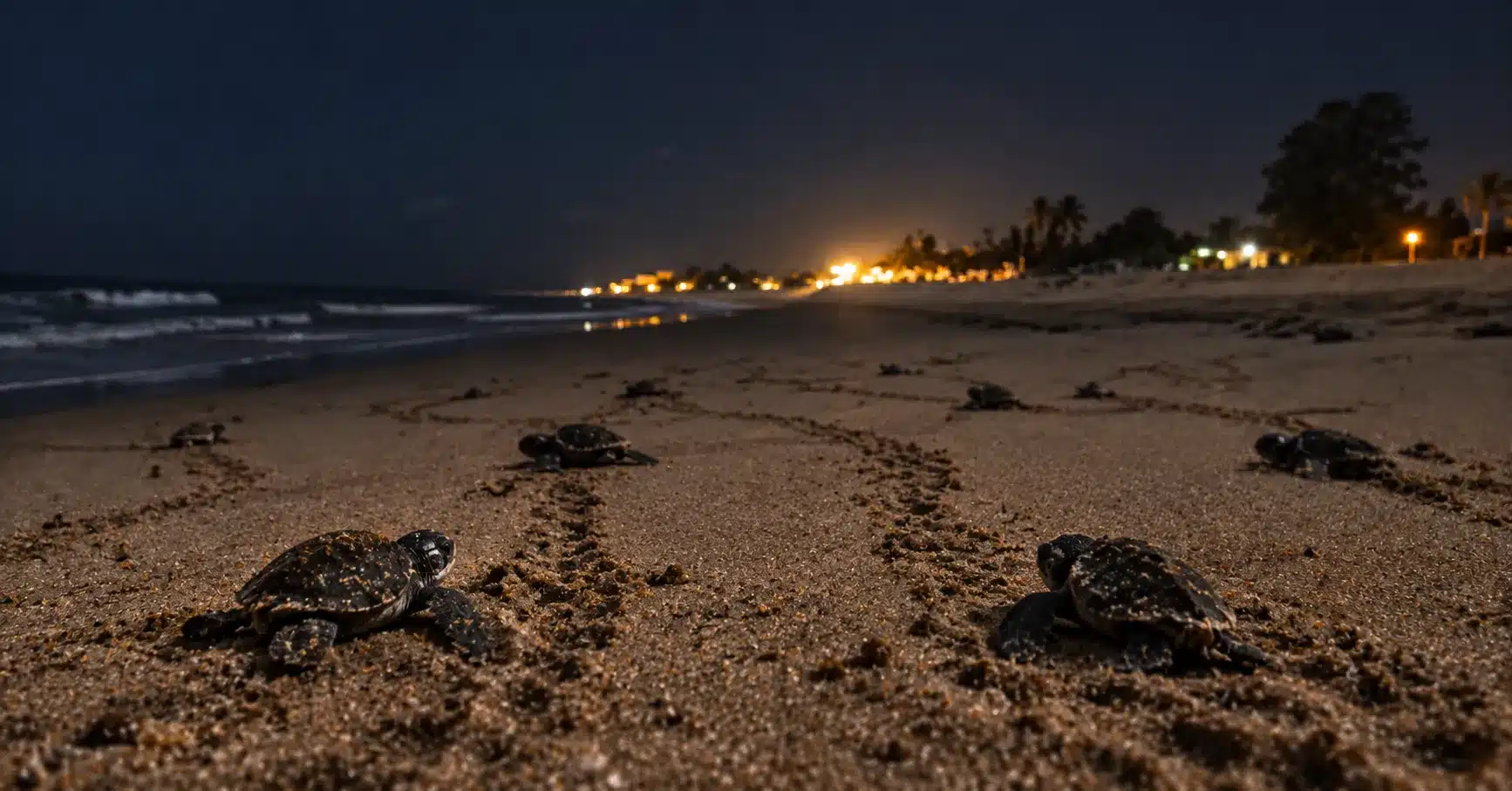
Beyond birds and insects, an entire category of nocturnal wildlife, evolved specifically to operate in darkness, faces disruption from festival-scale lighting through several distinct mechanisms.
Sea turtle hatchlings navigate from nest to ocean using light cues, historically the brighter, open horizon over water compared to a darker landward horizon; artificial lighting near beaches reverses this cue and can send hatchlings inland instead, a well-documented and often fatal disorientation. Bats show a more mixed but still disruptive pattern: some species avoid illuminated areas entirely, treating bright zones as a barrier that fragments their habitat and forces longer commuting distances between roost and foraging ground, while other, more light-tolerant species exploit the insects that artificial light concentrates, a short-term feeding advantage that longer-term shifts the balance of bat communities toward a smaller set of generalist species at the expense of rarer, light-averse ones. Fireflies and glow-worms, which depend on their own bioluminescent signals for mating, lose those signals against a backdrop of artificial light, and migrating monarch butterflies exposed to nighttime lighting during rest stops have been observed disoriented from their route the following day.
Dark sky
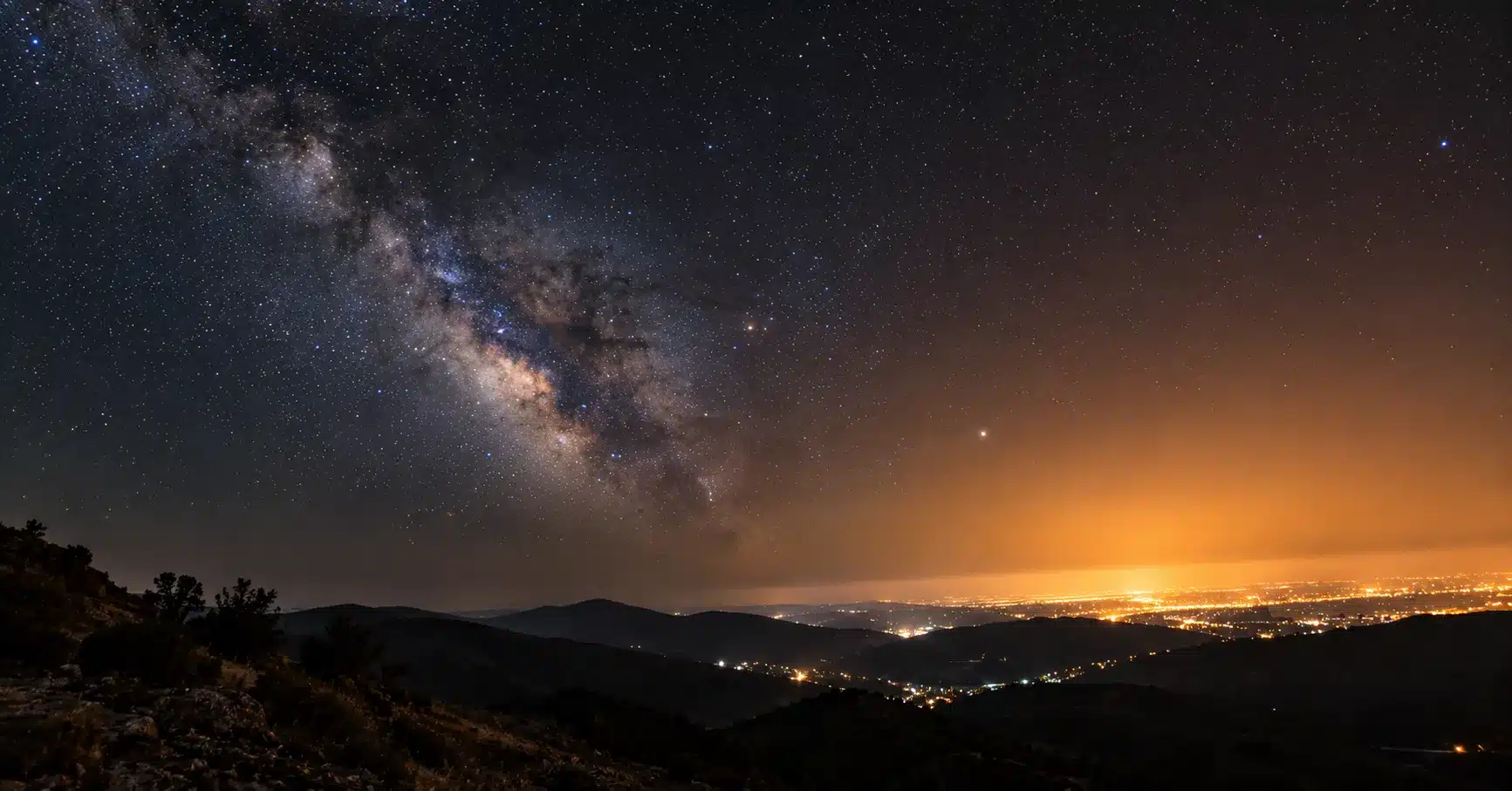
“Dark sky” is both a plain description and a formal designation, and the gap between the two is where most festival-relevant decisions actually get made.
DarkSky International (formerly the International Dark-Sky Association) certifies Dark Sky Parks, Reserves, and Communities based on measured sky quality and a demonstrated commitment to responsible lighting policy in surrounding areas. India’s first, Pench Tiger Reserve in Maharashtra, was certified in January 2024, becoming the fifth such certified park in Asia. Globally, roughly 83% of people, and 99% of Americans and Europeans, now live under measurably light-polluted skies, and the global night sky has been brightening by an estimated 10% per year over the past decade. For festivals, the practical relevance is proximity: an event held near or within a certified dark sky area carries meaningfully higher ecological stakes than the same production staged in an already brightly lit city, simply because the contrast between the event’s lighting and its surroundings is so much greater.
Light trespass
Light trespass is the specific, legally and practically relevant term for light that lands somewhere it wasn’t intended to, and it’s the category most likely to generate a direct complaint rather than an abstract environmental concern.
Alongside glare (excessive brightness causing visual discomfort) and skyglow (the cumulative brightening of the night sky), light trespass describes light spilling across a property line, into a bedroom window, or beyond a festival’s footprint into surrounding habitat. A single unshielded fixture can project usable light hundreds of feet beyond its intended target, and unlike skyglow, which accumulates gradually across a whole region, light trespass is typically traceable to one specific, identifiable source, which is why it tends to be the entry point for both neighbor complaints and municipal lighting ordinances.
Sustainable event lighting
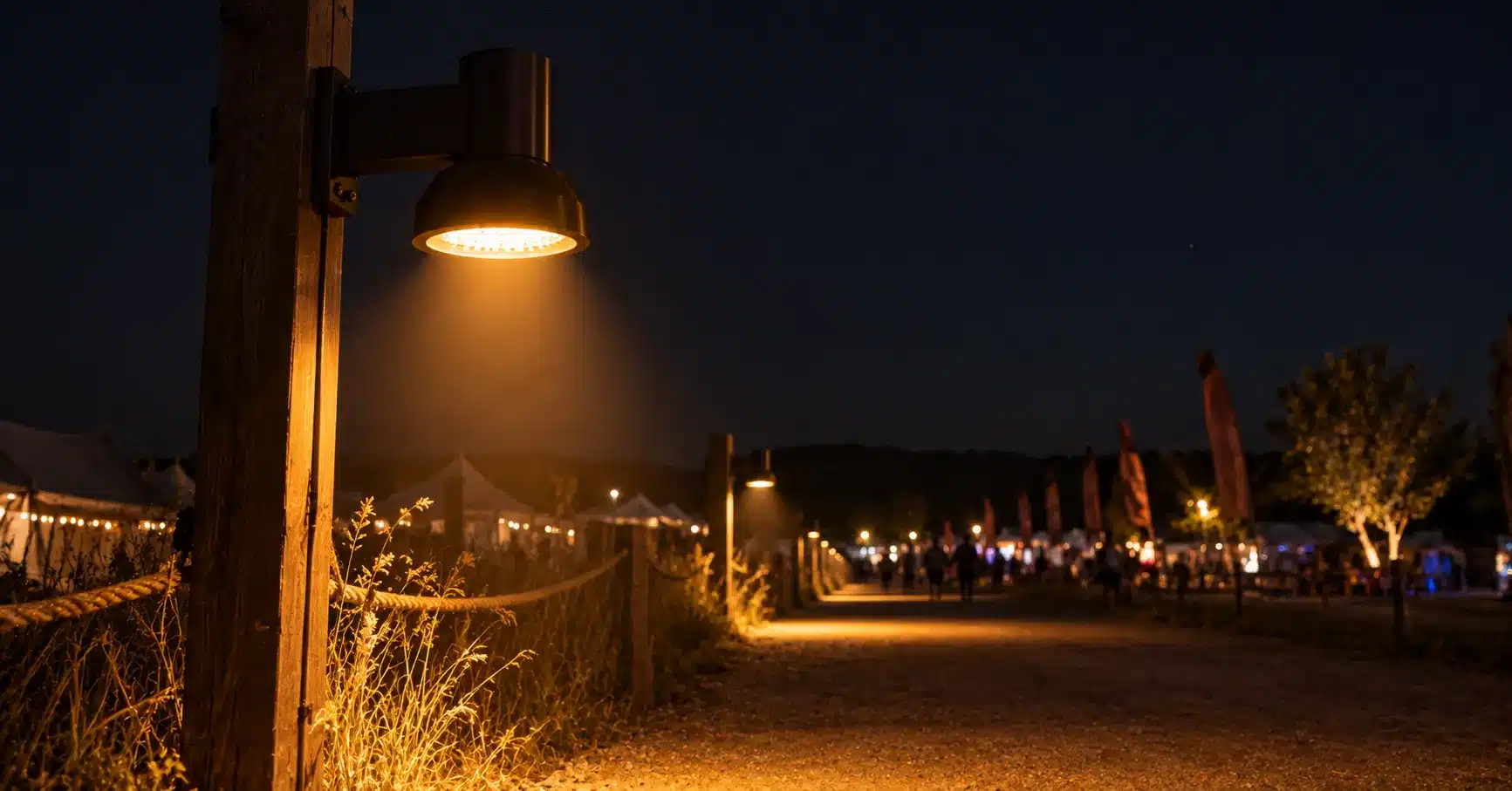
The technical fixes for festival light pollution are well established, standardized by dark sky organizations, and increasingly treated as production requirements rather than optional extras.
Three variables do most of the work: shielding, color temperature, and timing. Full-cutoff or fully shielded fixtures direct light downward onto the intended surface rather than letting it spill sideways or upward, addressing light trespass and skyglow simultaneously. Color temperature, measured in Kelvin, determines how blue-rich a light source is; DarkSky International recommends 3,000K or lower for outdoor lighting, since warmer, amber-toned light both scatters less in the atmosphere and appears less disruptive to the wavelength-sensitive navigation systems documented in birds and insects above. Timing controls, dimmers, timers, and motion sensors, reduce the total exposure window rather than the intensity, which matters most for the temporary, single-night installations covered earlier: a display that runs only when needed, rather than continuously from dusk to dawn, meaningfully shrinks its own impact without changing its design at all. None of these measures require abandoning ambitious lighting design. Our Green Man Festival guide covers a 25,000-attendee event built explicitly around restraint, “no giant LED brand walls,” as one description of it put it, alongside its refusal of corporate sponsorship. For the parallel case of festival sound, we’ve covered the same measure-first, design-around-the-limit approach in festival noise pollution, where it works for largely the same underlying reason: fixing the problem at the source is consistently more effective than managing complaints about it afterward.
FAQ
How does festival lighting actually harm birds?
Migrating birds navigate at night partly using a light-sensitive magnetic compass and celestial cues, both of which artificial light can disrupt. Disoriented birds may circle bright installations for hours, wasting energy needed for migration, or collide with structures. Radar tracking at one well-studied temporary installation recorded bird densities up to 150 times normal levels when the lights were active.
Do all colors of light affect wildlife the same way?
No. Research on migratory birds found red light specifically disrupts magnetic-compass-based navigation, while blue light left seasonal migratory direction largely unaffected and green caused only minor disturbance. For insects, the pattern is different again: UV and blue-white wavelengths are the most attractive, which is part of why dark-sky lighting standards recommend warm, low-Kelvin light for outdoor fixtures generally.
What is the “vacuum cleaner effect” in insects?
It describes how a light source continually draws insects in from the surrounding habitat rather than affecting only insects already nearby, functioning as a population sink. An estimated one-third of insects attracted to a stationary light die before dawn from exhaustion or predation, making brightly lit areas a net population drain on the surrounding area.
What’s the difference between light pollution and light trespass?
Light pollution is the broad category, covering skyglow, glare, clutter, and light trespass together. Light trespass specifically means light landing somewhere it wasn’t intended, spilling across a property line or into a window, and it’s usually the specific complaint that triggers a lighting ordinance or resident dispute, distinct from the more diffuse, cumulative problem of regional skyglow.
Are lasers worse for wildlife than regular festival lights?
Not necessarily worse overall, but different. A laser concentrates light into a narrow, high-intensity beam rather than spreading it across a wide area like a floodlight, so its wildlife impact is concentrated along specific sightlines rather than distributed broadly. The same phototaxis and disorientation mechanisms apply, which is also why aviation authorities restrict laser use near flight paths for human pilots.
Can festivals reduce light pollution without dimming the show?
Largely yes. The most effective measures target shielding, color temperature, and timing rather than raw brightness: full-cutoff fixtures aimed downward, warm color temperatures at or below 3,000K, and timers or motion sensors that limit how long lights run rather than how bright they are. None of these require a visually smaller production.
Is festival light pollution regulated the same way as festival noise?
Not consistently. Noise has decades of decibel-based licensing precedent in most countries; light pollution regulation is newer and far more uneven, often limited to dark sky reserve buffer zones or municipal lighting ordinances rather than a dedicated festival-specific framework. Wildlife-specific protections are essentially absent from both, despite comparable research showing measurable ecological impact in each case.
Which matters more for wildlife: a festival’s total brightness or its location?
Location, in most of the evidence reviewed here. The same lighting produces a far larger relative impact near a migratory flyway, a dark sky reserve, or a nesting beach than it does in an already brightly lit urban area, simply because the contrast with the surrounding darkness is what drives the disorientation and attraction effects documented above.
The bottom line
Festival light pollution has been studied less than festival noise, but where it has been studied directly, the evidence is unusually clear: turn a light on near a migration route, and disoriented birds appear within minutes; turn it off, and they disperse just as fast. That before-and-after clarity is rare in environmental science, and it points to an unusually tractable fix. Shielding, warmer color temperatures, and limited runtime address most of the documented harm without requiring festivals to go dark. What’s missing isn’t evidence or technology. It’s the same thing missing from festival noise management: treating wildlife impact as a planning input from the start, rather than a complaint to respond to after the lights are already up.

Abhay Ramola researches world festivals across primary sources, local accounts, and on-ground reporting. He founded Dionfest to cover what gets missed when festivals become tourism content the history, the ritual, and the people behind it.