How Much Water Does a Large Festival Use? Inside the Festival Water Footprint
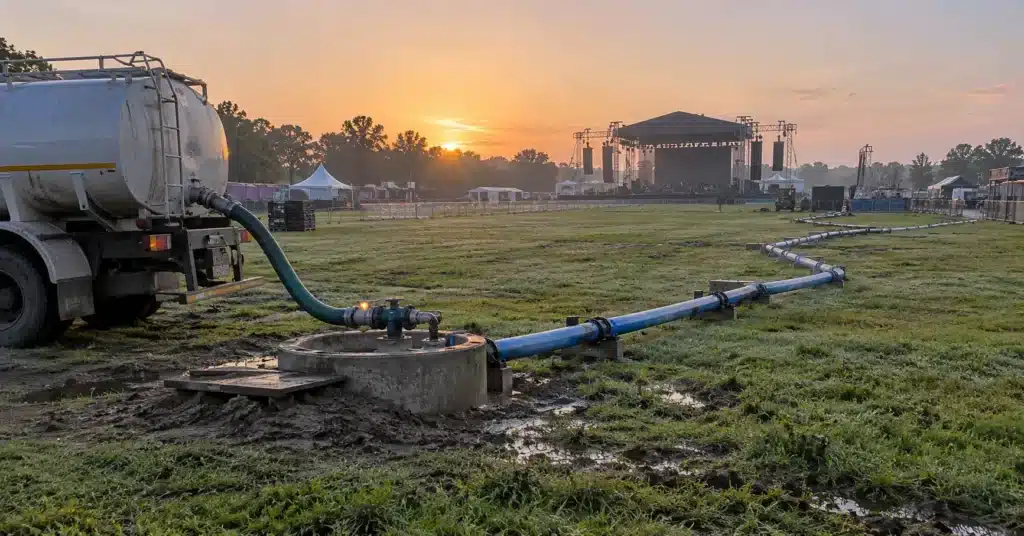
The village of Pilton in Somerset normally gets through about half a million litres of water a day. For five days each summer, the same pipes have to deliver six times that. Glastonbury Festival needs roughly three million litres a day at peak, and every litre of it arrives through infrastructure built for a village of a few hundred people.
That gap is the festival water footprint in its simplest form: a temporary city appears, demands what a small town demands, and then vanishes. Nobody buys a ticket thinking about it. But water is the one resource a festival cannot improvise, cannot substitute, and cannot run out of without the event ending early.
Fast facts
- Typical multi-day camping festival demand: 10 to 15 litres per person per day, rising to 20 litres in hot conditions
- Glastonbury at peak: around 3 million litres per day, roughly six times what the host village normally uses
- Drinking water alone: a baseline of about 500 ml per person per day, which can triple in heat
- Maha Kumbh 2025 water infrastructure: a 1,249 km pipeline network and 56,000 water connections, built for a single 45-day event
- The three components of a water footprint: blue (surface and groundwater consumed), green (rainwater), and grey (water needed to dilute the pollution created)
A large camping festival uses somewhere between 10 and 20 litres of water per person per day across all purposes combined. Drinking water is the smallest share of that. Toilets, showers, food vendors, and site cleaning account for most of it. Religious gatherings and desert events sit outside this range entirely, for reasons that come down to infrastructure and duration rather than crowd behaviour.
What a festival actually uses, per person
The working figure across the events industry is narrower than most people expect. A typical multi-day music festival with camping requires between 10 and 15 litres per person per day, rising toward 20 litres in hot weather or high-activity conditions.
That figure holds up against real supply data. Glastonbury’s 2010 infrastructure upgrade documented roughly 11 million litres used across five days for over 170,000 visitors, which works out to just under 13 litres per person per day. An independent estimate of Glastonbury water use from 2009 landed on the same 13-litre figure by a different route. Two separate methods converging on the same number is about as much confidence as this kind of estimate gets.
For scale, Ofwat puts average personal water consumption in England and Wales at 144 litres per person per day. A festival-goer uses roughly a tenth of that. The reason festival water demand feels enormous isn’t per-person consumption, which is genuinely low. It’s density: a hundred thousand people appearing in a field with no mains capacity, all needing water within the same 72-hour window.
Drinking water

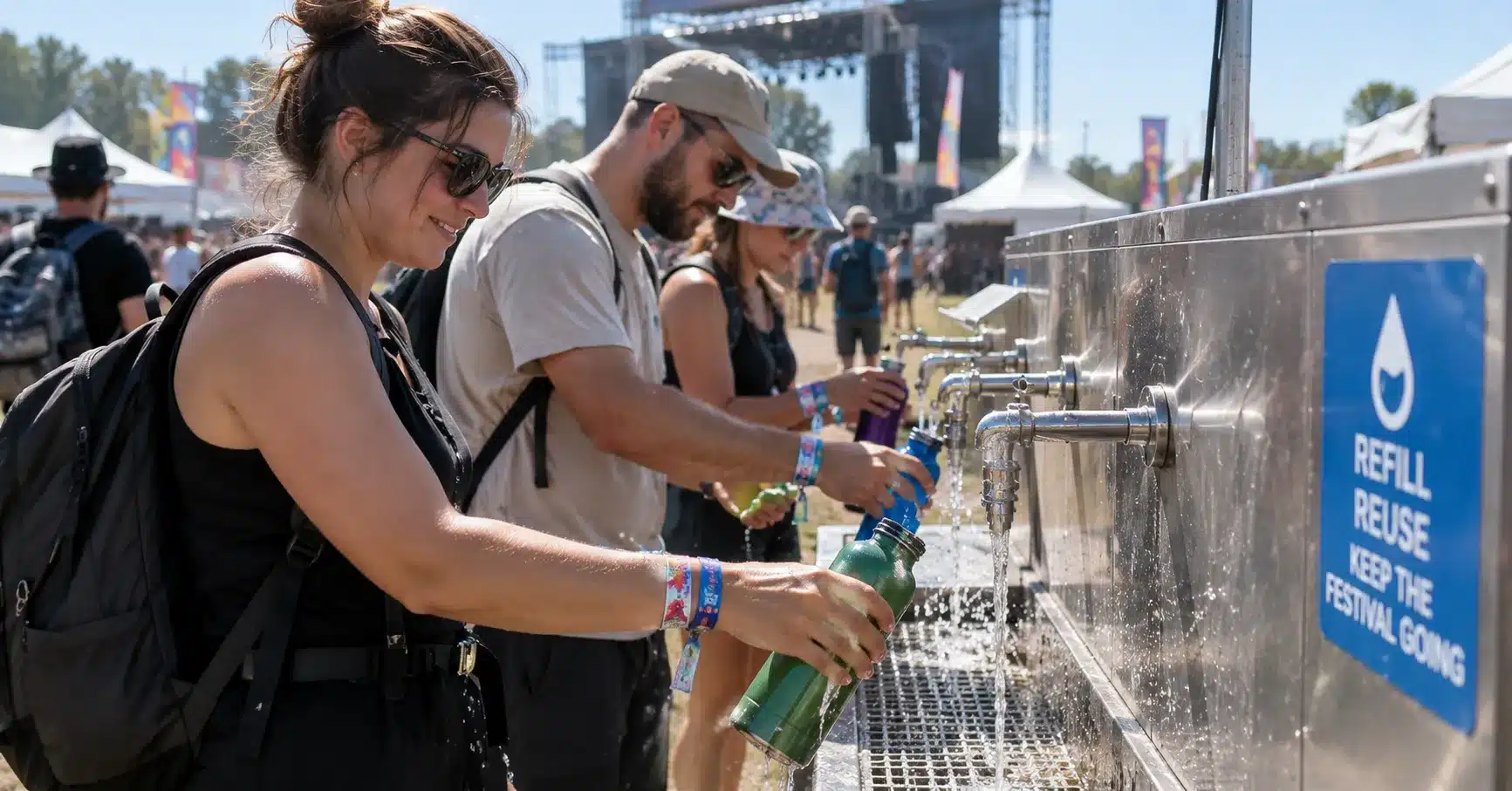
Drinking water is the smallest component of total festival water use and the only one where running short creates an immediate medical emergency rather than an inconvenience.
The planning baseline is around 500 ml per person per day, though that figure assumes moderate weather and does not survive contact with a heatwave. In hot conditions or at high-energy events, actual consumption commonly runs two to three times higher. Since Glastonbury banned single-use plastic bottles in 2019, the festival has supplied drinking water through more than 850 water points across the site, all fed from the mains supply rather than trucked in as bottled stock.
The shift away from bottled water changes the water footprint arithmetic in a way that isn’t obvious. Bottled water moves the water use off-site and upstream, into the bottling plant and the supply chain, where it doesn’t show up in the festival’s own consumption figures but still exists. Mains refill stations move it back on-site, where it becomes visible and measurable. A festival that switches to refill stations often appears to use more water, when what has actually changed is where the water is being counted.
Toilets and sanitation
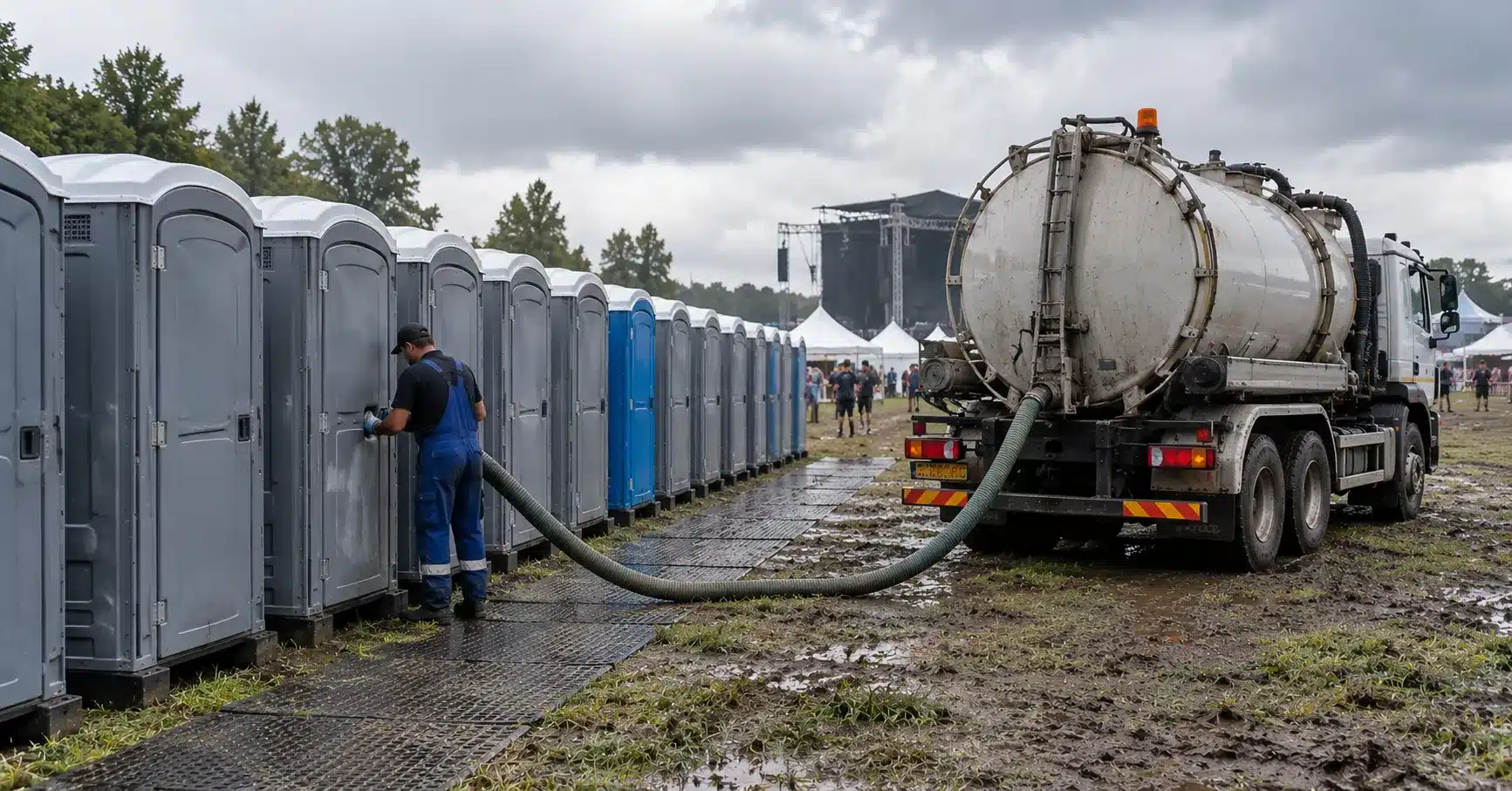
Toilets are usually the largest single water consumer at a festival that uses flushing sanitation, and the main reason many large events don’t.
Portable chemical toilets and composting units use little or no water per use, which is why they dominate temporary event sanitation. Flushing units, where they exist, change the maths substantially. The trade-off isn’t purely about consumption, though. Waterless systems shift the burden from water supply to waste removal, and the resulting sewage still has to be tankered off-site and treated somewhere.
Glastonbury’s pre-2010 arrangement illustrates the scale of that removal problem: sewage was driven off site by lorries making around 40 trips per day on 90-mile round journeys to a treatment plant at Avonmouth. The festival’s eventual fix was infrastructure rather than behaviour change, including two underground reservoirs holding a million litres each and an extended ring main around the site.
Handwashing and showers
Handwashing and showering sit between drinking water and sanitation in volume, and they are the category most directly shaped by what a festival decides to offer.
Showers are optional infrastructure. Plenty of large camping festivals don’t provide them at all, and the ones that do typically see them used by a minority of attendees. Where they exist, they generate the majority of a festival’s greywater, the relatively lightly contaminated wastewater from sinks and showers that can be separated from sewage and treated more simply.
That separation is where the opportunity is. Greywater kept apart from blackwater can be filtered and, in some cases, reused on-site for dust suppression or toilet flushing. Boom Festival in Portugal runs shower and kitchen greywater through on-site filtration gardens and reuses it rather than tankering it away. Even where reuse isn’t practical, separating greywater usually makes disposal both cheaper and less environmentally damaging than treating everything as mixed sewage.
Food preparation
Food vendors are the least visible major water consumer on a festival site, and the hardest for an organiser to control directly.
Every vendor needs water for cooking, for washing produce, and for cleaning equipment and surfaces between services, and food hygiene regulations in most jurisdictions set minimum requirements for that access. The structural problem mirrors the one in festival food waste: a single festival ground might host dozens of independent traders, each running their own kitchen with their own practices, and the organiser sets the site rules without controlling what happens inside each stall.
This is why vendor agreements, rather than infrastructure, tend to be the effective lever. Flow restrictors on vendor taps, shared washing-up stations instead of individual ones, and water use written into trading terms all target the same gap between what a site provides and what individual vendors actually do with it.
Cleaning, dust suppression and landscaping
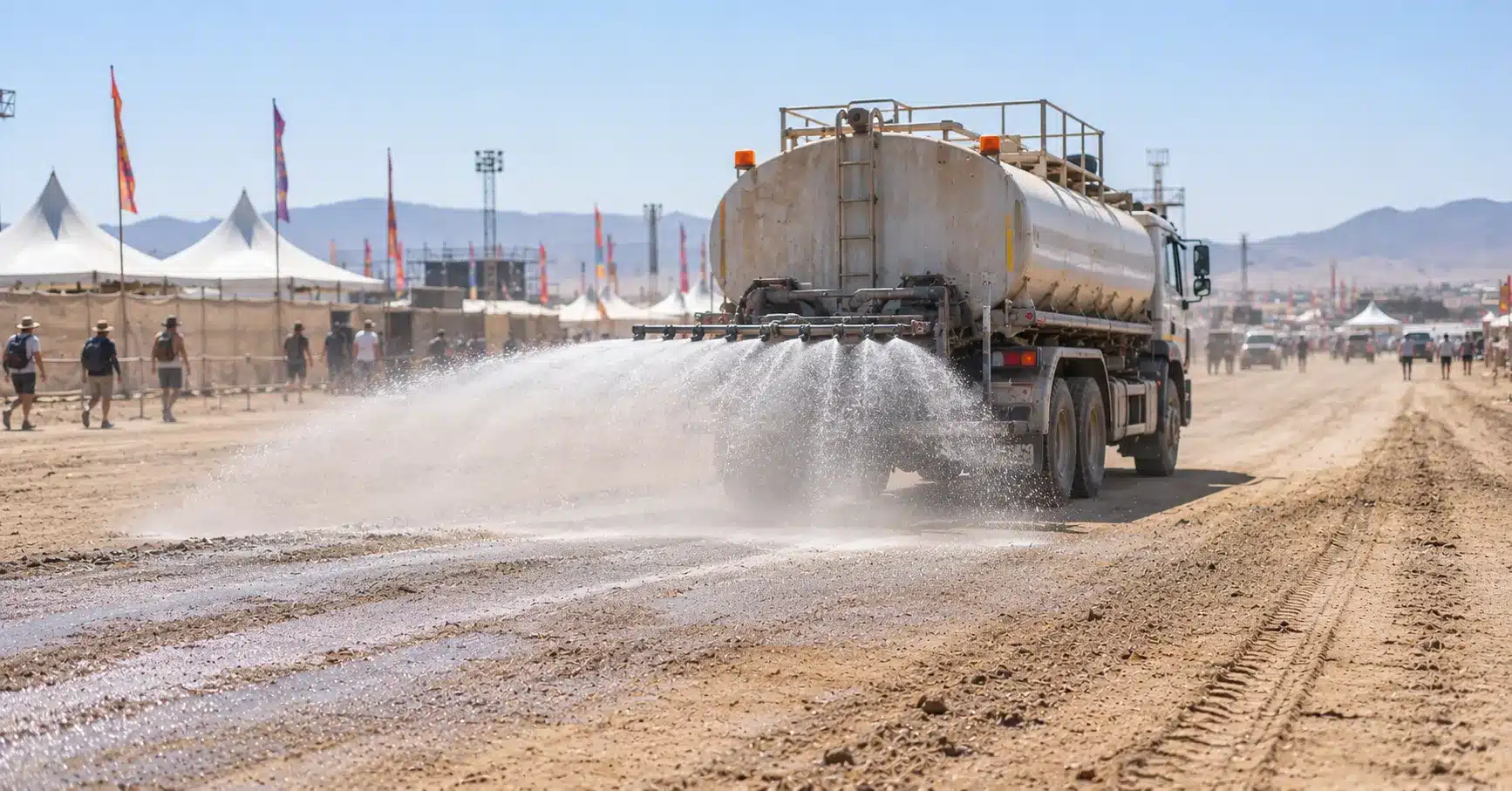 Site cleaning and dust suppression are the water uses most people never consider, and at dry-climate events they can rival drinking water in volume.
Dust suppression means spraying water onto roads and thoroughfares to stop vehicle movement generating airborne dust. At a desert or dry-season event, this can consume substantial volumes over a multi-day build, event, and breakdown cycle. Landscaping and ground recovery add another layer, particularly at events on farmland or parkland where the host expects the site returned in usable condition.
These uses are also the best candidates for non-potable water. Nothing sprayed on a road needs to be drinking quality, which makes dust suppression the most common first application for treated greywater at festivals that recycle at all.
Temporary camps: the multiplier

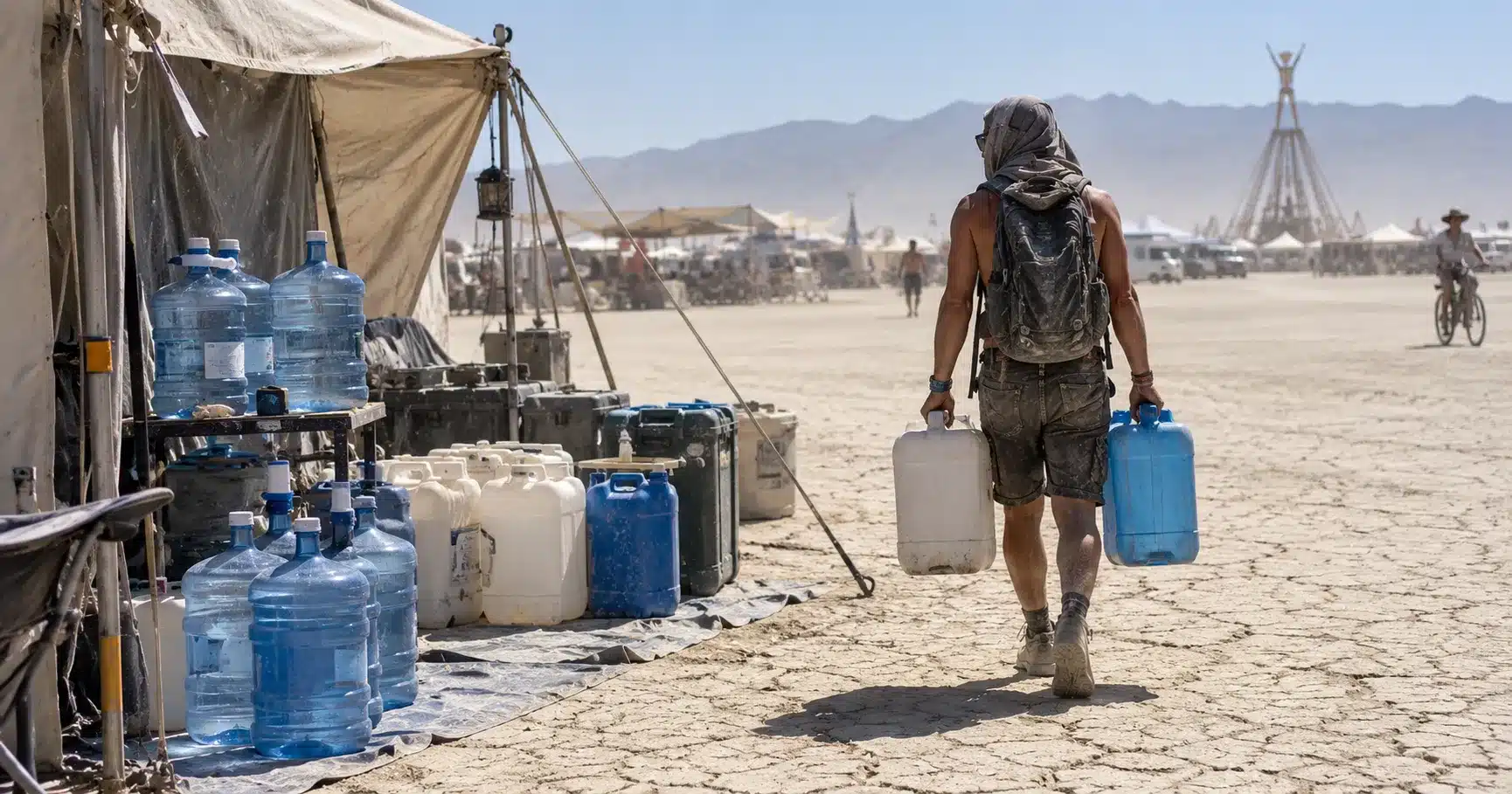
Camping is the single variable that most changes a festival’s water footprint, and it changes it the same way it changes the waste footprint.
A day-visit event serves people who arrive, spend some hours on site, and leave to use water at home. A camping festival takes over the entire daily water needs of every attendee for the full duration of the event: drinking, washing, sanitation, food, all of it, for people who have no alternative supply. The same person generates a fraction of the on-site demand at a day festival that they generate at a camping one.
This mirrors what the comparison of waste across festival types found: camping is the structural feature that separates high-footprint events from low-footprint ones, more than genre, size, or country. Burning Man sits at the far end of this spectrum. Its Leave No Trace principle means participants haul in their own water and haul out their own greywater, with a common planning figure of around 1.5 gallons, roughly 5.7 litres, per person per day, and official guidance explicitly directing participants not to discharge greywater onto the playa. That figure is lower than the festival average not because desert camping needs less water, but because every litre has to be physically carried in and the wastewater physically carried out.
Religious bathing: the category that breaks the maths
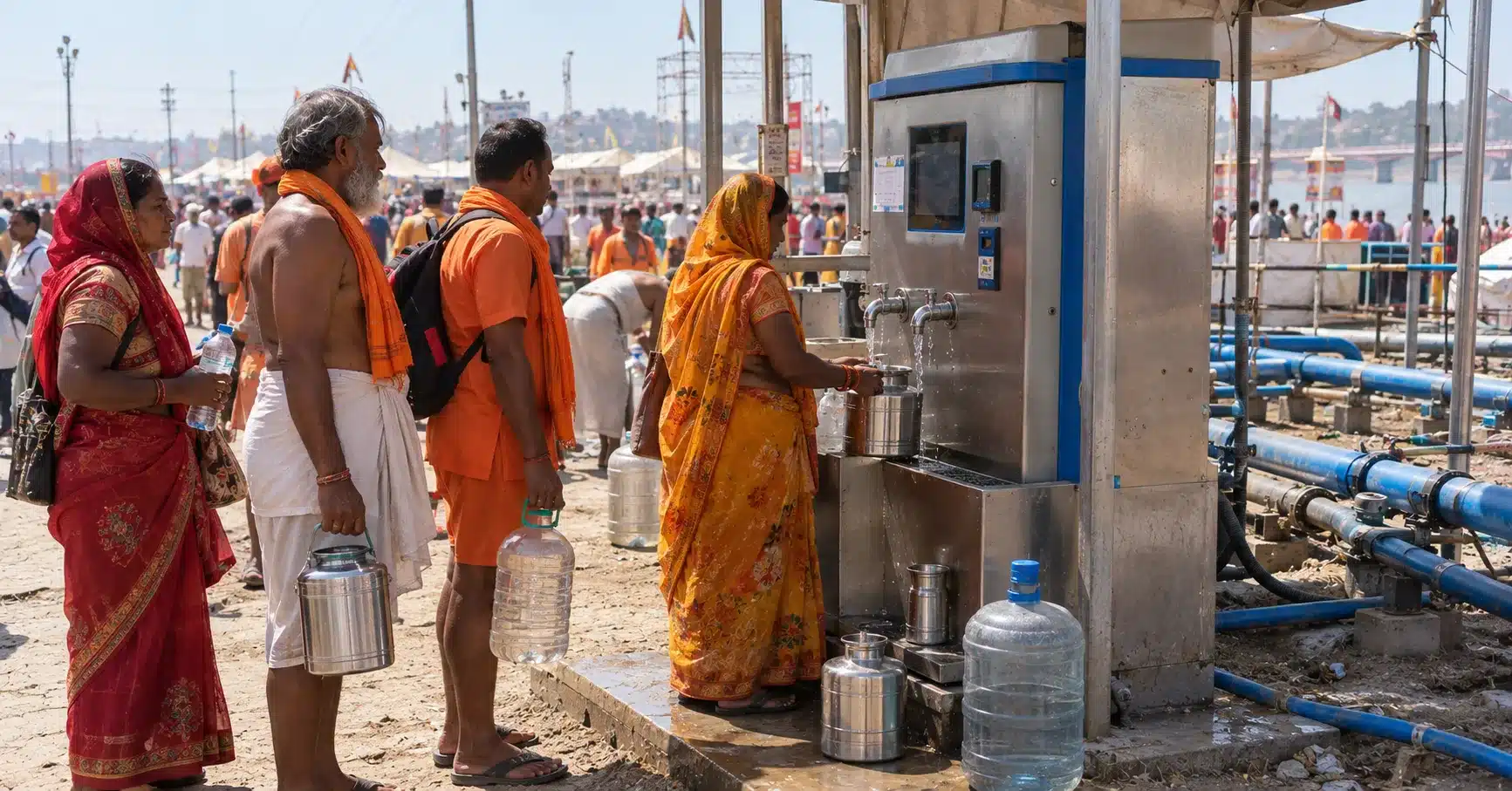
Mass religious gatherings use water in a way that doesn’t fit the per-person-per-day model at all, and any honest attempt to compare them to a music festival has to acknowledge that first.
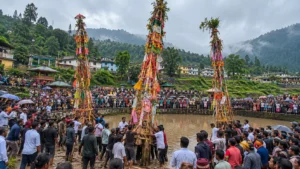
At the Maha Kumbh Mela, the water people come for is the river itself, not a supplied resource. Bathing at the Sangam consumes no piped water. But the infrastructure built to support the bathers is enormous by any standard: the 2025 Maha Kumbh required a 1,249 km pipeline network and around 56,000 water connections, laid across 4,000 hectares at a cost of roughly ₹40 crore. Drinking water was distributed through 233 water ATMs, each dispensing 12,000 to 15,000 litres of RO-filtered water daily. That drinking-water supply alone, between 2.8 and 3.5 million litres a day, is comparable to Glastonbury’s entire peak daily water supply.
Per-capita comparison breaks down here for the same reason it broke down when comparing festival waste: attendance is rolling and unticketed. Pilgrims pass through in hours rather than days, so there’s no stable denominator. What the figures do show is the infrastructure cost of the event, which is a different and arguably more useful measure. The river-quality consequences of that same gathering are covered separately in our piece on how religious festivals affect river water quality, and the waste-side equivalent appears in our coverage of the Kanwar Yatra’s impact on North India’s rivers and roads.
How a festival water footprint is calculated
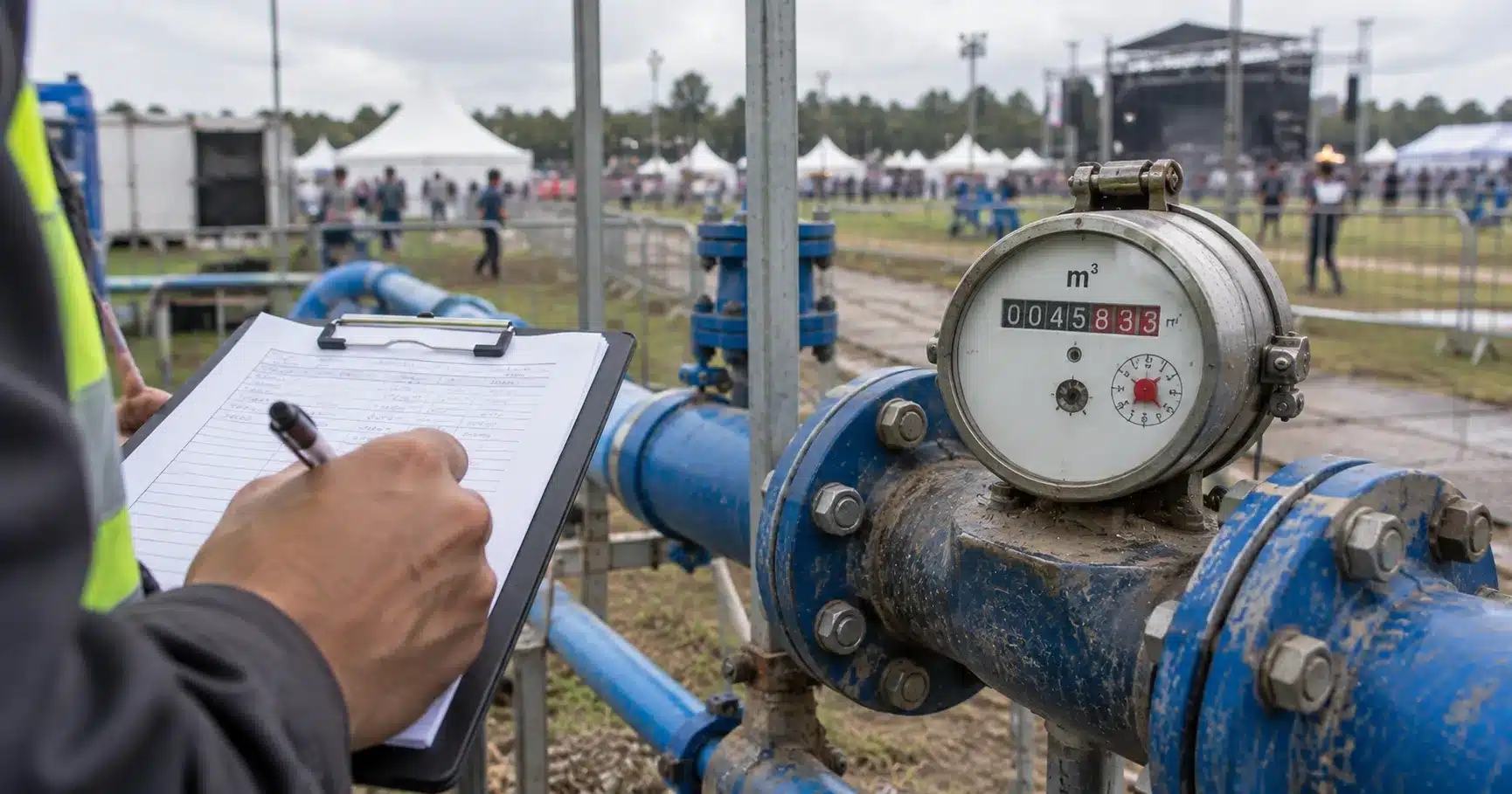 The standard methodology wasn’t designed for festivals. It was developed for agriculture and manufacturing, and it splits water use into three components that behave very differently.
The Water Footprint Network framework, established by Hoekstra and colleagues, divides total water footprint into blue, green, and grey. Blue water is surface and groundwater consumed, water withdrawn from a river, reservoir, or aquifer that doesn’t return to it. This is the mains supply a festival draws, and it’s what most people mean when they ask how much water an event uses. Green water is rainwater absorbed into soil and used by plants. For a festival on farmland, this is mostly irrelevant, though it matters for the food served on site. Grey water in this framework is not the same thing as greywater from showers. It means the volume of freshwater that would be needed to dilute the pollution created back to acceptable quality standards. It’s a calculated figure, not a physical one.
That third component is what makes the methodology useful rather than just descriptive. A festival that uses relatively little blue water but discharges poorly treated sewage can have a larger total water footprint than one using more water cleanly. The ISO 14046 standard takes this further by applying scarcity weighting, so that a litre used in a drought-stressed basin counts for more than a litre used where water is abundant. A festival in Somerset and a festival in Nevada using identical volumes do not have identical footprints under this approach, and the difference is not a rounding error.
For an event, a practical assessment means metering the supply, estimating vendor and contractor use, accounting for water embedded in food and materials brought on site, and calculating the dilution demand of whatever wastewater leaves. Most festivals currently do the first step and stop.
What actually reduces it
The measures that work are unglamorous and mostly involve knowing the numbers before the event rather than after.
Metering is the foundation. A festival that doesn’t measure its supply cannot identify which of the uses above is actually dominant, and the intuitive answer, drinking water, is almost always wrong. Even a manual meter checked a few times a day produces more actionable information than an annual invoice.
Beyond measurement: flow restrictors and push-taps on handwashing stations, waterless or low-flush sanitation, greywater separation from blackwater, and reuse of treated greywater for dust suppression, which needs no potable quality. On-site storage matters too. Glastonbury’s two million-litre reservoirs exist so the festival can draw steadily from the network over weeks rather than spiking local demand during the event itself, which is as much a solution for the host village as for the festival.
The pattern is the same one that appears in every other resource area covered on this site, from festival waste to noise: the fixes that work are decided during planning, not during the event. For broader context on environmentally-minded festival production, our Green Man Festival guide covers an event built around this approach from the outset.
FAQ
How much water does a large festival use per person?
Between 10 and 15 litres per person per day at a typical multi-day camping festival, rising to around 20 litres in hot weather. Glastonbury’s documented usage works out to roughly 13 litres per person per day, a figure independently estimated twice by different methods.
How much water does Glastonbury use in total?
Around 3 million litres per day at peak, roughly six times what the host village of Pilton normally consumes. Documented figures from a 2010 infrastructure upgrade recorded over 11 million litres across a five-day event for more than 170,000 visitors.
Is drinking water the biggest part of a festival’s water use?
No, and this is the most common misconception. Drinking water baseline is around 500 ml per person per day, a small fraction of the 10 to 20 litre total. Sanitation, showers, food vendors and site cleaning account for the large majority.
What is a water footprint and how is it calculated?
A water footprint has three components: blue water (surface and groundwater consumed), green water (rainwater), and grey water (the volume of freshwater needed to dilute resulting pollution to acceptable standards). The total is the sum of all three. The ISO 14046 standard goes further and weights these by local water scarcity.
What’s the difference between grey water and greywater at a festival?
They’re different concepts that share a name. Greywater is the physical wastewater from showers and sinks, as distinct from sewage. Grey water in water footprint accounting is a calculated volume representing how much clean water would be needed to dilute pollution back to acceptable quality. One is a liquid you can tanker away, the other is a number on a spreadsheet.
How much water did the Maha Kumbh Mela need?
The 2025 event required a 1,249 km pipeline network with around 56,000 water connections across 4,000 hectares. Drinking water alone was distributed through 233 water ATMs dispensing 12,000 to 15,000 litres each daily, a combined 2.8 to 3.5 million litres per day.
Why do camping festivals use so much more water than day events?
Because they absorb the entire daily water needs of every attendee for the full duration. A day-visit attendee does most of their drinking, washing and sanitation at home; a camping attendee does all of it on site, with no alternative supply available.
Can festivals recycle water?
Yes, primarily by separating greywater from sewage and treating it for non-potable reuse such as dust suppression or toilet flushing. Boom Festival in Portugal runs shower and kitchen greywater through on-site filtration gardens for reuse. Full potable recycling is rare at temporary events because the treatment infrastructure is difficult to deploy and decommission within a festival’s timeframe.
The bottom line
Per person, festival water use is modest. A festival-goer gets through roughly a tenth of what they’d use at home on the same day. The challenge was never individual consumption; it’s concentration, delivering a small town’s daily water to a field with no mains capacity, within a window measured in days.
That reframes what a solution looks like. Asking attendees to use less water is targeting the smallest variable in the system. Metering the supply, separating greywater, restricting vendor flow, and building storage so local demand doesn’t spike all target the actual structure of the problem. The festival water footprint is an infrastructure question dressed up as a behaviour question, and the events that have made real progress on it are the ones that worked that out first.

Abhay Ramola researches world festivals across primary sources, local accounts, and on-ground reporting. He founded Dionfest to cover what gets missed when festivals become tourism content the history, the ritual, and the people behind it.