Can Traditional Festivals Become Zero-Waste Without Losing Their Cultural Meaning?
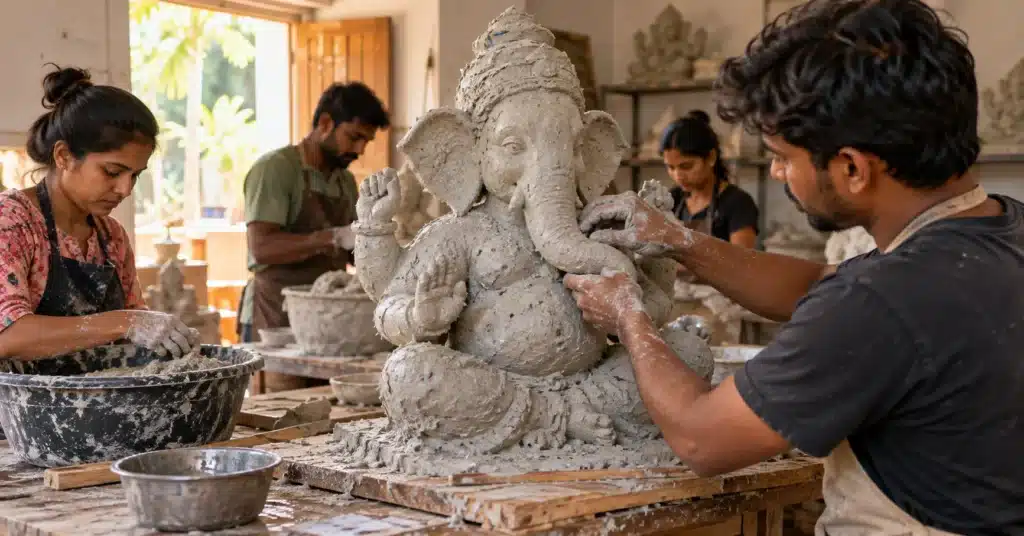
For nineteen years, a residential mandal in Mumbai’s Vile Parle neighbourhood has built its own Ganesh idol from scratch every year, out of paper pulp, banana fibre, cocopeat, and whatever else the previous year’s idol left behind. This is what a zero-waste festival tradition actually looks like in practice, not a certification or a marketing claim, but a habit repeated until it becomes the culture itself. Sunil Mayekar started in 2008 after watching immersed idols sit in the local pond for months, chalky and half-dissolved. His mandal’s paper idol breaks down within hours of immersion, and the pulp gets collected, stored, and reused to build next year’s Ganesha. Nobody in that mandal experiences this as a compromise. They experience it as the point.
That story sits at the centre of a question most coverage of “eco-friendly festivals” never actually asks: is sustainability something imposed on tradition from the outside, or is it, in a lot of cases, tradition itself, before a few decades of convenience and commercialisation replaced it with something cheaper? The honest answer turns out to depend on which specific practice you’re talking about, and this article goes through them one at a time rather than assuming the question has one answer.
Fast facts
- Clay is the older tradition, not Plaster of Paris. PoP became popular only in the mid-to-late 20th century because it’s cheaper and easier to mould into large, intricate idols
- Clay dissolves in roughly an hour in water; Plaster of Paris can sit on a riverbed for months before breaking down, per water-quality comparisons of the two materials
- A 2026 peer-reviewed ESG study of eco-friendly Ganesh festivals in Maharashtra found that clay idols, artificial immersion tanks, and better waste segregation together move festivals measurably closer to genuine sustainability performance
- India’s Central Pollution Control Board banned Plaster of Paris idols outright in 2020, redirecting the industry back toward the material it used before PoP arrived
- DGTL Festival in Amsterdam reported zero grams of landfill waste per visitor in 2022, through 100% waste separation and reusable cups, showing genuine zero-waste operation is achievable at festival scale, outside the religious-festival context specifically
Whether a traditional festival can become zero-waste without losing its meaning depends on which layer of the festival you’re changing. Swapping Plaster of Paris for clay, or synthetic dye for turmeric, restores a practice that’s often older than the wasteful version it replaced. Changing the scale, the public procession, or the immersion ritual itself touches something closer to the festival’s actual meaning, and that’s where the genuine tension lives.
What “zero waste” actually means for a festival
“Zero waste” has a specific technical meaning that’s easy to lose in festival marketing, and it’s worth being precise about before applying it to something as culturally loaded as a religious celebration.
The standard definition, used by zero-waste festivals like Chennai’s Kalai Theru Vizha and its literary-festival offshoot Lit for Life, is the near-elimination of material sent to landfill or incineration, achieved by redesigning what gets used in the first place so that it can be recycled, composted, or reused rather than discarded. It’s explicitly described in that framework as a continuous process, not a one-time certification. Amsterdam’s DGTL Festival is the clearest secular proof of concept: by eliminating single-use cups, going cashless to remove plastic tokens, and running a 100% waste separation system, it reported zero grams of landfill waste per visitor in 2022. That figure is a genuinely rare achievement, and it’s worth noting it happened at a purpose-built electronic music festival with full control over vendors and ticketing, a very different starting point from a centuries-old religious festival celebrated in millions of individual homes and neighbourhood mandals with no central operator at all.
That structural difference is the whole challenge in one sentence. A festival like DGTL can mandate its supply chain. Ganesh Chaturthi, Durga Puja, and Diwali are celebrated by hundreds of millions of people independently, which means “zero waste” for a traditional festival isn’t a single policy decision. It’s millions of separate ones.
The surprising history: the eco-friendly idol is usually the older one
 Most “go green this festival” advice implicitly frames sustainability as a modern imposition on ancient practice. The actual history of the Ganesh idol runs the other way.
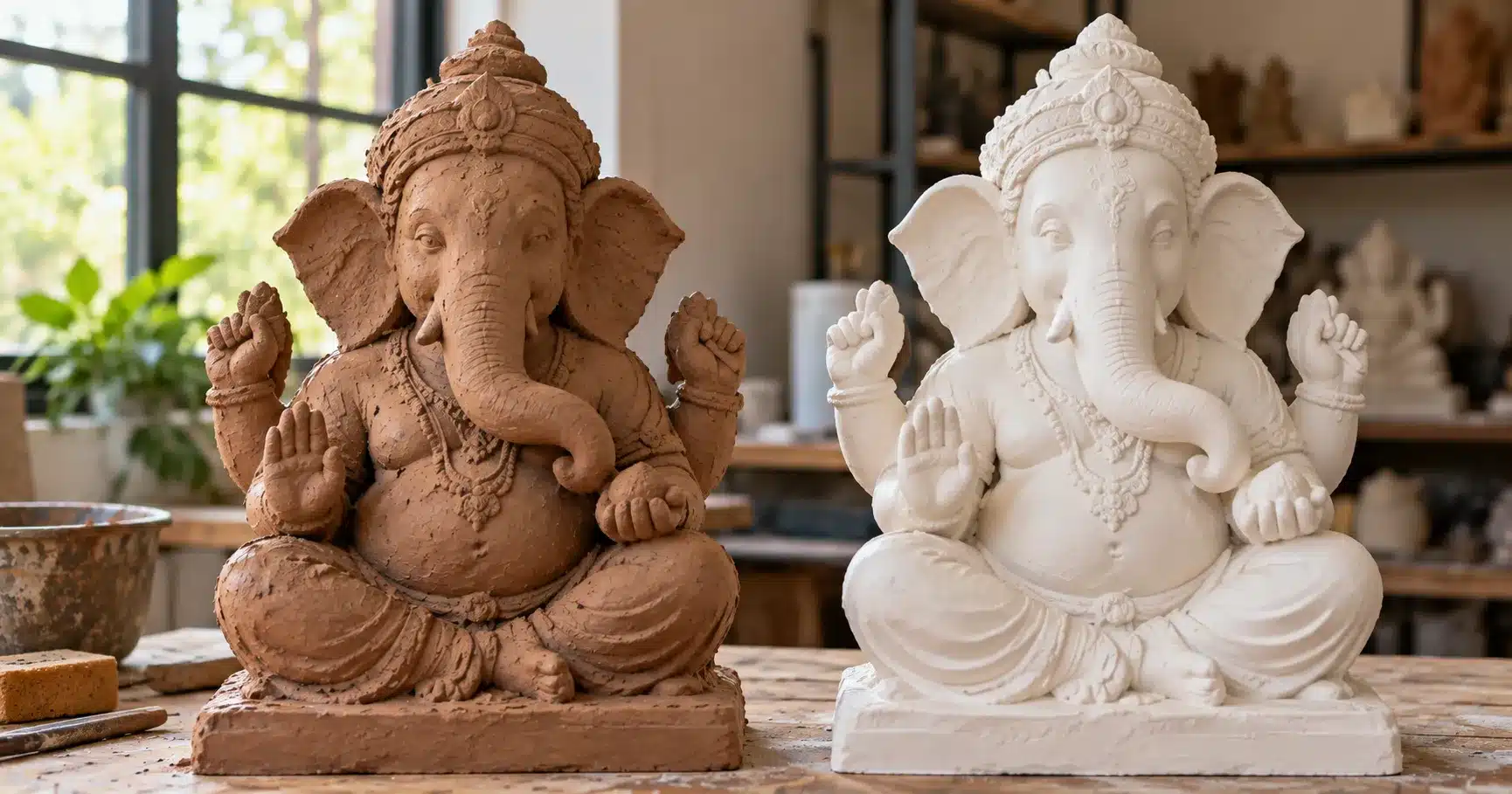
Clay, known locally as shaadu maati, is the original material, sourced from riverbeds and worked by hand. Plaster of Paris, a manufactured gypsum compound, became popular only in the mid-to-late 20th century specifically because it’s cheaper, lighter, and lets artisans mould larger, more intricate idols at lower cost, exactly the qualities that made bigger and more elaborate public idols commercially viable. The environmental difference between the two shows up only after immersion: clay dissolves in roughly an hour, breaking down into sediment that water bodies can absorb, while Plaster of Paris disintegrates slowly, sometimes sitting on a riverbed or lake floor for months. In some regions, the pre-PoP tradition went further still. Gobar Ganesh, idols made from cow dung, and turmeric-paste idols used in Karnataka’s Gowri Habba both predate widespread PoP use, and both carried their own spiritual significance around purity and natural materials that had nothing to do with 21st-century sustainability language.
India’s Central Pollution Control Board banned PoP idols outright in 2020, and several state governments, including Rajasthan, had already ordered the switch back to clay years earlier. Frame it that way and “eco-friendly idol” stops sounding like an innovation. It’s closer to a restoration, undoing a mid-century shortcut rather than asking the festival to become something it never was.
Where tradition and sustainability already agree
 Several of the practices most associated with “greening” a festival aren’t really compromises at all, because the traditional version and the sustainable version are close to identical.
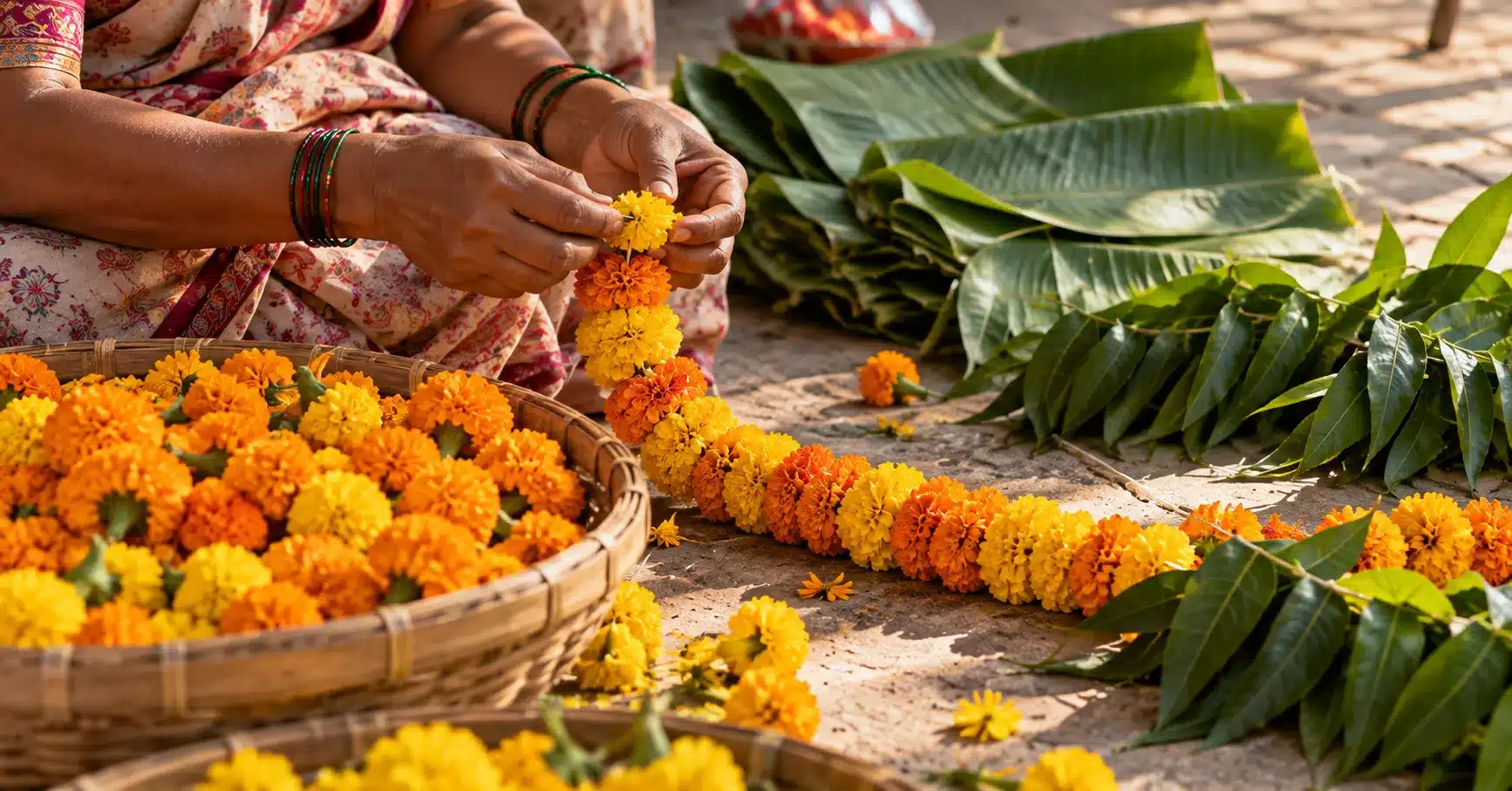
Natural decorations were the default before plastic bunting and thermocol backdrops existed: marigold and jasmine garlands, banana and mango leaves, rangoli made from rice flour and natural pigment. We’ve covered the fuller picture of what happens to flower and offering waste specifically, including the recycling and composting operations now built around it. Composting of flowers, leaves, and food offerings works precisely because these materials were always biodegradable by design, long before anyone called the practice composting. Pune’s SWaCH waste-picker cooperative has run exactly this kind of programme at scale during Ganeshotsav. Flower recycling into incense, dye, and compost, covered in that same piece, converts what religious tradition already treated as sacred, non-disposable material into a second use rather than dumping it. Reusable utensils, banners, refill stations, and public transport access are the genuinely modern additions to this list rather than restorations of older practice, and each targets a specific, identifiable leak in the system. Steel or reusable plates in place of thermocol ones, and cloth or vinyl banners designed to be repainted and reused season after season rather than replaced, both work on the same logic covered in more depth in our piece on festival plastic: removing single-use material at the source, rather than sorting it out afterward, whether the event is a temple festival or a music festival. Refill stations solve a narrower but very concrete problem, covered in our breakdown of festival water use: a mandal or a music festival that provides mains-fed water refill points removes an entire category of plastic bottle waste before it’s generated, rather than hoping it gets correctly sorted later. Public transport access matters for a different reason entirely, tied to carbon rather than waste: our analysis of the carbon footprint of festivals found that travel, not waste or energy, is consistently the largest single emissions category at any large gathering, which means a Ganesh Chaturthi procession or pandal-hopping crowd that walks or takes local transit rather than driving individually is addressing the biggest lever available, even though it’s the one sustainability conversation about festivals almost never mentions.
None of these changes ask a festival to become less traditional. In each case, the traditional version and the low-waste version were the same thing until a cheaper, more convenient alternative displaced it sometime in the last fifty to seventy years.
Where the tension is real
 Not every sustainable substitution is this clean, and treating them all as equally easy undersells the genuine friction involved in some of them.
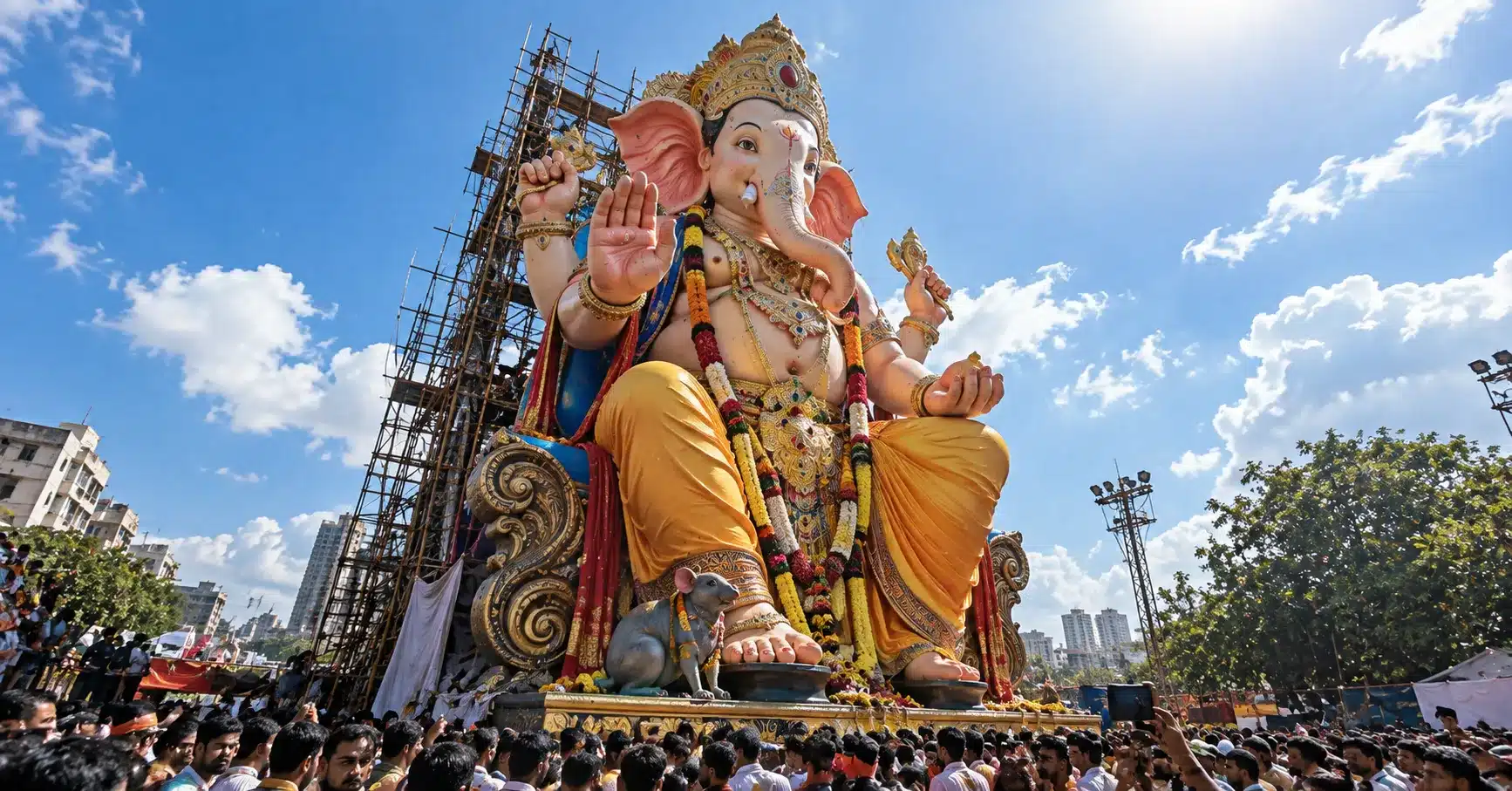
Scale has changed in a way pure tradition can’t absorb. A hand-worked clay idol from a century ago was built for a household shrine or a small neighbourhood gathering. Today’s largest public idols, like Hyderabad’s Khairatabad Ganesh, have reached 61 feet, requiring tonnes of Plaster of Paris and steel to achieve a scale clay alone struggles to support structurally. Reverting fully to clay at that scale isn’t simply a material swap; it may mean the idol itself gets smaller, which some communities experience as a genuine loss rather than a neutral adjustment. Clay isn’t automatically free of impact either. It’s a non-renewable material typically mined in states like Gujarat and West Bengal and transported elsewhere, with real environmental and worker-health costs at the mining end. Pune’s Punaravartan initiative, run by the environmental organisation eCoexist, has collected between 12 and 15 tonnes of clay sludge from immersed idols in different years to recycle into new ones, and exists specifically because “just switch to clay” doesn’t fully solve the problem at the volume modern festivals operate at. Artificial immersion tanks change something about the ritual’s public, communal character, even when they’re better for water quality. A neighbourhood procession culminating in immersion at a shared river or lake is a different collective experience than immersion in a municipal tank built for exactly that purpose; both are valid, but they’re not identical, and some practitioners feel that difference more than others.
And the politics are real, not hypothetical. When Telangana’s High Court pushed to restrict PoP idol immersion in Hyderabad’s Hussain Sagar lake, the effort was met with organised opposition from a Ganesh utsav committee that read the restriction as an intrusion on religious practice rather than a neutral environmental measure. That’s a genuine disagreement between two legitimate concerns, water quality and religious autonomy, not a case of one side being obviously right. It’s the same underlying tension covered in our piece on festival noise pollution, where loudspeaker restrictions during festivals have drawn comparable pushback. Sustainability advocates who treat this kind of resistance as simple ignorance are missing something real about what’s actually being asked of people.
What the ESG research on Ganesh festivals actually found
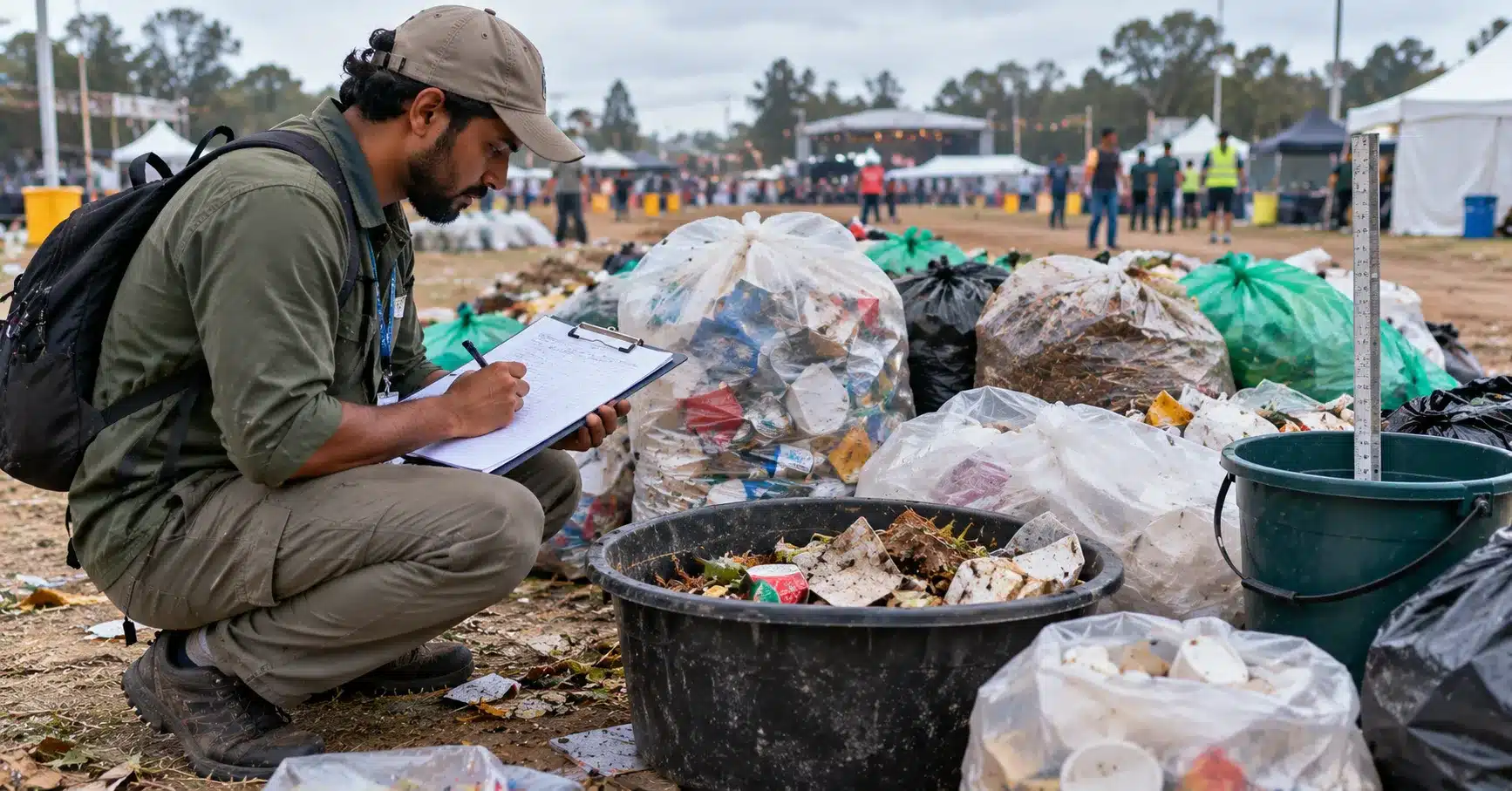 Academic interest in exactly this trade-off has caught up with the practice. A study published in early 2026, “From Tradition to Sustainability: An ESG Impact Analysis of Eco-Friendly Ganesh Festivals in Maharashtra,” examined how clay idols, artificial immersion tanks, reduced plastic use, and improved waste management map onto standard Environmental, Social, and Governance evaluation criteria, the same framework increasingly used to assess corporate sustainability performance, applied here to a religious festival for the first time in a formal academic sense.
Framing a temple festival through an ESG lens is itself notable: it treats Ganesh Chaturthi’s environmental choices with the same rigour normally reserved for corporate reporting, rather than as a matter of individual goodwill or civic messaging. Whether that framing changes anything in practice is a separate question the study doesn’t directly answer, but it’s a reasonable guess that it could: municipal bodies and mandal committees generally have to justify infrastructure spending, tank construction, clay subsidies, waste segregation, to funders and local government, and a measurable ESG-style framework gives them a vocabulary for that case that appeals to individual goodwill don’t.
What a genuinely zero-waste traditional festival looks like
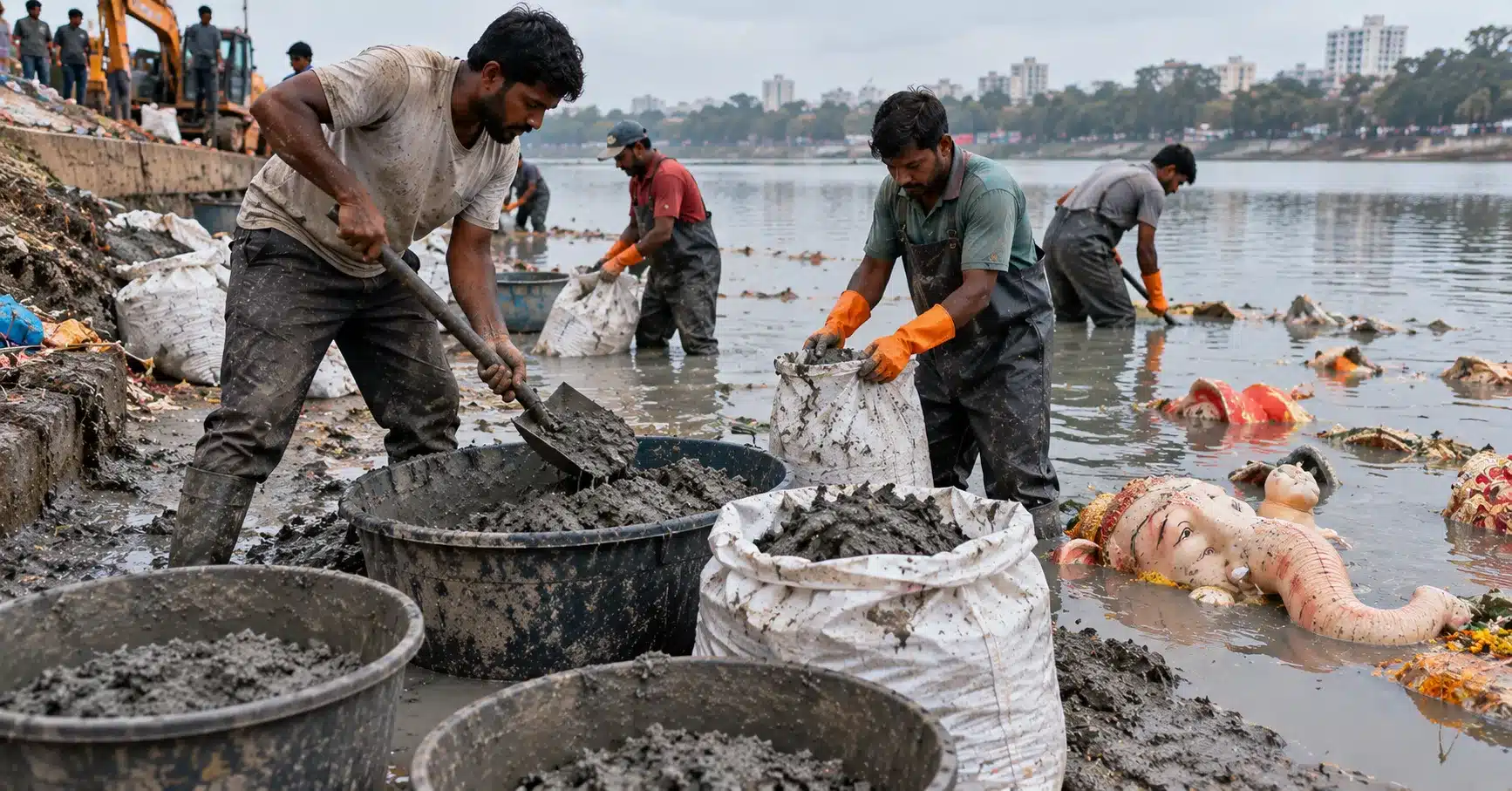 The examples that come closest share a specific feature: they didn’t try to solve the whole problem at once, and they didn’t treat sustainability as separate from the ritual itself.
The Mayekar family’s mandal in Vile Parle is the clearest version of this. Their paper-pulp idol isn’t a diluted version of a “real” Ganesha; it’s built, worshipped, and immersed with the same devotion as any PoP idol, and the fact that its pulp gets collected and reused the following year has become part of the mandal’s own identity rather than an afterthought bolted onto an otherwise unchanged celebration. Pune’s Punaravartan initiative works the same way from the infrastructure side, treating clay recycling as integral to the festival’s supply chain rather than a separate environmental programme running alongside it. Outside the religious-festival context, DGTL’s zero-grams achievement and the AGF-certified music festivals covered in our comparison of waste across festival types show the same underlying pattern: the festivals that get closest to zero waste build it into planning and vendor agreements from the start, the same conclusion this site’s coverage of festival water use and food waste keeps landing on regardless of what kind of event is being studied.
None of these examples required abandoning what the festival was actually for. They required deciding, early and specifically, what each material and each ritual choice was actually there to accomplish, and then finding a version of it that didn’t leave a river full of gypsum sludge behind.
FAQ
Can Ganesh Chaturthi actually become zero-waste?
Fully zero-waste at the scale of hundreds of millions of independent household and mandal celebrations is unlikely with current infrastructure. But individual components, clay idols, natural decorations, composted offerings, recycled immersion clay, can get very close, and several mandals already operate close to it at the local level.
Are clay idols actually more traditional than Plaster of Paris ones?
Yes. Clay (shaadu maati) is the original material for Ganesh idols. Plaster of Paris became popular only in the mid-to-late 20th century because it’s cheaper and easier to mould into large, elaborate idols. India’s Central Pollution Control Board banned PoP idols outright in 2020.
Do artificial immersion tanks actually help water quality?
Yes, measurably; this is covered in more depth in our piece on how religious festivals affect river water quality. The trade-off isn’t about effectiveness, it’s that some practitioners experience tank immersion as a different, less communal ritual than immersion in a shared natural water body.
Is clay actually environmentally free of impact?
No. Clay is a non-renewable material, typically mined in states like Gujarat and West Bengal and transported elsewhere, with real environmental and health costs at the mining end. Initiatives like Pune’s Punaravartan, which recycle clay sludge from immersed idols back into new idols, exist specifically to reduce how much fresh clay needs to be mined each year.
Why do some people oppose eco-friendly festival restrictions?
Some restrictions, particularly around idol material and loudspeaker use, have drawn genuine pushback from religious organisations who see them as government intrusion into religious practice rather than neutral environmental policy. This is a real, ongoing disagreement between legitimate concerns rather than a settled question.
What is the ESG approach to festival sustainability?
Environmental, Social, and Governance analysis, normally used to evaluate corporate sustainability performance, applied to a festival’s environmental choices, community impact, and management practices. A 2026 academic study applied this framework specifically to eco-friendly Ganesh festivals in Maharashtra, treating clay idols, artificial tanks, and waste management as measurable ESG factors rather than matters of individual goodwill.
What’s the difference between a zero-waste festival and an eco-friendly one?
“Eco-friendly” usually describes individual swaps: reusable cups, natural dyes, biodegradable decorations. “Zero waste” is a more specific, near-total elimination of material sent to landfill, achieved through systematic redesign of the entire supply chain, not just individual product choices. Very few traditional religious festivals currently operate at true zero-waste levels; secular festivals like DGTL in Amsterdam have gotten closest.
Does going eco-friendly mean a festival has to get smaller or less elaborate?
Not necessarily, but at the largest scale it can create real trade-offs. Multi-storey public idols built primarily from clay face structural limits that Plaster of Paris and steel don’t, which is part of why some of the biggest public celebrations have been slower to fully switch materials than smaller neighbourhood and household celebrations.
The bottom line
The honest answer to whether traditional festivals can go zero-waste without losing their meaning is: mostly yes, for the parts of the celebration that were sustainable before convenience displaced them, and genuinely complicated for the parts where scale, public ritual, or religious autonomy are actually at stake. Clay over Plaster of Paris isn’t a sacrifice; it’s what the festival looked like before a cheaper material took over. Reducing a century-old procession to a smaller private ceremony is a different kind of change, and pretending it isn’t does a disservice to the people for whom that difference matters. The mandals and initiatives getting this right aren’t the ones treating sustainability as a set of restrictions layered onto tradition. They’re the ones that went looking for what the tradition actually was before it got expensive to keep.

Abhay Ramola researches world festivals across primary sources, local accounts, and on-ground reporting. He founded Dionfest to cover what gets missed when festivals become tourism content the history, the ritual, and the people behind it.