
How Air Pollution Affects Outdoor Festivals – And Why Festival-Goers Need to Know This Now
You packed your bag, grabbed your tickets, and headed out for a weekend of music, food, and good times. The last thing on your mind was air quality.
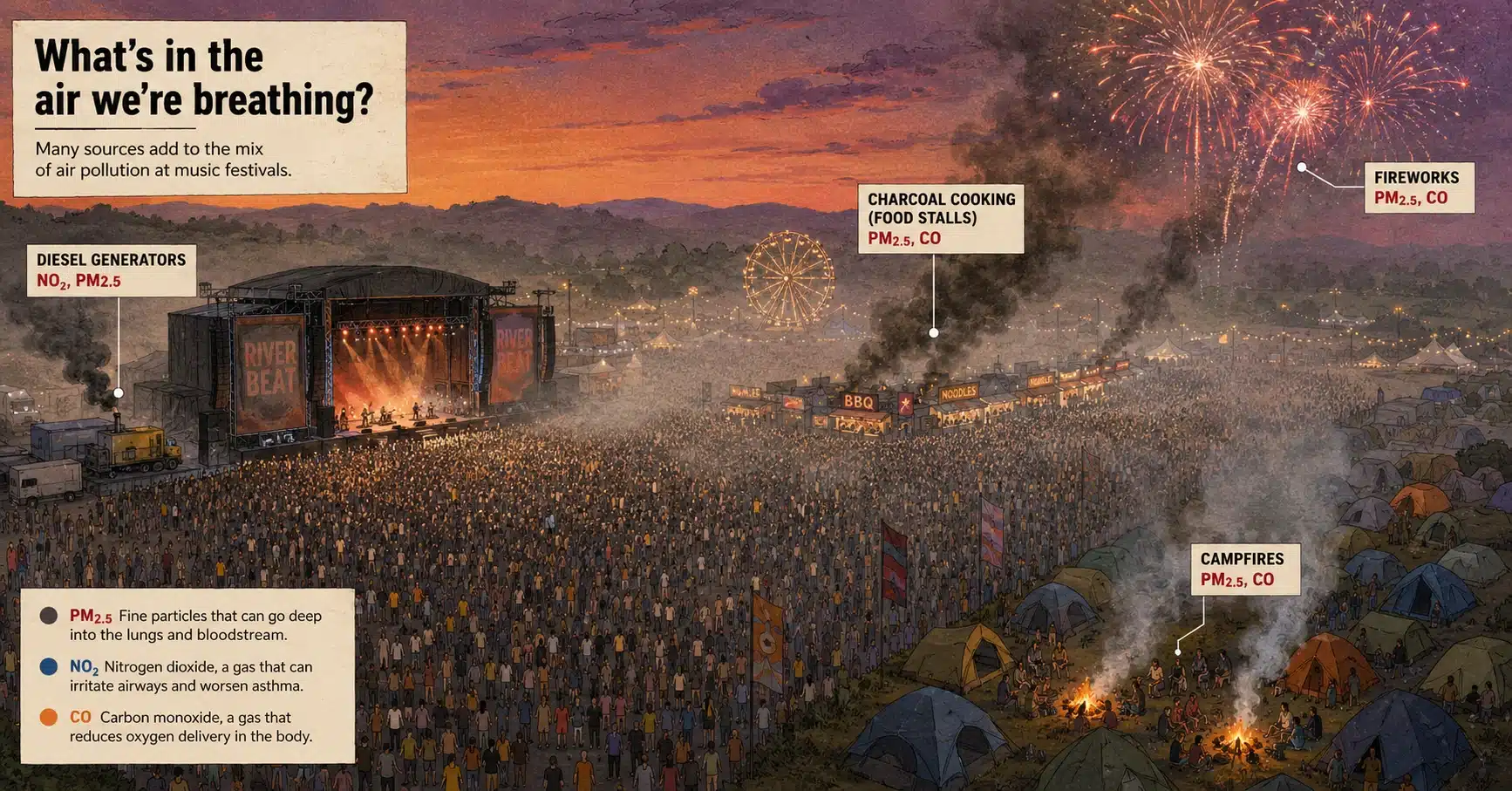
But while you were dancing near the main stage, diesel generators were running 50 meters behind you. Charcoal grills were burning across 200 food stalls. Campfires lit up every corner of the grounds after dark. And when the fireworks went off at midnight, PM2.5 levels spiked to levels that would trigger health warnings in any major city.
Nobody told you that. Nobody put it on the festival map.
This is exactly how air pollution affects outdoor festivals — quietly, invisibly, and at levels that real air quality monitors have recorded as genuinely hazardous. This article breaks down what’s actually in the air at these events, who it hits hardest, and what you can do about it before your next festival.
The Hidden Risk at Every Outdoor Festival
You paid for the ticket. You packed the sunscreen. You’re ready for the music.
But here’s something most festival guides won’t tell you: how air pollution affects outdoor festivals is one of the least-discussed public health issues in the events industry and the effects are real, measurable, and sometimes serious.
Outdoor festivals gather tens of thousands of people in open fields, parks, and urban spaces. Generators hum for days. Diesel trucks idle at loading docks. Hundreds of food stalls burn charcoal and gas. Campfires light up every night. Crowds kick up dust. And fireworks fill the sky.
All of this adds up to air that can be significantly more polluted than the city you drove out of to “escape.”
This article gives you the full picture not to scare you off festivals, but because you deserve to make an informed choice about what you breathe.
Where Festival Air Pollution Actually Comes From
Most people picture factory smokestacks when they think of air pollution. Festival pollution looks different, but it’s just as real.
The main sources at outdoor festivals include:
- Diesel generators running 24/7 to power stages, lighting rigs, and vendor equipment these release nitrogen dioxide (NO₂) and fine particulate matter (PM2.5)
- Charcoal and gas cooking stalls that burn for 12+ hours daily, releasing carbon monoxide and volatile organic compounds (VOCs)
- Campfire smoke at camping festivals, which contains wood-burning particles that penetrate deep into lungs
- Fireworks and pyrotechnics that spike particulate matter levels dramatically for short but intense periods
- Vehicle traffic — thousands of cars, tour buses, and freight trucks converging on a single location over days
- Crowd density — large groups of people in small areas raises CO₂ levels and ground-level ozone when combined with heat
- Dust from dry, compacted ground — particularly at summer festivals where grass is worn away by foot traffic
Each of these alone is manageable. Together, they create a pollution cocktail that air quality monitors have recorded at alarming levels.
Which World Festivals Produce the Most Air Pollution?
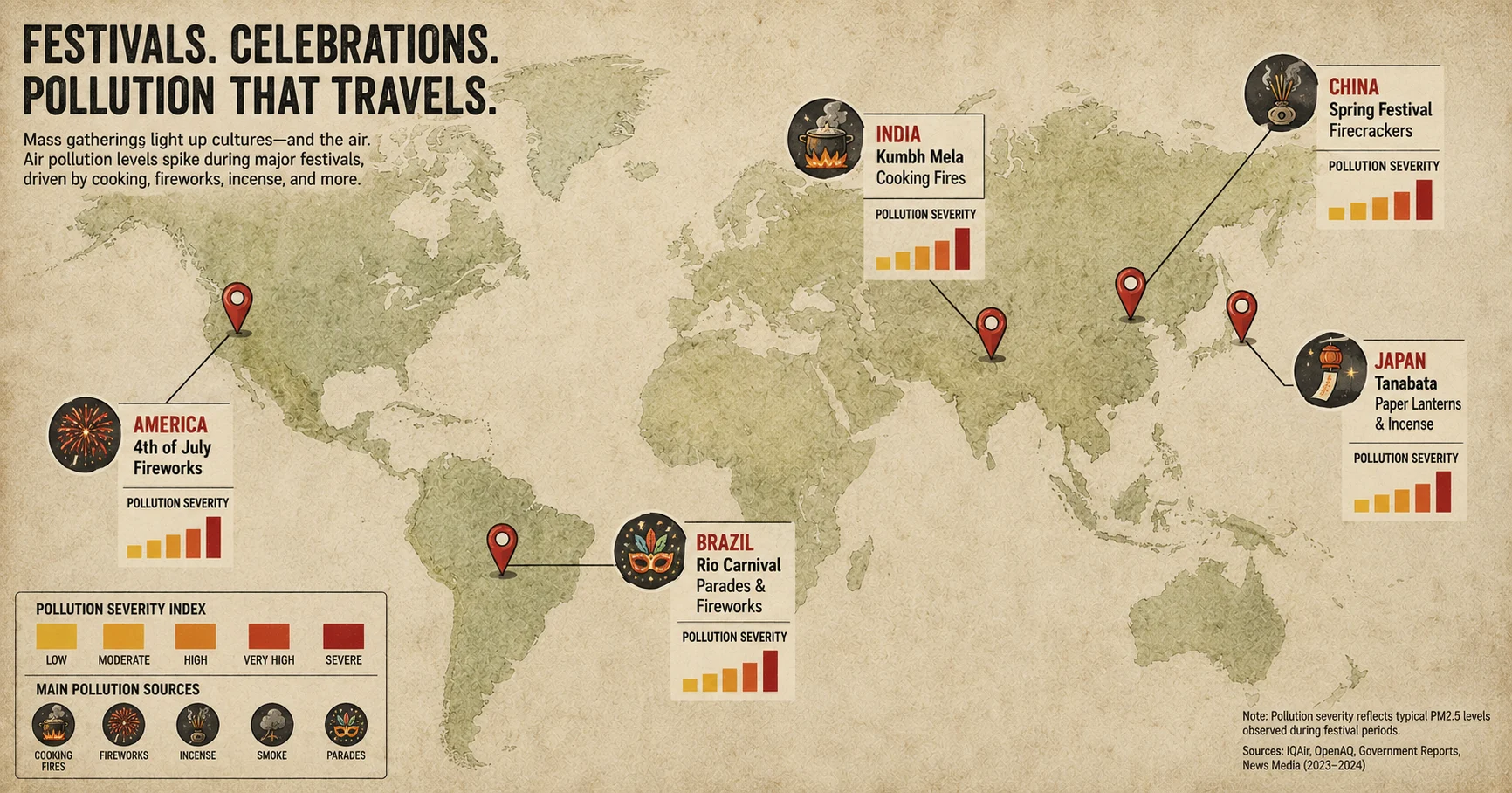 Not all festivals are equal when it comes to air quality. Scale, tradition, and location all determine how bad it gets.
Here are the festivals where pollution exposure is highest and most documented:
- Rio Carnival draws over 2 million people into the streets every night. Fireworks go off constantly, diesel sound trucks run 10+ hours a day, and narrow street corridors trap smoke at breathing height. PM2.5 readings in central Rio during Carnival consistently exceed WHO safe limits.
- Kumbh Mela is the largest peaceful human gathering on earth. Tens of millions of people, cooking fires running round the clock, waste burning at the site periphery, and massive vehicle congestion create a pollution burden that no single city infrastructure is built to handle.
- Dragon Boat Festival in China involves heavy firecracker use, especially near water bodies where smoke settles low instead of dispersing into the upper atmosphere.
- Gion Matsuri in Kyoto runs through narrow historic streets. Float processions burn incense continuously, and crowd compression in those tight lanes keeps pollution concentrations high for hours.
- Halloween festivals across America combine fog machines, fire performances, generator-powered lighting rigs, and bonfire pits — all concentrated in evening events where cold night air holds smoke closer to the ground.
The pattern is the same everywhere: large crowds plus combustion sources plus limited airflow equals poor air quality.
How Fireworks at Global Festivals Spike Pollution Levels
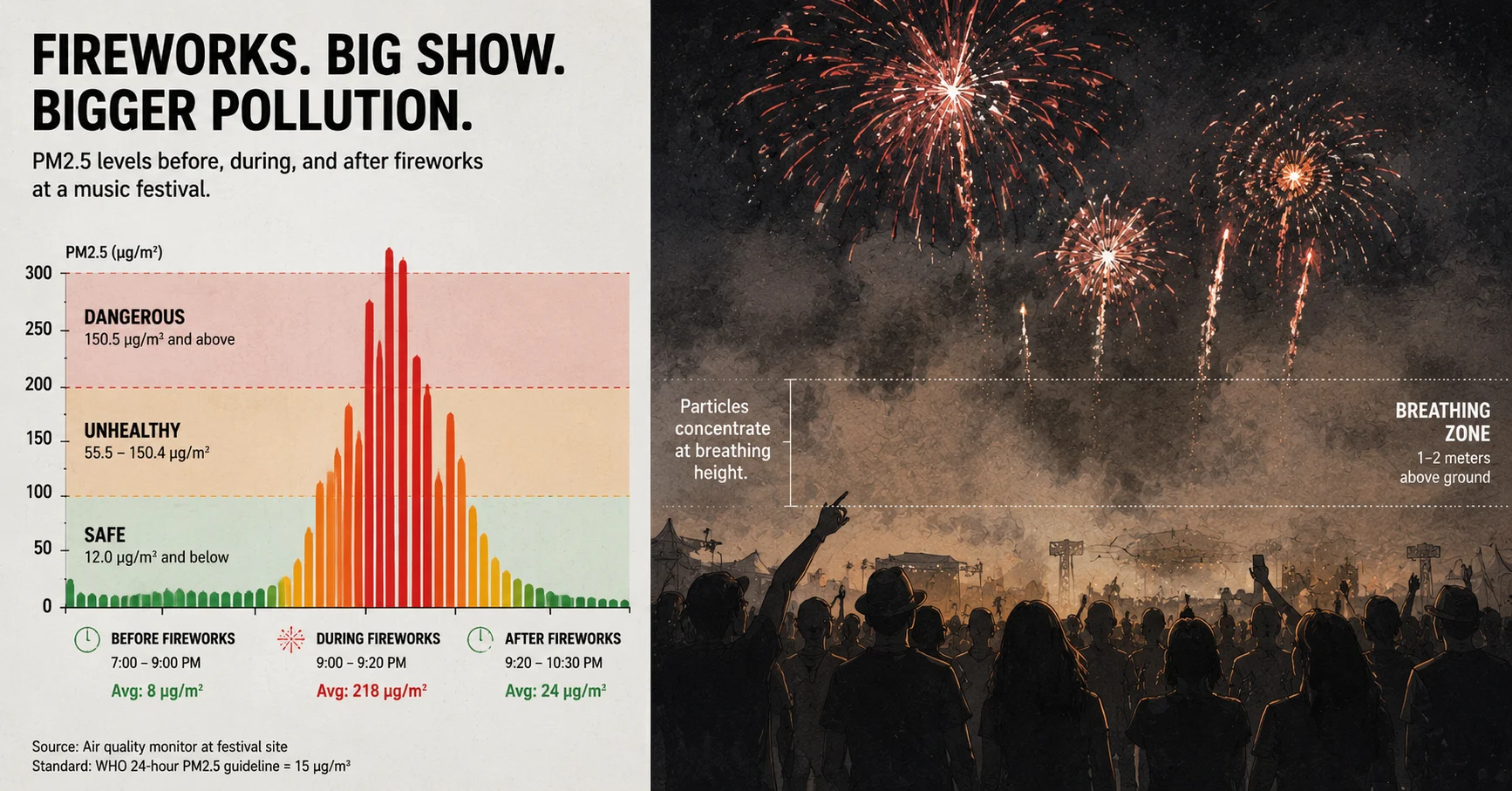 Fireworks are the single biggest short-term pollution spike at any outdoor festival. The numbers aren’t close.
A standard fireworks display raises local PM2.5 levels to over 1,000 µg/m³ during the show itself. The WHO’s safe daily limit is 15 µg/m³. That’s a 66x spike for anyone standing in the crowd below.
What makes it worse is that people move toward the fireworks, not away. You’re standing at maximum crowd density, breathing hardest from the excitement, right in the peak pollution zone.
Here’s how it plays out at specific festivals around the world:
- Tanabata Festival in Japan features Hanabi fireworks displays that Japanese researchers have measured at 10x normal PM2.5 levels in the surrounding area, with effects lasting 40+ minutes after the last burst.
- Mid-Autumn Festival celebrations combine firecrackers with heavy incense burning — a combination documented in Chinese cities as creating particularly dense ground-level particle clouds.
- Onam festival in Kerala includes fireworks displays that India’s pollution control boards have flagged for short-term AQI spikes in surrounding residential areas.
- Salvador Carnival street parties use pyrotechnics at street level rather than elevated platforms. Particles release directly into the crowd’s breathing zone with no dispersal height at all.
The practical takeaway: move away from the viewing area immediately after fireworks end. Particles stay suspended for 20-40 minutes and the crowd stays compressed. Every minute you linger increases your cumulative dose.
How Campfire and Bonfire Traditions at Festivals Worsen Air Quality
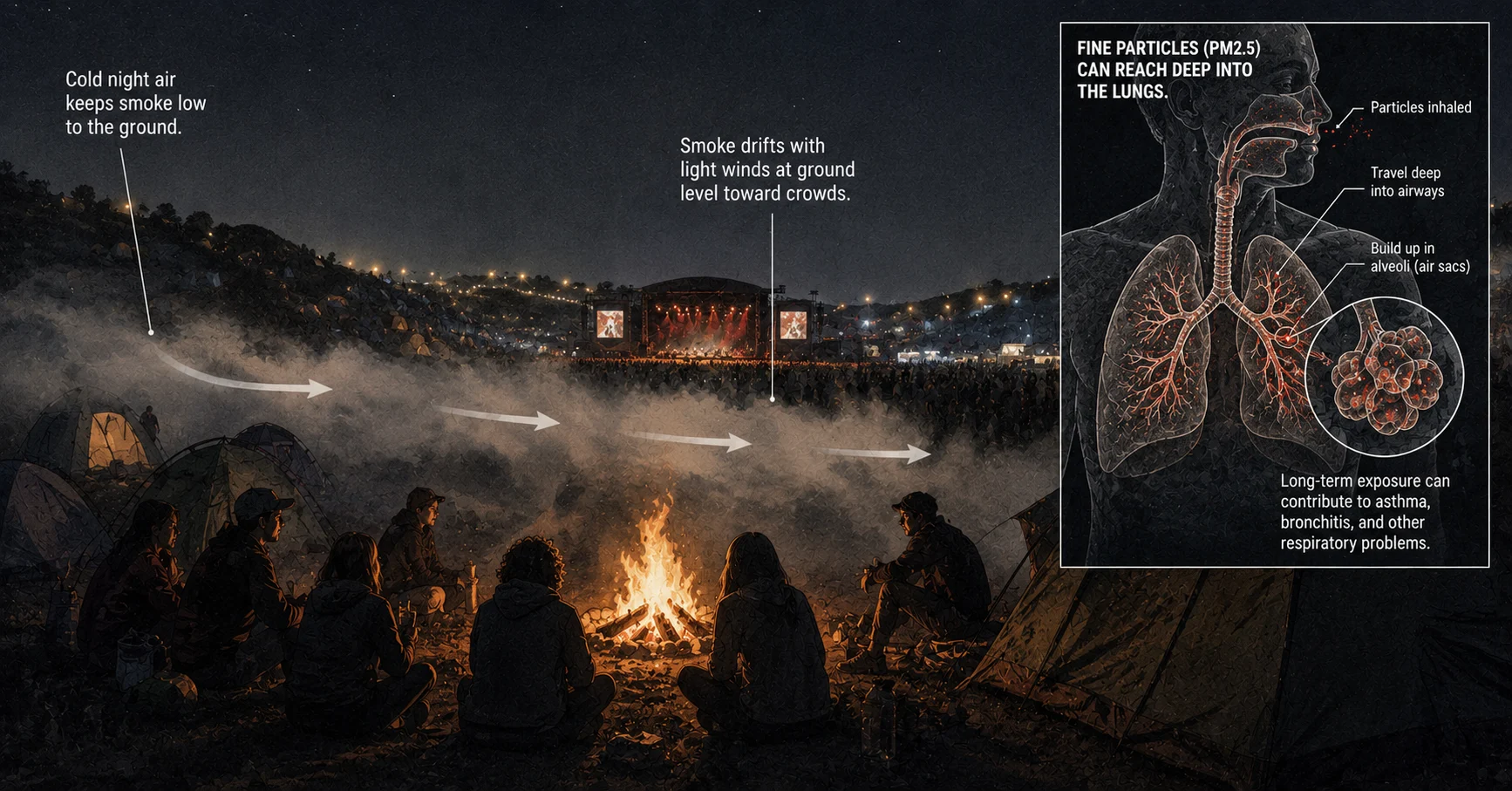 Campfires feel harmless. They’re part of the festival experience. But wood smoke contains fine particles, carbon monoxide, and dozens of toxic compounds — and it stays low to the ground where people are breathing.
The problem is worse at night. Cold air settles smoke downward instead of letting it rise. Evening campfire gatherings create the highest wood-smoke exposure of any part of a festival.
Several major festivals are built around fire traditions that create this exact problem:
- Festa Junina bonfires in Brazil are central to the celebration’s identity. In open rural fields the smoke disperses reasonably well, but urban Festa Junina events in city squares trap smoke at crowd height with nowhere to go.
- Onam outdoor celebrations include evening lamp-lighting and burning rituals where attendees stand close to the fire source for extended periods — precisely the exposure pattern that drives cumulative particle intake up.
- Camping festivals in America, including many of the events featured in America’s Halloween festival guide, treat bonfire culture as a core feature. Cold autumn nights make this worse because temperature inversions keep smoke pinned close to the ground all night long.
The simple fix: don’t sit directly downwind of any fire. Even moving 10-15 meters to the side reduces your wood smoke exposure by 60-70%.
Mass Gatherings and Air Quality – What Happens When Millions Attend One Place
Scale changes everything. A single food stall burning charcoal is a minor annoyance. Five hundred of them running simultaneously for three days is a public health event.
When millions of people converge on a single location, the cumulative effect of cooking, transport, generators, and human activity overwhelms whatever baseline air quality the region normally has.
- Kumbh Mela draws over 50 million visitors across its full run. The cooking infrastructure alone — serving tens of millions of meals — generates combustion pollution at a scale that rivals small industrial zones. Vehicle convoys bringing pilgrims in and out run 24 hours a day for weeks.
- Rio Carnival packs 2 million people into street corridors every evening where vehicle emissions, speaker truck generators, food stalls, and pyrotechnics all operate simultaneously in a confined area.
- Even events that seem less extreme create measurable effects. Thanksgiving travel periods in America show documented AQI deterioration in major hub cities purely from the vehicle congestion spike — and Thanksgiving doesn’t even involve generators or fireworks.
- Parintins Folklore Festival in the Amazon is a unique case. The surrounding region has almost zero baseline industrial pollution. When 100,000 people arrive with generators, boats, cooking equipment, and fireworks, the relative pollution spike is proportionally larger than in any city — because the baseline is clean air.
The lesson here isn’t to avoid large gatherings. It’s to understand that size is a multiplier for everything — including the pollution you breathe.
Festival Traditions That Look Beautiful But Pollute the Air Around You
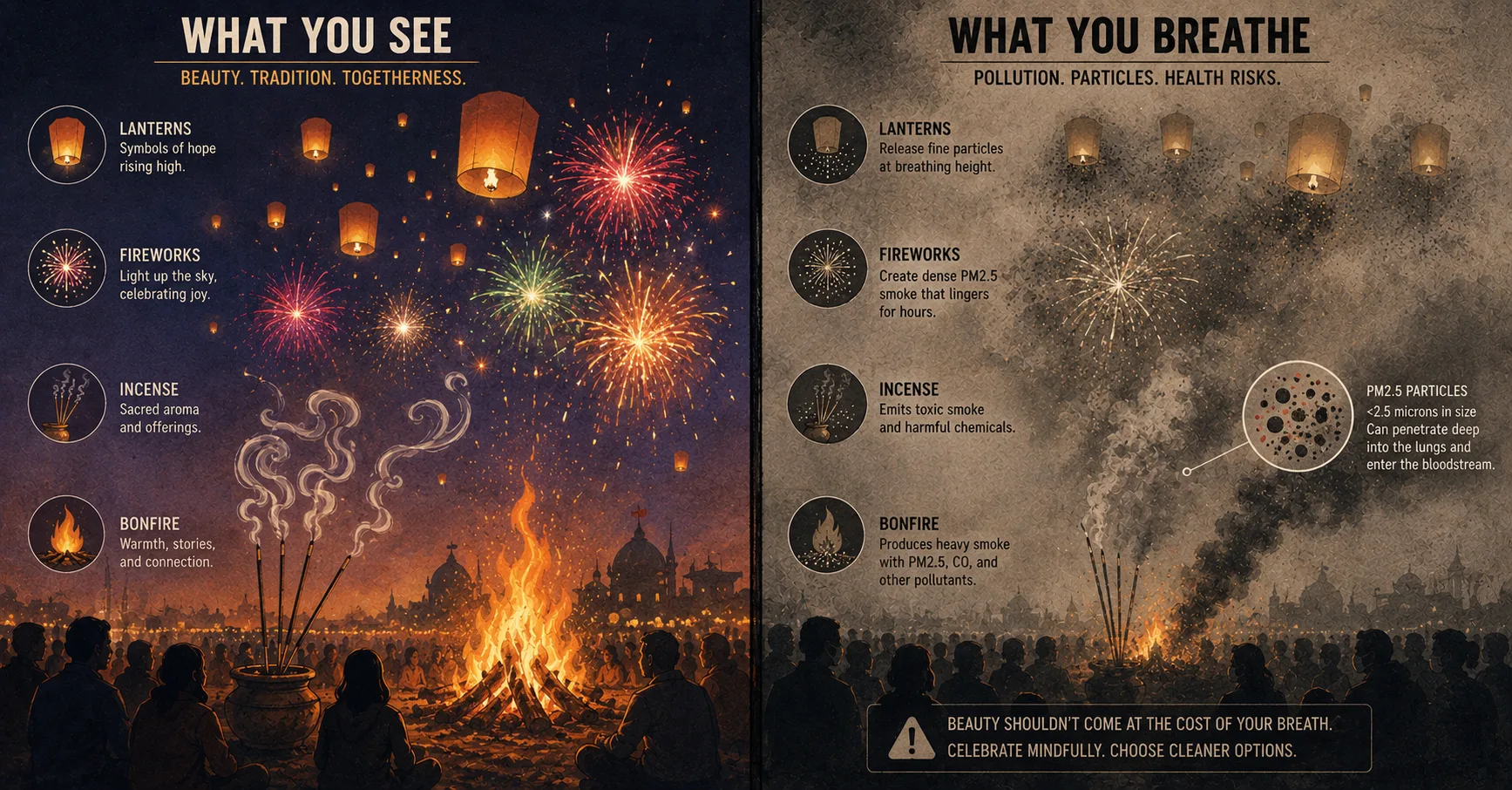 This is the part nobody talks about because it feels like killing the joy. But knowing what you’re actually inhaling during the most visually stunning moments of a festival is useful information.
Several beloved festival traditions are significant pollution sources:
- Lantern releases inspired by celebrations like Tanabata in Japan and Mid-Autumn Festival release burning paper and combustion residue directly at crowd height before the lanterns rise. For the first 10-15 seconds, you’re standing in the smoke of hundreds of small open flames simultaneously.
- Incense burning at traditional festivals like Gion Matsuri in Kyoto is a documented PM2.5 source. Research has shown that incense smoke contains toxic compounds — including benzene and formaldehyde — at concentrations comparable to cigarette smoke in the immediate vicinity.
- Bonfire rituals at Festa Junina in Brazil and various outdoor festivals in India produce dense wood smoke that stays ground-level in still evening air — exactly when crowds gather closest to the flames.
- Colored powder at Holi-inspired events contains chemical dyes that, when airborne in dense crowds, cause airway irritation and eye inflammation within minutes. The particles are small enough to reach deep lung tissue.
- Street-level pyrotechnics at events like Salvador Carnival and Dragon Boat Festival fire directly into crowd zones. Unlike stadium fireworks that burst 100+ meters overhead, street fireworks release all their particle load right where people are standing.
None of this means you should skip these moments. It means you should know when to step back, breathe through a mask, and move to the edge of the crowd.
How Air Pollution Affects Your Lungs at a Festival
This is the most direct and immediate effect.
When you breathe in PM2.5 particles the tiny particles small enough to pass through your nose and throat they go straight into your lung tissue. Your body can’t filter them out fast enough when concentrations are high.
At a festival, you’re also breathing more deeply and rapidly because you’re dancing, walking long distances, and staying active for hours. That means you’re pulling more polluted air into your lungs than you would sitting at a desk.
Short-term effects you might feel at the festival itself:
- Tightness in the chest or a feeling of difficulty breathing deeply
- A dry, irritated throat that gets worse over the day
- Coughing that you might blame on dust but is actually a lung response to fine particles
- Worsening symptoms if you have asthma, with some people needing their inhalers more frequently
People with pre-existing respiratory conditions like asthma or chronic bronchitis are at elevated risk. But even healthy people experience measurable drops in lung function after prolonged exposure to high-PM2.5 environments.
For a deeper look at how pollution damages lung tissue specifically, this breakdown on lung damage from air pollution explains the biological mechanics in plain terms.
The Surprising Heart Risk Nobody Warns You About
Here’s the part most people don’t expect: air pollution doesn’t just hurt your lungs. It stresses your heart.
Fine particles that enter your bloodstream through the lungs trigger inflammation in blood vessels. This makes your heart work harder. At festivals, this happens alongside dehydration, alcohol consumption, heat, and physical exertion all of which already increase cardiovascular strain independently.
Research from the European Heart Journal found that even a single day of high PM2.5 exposure increases the risk of heart attack in vulnerable individuals. The combination of festival conditions heat, exertion, dehydration, and polluted air multiplies that risk.
The warning signs to watch for:
- Unusual shortness of breath during light activity
- A racing or irregular heartbeat that doesn’t settle down with rest
- Chest pressure or discomfort (treat this as an emergency, not “festival fatigue”)
- Dizziness or lightheadedness that persists
The link between air pollution and heart attacks is better documented than most people realize. At festivals where medical staff focus on dehydration and drug-related incidents, pollution-triggered cardiac stress often goes unrecognized.
Air Pollution and Your Brain The Effect No One Talks About
This is the angle most festival health guides miss entirely.
Neurological research over the past decade has established a clear connection between air pollution and cognitive function. Short-term exposure to high-pollution air reduces mental clarity, slows reaction time, and impairs decision-making — even in young, healthy adults.
At a festival, this matters in ways you might not predict:
- Impaired judgment during late-night hours when pollution from generators and campfires peaks
- Increased susceptibility to poor decisions that are often attributed entirely to alcohol
- Post-festival “brain fog” that many attendees notice but rarely connect to air quality
- Headaches that feel like dehydration but are actually inflammation responses in the brain’s blood vessels
The research on air pollution and brain damage is still evolving, but what’s already established is enough to take seriously.
This matters especially for young festival-goers who assume they’re invulnerable.
Who Is Most at Risk at Outdoor Festivals?
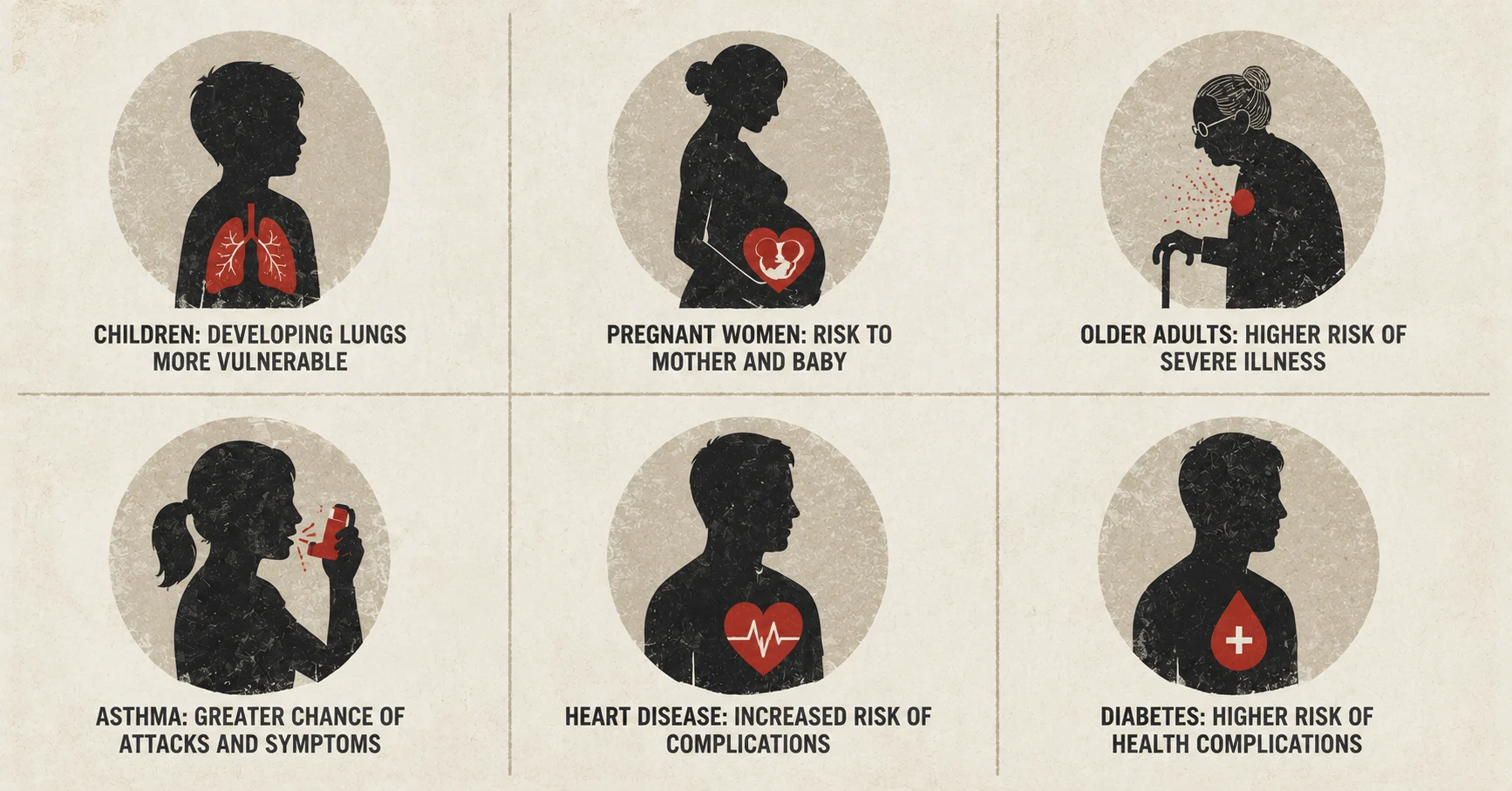 Not everyone at a festival faces the same level of risk. Some groups are significantly more vulnerable.
High-risk groups include:
- People with asthma or COPD – their airways react faster and more severely to airborne irritants, and rescue inhaler use at festivals is consistently higher than at other events
- People with heart disease or high blood pressure – the cardiovascular strain from pollution compounds existing conditions in ways that can be dangerous
- Children – their lungs are still developing, and they breathe more air relative to their body weight than adults do, so they absorb more pollution per kilogram of body weight
- Older adults – both lung capacity and cardiovascular resilience decrease with age, making the combined stressors at festivals harder to handle
- Pregnant women – research links high PM2.5 exposure during pregnancy to complications including preterm birth and low birth weight
- People with diabetes – inflammation from air pollution worsens insulin resistance and blood sugar control
If you fall into any of these categories, that doesn’t mean you can’t attend festivals. It means you need to plan differently.
Real Data: How Bad Does Air Quality Get at Festivals?
Studies have actually measured this. The numbers are worth knowing.
- A study at a UK music festival found PM2.5 concentrations near food vendor areas reaching 5-10 times the WHO daily guideline limit of 15 µg/m³
- Campfire areas at camping festivals regularly exceed 300 µg/m³ during peak evening hours – the WHO “hazardous” threshold is 250 µg/m³ over 24 hours
- Fireworks at large festivals spike PM2.5 readings to over 1,000 µg/m³ for short windows – well into the “hazardous” category by any measurement standard
- Research published in Environmental Research Letters showed that generators at outdoor events produce NO₂ at levels comparable to being near a major highway
These aren’t theoretical risks. They’re measured realities at real events that millions of people attend every year without knowing what the air around them contains.
What Organizers Are Doing (And What They’re Not)
The festival industry has made genuine progress on some environmental issues. Plastic waste reduction, solar-powered stages, and composting programs have all become more common. Events like Glastonbury in the UK have committed to cutting diesel generator use significantly.
But air quality monitoring at festivals remains rare. Most events don’t track PM2.5 or NO₂ levels in real time. There’s no standard requirement to do so in most countries.
What progressive festival organizers are starting to do:
- Replacing diesel generators with battery storage systems or solar microgrids
- Restricting campfire areas and switching to cleaner gas-powered communal fire pits
- Transitioning food vendor contracts to ban charcoal in favor of LPG or electric equipment
- Routing vehicle traffic away from high-density crowd areas
As awareness grows around festivals and their environmental footprint — something explored in depth around World Environment Day events and Earth Day initiatives — pressure on the industry is increasing.
Still, the gap between what’s possible and what’s standard remains large.
How to Protect Yourself at an Outdoor Festival
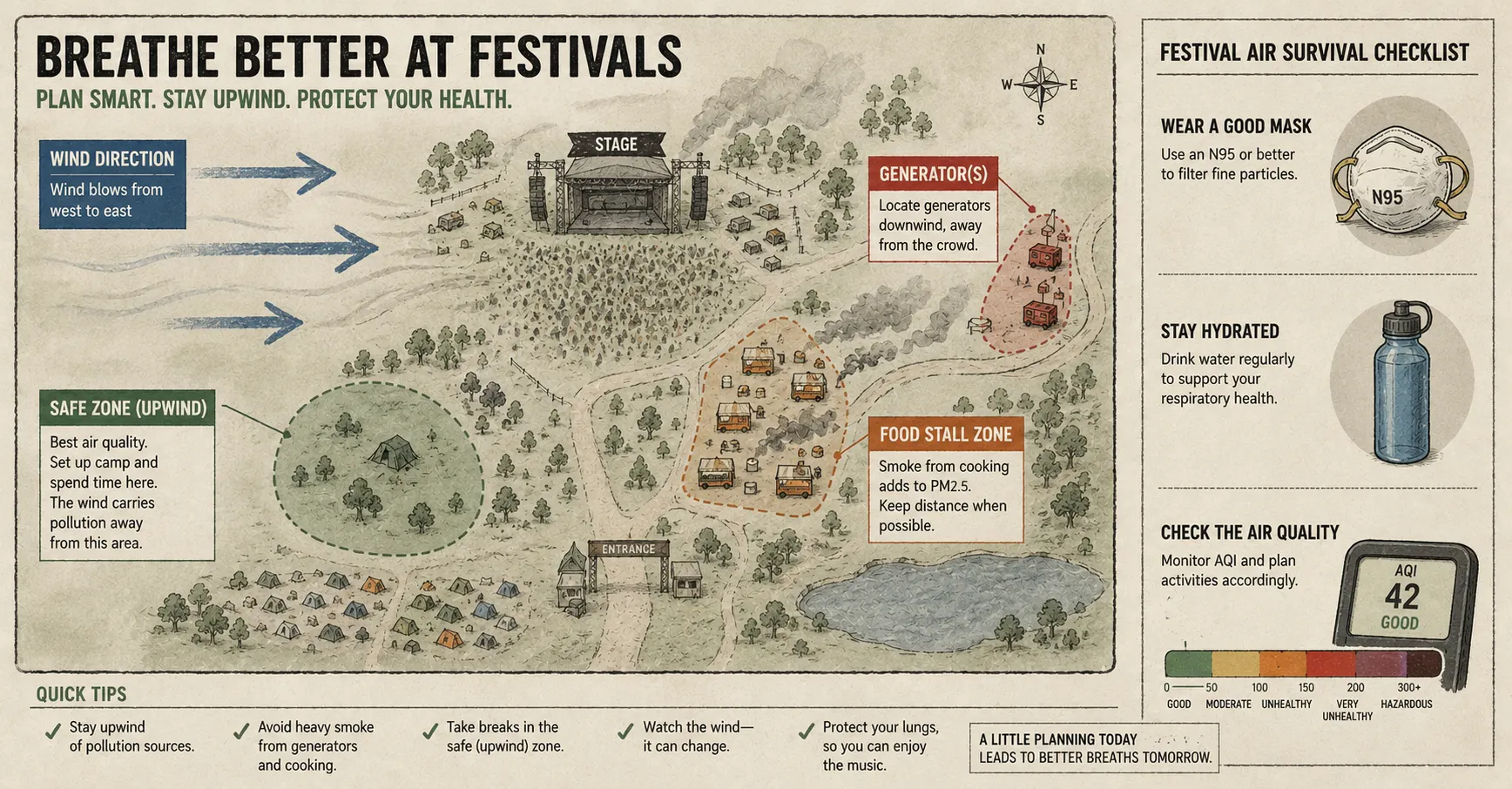 You can’t control what the organizers do. You can control how you respond.
Practical steps that actually reduce your exposure:
- Check the AQI before you go. Apps like IQAir or AirVisual give real-time air quality data for most locations. If the index is already above 100 before the festival starts, plan accordingly.
- Position matters during performances. Standing upwind of generator banks and cooking areas cuts your exposure significantly. Take a few minutes to figure out where the wind is coming from.
- Wear an N95 or KN95 mask during high-pollution windows – specifically during fireworks, near campfire areas at night, and near generator clusters. A cloth mask doesn’t filter PM2.5.
- Stay hydrated more aggressively than you think necessary. Your mucous membranes are your first line of defense against particles. Dehydration weakens them.
- Take breaks indoors or in well-ventilated areas. Even stepping into a festival tent with decent ventilation for 30 minutes per hour reduces cumulative exposure meaningfully.
- Don’t smoke near campfires. Combining cigarette smoke with wood smoke dramatically raises what you’re actually inhaling, even if each alone seems tolerable.
- If you have asthma, carry your rescue inhaler and use a preventative inhaler proactively, not just reactively. Tell someone near you about your condition.
- Leave fireworks viewing areas quickly once the show ends. Particles linger for 20-40 minutes after the show finishes, and the crowd compression during viewing keeps you in the peak exposure zone.
FAQ
Q: Is the air at outdoor festivals actually worse than city air?
In specific zones – near stages with diesel generators, food vendor rows, and campfire areas – yes, often significantly worse. Average PM2.5 across an entire festival site will vary, but hotspots routinely exceed urban air quality standards.
Q: Should people with asthma skip outdoor festivals entirely?
Not necessarily, but they need a plan. That means carrying a rescue inhaler, knowing the site layout, avoiding the highest-pollution zones, and having an exit strategy if symptoms develop. Talking to a doctor before attending is practical, not overcautious.
Q: Do fireworks at festivals cause long-term damage?
A single fireworks show is unlikely to cause permanent harm in healthy adults. But repeated exposure, combined with other festival pollution sources over multiple days, raises cumulative risk. Short-term effects like throat irritation and eye burning are common and are real pollution responses.
Q: What type of mask actually works against festival air pollution?
Only N95 or KN95 respirators filter PM2.5 particles effectively. Surgical masks and cloth masks block large particles but let fine particles through. If you’re serious about protection during fireworks or around heavy smoke, the grade of mask matters.
Q: Are indoor festivals safer in terms of air quality?
Partially. Indoor venues eliminate campfire smoke and some traffic pollution, but they can concentrate CO₂ and VOCs from crowds, cooking, and equipment. Ventilation quality in the specific venue is the deciding factor. A well-ventilated indoor arena may be cleaner than an outdoor field; a poorly ventilated warehouse may not be.
Final Word
How air pollution affects outdoor festivals is a real, documented, and largely ignored public health issue. The risks range from minor irritation for healthy adults to serious cardiovascular and respiratory events for vulnerable groups.
The festival industry is slowly improving but slowly. Until air quality monitoring and clean energy become standard at events, the responsibility falls on attendees to understand what they’re breathing and make smart choices.
Go to the festivals. Enjoy them fully. Just know what’s in the air around you and plan for it.

Abhay Ramola researches world festivals across primary sources, local accounts, and on-ground reporting. He founded Dionfest to cover what gets missed when festivals become tourism content the history, the ritual, and the people behind it.


2 thoughts on “How Air Pollution Affects Outdoor Festivals – And Why Festival-Goers Need to Know This Now”